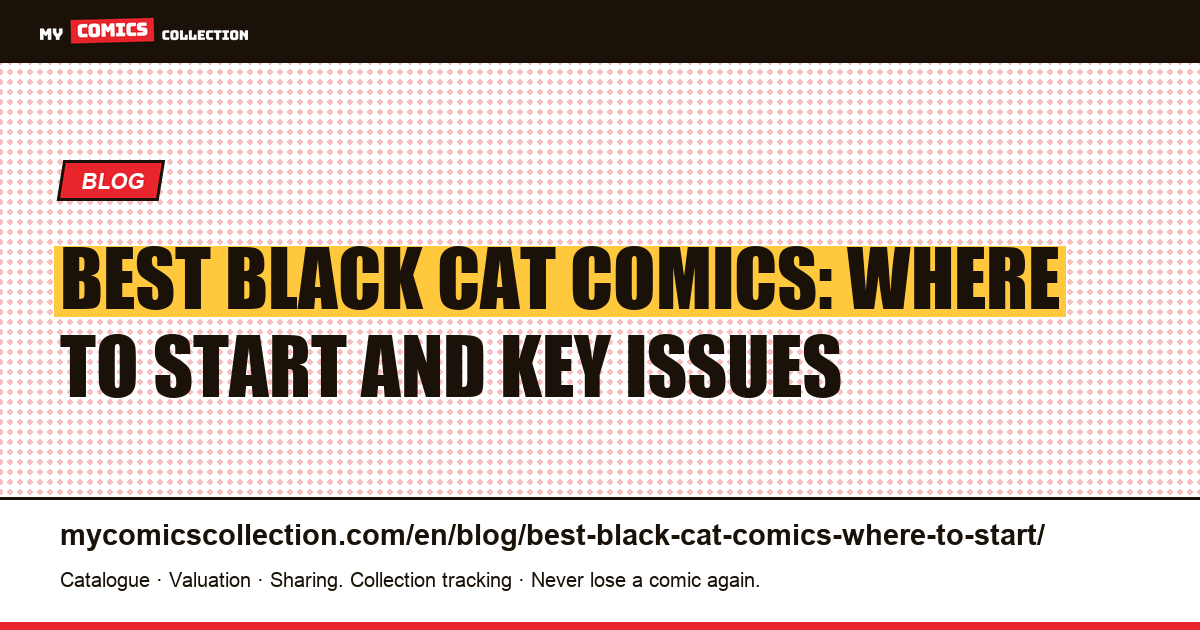
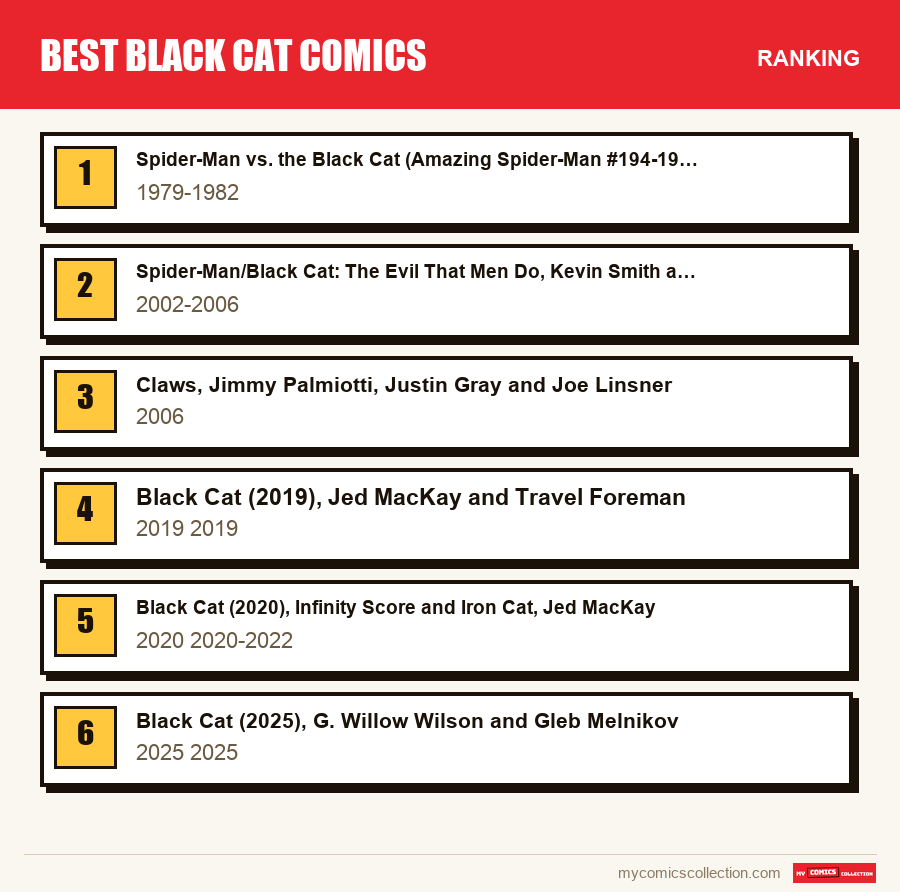
The best Black Cat comics to read start with The Amazing Spider-Man #194 (July 1979), written by Marv Wolfman and drawn by Keith Pollard, followed by her next team-ups with Spider-Man through #227. For a modern read, move on to Kevin Smith's Spider-Man/Black Cat: The Evil That Men Do (2002-2006), then Jed MacKay's Black Cat series (2019) and G. Willow Wilson's (2025). Those are the key issues and runs to know.
Felicia Hardy is the thief who flirts with the law and with the hero, and her best stories all play on that ambiguity. Depending on the writer, she is an accomplice, an adversary, a lover, a gang boss or a hero out of self-interest. This guide ranks six reads, says who each one is for and shows you how to approach them without getting lost in more than forty years of publishing.
As always in this guide, we only state verified facts (creators, issue numbers, dates); the analysis is our own, with no reproduction of protected pages or dialogue.
Her first appearance
Felicia Hardy first bursts onto the scene in The Amazing Spider-Man #194, cover-dated July 1979. Marv Wolfman writes the issue, Keith Pollard is the book's regular artist of the era, and the costume carries Dave Cockrum's signature. The character was first conceived for another series, Spider-Woman, before Wolfman moved her into Spider-Man's title when he changed assignments. Felicia is at this point an acrobatic cat burglar, without powers, trained in martial arts, and her first job is breaking her father out of prison.
We have devoted two pages to this issue: the story of this first appearance and the #194 issue profile. So we will not go back over it here. Above all, remember that the plot continues in #195, and that the pair of issues is Felicia's real entry into the series, before the returns of 1980 and 1982 turn her into a regular partner for Peter Parker.
1: Spider-Man vs. the Black Cat (Amazing Spider-Man #194-195, #204-205, #226-227), Wolfman, Michelinie and Stern (1979-1982)
This collection gathers six issues of Amazing Spider-Man that tell the birth of the series' most unstable couple: #194 and #195 from 1979, then #204 and #205, then #226 and #227 from 1982. According to the publisher's edition, the scripts are by Marv Wolfman, David Michelinie and Roger Stern; Keith Pollard draws the first chapters, with Pablo Marcos inking #204.
What these stories give the character is her complete grammar. Felicia starts as an amused adversary, then becomes a temporary ally, then a partner whose feelings for the hero grow more complicated as he hides behind his mask. She has no powers: her strength is agility, cunning and a taste for risk that Peter Parker cannot match. The bad-luck powers she will be given later are subsequent additions, and they have no place here.
Who is this entry for? Readers who want the source of it all, Bronze Age fans and collectors, since these are the issues to own to document the character. How should you read it? In publication order, in pairs. To place these issues in their era, our Spider-Man reading guide gives you the landmarks.
2: Spider-Man/Black Cat: The Evil That Men Do, Kevin Smith and Terry Dodson (2002-2006)
This six-issue miniseries, written by Kevin Smith and drawn by Terry Dodson with Rachel Dodson on inks, is the great love story of Felicia and Spider-Man. The first three issues come out in 2002, then the series stalls for years, and the ending ships in 2005-2006; a 2006 hardcover collects all six issues, and a paperback edition follows in 2007.
What it contributes is a central role: for six issues, Felicia is no longer a foil to the hero but the very subject of the story, with a title that makes the duo the stakes of the tale. The publication delays are part of the series' legend and explain its status as a curiosity among collectors.
Who is it for? Readers of superhero romance, fans of Kevin Smith's style and anyone who wants to read Felicia at the center of a complete story. How should you read it? Preferably as a collected edition, because the gap between the two halves of the miniseries disrupts the single-issue reading. No prior knowledge is needed beyond the basic relationship between the two characters.
3: Claws, Jimmy Palmiotti, Justin Gray and Joe Linsner (2006)
A three-issue miniseries, Claws pairs Black Cat with Wolverine in a two-hander adventure, with a script by Jimmy Palmiotti and Justin Gray and art by Joe Linsner. A sequel, Claws II, starts in July 2011.
This entry holds a special place on the list: it pulls Felicia out of Spider-Man's orbit and has her play opposite a partner from another corner of the same publisher's universe. You see what the character is worth outside her usual context, and which traits she keeps: the defiant spirit, the humor, the mobility. The whole thing is a short, light, standalone read.
Who is it for? Readers who like crossovers between series and Wolverine fans curious to see him paired with a different kind of character. How should you read it? On its own, in one evening, before or after the heavier entries on the list. To place Wolverine's releases, our Wolverine reading guide is a good companion.
4: Black Cat (2019), Jed MacKay and Travel Foreman (2019)
The 2019 Black Cat series, written by Jed MacKay, opens on June 5, 2019 with an issue drawn by Travel Foreman: Felicia teams up with Black Fox to burglarize Doctor Strange. Michael Dowling draws the backup story devoted to Black Fox. The first five issues make up the trade paperback Grand Theft Marvel. The 2019 series runs twelve issues according to the publisher's omnibus.
What this run gives the character is a tone: the heist as the engine of the story, with a heroine who owns her trade as a thief and does so across the whole Marvel universe. Instead of being a satellite of Spider-Man, Felicia runs her own business, with her own accomplices and her own enemies. The series pulls off the feat of making a thief a point of view, and no longer just a romantic backdrop.
Who is it for? Readers who like heist stories, fans of short series without heavy continuity, and those who have read none of the older issues. How should you read it? Straight from the 2019 #1, with no prerequisites. The first trade is enough to tell whether the series suits you.
Do you collect this series?
Track what you own, what you are missing and what your collection is worth. 7-day trial.
Start my trial →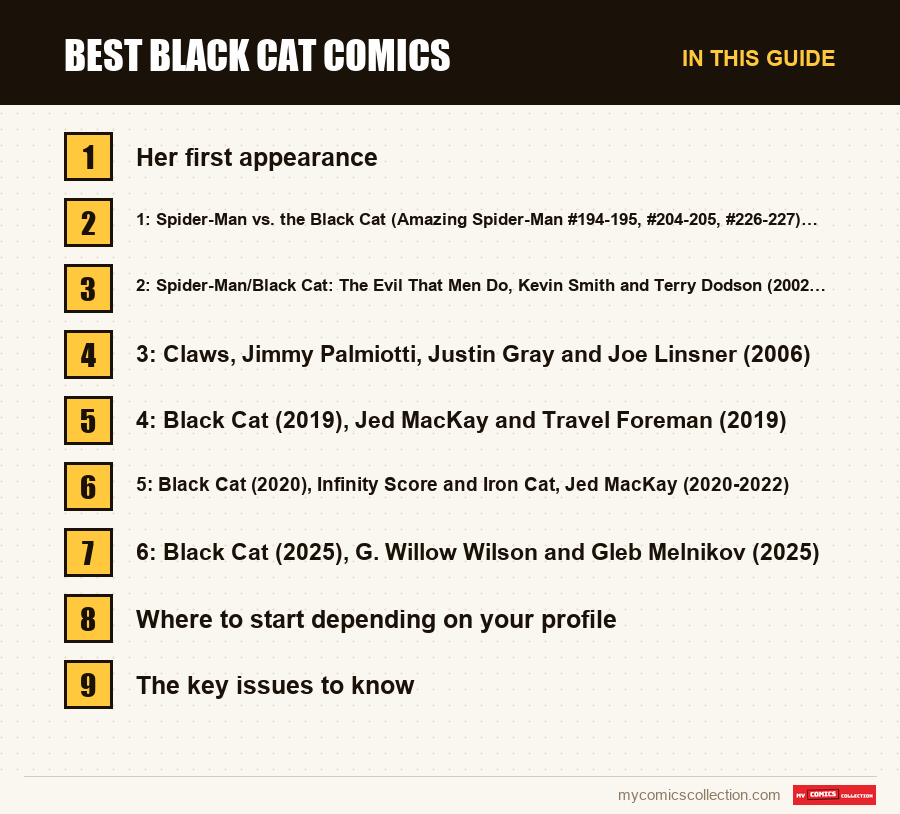
5: Black Cat (2020), Infinity Score and Iron Cat, Jed MacKay (2020-2022)
Jed MacKay's follow-up continues with a new Black Cat series launched in 2020 and running ten issues, then with Giant-Size Black Cat: Infinity Score #1 (December 2021), which concludes the Infinite Destinies storyline. Next come Mary Jane & Black Cat: Beyond #1 (January 2022), again by MacKay, and Iron Cat (2022, five issues), in which Felicia builds herself a suit of armor after infiltrating Stark Industries facilities.
This continuation adds scale: Felicia moves from a local heist to bigger stakes, and we get to see her armored version, outside the conventions of her classic costume. A July 2023 omnibus collects it all: the 2019 series (#1-12), the 2020 series (#1-10), the two annuals, Infinity Score and Iron Cat #1-5, with material from Free Comic Book Day 2020.
Who is this entry for? Anyone who enjoyed the start of MacKay's run and wants to follow it to the end. How should you read it? In the omnibus order, which serves as a guide. If you are short on time, read the 2020 series, then Infinity Score, and keep Iron Cat for last.
6: Black Cat (2025), G. Willow Wilson and Gleb Melnikov (2025)
G. Willow Wilson and Gleb Melnikov launch a new series in August 2025, whose first issue comes out on August 20 with a cover by Adam Hughes. The pitch announced by the publisher moves Felicia from thief to superhero, but for rather self-serving reasons: public attention flatters her ego. A trade paperback collects issues #1 to #10 under the title No Good Deed.
What this series brings to the character is a reversal of the ambiguity that has defined her since 1979: Felicia is no longer a criminal who sometimes helps the hero, but a hero whose motives remain dubious.
Who is it for? Readers of today, those who follow G. Willow Wilson and those who want an ongoing series rather than a classic. How should you read it? From #1, as a trade or in single issues, with no major prerequisites.
Where to start depending on your profile
You want to understand who Felicia Hardy is: read Amazing Spider-Man #194 and #195, then the list of Amazing Spider-Man key issues to place the period.
You like complete love stories: The Evil That Men Do by Kevin Smith and Terry Dodson, in a collected edition.
You are looking for a modern heist story with no prerequisites: Jed MacKay's 2019 series, starting with the Grand Theft Marvel trade.
You want a short standalone adventure: Claws, three issues, with Wolverine.
You follow ongoing series: the one by G. Willow Wilson and Gleb Melnikov, from the August 2025 #1.
You collect single issues: focus on Amazing Spider-Man #194 and #195, then on the first issues of each modern series.
The key issues to know
- The Amazing Spider-Man #194 (July 1979): the first appearance of Felicia Hardy, by Marv Wolfman and Keith Pollard.
- The Amazing Spider-Man #195: the continuation and conclusion of the introductory storyline.
- Spider-Man/Black Cat: The Evil That Men Do #1 (2002): the start of the Kevin Smith and Terry Dodson miniseries.
- Black Cat #1 (June 2019): the launch of Jed MacKay's series.
- Giant-Size Black Cat: Infinity Score #1 (December 2021): the conclusion of a MacKay cycle.
- Black Cat #1 (August 2025): the start of the G. Willow Wilson and Gleb Melnikov series.
To evaluate these issues, start from the issue's role in the character's history: an issue that introduces Felicia or launches a series follows collecting logic, while a middle issue follows reading logic. Compare copies by condition and by edition.
Frequently asked questions
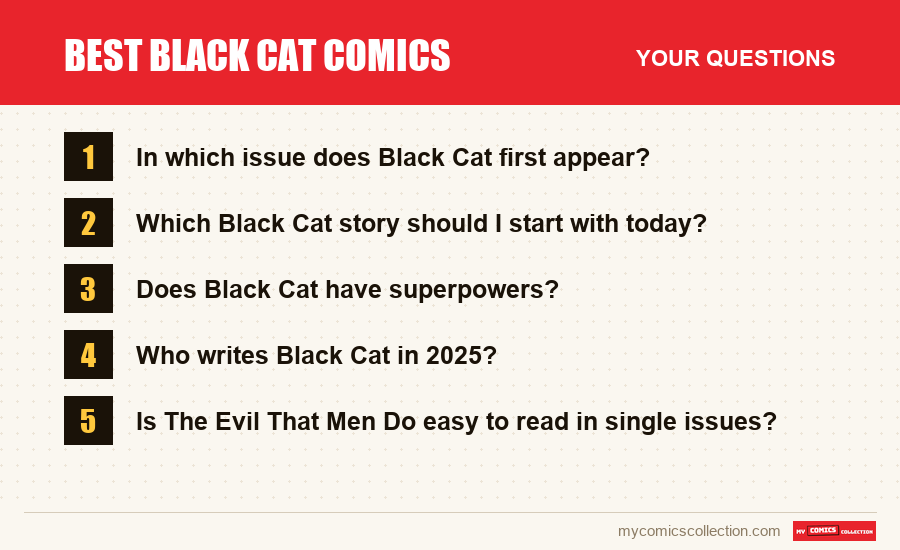
It is The Amazing Spider-Man #194, cover-dated July 1979, that introduces Felicia Hardy. The issue is written by Marv Wolfman and drawn by Keith Pollard; the costume is by Dave Cockrum. The story continues in #195.
For a modern read with no prerequisites, Jed MacKay's Black Cat series (2019), which opens with a heist at Doctor Strange's place. For the character's roots, read Amazing Spider-Man #194 and #195 first, then the 1980 and 1982 issues collected in one volume.
Originally, no: Felicia Hardy is an acrobatic cat burglar trained in martial arts. Abilities tied to bad luck and feline effects are attributed to her later in some stories, but they depend on the era and do not apply to her early adventures.
The Black Cat series launched in August 2025 is written by G. Willow Wilson and drawn by Gleb Melnikov. Its first issue came out on August 20, 2025, with a cover by Adam Hughes, and a first trade paperback, No Good Deed, collects issues #1 to #10.
It reads better as a collected edition. The first three issues come out in 2002, then the series stalls before the ending ships in 2005-2006. A 2006 hardcover collects all six issues by Kevin Smith and Terry Dodson and spares you that wait.
Do you own Amazing Spider-Man #194 and #195 or a Black Cat issue? Get your copy appraised before you keep it or sell it.
Appraise my comic