Spider-Man: Into the Spider-Verse (2018) brought to the screen Miles Morales , born in Ultimate Fallout #4 (2011) by Brian Michael Bendis and Sara Pichelli, and the concept of Spider-Verse (Dan Slott event, 2014-2015). The film reunites Spider-Gwen (Edge of Spider-Verse #2, 2014), Spider-Man Noir, Peni Parker and Spider-Ham. Very faithful to the spirit of the comics, he freely reinvents the plot. Here is the detailed comparison, film versus comics.
An Academy Award-winning animated masterpiece, Into the Spider-Verse celebrates the multiplicity of Spider-Mans. It draws on two major ideas from modern comics: Miles Morales and the Spider-Verse. Source-by-source decryption.
As in each article in this series, only verified information (creators, distribution, dates, comic numbers) is stated; the comparative analysis is ours, without reproducing dialogue or protected images.
Title : Spider-Man: Into the Spider-Verse (2018)
Directors: Bob Persichetti, Peter Ramsey, Rodney Rothman
Voice : Shameik Moore (Miles Morales), Jake Johnson (Peter B. Parker), Hailee Steinfeld (Gwen)
Exit : December 2018
Studio: Sony Pictures Animation
Ultimate Fallout #4 (2011): 1st appearance of Miles Morales
Edge of Spider-Verse #2 (2014): 1st appearance of Spider-Gwen
“Spider-Verse”(2014-2015): Dan Slott's event
Spider-Ham, Spider-Man Black, Peni Parker: Spider-Man variants
- Miles Morales, Brooklyn teenager who became Spider-Man.
- His own powers (camouflage, “venom” discharge).
- The concept of Spider-Verse and his multiple Spider-Mans.
- Spider-Gwen, Spider-Man Black, Peni Parker, Spider-Ham.
- His uncle Aaron / the Ranger and his parents.
- L'plot (the Caïd collider) is original.
- Peter B. Parker, a disillusioned mentor, is a creation of the film.
- Le Spider-Verse comics is much larger and darker.
- The meeting of variants is condensed for a single film.
- Some origins are simplified or reorganized.
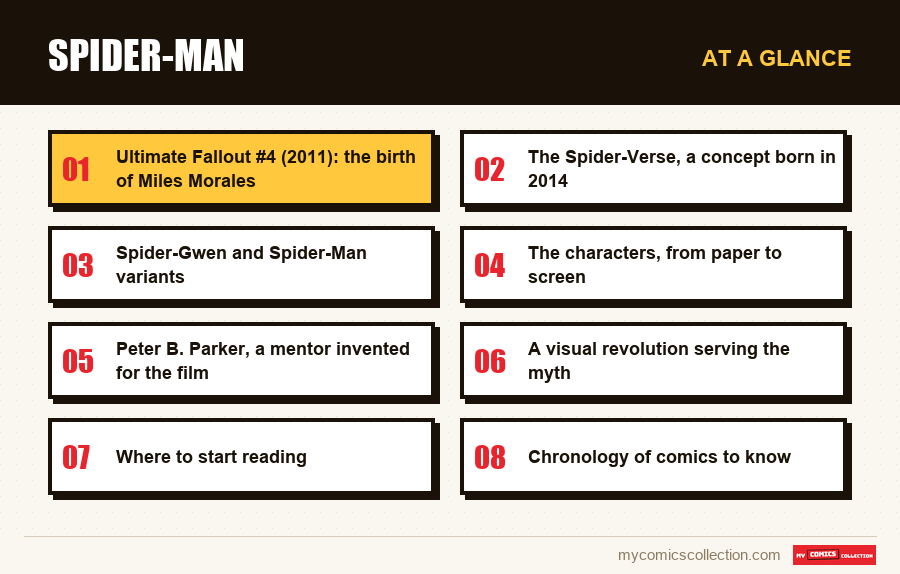
Ultimate Fallout #4 (2011): the birth of Miles Morales
The film's hero, Miles Morales, is born in Ultimate Fallout #4 (2011), created by Brian Michael Bendis and Sara Pichelli. In Marvel's Ultimate universe, after the death of this reality's Peter Parker, an Afro-Latino teenager from Brooklyn, bitten in turn by a genetically modified spider, takes up the mantle of Spider-Man. Miles has established himself as one of the most important characters created by Marvel in the 21st century, embodying a new generation of heroes more representative of the diversity of the real world. His powers, similar to those of Peter, are enriched with his own abilities: optical camouflage and a bioelectric discharge nicknamed “venom”.
The film is very faithful to this character. It covers Miles as a teenager from Brooklyn, his parents, his uncle Aaron, his specific powers, and above all his journey: that of a young hero who doubts, learns and ends up accepting his responsibility. The film captures the essence of Miles, an ordinary teenager crushed by an extraordinary destiny, with commendable accuracy. He simplifies certain original details, but respects the heart of the character. By bringing him to the screen, the film introduced Miles to a global audience, confirming his status as a major figure in the Spider-Man universe.
The Spider-Verse, a concept born in 2014
The central idea of the film, the coexistence of multiple Spider-Mans from parallel universes, comes from the “Spider-Verse” event (2014-2015), orchestrated by Dan Slott. This great crossover brought together all versions of Spider-Man ever to appear, from all media and all realities, facing a common threat. This is where the concept of the “Spider-Verse” takes on its full scope, celebrating the richness of a myth with infinite variations. The film takes this idea to make it the heart of its story: Miles meets Spider-Man from other dimensions, each with their own style and story, brought together by a dimensional accident.
The film, however, freely adapts this concept. The “Spider-Verse” of comics is much larger, darker and more complex, with cosmic stakes and a multitude of characters. The film retains its spirit (the plurality of Spider-Man, the idea that “anyone can wear the mask”) while building its own plot around the Kingpin's collider, which tears apart the dimensions. This reinvention, faithful to the message of the Spider-Verse without altering its events, illustrates the best form of adaptation: capturing the soul of a concept rather than its letter. The film is a universal celebration of the Spider-Man mythos.
Spider-Gwen and Spider-Man variants
The film brings together several emblematic variants of the hero. Spider-Gwen, aka Gwen Stacy who became Spider-Woman in a universe where she was the one who was bitten, appears in Edge of Spider-Verse #2 (2014), created by Jason Latour and Robbi Rodriguez. An immediately cult character, she is one of the great successes of the Spider-Verse. Spider-Man Black, 1930s version in black and white, Peni Parker and his manga-inspired robot SP//dr, and Spider-Ham, anthropomorphic cartoon, complete the gallery. Each comes from a different side of the comics, and their on-screen reunion celebrates the stylistic diversity of the mythos.
The film respects the spirit of these characters while condensing their presentation. In comics, everyone has their own universe and story; the film brings them together for the duration of a story, sacrificing depth for effectiveness. This motley gallery (a teenage girl, a black and white detective, a mecha pilot, a cartoon pig) illustrates the founding idea of the Spider-Verse: the Spider-Man mask can be worn by anyone, in any form. For the reader, these variants are invitations to explore their respective series, in particular Spider-Gwen, whose popularity has gone beyond the crossover to earn her her own titles.
Collecting this series?
Track what you own, what you are missing and what your collection is worth. 7 day trial.
Start my trial →The characters, from paper to screen
- Miles Morales: Brooklyn teenager turned Spider-Man, faithful to Ultimate Fallout #4.
- Peter B. Parker: Disillusioned mentor, creation of the film inspired by an older and weary Peter.
- Spider-Gwen: Gwen Stacy as Spider-Woman, faithful to Edge of Spider-Verse #2.
- The Caid: Antagonist, whose collider opens the dimensions.
- Aaron / the Ranger: Miles' uncle, an ambiguous figure from the comics.
Peter B. Parker, a mentor invented for the film
One of the film's most notable creations is Peter B. Parker, a middle-aged, disillusioned and divorced Spider-Man who unwillingly becomes Miles' mentor. This character does not exist as is in the comics: he synthesizes the idea of an older Peter Parker, marked by failures, counterpoint to the enthusiasm of young Miles. This mentor/student relationship, at the heart of the film, offers a touching reflection on transmission and renunciation. Peter B. Parker learns as much from Miles as the other way around, in a dynamic that gives the story its emotional depth.
This invention illustrates the creative freedom of the film, which draws on the spirit of the comics without copying the characters. The disillusioned Peter Parker echoes versions of the aging and tired hero, but his precise characterization is unique to the film. This relationship with Miles updates the central theme of Spider-Man, responsibility, by extending it over two generations. For the reader, it is a variation on a familiar myth, where the passing of the torch becomes the very subject of the story. The film thus transforms the multiplicity of the Spider-Verse into an intimate story of mentorship and legacy.
A visual revolution serving the myth
Beyond its fidelity, Into the Spider-Verse marked the history of animation with its aesthetic bias. By reproducing on screen the visual codes of comics (color frames, onomatopoeia, boxes, inking textures) the film creates a new language, as if a comic came to life. This audacity, rewarded by the Oscar for best animated film, redefined the possibilities of the medium and influenced numerous subsequent productions. The film does not just adapt comic book characters: it embraces their very form, paying homage to the original medium in its aesthetic.
This visual choice profoundly serves the purpose of the film. By giving each variant of Spider-Man a distinct graphic style (Miles and his colorful universe, the black and white of Spider-Man Noir, the manga aesthetic of Peni Parker, the cartoon of Spider-Ham) the animation materializes the diversity of the Spider-Verse. The form follows the substance: the multiplicity of styles illustrates the multiplicity of Spider-Man. For the reader, this approach is a celebration of the comic strip itself, its graphic richness and its capacity to present a myth in a thousand forms. The film proves that an adaptation can honor its source not only through its characters, but through its visual language.
Where to start reading
To extend the film, Ultimate Fallout #4 (2011) marks the first appearance of Miles Morales, whose adventures are developed in the “Ultimate Comics: Spider-Man” series. Edge of Spider-Verse #2 (2014) introduces Spider-Gwen. The “Spider-Verse” event (2014-2015) by Dan Slott deploys the concept to its full extent. This journey covers the sources of a film with great fidelity to the spirit of modern comics.
Chronology of comics to know
- 2011: Ultimate Fallout #4: the first appearance of Miles Morales.
- 2014: Edge of Spider-Verse #2: Spider-Gwen's first appearance.
- 2014-2015: “Spider-Verse”: Dan Slott’s event which brings together all the Spider-Mans.
Collection side: what numbers to aim for after the film
Into the Spider-Verse points to some highly sought-after modern keys. Ultimate Fallout #4 (2011, first appearance of Miles Morales) is one of the most coveted modern keys, whose popularity has exploded with the popularity of the character. Edge of Spider-Verse #2 (2014, premiere of Spider-Gwen) is another major target, driven by the immediate cult of the character. The issues from the “Spider-Verse” event (2014-2015) complete the set. These targets cover varied budgets within modern comics. As always, condition and gradation determine value; relying on real recent sales is strongly recommended.
Its place in the saga and for the collector
Into the Spider-Verse brought Miles Morales and the concept of the Spider-Verse to the screen with Oscar-winning fidelity and inventiveness. For the collector, it exploded interest in Ultimate Fallout #4 and Edge of Spider-Verse #2, major modern keys. It illustrates the considerable effect of adaptations on the market. Beyond speculation, the film invites you to discover modern Spider-Man comics, where Miles and the Spider-Verse have renewed the myth. By celebrating the idea that “anyone can wear the mask”, it pays homage to the richness of an infinitely varied character.
The verdict: a faithful celebration of the myth
- Loyalty: Miles Morales, his powers, the concept of the Spider-Verse, Spider-Gwen and the variants come from the comics.
- Freedoms: the collider plot, Peter B. Parker invented, a simplified Spider-Verse, the meeting of condensed variants.
- Collectible numbers: Ultimate Fallout #4 (Miles Morales), Edge of Spider-Verse #2 (Spider-Gwen), the “Spider-Verse” event.
Into the Spider-Verse celebrates the multiplicity of Spider-Man with an Oscar-winning fidelity to the spirit of the comics and inventiveness. Faithful to Miles Morales and the concept of the Spider-Verse, the film freely reinvents the plot around an invented mentor, Peter B. Parker. For both the reader and the collector, it is an invitation to discover Ultimate Fallout #4 and Edge of Spider-Verse #2, two of the most significant keys to modern comics, carried by characters who have profoundly renewed the myth of the Spider-Man.
Frequently asked questions
From Ultimate Fallout #4 (2011), created by Brian Michael Bendis and Sara Pichelli. An Afro-Latino teenager from Brooklyn, he takes up the torch of Spider-Man in the Ultimate universe. The film is very faithful to him, right down to his own powers.
From the “Spider-Verse” event (2014-2015) by Dan Slott, which brought together all versions of Spider-Man from all realities. The film takes up the spirit, the plurality of Spider-Man, while constructing its own plot.
Gwen Stacy became Spider-Woman in a universe where she was the one who was bitten. She appears in Edge of Spider-Verse #2 (2014), created by Jason Latour and Robbi Rodriguez, and has become a cult character, faithfully reproduced in the film.
Not as is: this disillusioned and divorced mentor is a creation of the film, inspired by the idea of an older, failure-scarred Peter Parker. Her relationship with Miles is at the heart of the story.
Ultimate Fallout #4 (2011, Miles Morales' premiere) is one of the most coveted modern keys. Edge of Spider-Verse #2 (2014, Spider-Gwen premiere) is another major target.
Does the film make you want to collect? Estimate the value for free of your issues (Ultimate Fallout #4, Edge of Spider-Verse #2…) with our tool based on current eBay listings.