Spider-Man: Across the Spider-Verse (2023) continues the adventure of Miles Morales and introduced Miguel O'Hara (Spider-Man 2099), born in Spider-Man 2099 #1 (1992) by Peter David and Rick Leonardi, as well as the Stain (Spectacular Spider-Man #98, 1985). The film expands the Spider-Verse to a Spider-Society and multiple variants, while building an original plot. Here is the detailed comparison, film versus comics.
Ambitious sequel to the Oscar-winning film, Across the Spider-Verse multiplies the Spider-Man and explores the notion of “canon” of the myth. It draws on modern comics and the long history of spider variants. Source-by-source decryption.
As in each article in this series, only verified information (creators, distribution, dates, comic numbers) is stated; the comparative analysis is ours, without reproducing dialogue or protected images.
Title : Spider-Man: Across the Spider-Verse (2023)
Directors: Joaquim Dos Santos, Kemp Powers, Justin K. Thompson
Voice : Shameik Moore (Miles), Hailee Steinfeld (Gwen), Oscar Isaac (Miguel O'Hara)
Exit : June 2023
Studio: Sony Pictures Animation
Spider-Man 2099 #1 (1992): 1st appearance of Miguel O'Hara
Spectacular Spider-Man #98 (1985): 1st appearance of the Spot
“Spider-Verse”(2014-2015): Dan Slott's event
Spider-Punk, Spider-Man India, Jessica Drew: variants
- Miguel O'Hara, the Spider-Man of 2099.
- The Stain, villain with portals, from the comics.
- The multiplicity of variants from Spider-Man.
- Spider-Punk, Spider-Man India, Jessica Drew.
- The idea of a Spider-Man community across the universes.
- La Spider-Society and the “canon” are creations of the film.
- Miguel O'Hara as an authoritarian leader, far from his original role.
- Le Stain, a minor villain, becomes a major threat.
- L'plot (the “canon events”) is original.
- The story ends with a cliffhanger, waiting for more.
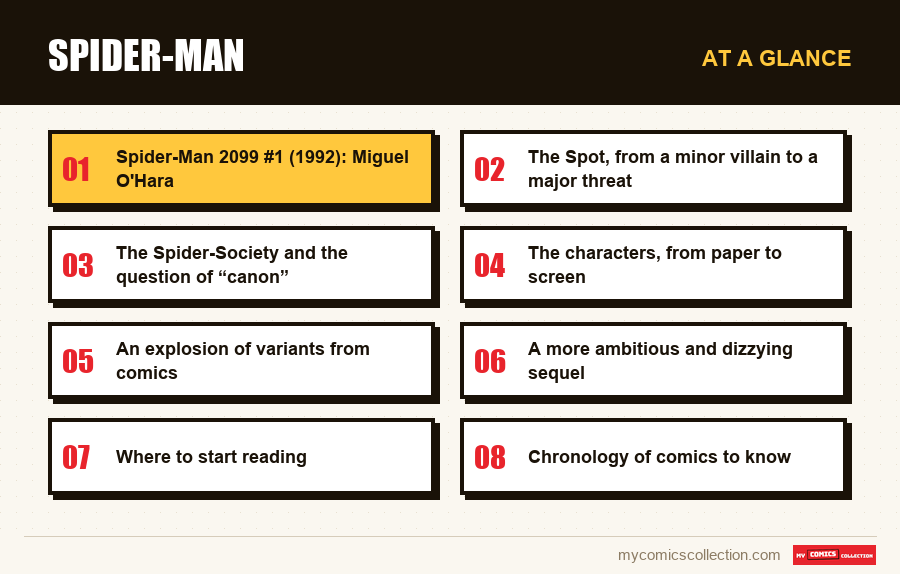
Spider-Man 2099 #1 (1992): Miguel O'Hara
The big news in the film is Miguel O'Hara, aka Spider-Man 2099, created by Peter David and Rick Leonardi in Spider-Man 2099 #1 (1992). A geneticist at the end of the 21st century on a futuristic Earth dominated by corporations, Miguel sees his DNA merge with that of a spider during an experiment, which gives him spider-like powers: including claws and fangs, absent from classic Spider-Man. A flagship character in the “Marvel 2099” line of the 1990s, he has experienced a recent resurgence in popularity, notably thanks to his central role in stories linked to the multiverse. The film makes him the leader of the Spider-Society, guardian of the integrity of the universes.
The film faithfully reproduces Miguel's appearance and powers (the blue and red costume, the claws, the futuristic origin) but completely reinvents his role. Where the comics make him one hero among others, the film transforms him into an authority figure, almost antagonistic, obsessed with preserving the “canon” of the Spider-Verse. Oscar Isaac gives him a tormented gravity. This rereading, which makes Miguel the point of friction in the story, moves away from his original characterization. However, it serves the purpose of the film on destiny and free will, by opposing its rigidity to the freedom that Miles claims.
The Spot, from a minor villain to a major threat
The main antagonist, the Spot, is a character from Spectacular Spider-Man #98 (1985), created by Al Milgrom and Herb Trimpe. Jonathan Ohnn is a scientist transformed by an accident into a being covered in portals, capable of creating dimensional holes on his body and in space. Long considered a minor, almost comical villain, the Spot is rehabilitated by the film which makes it a threat of cosmic magnitude. As he learns to master his portal powers, he becomes able to travel between dimensions and threaten the entire Spider-Verse. This rise in power is one of the boldest choices in the film.
This transformation illustrates the freedom of the film towards its source. The Stain from the comics was a secondary opponent; the film sees untapped potential in it and makes it a real tragic enemy, born from an accident linked to Miles himself. This rehabilitation, faithful to the powers and origins of the character but considerably amplifying his role, shows how an adaptation can bring a forgotten figure back to life. For the reader, it is an invitation to rediscover the Spot in the comics, where his portal powers offer visual and narrative potential that the film exploits brilliantly, revealing the hidden wealth of Spider-Man's gallery of enemies.
The Spider-Society and the question of “canon”
The film develops a central, largely original idea: the Spider-Society, an organization bringing together hundreds of Spider-Mans from all universes, responsible for preserving the "canon": the key events (such as the death of a loved one) supposed to repeat themselves in each reality to maintain balance. This meta notion, which questions the very structure of the Spider-Man myth, is a creation of the film. It is based on a truth from the comics, Spider-Man stories often replay the same founding dramas, but makes it an explicit narrative issue. Miles, refusing to accept an imposed tragic destiny, stands against this logic.
This reflection on fate and free will gives the film a rare depth for an animated blockbuster. By questioning the idea that Spider-Man would be condemned to suffer, the film questions the conventions of the genre and claims the freedom of its hero. This statement, absent from the comics in this form, nevertheless extends their spirit: the Spider-Verse celebrates plurality, and Miles, by refusing the “canon”, affirms that each Spider-Man can write his own story. For the reader, it is a stimulating rereading of the myth, which transforms the repetition of Spider-Man's dramas into a story subject in its own right.
Collecting this series?
Track what you own, what you are missing and what your collection is worth. 7 day trial.
Start my trial →The characters, from paper to screen
- Miles Morales: Hero of the film, refusing the tragic destiny imposed on him by the Spider-Society.
- Miguel O'Hara / Spider-Man 2099: Authoritarian leader of the Spider-Society, faithful in appearance but reinvented.
- The Stain: Minor comic book villain transformed into a multiverse threat.
- Spider-Gwen: Miles' adventure companion, at the emotional heart of the story.
- Variants: Spider-Punk, Spider-Man India (Pavitr Prabhakar), Jessica Drew and hundreds more.
An explosion of variants from comics
The film takes the concept of the Spider-Verse to its climax by bringing together hundreds of variations of Spider-Man, many of which exist in the comics. Spider-Punk (Hobie Brown), rebellious and anti-capitalist figure; Spider-Man India (Pavitr Prabhakar), Indian version of the hero born in the 2000s; Jessica Drew, one of the historical Spider-Woman, here pregnant and a biker. Each draws from a different part of Marvel's editorial history, testifying to the incredible diversity of the mythos. This profusion, a celebration of all the incarnations of Spider-Man, is one of the film's great pleasures for connoisseurs.
This richness illustrates the fertility of the concept forged by comics: Spider-Man is a myth so universal that it can be declined in all cultures, all eras, all styles. The film pays homage to this diversity by bringing sometimes obscure characters to life, rekindling interest in their origin stories. For the reader, each variant is a gateway to a little-known part of the spider universe. By bringing together this diverse community, the film extends the founding message of the Spider-Verse: the Spider-Man mask belongs to everyone, and its strength lies precisely in its ability to endlessly reinvent itself.
A more ambitious and dizzying sequel
Across the Spider-Verse pushed the biases of its predecessor even further, both visually and narratively. Each universe crossed has its own graphic identity (the watercolor of Gwen's world, the saturated colors of Mumbattan, the punk aesthetic of Spider-Punk's dimension) making the film a festival of animated styles. This visual riot, praised by critics, extends the founding idea of the saga: the diversity of the Spider-Verse is expressed as much in the forms as in the characters. The film assumes a rare ambition for an animated blockbuster, at the risk of overload, but with constant inventiveness.
Basically, the sequel also takes more risks. By ending on a cliffhanger, without resolution, it assumes its status as the first part of a diptych, a bold choice which divided. Above all, it deepens the reflection on destiny and identity: Miles confronts the idea that his very existence would be an “anomaly”, and refuses the tragic role that we want to assign to him. This questioning, more mature and darker than in the first film, enriches the myth of Spider-Man with a new meta dimension. For the reader, it is a stimulating rereading of the conventions of the hero, which transforms the repetition of spidery dramas into a real dramatic issue.
Where to start reading
To extend the film, Spider-Man 2099 #1 (1992) by Peter David and Rick Leonardi features Miguel O'Hara. Spectacular Spider-Man #98 (1985) introduced the Spot. The event “Spider-Verse” (2014-2015) by Dan Slott, and its sequel “Spider-Geddon”, deploy the Spider-Man community. This journey covers the sources of a film which multiplies the variants and questions the myth.
Chronology of comics to know
- 1985: Spectacular Spider-Man #98: the first appearance of the Spot.
- 1992: Spider-Man 2099 #1: The first appearance of Miguel O'Hara.
- 2014-2015: “Spider-Verse”: the event that brings together the variants of Spider-Man.
Collection side: what numbers to aim for after the film
Across the Spider-Verse points to varied keys. Spider-Man 2099 #1 (1992, first appearance of Miguel O'Hara) is a sought-after modern key, whose popularity has benefited from the character's resurgence in popularity. Spectacular Spider-Man #98 (1985, premiere of The Spot) is another target, driven by the major role of the villain in the film. The issues from the “Spider-Verse” event (2014-2015) complete the set. These targets cover various budgets, from the Bronze Age to modern. As always, condition and gradation determine value; relying on real recent sales is strongly recommended.
Its place in the saga and for the collector
Across the Spider-Verse took the concept of the Spider-Verse to its climax, introducing Miguel O'Hara and rehabilitating the Spot. For the collector, it reignited interest in Spider-Man 2099 #1 and Spectacular Spider-Man #98. It illustrates the effect of adaptations on the market, including for long-minor characters. Beyond speculation, the film invites you to discover the wealth of variations of Spider-Man in the comics and the mythology of the Spider-Verse. By questioning the “canon” of the hero, he offers a stimulating reflection on a myth with infinite variations.
The verdict: a multiplied Spider-Verse
- Loyalty: Miguel O'Hara, the Spot, Spider-Man variants and the spirit of the Spider-Verse come from the comics.
- Freedoms: the Spider-Society and the “canon” invented, Miguel as authoritarian leader, the Spot promoted to major threat, a story to follow.
- Collectible numbers: Spider-Man 2099 #1 (Miguel O'Hara), Spectacular Spider-Man #98 (the Spot), the “Spider-Verse” event.
Across the Spider-Verse multiplies the variations of Spider-Man and questions the myth, by introducing Miguel O'Hara and rehabilitating the Spot. Faithful to the spirit of the Spider-Verse but built on an original plot (the Spider-Society, the “canon”) the film ends on a cliffhanger. For the reader as well as the collector, it is an invitation to discover Spider-Man 2099 #1 and the universe of spider variants.
Frequently asked questions
From Spider-Man 2099 #1 (1992), created by Peter David and Rick Leonardi. A geneticist from a futuristic Earth, Miguel fuses his DNA with that of a spider. The film faithfully repeats his appearance, but reinvents him as the authoritarian leader of the Spider-Society.
No: appearing in Spectacular Spider-Man #98 (1985), he was long considered a minor, almost comical villain. The film rehabilitates him into a threat of cosmic magnitude, by amplifying his portal powers.
The concept of a Spider-Man community comes from the "Spider-Verse" event (2014-2015), but the film's Spider-Society and its doctrine of "canon" are largely creations specific to the story, serving its reflection on destiny.
The idea that certain tragic events (like the death of a loved one) must repeat themselves in each Spider-Man universe to maintain balance. A meta notion invented by the film, which is based on the repetition of the hero's founding dramas in the comics.
Spider-Man 2099 #1 (1992, first by Miguel O'Hara) is a sought-after modern key. Spectacular Spider-Man #98 (1985, Spotlight premiere) is another target, driven by the role of the villain in the film.
Does the film make you want to collect? Estimate the value for free of your issues (Spider-Man 2099 #1, Spectacular Spider-Man #98…) with our tool based on current eBay listings.