
The best Jessica Cruz comics to start with are in Green Lanterns (2016): the Rage Planet arc, by Sam Humphries and Robson Rocha, sets her up as a Green Lantern alongside Simon Baz. Then go back to Justice League #31 (2014), where she receives the ring of fear, and to Darkseid War, where she joins the Corps. Seven ranked reads run from 2014 to 2024, each with a reader profile.
Jessica Cruz is a heroine whose power depends first on her ability to stay on her feet. She wears a ring that feeds on fear, she lives with anxiety, and the appeal of her best stories lies in how DC turns that fragility into team strength. Between 2014 and 2024, she went from being the victim of a ring to a full Green Lantern, then from a Justice League member to a heroine you find in the Corps books.
As always in this guide, we only state what is verified (creators, issue numbers, dates); the analysis is our own, with no reproduction of protected art or dialogue.
Her first appearance
The name Jessica Cruz and a gloved hand appear in a panel of Green Lantern (2011) #20, dated July 2013, when the series was written by Geoff Johns. It is only a passing appearance, but it is the earliest one that references list. The character takes shape a year later: the ring of Volthoom spots her at the end of Justice League (2011) #30, in 2014, then she becomes Power Ring in Justice League #31, dated August 2014, written by Geoff Johns and drawn by Doug Mahnke. It is also her first cover appearance.
For a collector, the hierarchy is therefore clear: Green Lantern #20 is the archival curiosity, Justice League #31 is Jessica's entry into the story. Her official induction into the Green Lantern Corps, for its part, takes place at the end of Justice League #50, in 2016.
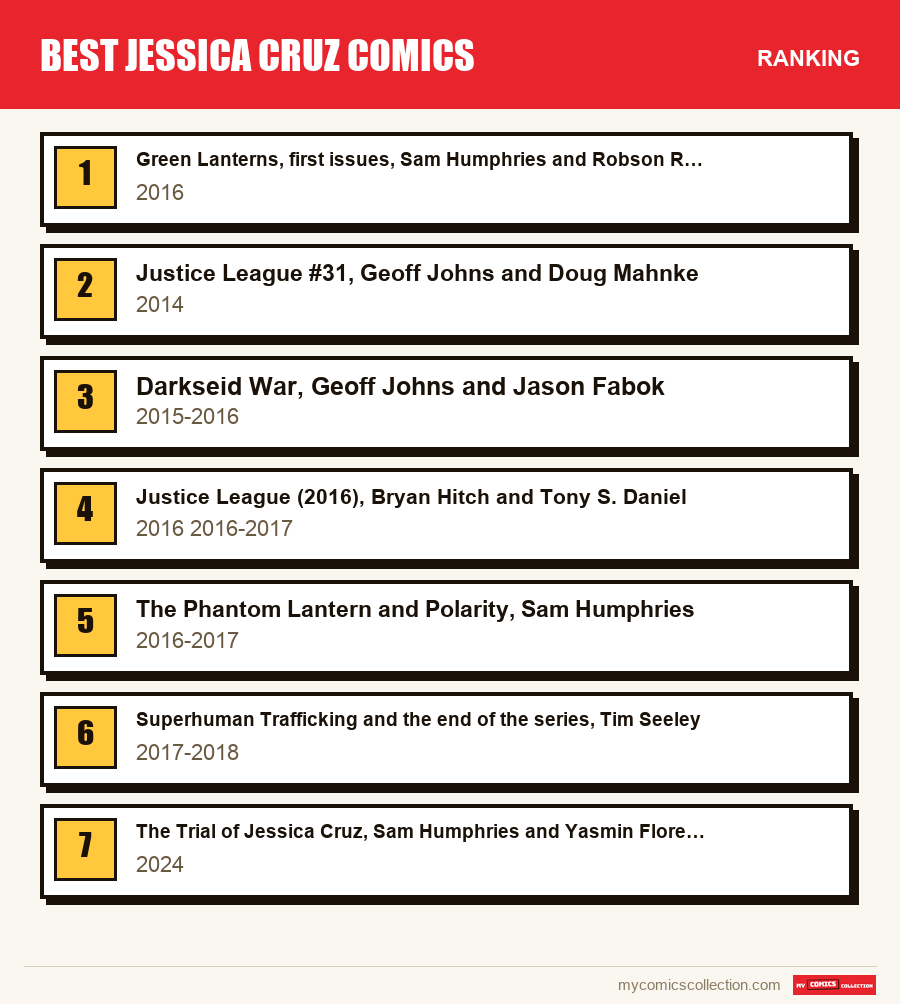
1: Green Lanterns, first issues, Sam Humphries and Robson Rocha (2016)
This is the entry point we recommend. Green Lanterns #1 (August 2016) launches the ongoing series centered on the duo of Jessica Cruz and Simon Baz, with Sam Humphries on script and Robson Rocha on art. The first arc, titled Rage Planet, runs six issues: Jessica faces Bleez, the Red Lantern, while the agency A.R.G.U.S. monitors the situation.
What the arc gives Jessica: a setting where she is no longer the heroine we save from her ring, but a partner who has to learn to fight beside a more impulsive teammate. A single American trade paperback collects the one-shot Green Lanterns: Rebirth and these six issues: you have nothing else to look for to get started. It is for the reader who has never opened a Green Lantern book and wants a self-contained story, without going through the crossovers of the previous decade.
2: Justice League #31, Geoff Johns and Doug Mahnke (2014)
The issue that opens Jessica Cruz's story. After the death of the previous Power Ring in Forever Evil, the ring of Volthoom looks for a new host and attaches itself to her. Geoff Johns writes, Doug Mahnke draws, and Keith Champagne and Christian Alamy share the inking. The story lays down the principle that makes up the whole character: a ring that feeds on fear is entrusted to a young woman who has plenty of it.
Read it with the neighboring issues of Justice League, in particular issue #33, where part of her past is revealed. It is not a complete story about her, because the series stays focused on the League, but it is the most useful read for understanding why her later adventures are so much about trust. It suits the reader who likes going back to a character's source and who accepts a serialized story rather than a self-contained volume.
3: Darkseid War, Geoff Johns and Jason Fabok (2015-2016)
The Justice League's big saga at the turn of 2015, in Justice League (2011) issues #40 to #50. Johns writes, Jason Fabok draws the main-line episodes, and the final chapter, Darkseid War: Conclusion: Death and Rebirth, is the one where Jessica is officially admitted to the Green Lantern Corps, in 2016. In other words, she is here a heroine on the rise in the middle of a clash that involves the whole League.
It needs saying before you buy: Jessica is not the center of the saga, which revolves around Darkseid and the Anti-Monitor. She finds a turning point in it, not a story with her name on it. Read it if you want to know how she goes from the yellow ring to the green ring, and to understand why that shift is an event in the Corps mythology. The American trade paperbacks split the whole into two volumes, which lets you buy only what interests you.
4: Justice League (2016), Bryan Hitch and Tony S. Daniel (2016-2017)
After Rebirth, the League is rebuilt and Jessica Cruz sits on it alongside Simon Baz. Bryan Hitch writes, Tony S. Daniel draws most of the first issues, and the one-shot Justice League: Rebirth is drawn by Hitch himself. The trade paperback The Extinction Machines takes the first five issues, and Outbreak follows with the sixth through the eleventh. The League of this moment has two recent Green Lanterns, and Jessica is one of them.
Same caveat as for Darkseid War: Jessica is a member of a large cast here, not the protagonist. Choose this read if you prefer the feel of a big team and want to see her alongside other heroes rather than sharing a series with a single partner. It reads with no prior knowledge of the earlier series, thanks to the opening one-shot.
Do you collect this series?
Track what you own, what you are missing and what your collection is worth. 7-day trial.
Start my trial →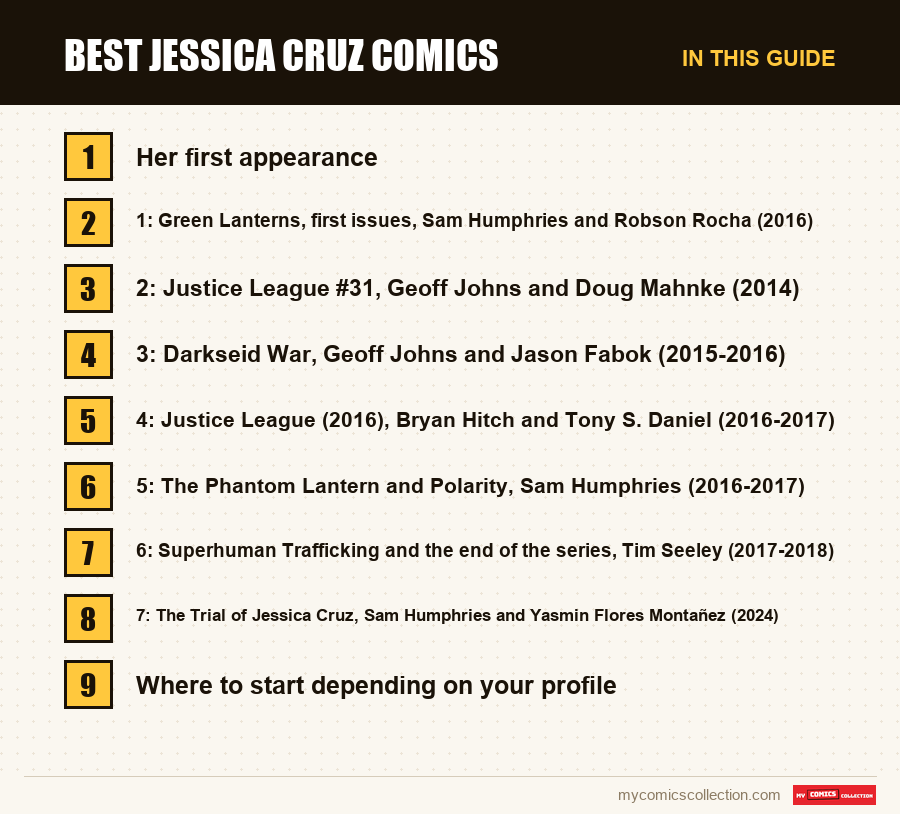
5: The Phantom Lantern and Polarity, Sam Humphries (2016-2017)
The direct sequel to Rage Planet in Green Lanterns. The Phantom Lantern runs from January to March 2017, Polarity from May to June of the same year. Sam Humphries still holds the pen, and the trade paperback listings mention Robson Rocha as well as Eduardo Pansica at the drawing board. These two arcs deepen the relationship between the two partners, which the series treats as a forced collaboration that becomes a working friendship.
For Jessica, the appeal is consistency: several months in a row from her point of view, with no detour through a big saga. The reader who enjoyed Rage Planet can continue without a gap, with the Phantom Lantern trade covering issues #7 to #14 and Polarity issues #15 to #21. The crossovers of the same period (Justice League vs. Suicide Squad, in 2017) are optional.
6: Superhuman Trafficking and the end of the series, Tim Seeley (2017-2018)
Starting with Green Lanterns #33, dated December 2017, Tim Seeley takes over the scripts. Under his pen, Superhuman Trafficking appears from April to May 2018; the title ends in December 2018, at issue #57, with several artists. On the trade paperback shelf, A World of Our Own takes issues #33 to #39; the Superhuman Trafficking volume follows, annual included.
This run is for a reader who has finished the Humphries part and wants to see what becomes of the duo after a change of writer. It is cited less often than the 2016 openings, which makes it easier to pick up secondhand, and it lets you follow Jessica to the close of the series. Do not start with it: it assumes the earlier arcs.
7: The Trial of Jessica Cruz, Sam Humphries and Yasmin Flores Montañez (2024)
The most recent read in this ranking, and the one whose title carries her name. In Green Lantern (2023) #9, the main story is drawn by Xermanico; it is followed by an eight-page backup story, The Trial of Jessica Cruz, written by Sam Humphries with art by Yasmin Flores Montañez. The writer who launched the duo in 2016 thus returns to the protagonist in 2024.
It is a short read, best kept for the reader who already knows Jessica and wants to see where the character stands. It cannot be understood without Green Lanterns and only has value in that context. If you collect the current series, the issue is easy to add; otherwise, it is not essential.
Where to start depending on your profile
- You are new to Green Lantern: start with the 2016 launch volume, then move on to the second. No earlier reading is required.
- You want to understand the ring: read Justice League #31 and #33, then Darkseid War through issue #50. That is the path from the yellow ring to the green ring.
- You like big teams: bet on the League rebuilt by Bryan Hitch, whose first two volumes set the stage.
- You follow Geoff Johns: go back to Green Lantern (2011) #20 and read the Justice League issues keeping in mind how small Jessica's role is before 2014. Our Geoff Johns reading guide puts these series back in the context of his body of work.
- You collect the Corps: broaden out with the history of Green Lantern and Kyle Rayner's path, another successor ring bearer.
The key issues to know
The values of these issues change over time; the method is worth more than a figure. Compare sold listings of issues in the same condition, rather than asking prices, and note the difference between a standard print and a variant cover.
- Green Lantern (2011) #20 (July 2013): the mention of her name and the gloved hand. It is an archival curiosity, sought mostly by completists.
- Justice League (2011) #30 (2014): the ring of Volthoom spots her. A transitional issue, which gains its value from the next one.
- Justice League (2011) #31 (August 2014): her full entrance and her first cover, by Geoff Johns and Doug Mahnke. This is the reference issue.
- Justice League (2011) #50 (2016): her induction into the Corps, at the end of Darkseid War.
- The one-shot Green Lanterns: Rebirth then Green Lanterns #1 (August 2016): the opening of the title. Watch out for variant covers, including one by Emanuela Lupacchino on issue #1.
- Green Lanterns #33 (December 2017): Tim Seeley succeeds Sam Humphries: the break between the two halves of the title.
Before buying a copy that is already graded, check the serial number on the label and that it matches the cover; for an issue with multiple printings, verify which printing it is. To avoid confusing the 2011 and 2016 titles, rely on our Green Lantern issue count.
Frequently asked questions
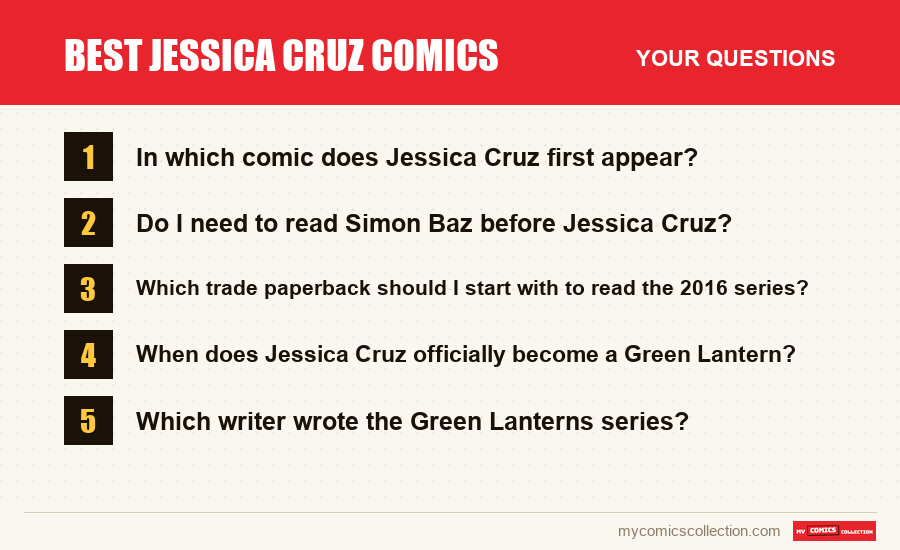
Her name and a gloved hand appear in Green Lantern (2011) #20, dated July 2013. Her full appearance and first cover date from Justice League (2011) #31, in August 2014, written by Geoff Johns and drawn by Doug Mahnke. Collectors mostly look for the latter.
No. Simon Baz debuts in 2012 and Jessica in 2013, then fully in 2014; the 2016 Green Lanterns title puts them on equal footing, so the order in which you discover them hardly matters. If you want to get to know the duo's other partner, our Green Lantern guide covers him.
With the inaugural volume, Rage Planet, which contains the launch one-shot and the first six issues. Volume 2, Phantom Lantern, then covers issues #7 to #14, and volume 3, Polarity, issues #15 to #21.
At the end of Darkseid War, in Justice League (2011) #50, in 2016. Before that, she wears the ring of Volthoom as Power Ring, since Justice League #31 in 2014, and so does not have the Corps' green ring.
Sam Humphries wrote the first part, through issue #32, with Robson Rocha and Eduardo Pansica among the artists. Tim Seeley takes over from issue #33, in December 2017, and the series ends with issue #57, in December 2018.
Found a copy of Justice League #31 or Green Lanterns #1 again? Assess its condition and value before deciding whether to keep it or sell it.
Estimate my comic