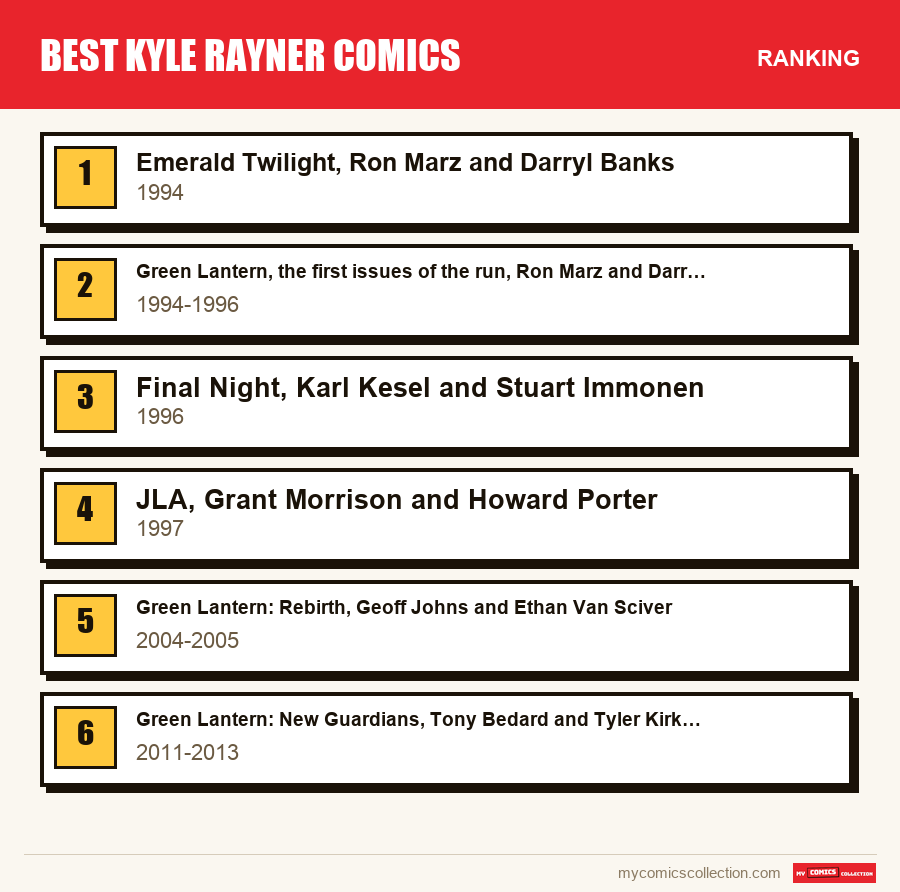
The best Kyle Rayner comics start with Emerald Twilight (Green Lantern #48-50, 1994), the Ron Marz and Darryl Banks arc where Hal Jordan falls and Kyle receives the last ring. Continue with the first issues of his own run, #54 included, then Final Night, Grant Morrison's JLA, Green Lantern: Rebirth and New Guardians. His first appearance is Green Lantern #48 (January 1994).
Kyle Rayner holds a singular place in Green Lantern mythology: he carries the title as an isolated hero, with no rebuilt Corps, no Guardians around him and no mentor. For a reader today, this position looks like an anomaly; for the collector, it explains why the issues of the mid-1990s matter more than their reputation at the time suggested.
As always in this guide, only verified facts (creators, issue numbers, dates) are stated as fact; the analysis is our own, with no reproduction of protected art or dialogue.
His first appearance
Kyle Rayner first appears in Green Lantern #48, dated January 1994, in the middle of the Emerald Twilight arc. The character is created by writer Ron Marz and artist Darryl Banks. This issue introduces a young freelance artist, a stranger to the Lantern universe; #50, dated March 1994, is the one where he appears as a full-fledged Green Lantern.
The editorial situation explains why this moment matters. Hal Jordan, the title's hero since 1959, has just broken down after the destruction of Coast City in the Superman stories of 1993. He destroys the Corps and drains the power batteries, until the last Guardian, Ganthet, hands the last ring to an unknown. The idea is bold: hand the mantle to someone and expect the reader to accept the break.
1: Emerald Twilight, Ron Marz and Darryl Banks (1994)
This three-issue arc, Green Lantern #48-50, is the most debated moment in the history of the character of Hal Jordan, and paradoxically it is Kyle's birth certificate. Marz stages Hal's fall as a mirror of his successor's arrival: the more Hal closes himself off, the more Ganthet looks for someone with no history with the ring yet.
What the arc brings to Kyle is a rare starting condition: he inherits a damaged symbol, in a universe where former colleagues distrust him. It suits anyone who wants to grasp why this period still divides readers, and who accepts watching Hal Jordan cross over to the other side. Read it in single issues if you collect, otherwise in a trade paperback that gathers the three chapters, and keep in mind that the meaning of the final scene depends entirely on what precedes it.
2: Green Lantern, the first issues of the run, Ron Marz and Darryl Banks (1994-1996)
The start of Marz's run on Kyle is the period when the character finds his voice. With no model to imitate, Kyle learns to use the ring by trial and error, and his work as an artist becomes a series hook: his constructs come from his imagination as an illustrator, with details that Hal, a former pilot, would not look for. It is a writing choice that sets Kyle apart from his predecessors more than any costume.
The issue to remember is #54, which shows the death of Alexandra DeWitt, Kyle's girlfriend, at the hands of the villain Major Force. This scene has stayed in the history of the genre: in 1999, writer Gail Simone drew from it the phrase "Women in Refrigerators" to describe female characters sacrificed in service of a hero's pain. The single issue is therefore both a narrative and a critical landmark, reread today with a very different eye from that of 1994.
This section is for the reader who wants to watch Kyle take shape. How to read it? In blocks, in trade paperbacks when they exist, but the monthly serial keeps an advantage here: the series' standalone episodes are also what gives it its flavor, and they are best enjoyed in small doses.
3: Final Night, Karl Kesel and Stuart Immonen (1996)
A DC universe event, Final Night stages the death of the Sun, devoured by an entity from space. The heroes must hold on in a world plunged into darkness, and Kyle finds there his first chance to hold his place in a major shared-universe event, and no longer just in his own title. The miniseries is written by Karl Kesel and drawn by Stuart Immonen; it extends into the regular series, including Green Lantern.
For Kyle, this step matters because the hero of a monthly title becomes an actor in the whole DC universe. His predecessor is never far in those years: his shadow hangs over the whole decade, until a return that DC would not bring about until 2004. It is for the reader who likes events and wants to place Kyle in the context of the 1990s. To place this story among the franchise's other sagas, our guide to Green Lantern crossovers gives an overview.
4: JLA, Grant Morrison and Howard Porter (1997)
In 1997, Grant Morrison and Howard Porter relaunch the Justice League; the Green Lantern seat goes to Kyle, surrounded by Superman, Batman, Wonder Woman, Flash (Wally West), Aquaman and Martian Manhunter. For a three-year-old character, it is proof of swift editorial recognition.
The interest of this choice is to show Kyle outside his own series, seen by others. His role as the youngest of the group gives him the function of a reader surrogate: he discovers what the reader discovers. The series is for those who want a large-scale superhero story, with little continuity to know. Read it in trade paperbacks, starting with the first arc, before or after Final Night depending on your taste for chronology.
Do you collect this series?
Track what you own, what you are missing and what your collection is worth. 7-day trial.
Start my trial →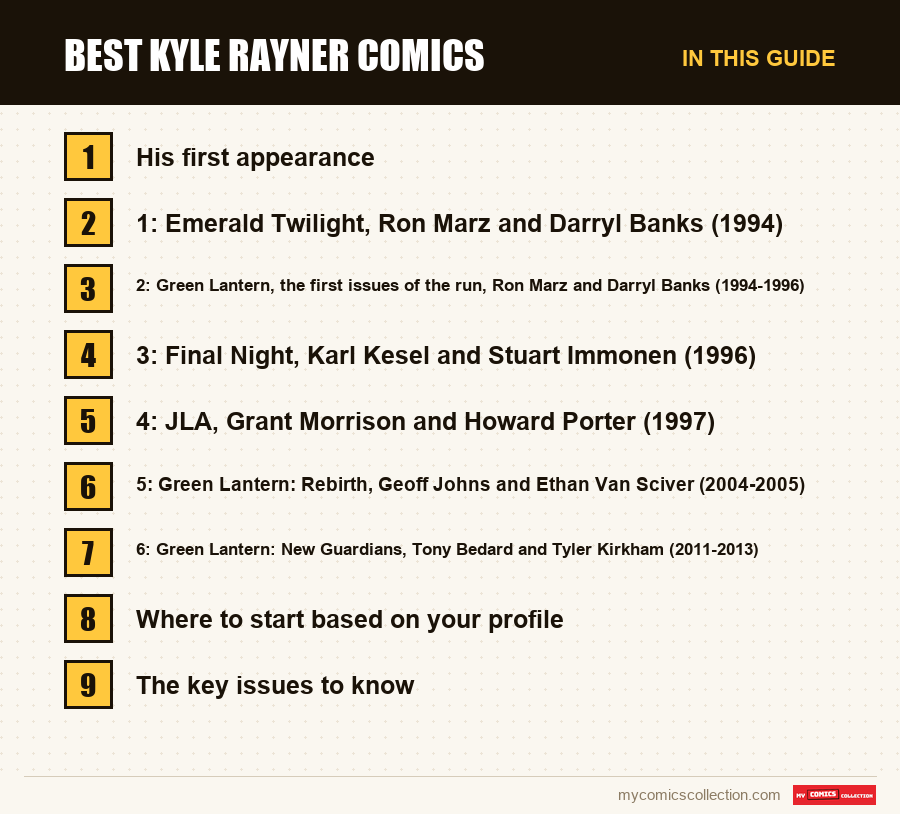
5: Green Lantern: Rebirth, Geoff Johns and Ethan Van Sciver (2004-2005)
Geoff Johns and Ethan Van Sciver deliver six issues that bring Hal Jordan back: his 1994 fall is reread as the effect of an entity that inhabited him, and the hero thus regains his place. For a Kyle reader, it is a double-edged read. The book does not put him at the center, but it reorganizes his place: he remains a Lantern, now among others, and no longer alone.
Why read it? Because you can only measure Kyle's legacy by seeing what his successors do with his role. It is for the reader who has finished the previous steps; it reads as a trade paperback. Johns's long-term work is detailed in the hub devoted to this writer, and our reading order shows how Rebirth fits into his whole career.
6: Green Lantern: New Guardians, Tony Bedard and Tyler Kirkham (2011-2013)
After the relaunch of the DC universe in 2011, Kyle gets a title in his name again with New Guardians, written by Tony Bedard and drawn by Tyler Kirkham. In it he gathers ring bearers of different colors, which extends the central idea of his career: the one who was not trained by tradition is best placed to get opposing traditions talking.
This entry is the most recent in the ranking, and that is deliberate: it shows that the character survived Hal Jordan's return, which was not a given. It is for the reader who prefers team series and the color of the modern era. Read it last, after Rebirth, because the story assumes you know all the factions of the spectrum.
One last word on how to approach these reads: Marz's run has aged unevenly. The first collected editions keep the energy of a launch, while some late episodes are more dated, and nothing requires you to read everything in strict order. A reader in a hurry can stop after Emerald Twilight and #54, then jump to JLA, without losing anything essential to understanding the character.
On the collecting side, this choice has a practical consequence. You do not need to gather the whole 1990s series to own the essence of Kyle Rayner: issues 48, 50 and 54 form its core, and the rest fills in as opportunities arise, in trade paperbacks or single issues depending on your shelf-space budget.
Where to start based on your profile
If you want the tightest story, read Emerald Twilight and then stop at #54: you will have the character's birth and one of the most-cited issues of the decade. If you want to understand the character, read Marz's run to the end; Marz writes the Green Lantern series from #48 until Judd Winick arrives, and it is the only path that does justice to the idea of a hero built slowly.
If you come from Hal Jordan, go through Rebirth before going back to the 1990s: reading backward has the advantage of showing what Hal's return owes to the previous episode. If you are more interested in teams, start with JLA, which requires almost no prior knowledge, then return to the solo title.
The key issues to know
For a character whose story fits in about thirty important issues, the list remains readable.
- Green Lantern #48 (January 1994): the first appearance of Kyle Rayner.
- Green Lantern #50 (March 1994): Kyle appears as a full-fledged Green Lantern.
- Green Lantern #54 (1994): the death of Alexandra DeWitt, a narrative turning point and critical landmark.
- JLA #1 (1997): Kyle represents the Green Lanterns in Grant Morrison's League.
- Green Lantern: Rebirth #1 (2004): the return of Hal Jordan, which redefines Kyle's place.
The method is the same for each: ask yourself what event the issue represents, then check the cover date and the printing notice before comparing listings. Issues from the 1990s had large print runs, which makes condition and true scarcity more decisive than the arc's reputation. An issue that marks the character's history but was printed in large quantities trades differently from a scarce issue; that distinction should guide your choices.
Frequently asked questions
Kyle Rayner appears in Green Lantern #48, dated January 1994, as a young artist still a stranger to the Lantern universe. Issue #50, dated March 1994, shows him as a full-fledged Green Lantern. Both single issues are created by Ron Marz and Darryl Banks and sell as landmarks of the character.
Start with Emerald Twilight (Green Lantern #48-50), which tells the fall of Hal Jordan and the arrival of Kyle, then continue with Ron Marz's run. If you prefer a more recent entry point, New Guardians (2011) works as a standalone series for anyone who knows the colors of the spectrum.
No, but it helps to measure the break of 1994. Emerald Twilight can be understood alone, because the story presents Hal Jordan's fall with the context needed. If you want the background, browse our history of Green Lantern first, then come back to Kyle with a reference point.
This 1994 issue shows the death of Alexandra DeWitt, Kyle's girlfriend, at the hands of Major Force. In 1999, writer Gail Simone drew from it the phrase "Women in Refrigerators," which became a common term in comics criticism for a type of plot.
He survived Hal Jordan's return and has kept a role in the franchise, notably at the center of New Guardians in 2011. His status varies with editorial relaunches, which means checking for each series which continuity it sits in before buying it.
Do you own a copy of Green Lantern #48 or #50 from 1994? Get it appraised before deciding whether to keep or sell it.
Appraise my comic