
The 3 essential Green Lantern crossovers: Blackest Night (the full emotional spectrum event), Crisis on Infinite Earths (destruction of the Body) and War of the Green Lanterns (betrayal of Krona and dismissal of Hal Jordan).
Green Lantern is one of the few DC characters whose mythology has been deeply enriched by crossovers rather than simply impacted. Geoff Johns transformed the concept of Lantern into a universe of cosmic war, and the events he orchestrated between 2004 and 2013 form a continuous story arc that rivals the best Marvel sagas in terms of ambition and collectability.
For a collector, Johns' Green Lantern cycle represents a unique opportunity: interconnected events with identifiable key issues and first appearances of characters become iconic (Atrocitus, Larfleeze, the different Corps). This guide lists the essential crossovers to build a coherent GL collection.
Blackest Night (2009-2010). The GL Masterpiece
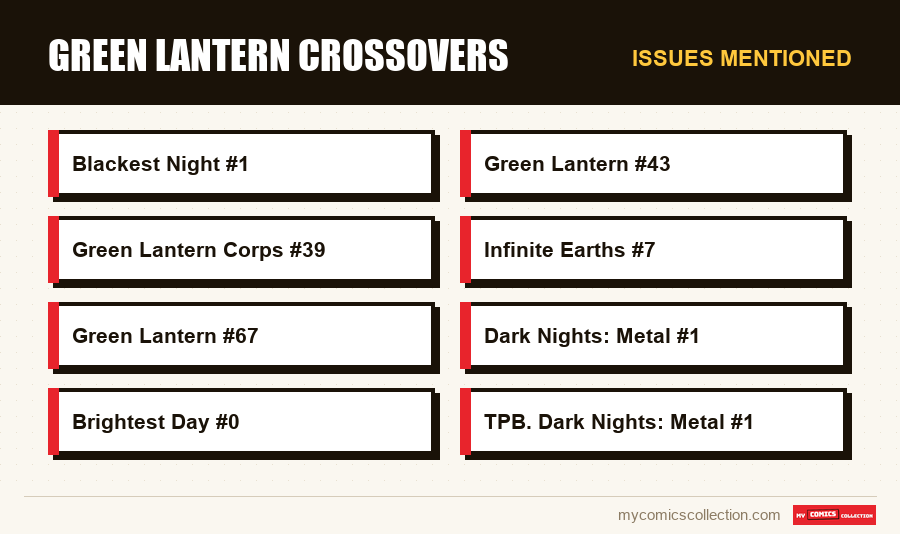
Geoff Johns and Ivan Reis deliver an 8-issue event that represents the culmination of five years of preparation. The Black Lanterns (resurrected dead) are invading the DC Universe, and only the alliance of the seven Emotional Specter Corps can stop them. Blackest Night #1 is the main key issue, regularly quoted between 40 and 100 € in 9.8 CGC.
The event introduces the White Lantern Entity and gives Hal Jordan a central cosmic role. Green Lantern #43-52 and Green Lantern Corps #39-47 tie-ins are essential for the complete collection. For the Green Lantern key numbers, Blackest Night is the highlight.
Crisis on Infinite Earths (1985-1986). The Fall of the Corps
In Crisis on Infinite Earths, the Green Lantern Corps suffers massive losses. Entire worlds are destroyed, and the Guardians are powerless against the Anti-Monitor. Hal Jordan is no longer the main GL at this time (John Stewart takes the role in the Justice League), but the event redefines the Corps for a decade.
Key issues
Crisis on Infinite Earths #7 (death of Supergirl, presence of GL), issues 1-12 form an essential set for any DC collection.
Brightest Day (2010-2011). The Aftermath of Blackest Night
A direct sequel to Blackest Night, Brightest Day is a 24-issue bi-monthly series that explores the return to life of 12 characters. For Green Lantern, the event focuses on the hunt for emotional entities and prepares for War of the Green Lanterns. The number #0 and #24 are the main issues of this often underrated series.
War of the Green Lanterns (2011): Betrayal within the Corps
Krona takes control of the Guardians and corrupts the Central Power Battery. Hal Jordan, Guy Gardner, John Stewart and Kyle Rayner must use rings from other Corps to save the universe. The event culminates with Hal Jordan's dismissal from the Corps, a pivotal moment. Green Lantern #67 is the concluding key issue of this arc.
Dark Nights: Metal (2017-2018). The cosmic dimension GL
Scott Snyder integrates Green Lantern mythology into his exploration of the Dark Multiverse. Hal Jordan plays a crucial role in the resistance against the Dark Knights, and the connection between the emotional spectrum and cosmic metals enriches GL lore. Dark Nights: Metal #1 remains a major key issue of the modern DC era, between €25 and €70 in 9.8.
Summary for the GL collector
Blackest Night #1: €40-100 (9.8 CGC). Green Lantern #43 (Blackest Night prologue): €20-50. Brightest Day #0: €10-25. War of the Green Lanterns is easily found in TPB. Dark Nights: Metal #1: €25-70. The Johns cycle remains the best GL investment.
Manage your entire Green Lantern collection. Track each issue of the different arcs, identify your missing ones and monitor the values with My Comics Collection.
Organize my GL collectionReading order of the Geoff Johns cycle
The crossovers presented above are not isolated blocks. They fit into a cycle of about ten years that begins before Blackest Night and continues well after War of the Green Lanterns. Here are the chronological markers to read it in order without getting lost.
2004 to 2007: Hal Jordan's return and the war against Sinestro
The cycle opens with Green Lantern: Rebirth, a six-issue miniseries published from October 2004 to May 2005, written by Geoff Johns and drawn by Ethan Van Sciver. It brings Hal Jordan back to the forefront and lays the foundations for everything that follows. Next comes Sinestro Corps War, a saga published from June to December 2007 in Green Lantern and Green Lantern Corps, with special issues as a complement. A corps of fear, with yellow rings, rises against the Green Lantern Corps. It is the step that establishes the idea of an emotional spectrum, without which Blackest Night would make no sense.
2008 to 2011: the spectrum widens
Secret Origin (2008) retells Hal Jordan's origin for new readers, then the other colors enter the stage: the Red Lantern Corps, fueled by rage and led by Atrocitus, the orange of avarice with Larfleeze, the blue of hope, the indigo of compassion and the violet of love. Blackest Night gathers these seven corps against the Black Lanterns, Brightest Day draws the consequences, and War of the Green Lanterns closes the whole in 2011 with the crisis of the Green Lantern Corps itself.
2012 and 2013: the final stretch
The following arcs, Rise of the Third Army and then Wrath of the First Lantern, extend the cycle. The latter, published in 2013, is Geoff Johns' last major story on the series, after nine years of work. It pits the Corps against Volthoom, the first Lantern, released by mistake by the Guardians turned renegade.
How to find your way as a collector
To read without scattering, follow the order Rebirth, Sinestro Corps War, Blackest Night, Brightest Day, War of the Green Lanterns. The tie-ins are found in the monthly Green Lantern and Green Lantern Corps series, but the Sinestro Corps War special issues are published separately: check that they are in your lot before judging it complete.
On the collecting side, do not seek completeness right away. The issues that introduce a colored corps or a character who became iconic, such as Atrocitus or Larfleeze, are the ones that draw attention, and the collected editions are enough to understand the rest. An event is read continuously: buying the tie-ins in bulk and sorting them afterwards is the best way to end up with gaps in the sequence.
Frequently asked questions
Blackest Night (2009-2010) for the full emotional spectrum event, Crisis on Infinite Earths for the destruction of the Corps and War of the Green Lanterns (2011) for Krona's betrayal and Hal Jordan's dismissal. Brightest Day and Dark Nights: Metal complete the picture.
Geoff Johns and Ivan Reis deliver eight issues that conclude five years of preparation. The resurrected dead invade the DC universe, and only the alliance of the seven Corps of the emotional spectrum can stop them. The event also introduces the White Lantern Entity.
Green Lantern #43 to 52 and Green Lantern Corps #39 to 47. Green Lantern #43 is the prologue to the event, and these tie-ins are essential for a complete collection.
Krona takes control of the Guardians and corrupts the Central Power Battery. Hal Jordan, Guy Gardner, John Stewart and Kyle Rayner must use rings from other Corps to save the universe. The event culminates with Hal Jordan's dismissal from the Corps.
Scott Snyder weaves the Green Lantern mythology into his exploration of the Dark Multiverse. Hal Jordan plays a crucial role in the resistance against the Dark Knights, and the link between the emotional spectrum and cosmic metals enriches the lore.