
Top 3 crossovers involving Wonder Woman
- Crisis on Infinite Earths (1985-1986): Diana dies heroically, allowing her reboot by George Pérez, one of DC's most memorable moments.
- Blackest Night (2009-2010): Wonder Woman briefly becomes Star Sapphire then wears a Black Lantern ring, a double iconic moment.
- Dark Nights: Metal (2017-2018): Diana leads the resistance against the Dark Multiverse, confirming her status as a cosmic warrior.
Wonder Woman occupies a unique position in DC crossovers: as both frontline warrior and diplomatic figure, she intervenes in every major crisis with a role distinct from Superman and Batman. For the collector, his key appearances in events are often undervalued in relation to their narrative importance.
From the destruction of the multiverse in Crisis to the Dark War in Metal, Diana has spanned four decades of crossovers while maintaining remarkable relevance. This guide identifies the issues where his intervention changes the course of the event: the real keys that every serious DC collector should target.
Crisis on Infinite Earths (1985-1986)
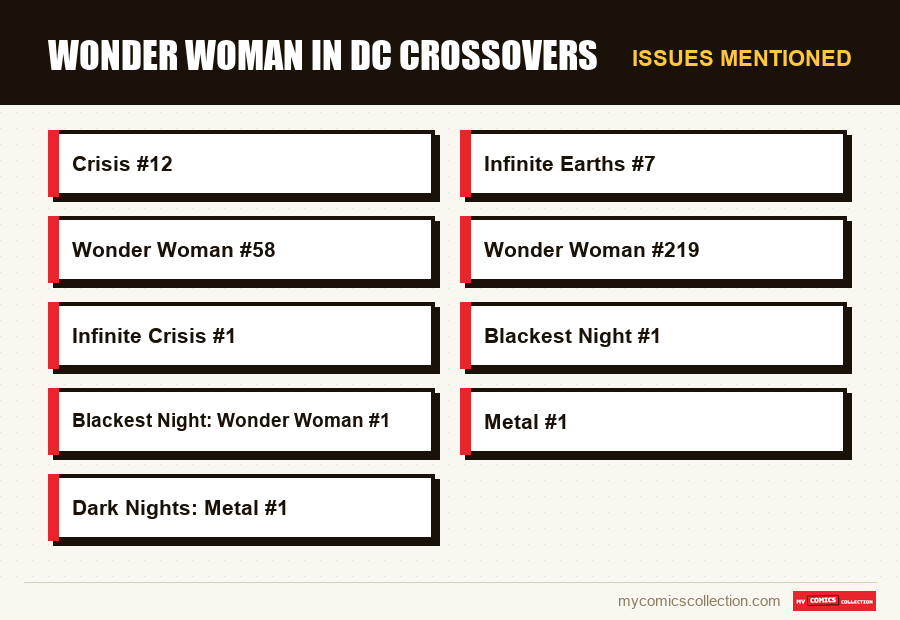
The first great DC Crisis is also the last adventure of the pre-Crisis Wonder Woman. Diana is returned to clay in #12, erasing her existence to allow for George Pérez's reboot. This narrative sacrifice makes Crisis #12 a doubly key issue for Wonder Woman collectors.
Essential numbers
Crisis on Infinite Earths #7 (death of Supergirl) and #12 (end of Diana) are the two pillars. #12 is often overlooked in favor of #7, creating an acquisition opportunity for informed collectors. Consult our guide to Wonder Woman key numbers for an in-depth analysis.
War of the Gods (1991)
George Pérez's Wonder Woman-centric crossover pits Diana against Circe in a war involving all of the DCU's mythological pantheons. This four-issue event plus tie-ins is the only major DC crossover where Diana is truly the main protagonist.
Collectible value
Despite its historical importance, War of the Gods remains very financially accessible. The four issues of the main miniseries and tie-ins Wonder Woman #58-62 make for an affordable and often underrated complete set.
Infinite Crisis (2005-2006)
Diana makes the controversial decision to kill Maxwell Lord on live television (Wonder Woman #219), sparking a rift within the Trinity. This moment directly precedes Infinite Crisis and redefines the public perception of Wonder Woman in the DCU.
Market impact
Wonder Woman #219 (the death of Maxwell Lord) became a major key issue whose rating increased significantly after the announcement of the DC films. Infinite Crisis #1-7 completes the picture, with #1 (multiple variants by Jim Lee and George Pérez) as the centerpiece.
Blackest Night (2009-2010)
Geoff Johns gives Diana one of her most visually striking crossover moments: first transformed into a Black Lantern, she is saved by the Star Sapphire ring of love. This double transformation makes him a central character of the event beyond simple figuration.
Issues to target
Blackest Night #1-8 forms the main body, but Blackest Night: Wonder Woman #1-3 is the essential miniseries for Diana fans. Greg Horn's covers for this mini are some of the most sought after of the event.
Dark Nights: Metal (2017-2018)
Scott Snyder places Wonder Woman at the heart of the resistance against Barbatos and the Dark Multiverse. Diana forges a weapon from Nth Metal and leads the final assault, a warrior role reminiscent of her mythological origins. Metal #1-6 by Snyder and Capullo defines modern DC cosmology.
Collection strategy
The variants of Metal (notably the foil covers of #1) experienced intense speculation upon release. The market has stabilized, providing reasonable entry points. Dark Nights: Metal #1 and #6 are the two priority issues for a Wonder Woman collector.
Overall Acquisition Tips
Wonder Woman crossovers have a strategic advantage: demand is historically lower than key Batman or Superman for narrative moments of comparable importance. This gap tends to narrow with each new film or series, creating windows of opportunity for patient and informed collectors.
Organize your Wonder Woman crossovers
From Crisis to Metal, catalog every key appearance of Diana in DC events. Identify your gaps and prioritize your next acquisitions using our specialized tool.
Manage my DC collectionBefore and after Crisis: placing Wonder Woman in time
Wonder Woman's crossovers read better when placed on either side of a border: Crisis on Infinite Earths. Before it is the historic Wonder Woman; after it, the one George Pérez rebuilt.
Before Crisis. Wonder Woman first appears in All Star Comics #8 (December 1941), created by William Moulton Marston and drawn by Harry G. Peter, and gets her own series with Wonder Woman #1 (summer 1942). It is this Golden Age version that Crisis #12 erases by returning her to clay.
Pérez's fresh start. The reboot arrives with Wonder Woman vol. 2 #1 (February 1987), by George Pérez. It defines the modern Diana, both mythological and diplomatic, who then runs through all the article's crossovers, from War of the Gods to Metal.
To find your way on the collecting side, four practical markers:
- Tell the two series apart. Wonder Woman #1 exists in 1942 and in 1987: without the year, a listing says nothing, and the prices have no relation.
- Think in blocks of issues. War of the Gods is four main issues plus the regular series tie-ins (#58-62): a complete set is more interesting than isolated issues.
- Beware of speculative variants. Those of Metal, notably the foil covers of #1, were heavily speculated at release: favor standard issues, which are steadier.
- Look for the cover, not just the issue. For Blackest Night: Wonder Woman, Greg Horn's covers are among the most sought after of the event.
One last tip, on reading this time: read the crossovers in order of publication, from Crisis to Metal. You will see the character evolve from sacrificial victim to war leader, and understand why her key moments are so often undervalued relative to their narrative importance. Also note for each event whether it is a main issue or a tie-in: that avoids paying the price of one for what only has the importance of the other.
A final remark on budget: because demand for Wonder Woman's event issues has historically been lower than for comparable Batman or Superman moments, patient buyers can often assemble a coherent set across several events without chasing a single expensive piece. Prioritize the issues where Diana's choices change the course of the story, and add the rest as opportunities arise.
Frequently Asked Questions
Crisis on Infinite Earths (1985-1986), War of the Gods (1991), Infinite Crisis (2005-2006), Blackest Night (2009-2010) and Dark Nights: Metal (2017-2018). She plays a role there distinct from Superman's and Batman's.
Diana is returned to clay there, erasing her existence to allow George Pérez's reboot. This narrative sacrifice makes it a doubly key issue, often overlooked in favor of #7 (Supergirl's death), which creates an opportunity for informed collectors.
War of the Gods (1991), where George Pérez pits her against Circe in a war involving all the DCU pantheons. It is the only major DC crossover where she is the main protagonist, and it remains very affordable.
Diana makes the controversial decision to kill Maxwell Lord live on television, which fractures the Trinity and directly precedes Infinite Crisis. It has become a major key issue, whose value rose after the DC films were announced.
For Blackest Night, the miniseries Blackest Night: Wonder Woman #1-3 is essential for Diana fans. For Dark Nights: Metal, issues #1 and #6 are the two priorities, since Diana leads the resistance against the Dark Multiverse.