How many Green Lantern comics are there? By our count, ten main series: thirty-eight issues in 1941-1949, Hal Jordan's series launched in 1960 and carried through #224 (retitled Green Lantern Corps from #201), then the 1990, 2005 and 2011 volumes and their relaunches. Run limits are checked series by series; #0 issues, decimal issues and annuals are counted separately.
No other DC hero mixes eras under one name quite like this: two human Green Lanterns with series separated by ten years of silence, a title that changes its name midstream, relaunches that restart at #1 without warning. Asking how many issues there are really means asking which line of that past you want to follow.
As always in this guide, we only state verified facts (creators, issue numbers, dates); the analysis is our own, with no reproduction of protected art or dialogue.
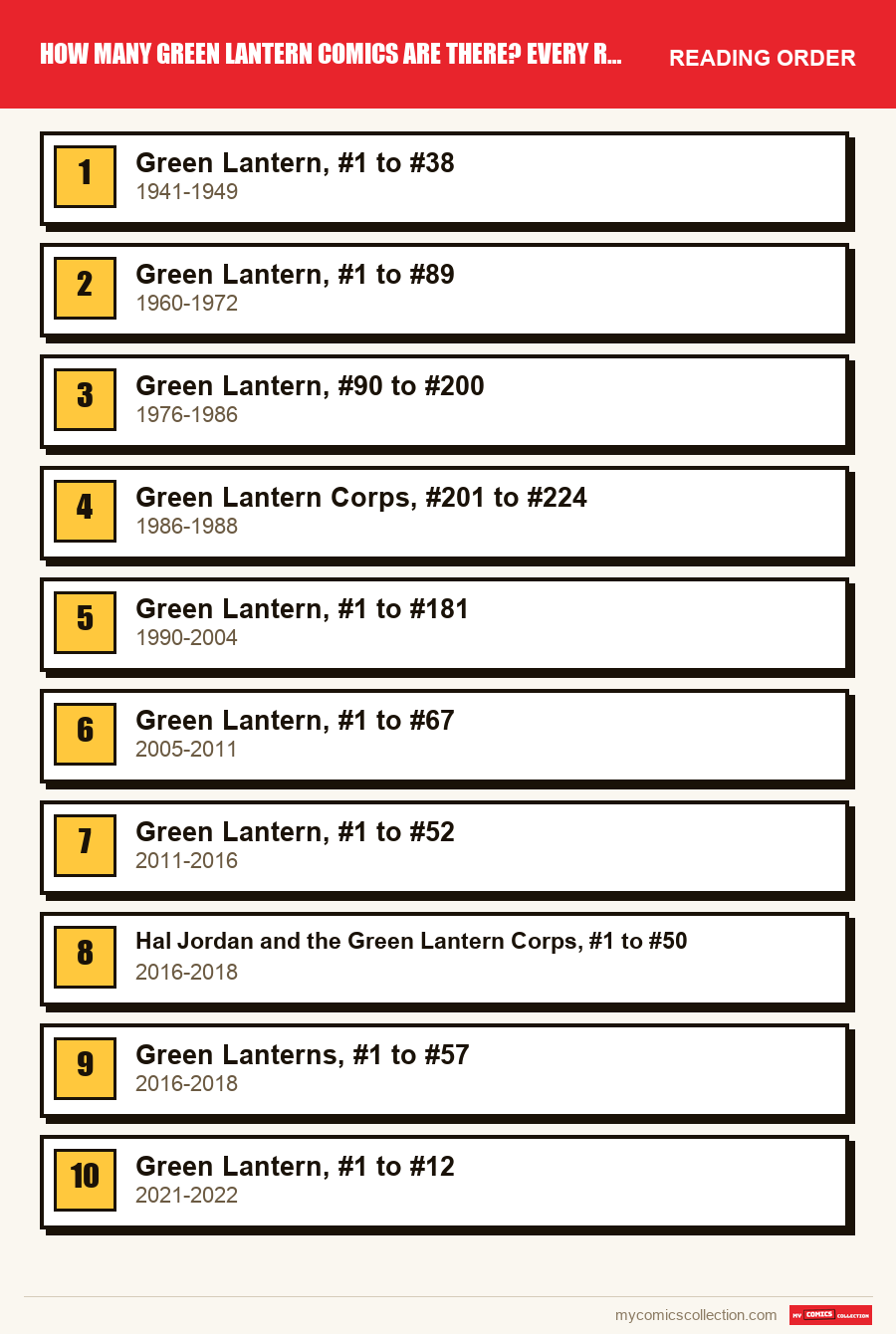
Series 1: Green Lantern, #1 to #38 (1941-1949)
For Alan Scott's debut in All-American Comics #16, which predates any series, see Green Lantern's first appearance. His own series starts in the fall of 1941 and stops in the summer of 1949, after thirty-eight issues. Bill Finger works alongside several other writers there, Alfred Bester among them, and Martin Nodell is joined on art by Irwin Hasen and Alex Toth.
This first series is a closed block: it will never be revived or renumbered. It belongs to the Golden Age and is filed apart from all the later ones, which makes it easy to bound and very hard to assemble in period single issues.
Series 2: Green Lantern, #1 to #89 (1960-1972)
Before this #1, Hal Jordan proved himself on a tryout basis in Showcase, starting with #22: those issues of another magazine come before the series and do not count within its limits, but a Hal Jordan collector shelves them at the top of the list.
Hal Jordan first appears in Showcase #22 in 1959, created by John Broome and Gil Kane. His own magazine begins in the summer of 1960 with a #1: the counter starts from zero, with no link to Alan Scott's series. It runs to #89, dated April-May 1972.
From #76 in April 1970, Green Arrow joins the hero in the title, and the pairing of Dennis O'Neil and Neal Adams becomes the benchmark of the period. Our page on Green Lantern #76 details that turning point, and the Neal Adams hub gathers his other series. Issue #88 is an unplanned reprint issue: it counts in the sequence, but contains no new story.
Series 3: Green Lantern, #90 to #200 (1976-1986)
After a four-year interruption, the series resumes at #90 in August-September 1976 without restarting at #1. The team-up format is kept: Green Arrow leaves the title with #123 in December 1979. Marv Wolfman, Len Wein and Steve Englehart each write stretches of it, while Mike Grell, Joe Staton and Dave Gibbons are among the artists.
The double-sized #200 of May 1986 closes this period of the title. Between #89 and #90, the sequence of numbers is continuous; only the calendar has a gap of several years, which trips up more than one collector who reasons in dates rather than issue numbers.
Series 4: Green Lantern Corps, #201 to #224 (1986-1988)
The next issue, #201 of June 1986, appears under the title Green Lantern Corps and continues the numbering, with Steve Englehart writing and Joe Staton drawing. The series lasts until #224 in May 1988, twenty-four issues.
For the count, the 1960 series therefore totals two hundred and twenty-four numbered issues with no restart, spread across three successive titles. A seller who advertises "Green Lantern #210" is actually describing an issue of Green Lantern Corps, and that nuance is enough to create a duplicate in a poorly kept list.
Series 5: Green Lantern, #1 to #181 (1990-2004)
In June 1990, a new Green Lantern restarts at #1 and lasts until #181 in November 2004. Gerard Jones writes the first forty-seven issues; Ron Marz takes over from #48, where Kyle Rayner appears, and the rest of the run sees Judd Winick (#129 to #164) and then Ben Raab (#165 to #175).
To these one hundred and eighty-one regular issues are added a #0 and a #1,000,000, which bring the total of numbered single issues to one hundred and eighty-three, as well as nine annuals. The #0 and the #1,000,000 are filed outside the arithmetic sequence, on a separate tracking line.
Series 6: Green Lantern, #1 to #67 (2005-2011)
A preliminary miniseries, Green Lantern: Rebirth, entrusted to Geoff Johns and Ethan Van Sciver, puts Hal Jordan back at the center; the monthly starts in July 2005 and reaches sixty-seven issues. Geoff Johns writes this series, with Carlos Pacheco, Ethan Van Sciver, Ivan Reis and Doug Mahnke among the artists.
The Geoff Johns hub gathers this run and the ones that follow. For a collection, sixty-seven issues make a volume of reasonable length, to be bounded in one go.
Series 7: Green Lantern, #1 to #52 (2011-2016)
In the fall of 2011, DC relaunches its entire line and Green Lantern starts over at #1 once again. Geoff Johns launches the series, then Robert Venditti takes over; Doug Mahnke and Billy Tan are on art. It ends at #52 in May 2016.
The count requires precision here: a #0 is slotted into the series, and four decimal issues, from #23.1 to #23.4, are slotted in around #23. Counting everything, the series totals fifty-seven numbered single issues, to which four annuals are added.
Do you collect this series?
Track what you own, what you are missing and what your collection is worth. 7-day trial.
Start my trial →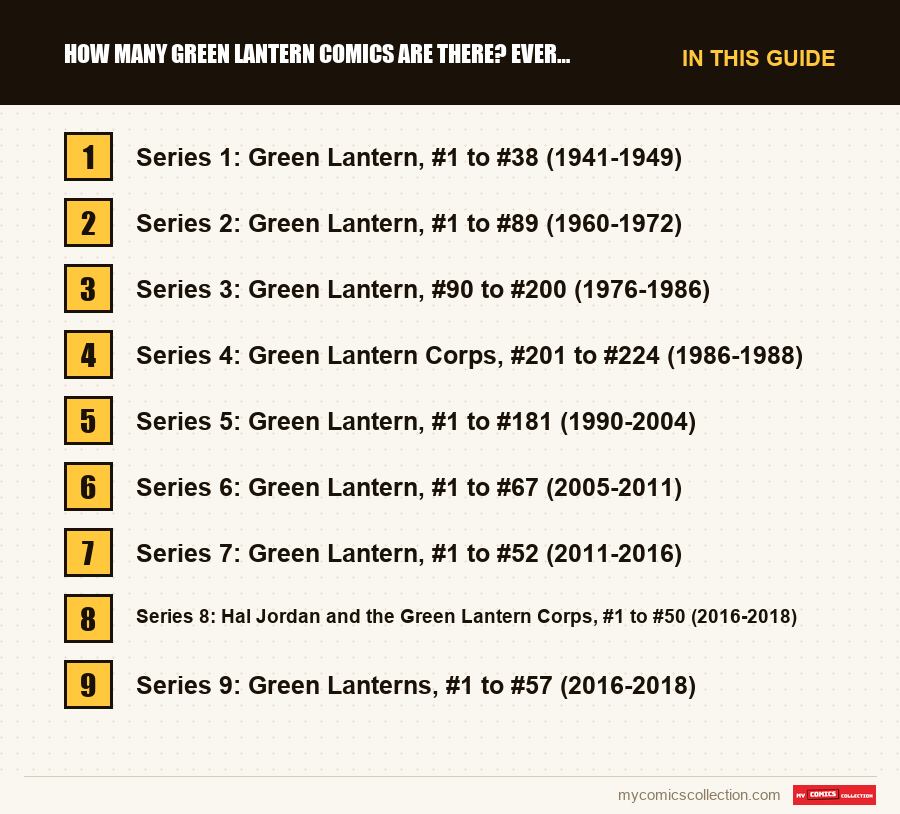
Series 8: Hal Jordan and the Green Lantern Corps, #1 to #50 (2016-2018)
Launched in the summer of 2016, this series entrusted to Robert Venditti with Rafa Sandoval on art runs fifty issues, preceded by a one-shot from the Rebirth line. It ends in 2018.
The title is long, and that is a search trap: a list that only notes "Green Lantern" misses it. Write down the full title so it does not get lost in a want list.
Series 9: Green Lanterns, #1 to #57 (2016-2018)
At the same time comes Green Lanterns, with an "s": fifty-seven issues and a Rebirth one-shot, from the summer of 2016 to 2018, with Robson Rocha on art. Sam Humphries writes the first thirty-two issues, Tim Seeley the next fifteen, Aaron Gillespie two, and then Dan Jurgens closes the series from #50 to #57. It follows Jessica Cruz and Simon Baz.
The one-letter difference from Green Lantern is enough to muddle listings. Soon after, Grant Morrison writes The Green Lantern with Liam Sharp: a first season of twelve issues and an annual, a three-issue miniseries titled Blackstars, then a second season of twelve issues that ends in April 2021. The Grant Morrison hub gathers his work.
Series 10: Green Lantern, #1 to #12 (2021-2022)
From April 2021 to April 2022, a twelve-issue Green Lantern, plus an annual, is written by Geoffrey Thorne and drawn by Dexter Soy. It is a short volume, the easiest to bound of the recent period.
Since May 2023, a new series of the same title has been written by Jeremy Adams with Xermánico on art. It has no end date to report here yet, which is why this guide's list stops without concluding: the end date remains to be added as soon as the publisher announces it.
The 1960 series numbering: three titles, one counter
Hal Jordan's series has no legacy numbering in the modern sense, but it works like one: from #1 to #224, the number never restarts, despite the interruption from 1972 to 1976 and the title change in 1986. The 1990, 2005 and 2011 series each restart at #1, and none picks up this counter.
Adding up the run limits gives thirty-eight issues for the first series, two hundred and twenty-four for the 1960 series, one hundred and eighty-one for the 1990 one, sixty-seven for the 2005 one and fifty-two for the 2011 one, for a total of five hundred and sixty-two single issues of the main title. The #0s, #1,000,000, #23.1 to #23.4 and annuals come on top of that, depending on what you decide to count. The total therefore changes from one collector to the next.
Annuals and spinoff series
The 1960 series had three annuals and two specials; the 1990 series nine annuals; the 2011 series four. Our selection of Green Lantern annuals and specials helps you choose which ones deserve a place on your list.
Four spin-off runs come up again and again on collectors' lists. Green Lantern: Emerald Dawn (six issues, 1989-1990) and then Emerald Dawn II (six issues, 1991) retell Hal Jordan's beginnings just before the 1990 relaunch. Green Lantern: Mosaic (#1 to #18, 1992-1993) gives John Stewart a title of his own. Guy Gardner, launched in 1992, becomes Guy Gardner: Warrior along the way and ends in 1996. Finally, Green Lantern Corps (#1 to #63, 2006-2011) runs alongside the 2005 series and carries a large share of Sinestro Corps War and Blackest Night.
Around these series also orbit titles devoted to the Corps, origin miniseries and parallel series that follow other Lanterns. We do not claim to be exhaustive: these groups are numerous enough to deserve a separate list, and the main line above is enough to build a first coherent collection.
Completing a run: where to start
Begin by choosing which Green Lantern you collect: Alan Scott in the 1941 series, or Hal Jordan from 1960 on. In the first case the limit is clear (thirty-eight single issues); in the second it depends on the period that draws you. Do not mix the two on one list: their numbers look alike and their dates do not overlap. A page on the first Green Lantern series develops what each slice contains.
Next, enter each series with its limits, as in this guide, then mark what you own. For series with decimals or a #0, note those issues on a separate line; do the same for annuals, whose limits are independent of the monthly magazine's. A run advertised as complete without mention of those lines rarely is in the strict sense. Before buying, match the printed title, the cover date and the number, especially for the 1986 to 1988 slice, which carries the name Green Lantern Corps. Finally, value a copy from completed sales rather than active listings.
Frequently asked questions
There is no official total. The main series add up to 562 numbered single issues between 1941 and 2016 (38, 224, 181, 67 and 52), to which are added the #0s, the decimals, the annuals and several recent relaunches. That figure moves depending on where you draw the line.
No. Alan Scott has his series from 1941 to 1949, with thirty-eight issues, and Hal Jordan gets another in 1960 with a new #1. The two share no counter and are filed separately in a collection.
Because the 1960 title kept its counter while changing its name. After #200 in May 1986, the series becomes Green Lantern Corps at #201 and continues to #224 in May 1988. It is the same numbered thread under a different title.
Not for the recent relaunches: the 1990, 2005 and 2011 series each restart at #1 and do not pick up the old counter. The only long continuity is the 1960 one, from #1 to #224, despite the 1972 to 1976 interruption.
That depends on your goal. A run is complete when its regular issues are gathered; the #0, the #1,000,000 and #23.1 to #23.4 are noted separately. They do exist, but missing them leaves no hole in the sequence.
Once you have identified your Green Lantern series, get a value for the copy you own or are being offered.
Value my comic