In the €100 to €250 bracket of the French market, the statement of August 30, 2026 shows 7,543 advertisements, two hundred of which were examined one by one: lowest amount €100.00, median amount €149.00, highest amount €250.00. All of these amounts are what sellers are asking that day, not what a buyer actually paid. The highlight of the level is contained in one line: at the top of the section, an old French periodical sold complete with its poster claims exactly the same amount as an American issue from 1962 and as a verified and graded American copy. Three objects without the slightest connection, a single number.
Previous levels in this series of budget guides described an abundant market, where the difficulty was less in finding a copy than in choosing between dozens of comparable listings. Here, the decor changes. The number of ads increases from 21,065 in the €50-100 bracket to 7,543 between €100 and €250, a division by almost three from one notch to the other. This rarefaction is not a statistical detail: it transforms the way in which a buyer can work. With twenty advertisements in front of us for the same object, we spot the aberration; with two, we no longer have any reference at all, and the amount displayed by the seller becomes, by default, the only reference available.
The second fact of the survey is even more surprising, and it is this which gives its title to this guide. We expect, in a three-digit bracket, to see old American issues dominate, those whose reputation crosses borders. The top of the bracket is equally occupied by a French publication. A copy of Strange No. 5, published by Lug, described as large format in color, printed in a limited and numbered series, with its poster still attached, fetches €250.00: the ceiling of the installment. On the same day, for the same amount, a number 3 of The Incredible Hulk dated September 1962 and a verified and rated 5.0 copy of Amazing Spider-Man number 39 from August 1966. The local market values what it itself has circulated, not just what comes from elsewhere.
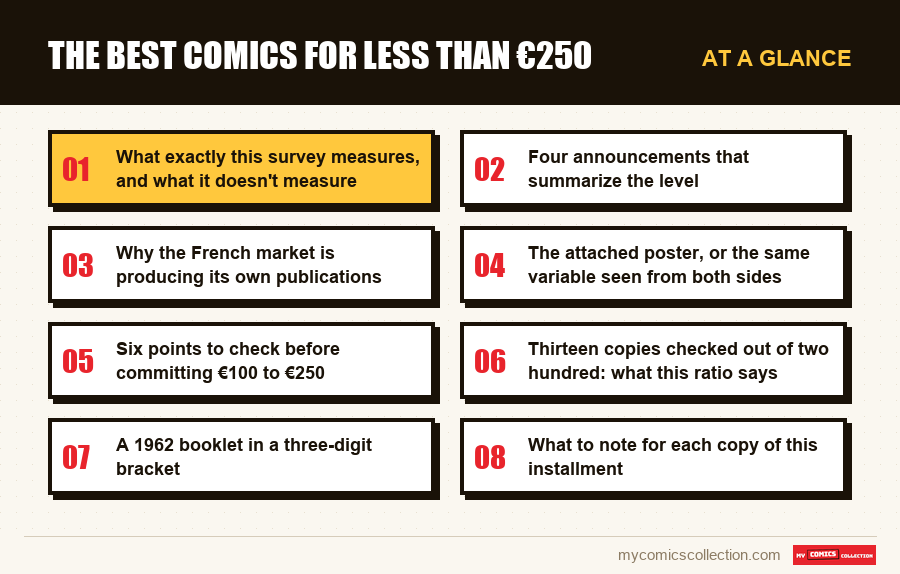
What exactly this survey measures, and what it doesn't measure
Before any reading, it is necessary to establish the nature of the data, otherwise it will make it say what it does not contain. The figures presented here come from a consultation of a general auction site carried out on August 30, 2026, on the French market, with amounts expressed in euros. The request related to the word “comics”, restricted to the €100 to €250 range. The site announced 7,543 results; two hundred were opened and noted. These are therefore prices asked by sellers at a specific time. None of them attest that a transaction took place, much less at this amount. A seller can display a price for months without finding a buyer: the ad remains visible, it continues to feed the statistics, and it proves nothing other than the intention of its author.
We must also refuse a natural temptation: that of comparing this reading to old observations to deduce a movement. A measurement taken only once, on a single date, does not describe any trajectory. It does not say whether the level is rising, falling or stagnating, and any sentence like “prices have increased” would here be a pure invention. What this statement describes is the form of an offer at a given moment: how many announcements, at what levels, with what characteristics. That's already a lot, provided you don't ask for more.
One last precaution concerns the maximum. In a set of two hundred observations, the highest value is by construction the highest ambition of the group. It designates the hope of a seller, not an observed level. The fact that three objects here reach the ceiling of €250.00 makes the finding more interesting than if it were an isolated case, but does not transform it into a rating. The median, at €149.00, is a much more solid benchmark: it indicates that half of the ads examined are below this amount, which refocuses the level on an area quite far from the ceiling that everyone is talking about.
Four announcements that summarize the level
Amazing Spider-Man n° 36, version américaine: 100,00 €
At the exact floor of the tranche, an American issue of a very well-known title. The announcement specifies that this is the original version and not a cover. It is a reminder that €100 does not only buy obscure objects: the notoriety of personnage is not enough to propel any number to the top of the bracket, the number counts as much as the title.
Batman Adventures n° 28 from 1995, verified copy rated 9.8-€100.00
A copy passed by a verification body, sealed and noted at the top of the scale, claims the floor amount of the tranche. A booklet from the 1990s in near perfect and certified condition weighs the same price here as an American booklet from the 1960s that is not certified. The note is not mechanically converted into an amount: it acts on a given security, at a given time. See the universe of Batman depicted at both ends of the landing is in itself revealing.
The Killing Joke, 1988 edition with red logo, described as new: €100.00
A complete signed story Alan Moore, in a 1988 edition that the seller distinguishes by the color of its logo. Two pieces of information are stacked here: the year of edition and a cover detail which serves to identify one edition among others. The asking price reaches the floor of the tranche, and the announcement is based on a condition claimed to be like new, without external verification.
Strange n°5 published by Lug, poster attached: €250.00
The ceiling of the section, occupied by a French periodical. The seller highlights the large format, the color, the limited and numbered nature of the print, and especially the poster still attached. It is this last point that carries the message: what sets the copy apart is not the story it contains, it is a physical element that most readers detached decades ago.
Placed side by side, these four announcements tell the same thing in four forms: in this level, the amount requested is not deduced from the title, nor the age, nor the country, nor the certification taken in isolation. A well-known American booklet and a certified copy at the highest level share the floor; a French periodical and an American issue from 1962 share the ceiling. Each ad tells a particular story that the number alone overwhelms.
A verified copy rated 5.0 of an American issue from 1966 fetches €250.00. A French periodical complete with its poster costs €250.00. An American booklet from 1962 asks for €250.00. Three objects which have neither the country of publication, nor the period, nor the format, nor the method of evaluation in common.
Conclusion to remember before any purchase in this bracket: the amount alone describes nothing. He doesn't say what he pays for access. It is by opening the ad, reading what the seller highlights and identifying what he does not say, that the price becomes interpretable again.
Why the French market is producing its own publications
The observation deserves attention, because it clashes with a widespread intuition according to which the original American edition would always dominate the local edition. On a general French auction site, this is not what we observe in this tranche. One explanation lies in circulation: periodicals published in France were purchased in France, read in France, then thrown away, loaned, cut up in France. The supply available today therefore comes from local attics, and the demand comes from buyers who have known these objects. A market readily values what it itself has circulated, because the collective memory is denser and because the comparison is easier for the buyer.
The other explanation relates to the nature of the object. A French periodical from this period is not a simple translation: it is a particular assembly, with its format, its pagination, its own cover, and sometimes supplements such as a central poster. These supplements have a formidable property for rarity: they are detachable, therefore destined to disappear. A poster attached to its support forty or fifty years after publication is, mechanically, a survivor. The corresponding American fascicle does not have this object in play; it is judged on the cover, the spine, the staples and the pagination. Two markets, two reading grids, and therefore two ways of arriving at the same amount.
We must be careful not to generalize beyond the statement. There is nothing here to suggest that the French edition would be more expensive overall than the American one, nor vice versa. What we observe is narrower and more solid: in this precise section, on this precise date, on this precise site, the ceiling is shared, and a French publication appears at the same level as old American fascicles. This is enough to change the way we look, without being enough to build a theory of the market.
This observation has a practical corollary. A French buyer who limits his searches to American titles misses a significant part of the top of the range, and deprives himself of the only category of objects on which he has an information advantage: he knows what a complete issue looked like, what it contained, and what is missing when something is missing. This advantage disappears as soon as it is an imported booklet, where verification goes through more distant sources.
The attached poster, or the same variable seen from both sides
A detail connects this level to the lowest sections of this series of guides. In the entrance landings, a salesman honestly reported the absence from the poster of his copy. Here, a seller highlights his presence. It is the same variable, stated in both directions, at two very different price levels. This parallelism is instructive: it shows that a unique physical characteristic can serve as an excuse at the low end and as a main argument at the high end, without either seller being wrong.
For the buyer, the lesson is direct. On publications with a detachable supplement, the state of completeness is not a bonus: it is a component of the identity of the object. A copy without its poster and a copy with its poster are not the same good, even if they bear the same title and the same number. Confusing the two is comparing amounts that do not relate to the same thing: the exact error that makes the averages say anything.
The lesson goes beyond the poster. Cut advertising insert, completed reply coupon, torn mail page, replaced staples: any removable part of an old periodical is a checkpoint. The salesperson who mentions it, one way or the other, gives you actionable information. The salesperson who doesn't talk about it isn't telling you that everything is fine; he tells you he doesn't talk about it, which is different and worth a question before the auction.
Six points to check before committing €100 to €250
Is the supplement present?
For any publication likely to have contained a poster or central insert, the question must be asked explicitly, including when the ad does not mention it. A written response from the seller is better than an inference from a cover photograph.
What year of publication, and not what year of story?
An announcement may cite a date linked to the published story, the first publication of the title or this print run. Only the last describes the object placed on the table. A story from 1988 reissued later remains a story from 1988, but the object has the date of its own printing.
Does the cited cover detail really identify a print?
The color of a logo, a printed price notice, a banner: these marks are used to distinguish prints from each other. They only have identification value if we know what they are against, otherwise they only decorate the ad.
How much is shipping included?
On a three-digit level, a few euros of transport weigh little in percentage terms but change the ranking between two close announcements. An old and fragile object also justifies reinforced packaging, the cost of which must appear before the commitment, not after.
Is the number announced that of the title or that of a local series?
The same number can designate two completely different objects depending on the country of publication. Without the exact title, publisher and country, a number alone does not identify anyone. This is the most frequent source of error in publications that exist on both sides of the Atlantic.
Is the described state claimed or verified?
“New” written by a seller and a rating assigned by an external organization do not have the same status. The first is an assessment, the second an opposable evaluation. Neither is disqualifying, but confusing them distorts any price comparison.
Collecting this series?
Track what you own, what you are missing and what your collection is worth. 7 day trial.
Start my trial →Thirteen copies checked out of two hundred: what this ratio says
Of the two hundred advertisements examined, thirteen concern a copy passed by a verification body, that is to say evaluated, noted and sealed by a third party. This figure calls for two complementary readings. On the one hand, the verification ceases to be anecdotal at this price level: it appears regularly, which was not the case on the entry levels of this series. On the other hand, it remains a very small minority, around one-twentieth of the announcements. In other words, in this bracket, having your copy verified is still a seller's choice, not a market standard.
This intermediate status has a direct consequence on the comparison. When certification is rare, certified and non-certified ads coexist at the same price levels, and the buyer must decide between two pieces of information of a different nature: a numerical rating on one side, a subjective description on the other. The survey gives the clearest possible illustration. A verified copy rated at the highest of the scale costs €100.00; a copy checked and graded at mid-scale costs €250.00. The note, taken alone, therefore does not classify anything at all: it only takes on meaning in relation to a specific title, number and time.
A statistical reservation must be added. Thirteen observations are not many. This number is sufficient to note that verification is present and in the minority, but not to establish a price level specific to certified copies, nor to seriously compare one note to another. Drawing from such a small group a rule like “this level of note is worth this amount” would amount to transforming noise into a method. On this point, the survey imposes caution rather than suggests it.
Finally, verification has a cost, and this cost is independent of the price of the object. On the scale of a three-digit copy, it represents a significant fraction. This partly explains why the practice progresses as the amounts rise, and why it remains marginal below: no one certifies an object whose certification would cost more than the price difference it provides.
A 1962 booklet in a three-digit bracket
The third item at €250.00 in the survey is an issue 3 of The Incredible Hulk dated September 1962, with no mention of verification. It deserves to be looked at for its own sake, because it illustrates a common and poorly understood case: that of a very old booklet, from a historically important title, whose condition is briefly described and whose asking price remains within an accessible range.
Two hypotheses are compatible with what the announcement shows, and the statement does not allow us to decide between them. Or the copy shows marked wear, which would explain why an issue of this age remains in this section. Or the seller has positioned his price without an external reference. What is certain is that age alone does not guarantee anything: it describes the date of a print, not the condition of the surviving object. Those who wish to place this title in its publication context will find the detailed story in the file dedicated to the history of the character in comics, and all the apparitions referenced on the hub dedicated to him.
This case finally reminds us why examining the advert takes precedence over reading the amount. Two issues of the same title, the same number and the same year can occupy very distant price positions depending on their condition, and the difference between the two is not visible in a statistical table. It can be read in the photographs, in the seller's vocabulary, in what he measured and in what he said.
What to note for each copy of this installment
The presence and condition of the supplement, for any French edition. Note explicitly whether the poster or central insert is present, whether it is still attached to its support or detached, and whether it shows signs of folding, pins or adhesive tape. A complete copy and a copy without its supplement are not comparable, and this information disappears permanently if it is not recorded at the time of purchase.
The note and the organization that issued it, for any verified copy. An isolated rating means nothing as long as we don't know who assigned it and on what scale. Record the exact note, the entity that issued it, and the identification number on the box. Without these three elements, a sealed copy becomes, in your archives, a hand-described copy.
The year of publication, kept separately from the year of the story. Open two separate fields. The first bears the date of the print you hold, the one that describes the physical object. The second bears the date of first publication of the story, useful for editorial context. Confusing them makes any subsequent comparison between an original print and a reissue of the same content impossible.
The country of publication, systematically, including when it seems obvious. A number alone does not identify an object when the same title exists in several countries with their own numbering. Note the publisher, country and language of the text. This is the only way to avoid a French periodical and an American issue ending up classified under the same entry because they share a number.
The price paid, including shipping, and the date of the transaction. Record the amount actually paid, including shipping and fees, and the date you paid it. It is this data, and not the price displayed before negotiation, which will allow you later to know what your collection cost you and to compare your own purchases with each other rather than with advertisements never concluded.
No. This is the number of results displayed by a French general auction site on August 30, 2026 for the €100 to €250 range. Each line corresponds to an item offered for sale, with a price decided by its seller. There is no indication that a buyer accepted this price, nor that a transaction took place. An ad can remain online for a long time without finding a buyer and still appear in this total.
Because the median divides the sample into two equal halves: half of the two hundred ads examined are below €149.00. The maximum only describes one point in the sample, that of the most ambitious salesperson in the group. It indicates an intention, not an observed level. Setting yourself on the ceiling means taking the highest hope on the market as your reference.
Because a note can only be compared with the same title and number. The two announcements concern different objects, published decades apart. The note describes the condition of an item within its own reference; it does not prioritize references between them. A booklet from the 1990s in near perfect condition and a booklet from the 1960s in average condition are not placed on the same scale of desirability by the market.
Yes, and it is even the most concrete change. Going from 21,065 listings in the €50-100 bracket to 7,543 here means that a given item appears much less often. Comparison between sellers, which constitutes the buyer's main protection, becomes difficult if not impossible. In practice, this requires extending the observation time before purchasing and considering each isolated ad with more circumspection, for lack of a point of comparison.
Absolutely not. An observation made on a single date does not contain any information on an evolution. To talk about movement, we would need at least two comparable surveys separated in time, constructed with the same query and the same sampling mode. As is, this document describes the shape of the offer on August 30, 2026, nothing more, and any assertions about a trend would be added by the reader, not provided by the data.
Keep track of what you buy, not just what you see passing by
Poster attached or not, note and organization, year of publication distinct from the year of the story, country of publication, price paid including shipping: these five pieces of information decide the value of your archives in ten years. My Comics Collection allows you to consign them copy by copy, instantly find what you already own and avoid buying the same issue twice in two different editions.
The full scale of budgets
- Palier précédent : less than 100 €
- Palier suivant : less than €500
- Less than €5
- Moins de 10 €
- Less than €20
- Less than €50