Between twenty and fifty euros, the French offer becomes wide enough for us to stop being left to chance. On August 30, 2026, a statement of the €20-50 bracket on Marvel comics showed 13,560 ads, and of two hundred of them examined one by one, the lowest amount requested was €20.00, the median amount was €25.95 and the highest was €50.00. Please note: these are prices claimed by sellers on a given date, not completed transactions, and no conclusion on an increase or decrease follows. In these two hundred advertisements, not a single copy verified by an independent organization. The real gain from this level is therefore not the guaranteed quality: it is the freedom to aim for a number decided in advance.
The previous levels of this series of guides revolved around the same constraint: the budget dictated the find. We took the lot of French periodicals that presented themselves, we picked up any American issue because it fit in the envelope, and the result looked more like a deposit than a collection. Under twenty euros, the buyer doesn't really choose: he validates or he passes. The difference between two ads comes down to shipping details more than content.
Above twenty euros, the relationship reverses. The statement from August 30, 2026 shows a €20-50 bracket announced at 13,560 bids for a single “Marvel comics” query on a French general auction site. Thirteen thousand listings means that a buyer can arrive with a specific number in mind and hope to find it, instead of arriving with an amount and leaving with what was left. This is the first level where the question “what do I want?” » makes economic sense. This guide describes what this switch actually changes, and what it does not change.
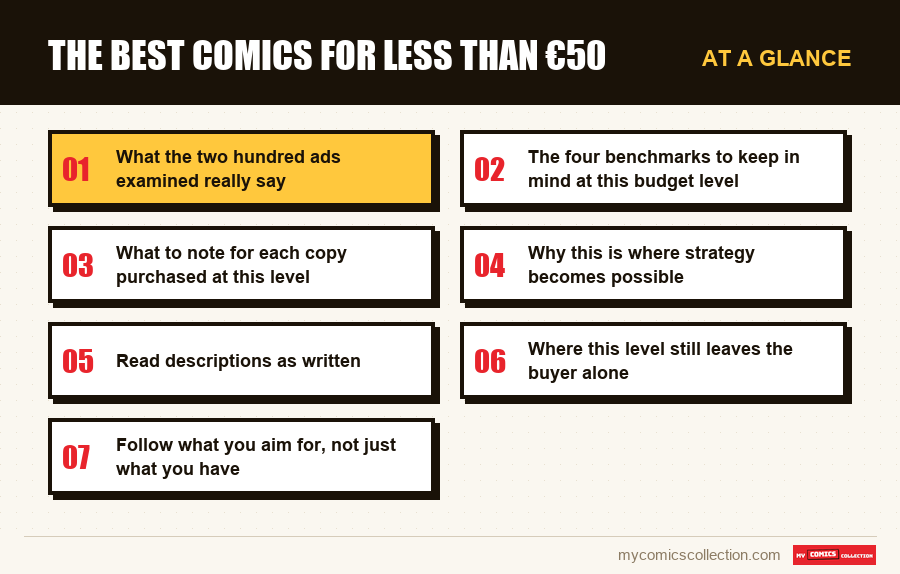
What the two hundred ads examined really say
A global number is worthless until you open it. Two hundred advertisements in the tranche were therefore looked at one by one, and the distribution that emerged was remarkably compact: minimum €20.00, median €25.95, maximum €50.00. In other words, half of the offers examined are barely above the floor of the tranche. The bearing does not spread, it accumulates against its lower edge. The seller who asks for fifty euros is the exception, not the norm, and an isolated maximum reflects the hope of the person who wrote the ad, never a price that anyone would have agreed to pay.
It is necessary to repeat the nature of these amounts, because everything else depends on it: these are requests posted on a given day, August 30, 2026, on a French general auction site, in euros. None of these lines prove that a buyer has come forward. A measurement taken on a single date describes neither progression, nor a decline, nor a trend: it describes a state of supply, over the space of an afternoon. Anyone who claims to infer from this reading that comics are "rising" or "falling" would be adding a story to the data instead of reading it.
The detail of the announcements noted is more telling than the statistics. Five issues of Amazing Spider-Man from the 1970s-1980s (a #176 dated 1978, a #187, a #193, a #217 and a #242) are all listed at €20.00, exactly at the floor. These five lines tell the same thing: the current American booklet of that time, on the French market, costs twenty euros, regardless of the number. The seller does not segment, he applies a shelf price.
The top of the range belongs to something else. For fifty euros you can find a French periodical from December 1970 bringing together several series in the same volume, an unusual American format measuring 34 cm by 25 cm, and a contemporary French bound edition from the deluxe range. Three objects that are neither the same age, nor the same country, nor the same format, but none is an ordinary American issue. The top of the level is occupied by what comes out of the row.
The four benchmarks to keep in mind at this budget level
Only one ad in eight carries a numerical note
Among the ads noted, only one displays a condition expressed by a number: a 6.0 qualified as “Fine” on an Amazing Spider-Man #176. All others describe the object in words, or not at all. This rating, moreover, was assigned by the seller himself: it is an assessment, formulated by the person who has an interest in formulating it. Nothing dishonest about it, but nothing measured either.
An announced signature is not an established signature
A copy of the statement, Amazing Spider-Man #242, is presented as signed by its artist. No mention of independent verification accompanies this claim. It therefore only binds the person who writes it. The interesting point is elsewhere: this copy is priced at €20.00, like the others. The claimed signature does not result in any extra in this statement: the market, here, does not charge for it.
The old French edition costs more than the American
The French periodical from 1970 asked for fifty euros while the American issues from the following decade asked for twenty. On the French market, the old local publication, printed and then preserved locally, trades above its original equivalent. The geography of the seller has more influence on the displayed price than the editorial origin of the content.
No verified copy out of two hundred
Of the two hundred advertisements examined, zero copies certified by an independent verification body. The count is clear: certification does not go down to this level. This is not an accident of the survey, it is a consequence of cost: having a copy verified requires a sum of the same order as the copy itself.
These four observations converge towards a simple conclusion: at this level, the buyer trusts what he sees and what the seller affirms, without an external net. This is not dramatic, the amount involved remains modest, but it requires treating each description as a point of view rather than as a statement.
The useful rule at this level can be summed up in one sentence: systematically distinguish what is constaté of what is declared. A clear photograph is a statement. A status note written by the seller, an announced signature, a mention of rarity are declarations.
This distinction costs nothing to apply and will save you from paying extra for an affirmation. In the statement of August 30, 2026, precisely, no supplement was requested for the signed copy: proof that the market itself, at this level, does not attach monetary value to an unverified declaration.
What to note for each copy purchased at this level
The status note, and who wrote it
If the ad carries a number like the 6.0 “Fine” noted on Amazing Spider-Man #176, note it, but at the same time note its provenance: seller. A note without an author becomes, six months later, a note that you will believe to be official. By recording “6.0, declared by the seller”, you keep the information and its level of reliability in one place.
The mention of signature and its absence of proof
For a signed signed copy, such as #242 of the statement, enter « signature annoncée, non vérifiée ». This formula protects you from two opposing errors: forgetting the existence of the signature, or lending it an authenticity that no one has established. If a certificate arrives later, the row updates; in the meantime, she tells the truth.
The format when it's out of the ordinary
The survey contains an American volume measuring 34 cm by 25 cm. This kind of dimension changes everything: storage, protection, transport, shelf space. Note the measurements upon purchase. An out-of-size copy that is discovered upon receipt causes handling damage that a slip line would have avoided.
Publisher and country of publication
A French periodical from 1970 and an American booklet from 1978 do not belong to the same market, even when the characters look similar. Distinguish the two in your file: original edition or local edition, publisher, country. It is this column which will explain, later, why two seemingly similar objects are priced at twenty euros and fifty euros.
The price paid, shipping included
On a slice whose median recorded is €25.95, a few euros of shipping represent a considerable part of the total. A copy purchased for twenty euros and delivered for eight cost you twenty-eight. Record the full amount, not the label amount: this is the only number that will accurately describe your collection.
The date of the statement that guided your decision
The benchmarks in this article are valid for August 30, 2026 and for that day only. If you use them to arbitrate a purchase, note this date next to the price paid. You will know later which market photograph you relied on, instead of comparing a price today to a print without origin.
Collecting this series?
Track what you own, what you are missing and what your collection is worth. 7 day trial.
Start my trial →Why this is where strategy becomes possible
Under this level, the collection is built by accumulation: we add what presents itself, and coherence, if it arrives, arrives by accident. From twenty euros and up to fifty, two resources appear at the same time: the volume of supply and the budget margin. Thirteen thousand ads on a single query means that a given number has a reasonable chance of being available somewhere. A median of €25.95 means that you can buy several without using up an ordinary monthly envelope.
The practical consequence is a change of method. We first make a list (the numbers that count for the arc we want to own, the period we want to cover, the author we want to follow) and then we search. The order is reversed: the list precedes the announcement, instead of the announcement making the list. It is this reversal, and not the amount itself, that defines this level.
The tension at this level is due to a now real arbitration. With the same amount, you can buy two current American issues at the bottom of the range, or a single item at the top of the range: an old French periodical, a recent bound volume, an unusual format. Both options are valid, but they do not build the same collection. The first fills a series; the second adds a singular piece which does not fit into any suite.
One point deserves to be said bluntly, because it tempers enthusiasm: moving to this level does not improve the reliability of the information. No verified copy out of two hundred, a single encrypted note, a signature announced without proof: the documentary environment remains exactly that of the previous level. What increases is choice; what remains constant is uncertainty. Confusing the two leads to paying extra for a warranty that doesn't exist.
Read descriptions as written
The titles noted are crude, sometimes clumsy, often bilingual. The same title mixes the number, the indication “comics us vo”, the mention of an original series and sometimes a year. This style is not a lack of seriousness: it is the way in which a particular seller accumulates the keywords which he thinks the buyer will use. These announcements must therefore be read as lists of juxtaposed benchmarks, not as structured sheets.
Concretely, this means that the absence of information does not mean its absence in the object. A copy without a condition note is not necessarily damaged; a copy without an edition note is not necessarily a reprint. Conversely, the presence of information does not validate it. The imbalance is structural: what is written is of little engagement, what is you do not inform. The only part of the file that resists this ambiguity remains the photograph, when it is clear and shows the edges, the spine and the staples.
This careful reading applies with particular force to mentions of rarity or importance. A number is not notable because an ad says so; it is so because a catalog or reference guide establishes it, independently of the person selling. Building your list before opening the ads, once again, protects you from this influence: you know why you are looking for this number, and the seller's argument does not enter into the decision. The characters who cross these catalogs, from Spider-Man to Fantastic Four until Captain America, each have sequences documented elsewhere than in the title of an ad.
There remains a statistical caution. Some very fine categories at this level only have a few announcements: a particular format, a specific old edition. When a number falls below ten, it says nothing about a price level: three advertisements for fifty euros describe three sellers, not a market. On these pockets, the correct conclusion is not to conclude.
Where this level still leaves the buyer alone
The question of future value is off topic here. A single statement, no matter how broad, provides no directional information: it captures what sellers were asking for one day, without indicating whether those requests are successful or how they are evolving. Buying at this level is justified by the desire to own and read, not by a numerical projection that the data does not allow. To understand the mechanics that links the condition of an item to its price, the guide dedicated to rating and grades treats the subject properly; for low budget entry strategies, buy Spider-Man without breaking the bank covers the lower bearings. And to follow a designer rather than a series, this approach by creator which becomes playable as soon as you can aim, the page dedicated to John Romita Jr. gives a starting point.
The site announced 13,560 results for the query “Marvel comics” restricted to this segment, on August 30, 2026, on the French market. Two hundred of these advertisements were examined in detail: minimum €20.00, median €25.95, maximum €50.00. The overall figure comes from the site itself; only the two hundred were checked line by line.
Not in this statement. The copy presented as signed by its designer was priced at €20.00, the same amount as ordinary copies of the same series. No independent verification accompanied the ad, and the price difference was zero. At this level, a declared signature is not charged.
The statement shows a French periodical from December 1970 asking for fifty euros, while American issues from the end of the 1970s ask for twenty euros. On a French sales market, the old local publication circulates in a narrower circuit than the original imported booklet. The observation relates to the prices displayed that day, without the statement making it possible to explain the mechanics further.
None out of the two hundred ads examined. Certification by an independent body does not appear at this level, and the count is unambiguous. The buyer therefore relies on the photographs and the seller's description, which remains acceptable for amounts of this order provided that declaration and guarantee are not confused.
No, and that's important. All these values come from a single reading taken on August 30, 2026. A measurement taken on a single date describes a state, never a movement: it would take at least two spaced readings to speak of direction. These are also amounts claimed by sellers, not sales concluded.
Follow what you aim for, not just what you have
The fifty euro level rewards those who arrive with a list. My Comics Collection lets you build this list, check off the issues obtained, record the declared condition, format, publisher and price paid including shipping, and see at a glance what's missing before opening any ad.
The full scale of budgets
- Previous level: less than 20 €
- Next level: less than 100 €
- Less than €5
- Less than €10
- Less than €250
- Less than €500