The best comics for less than €5: what you really find at this budget
At less than five euros, the French market sells almost no American issues: it sells French periodicals, monthly magazines, pocket formats and bound albums. Our statement from August 30, 2026 on a general auction site, in euros, counts 27,619 ads between €1 and €5 for the query “Marvel comics”, with a median of €4.00 out of the two hundred ads that we examined one by one. Of these two hundred advertisements, no copy verified by an independent organization. These amounts are those that sellers claimed that day, not completed transactions: nothing here describes a completed sale, and even less a trend.
The five euro budget has a bad reputation. We associate it with the sales bin, with the wet cardboard bottom, with what remains when everything else is gone. This prejudice misses the most interesting fact about this level: it is the only one, in the entire price scale, where the supply available in France far exceeds what a collector will ever be able to absorb. Twenty-seven thousand ads in a four-euro wide bracket, that's not a stock fund, it's a deposit. And when the supply reaches this volume, the usual rules of collecting-hurry, arbitrate, accept a compromise on condition-become irrelevant.
This article opens a series of guides organized by budget. This is the first level, and it is special: it does not ask the question “what rarity can I afford” but “what does this sum actually buy, and how can I not waste my time sorting”. We do not recommend securities to buy because they would rise: a measurement taken on a single date says absolutely nothing about a price movement, and we refrain from deducing anything from it. We describe what's on sale, in what language, in what format, and the two or three variables that separate a good deal from a disappointment when you open the package.
A French statement, in euros, and what to think about it
Let's clarify the framework straight away, because it changes everything. Our usual statements relate to the American market and are expressed in dollars; this concerns the French market and the amounts are in euros. We queried a general auction site on August 30, 2026 with two distinct queries, systematically filtering between €1 and €5. The first, “Marvel comics”, returns 27,619 ads in this bracket according to the interface count; we opened and read two hundred. Minimum observed: €1.00. Median: €4.00. Maximum: €5.00, which is not surprising since this is the limit of the filter. The second query, “Strange Lug”, narrower, lists 517 ads; of the two hundred examined, the minimum falls to €1.99 and the median rises to €4.90. In both cases, the number of copies accompanied by independent certification is zero.
These numbers describe price requests posted on a Sunday in August. A seller who asks for €4.90 has not yet sold anything; he suggests. The difference is essential and we apply it throughout this article: we do not have any transaction data, so we will never say that a security is “worth” this amount, nor that it “trades” around this other. We say what is asked. In the same way, a single photograph of the market cannot show an evolution: to speak of an increase or a decrease, we would need at least two separate readings over time, comparable, and we only have one.
The maximum deserves a separate remark. In a filtered reading, it means nothing more than the upper limit of the filter; in a free reading, it would reflect the optimism of an isolated seller, not a market level. It is the median which carries the information: it indicates the middle of the distribution, the place where the mass of propositions is concentrated. Here, it places the bulk of the French offer at the top of the bracket, closer to five euros than one euro.
What the budget actually buys: French periodicals
The monthly magazine
« COMICS MARVEL, Revue mensuelle SPIDEY, N°97 - Février 1988 » is priced at €1.50. This is the dominant format at this level: a French periodical magazine, dated monthly, which reproduces in translation episodes previously published across the Atlantic. You don't buy a booklet, you buy a magazine issue.
The special issue
“MARVEL UNIVERSE HS n°5: Avengers Invaders: Panini Comics 2009 - VF” is priced at €2.00. The special issues constitute a numbering parallel to that of the main journal: a “HS n°5” is not the fifth issue of the series, and confusing the two is the most frequent classification error at this level.
The small format
“SMALL FORMAT COMICS MARVEL HEROES 15 panini marvel 2012” is asking €2.50. The pocket format is a French publishing tradition: reduced dimensions, thick pagination, economical paper. It doesn't match anything on the American market, and that's precisely why it's affordable.
The bound album
« Titans Binding Album n. 22 LUG Marvel Strange Vintage BE” is offered at €5.00, the upper limit of the filter. A binding album brings together several issues of the magazine under a publisher's cardboard cover. A single purchase then covers several publications, which completely changes the calculation of the cost per issue.
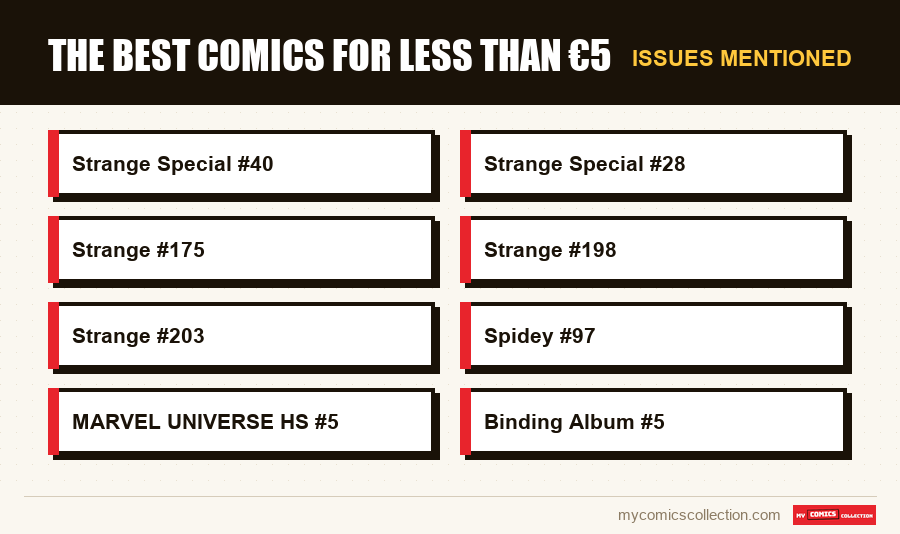
This observation is the central fact of the article, and it should reorient the way we search. At five euros, you can't find American booklets; we find the French edition which published them here. The advertisements noted confirm this without exception: “Spidey 95 EO Marvel Lug comics epoque Strange Fr used Good Condition” at €1.99, “STRANGE n°198 1986 (LUG MARVEL) PROOF: NO POSTER” at €2.00, “STRANGE n°203 1986 (LUG MARVEL) CORRECT CONDITION” at €2.00, “Marvel Special STRANGE n°40 - LUG 1985” at €2.20, “STRANGE N°175 LUG 1984 ABE” at €2.80, “Special Strange n° 28 LUG 1982 BE” at €5.00. All are French periodicals.
This has an immediate practical consequence on the way of searching. A request made with American titles will bring little in this price bracket, because that is not how French sellers describe their stock. Our two queries show this: “Marvel comics” casts a wide net and returns tens of thousands of ads, while “Strange Lug”, which uses the vocabulary of sellers, isolates 517 that are much more homogeneous, and whose median is higher, which is understandable: the query targets better, so it brings back less noise and fewer objects for one euro.
One last point on the composition of the statement: not everything that appears under these requests is a comic. We came across, in the same price bracket, a bag of figurines offered at €1.00. The price filter does not filter the nature of the item.
This detail is not anecdotal when we think in volume. If you look through several hundred ads on the channel, some of what you see is a derivative product, odd bundle or accessory. Reading the entire title before clicking saves more time than any search trick.
Certification does not exist at this level
Out of four hundred advertisements examined through the two requests, the number of copies accompanied by verification by an independent body is zero. Not “little”: zero. This result is not surprising, and it is worth explaining why rather than stating it flatly.
Having a copy verified costs money: the service itself, the postal round trip, transport insurance. This cost is independent of the value of the object, which makes it structurally incompatible with a five-euro level. No one spends several dozen euros to authenticate an object that they hope to resell for two euros. Certification is therefore a service which is aimed at other price levels, and its absence here is not a market defect: it is its normal economic logic.
Two consequences for the buyer. The first is liberating: at this budget, you do not have to ask yourself whether a verified copy would be preferable, the question does not arise, the option does not exist in the offer. The second is more demanding: the assessment of the condition is based entirely on what the seller writes and on the photographs he publishes. No third party gets involved. If you want to understand how condition and price relate when certification comes into play, our guide on the link between grade and price treats this mechanism; just remember that it does not apply to the radius described here.
Completeness matters more than state
Here's the variable that most buyers discover too late. Among the advertisements noted, one specifies “NO POST”. This mention refers to a manufacturing characteristic of these French magazines: they included a detachable central poster, inserted in the middle of the magazine. It was made to be taken down and hung on the wall, and very often it was.
A copy from which the poster has been detached is not a damaged copy, it is an incomplete copy: it is not the same object. The distinction is real: a crumpled cover remains a cover, while a missing insert is a missing part of the magazine. And on a periodical whose price is measured in euros, this difference in nature weighs more than three millimeters of bending at the corner.
We only have one announcement that explicitly mentions this point, which prohibits any statistics. We will therefore not say what proportion of sellers report this or what proportion of copies are affected: the sample does not allow this. What we can say, on the other hand, is an observation of principle: the silence of an announcement on the poster is not a guarantee of its presence. A seller who is not aware of this editorial feature does not think to check it, so does not mention it. Asking the question before buying costs a message and avoids unpleasant surprises.
This reasoning generalizes to everything that was inserted, stapled or slipped into a periodical publication. As soon as a magazine was designed with a detachable element, the complete copy and the amputated copy circulated side by side on the market, often at the same displayed price, without anything in the title of the ad distinguishing them. This is the most banal and costly information asymmetry at this level.
French state abbreviations are not a scale
Reread the titles noted: “BE”, “ABE”, “CORRECT CONDITION”, “Good Condition”, “BE” again. These are the condition statements used by French sellers, and you need to understand what they are, and what they are not.
These are not the levels of a common frame of reference. No institution defines them, no convention sets their thresholds, and nothing obliges one seller to use them in the same sense as another. Two advertisements marked “BE” can describe two very different copies, simply because the two people who wrote them do not have the same requirements, the same experience nor the same point of comparison. An occasional seller who clears out an attic and a specialized bookseller do not go hand in hand.
The practical consequence is simple: these abbreviations are used to roughly sort, not to decide. They tell you that the seller considers his copy to be good rather than bad, which excludes the worst; they tell you nothing about the corners, the edge, the cleanliness of the spine, the staple marks or the presence of the central insert. It is the photographs that carry the information, and the absence of usable photographs is in itself information.
This results in a method of reading ads: treat the status mention as a first-pass filter, then systematically drill down into the images and body text to check it. At five euros, the gap between what is announced and what happens is not financially dramatic, but if you buy thirty issues to complete a series, the accumulation of gaps ends up being seen on the shelves.
Collecting this series?
Track what you own, what you are missing and what your collection is worth. 7 day trial.
Start my trial →Twenty-seven thousand announcements: what abundance changes
Search with sellers' words
Our two requests do not bring back the same market. The vocabulary used by French sellers (name of the journal, name of the historical publisher) isolates a coherent stock where a generic formulation drowns the results in noise. Adjust the query before adjusting the price filter.
Rien ne presse jamais
With 27,619 announcements in a single four-euro bracket, scarcity does not exist at this level. The copy you pass up today has thousands of twins online. It costs nothing to walk away from a poorly photographed ad, and it's the most cost-effective decision by default.
Don't pay the status note
An ad title that is more flattering than another does not justify any additional charge, since the abbreviations do not refer to any shared reference. For such amounts, the price difference between two comparable copies almost always depends on the declared condition.
Shipping is the real cost
When the object costs two euros, the shipment weighs more than the object. This is the only line in the budget that deserves to be optimized, and it is done by grouping: several numbers from the same seller, in a single package, in a single order.
Notez la numérotation exacte
Main magazine, special issue, special, binding album: these French publications maintain several parallel numberings. A “n°40” of one has no relation to the “n°40” of the other, and a collection kept without this precision quickly becomes illegible.
Think cost per number
A hardcover album for €5.00 brings together several publications under the same cover. Compared to the unit purchase of each of these publications, shipping included, the arithmetic often tilts in favor of the collection: it is still necessary to check which issues it contains.
The rational strategy at this level follows directly from these six points, and it can be summed up in one sentence: buy in batches from the same seller rather than in isolated advertisements. This is not a trick, it is the mechanical consequence of a market where the object is abundant and cheap while transport is rare and expensive. A collector who buys ten issues from ten different sellers will pay for ten shipments; the same purchase concentrated on two or three sellers divides this line by three or four, for an identical basket.
This logic has an often overlooked corollary: it favors sellers who have deep inventory. An individual who liquidates five numbers offers no consolidation savings; a seller who lines up dozens of issues of the same magazine offers a lot. Spotting these stocks and then returning to them is better than combing through the entire search results every session. If you are hunting more specifically around a character, our article on buying Spider-Man at a low price addresses the issue from the perspective of the title rather than the budget.
Where does this level lead?
We must be frank about what this budget does not do. It does not build a heritage: we do not have any sales data, therefore no element allowing us to assert that these magazines gain or lose value, and we refuse to suggest this. A single reading shows no movement. What this level does, on the other hand, it does well: it provides access to the material printed in volume, in the language of the reader, at a cost which allows for error.
This is a difference in nature with the higher levels. At five euros, making a mistake has no consequences. You can buy a number to see, discover that you don't like the period, put it down without regret. This permission to make mistakes is exactly what is missing when the amounts go up, and that is why this level is the best place to learn how to read an ad, recognize a format, understand French numbering and develop an eye.
These French journals also cover a very broad editorial spectrum. The titles noted in our sample refer to universes that the site also documents: the pages Spider-Man, X-Men et Avengers bring together what has been published around each of them, and the hub dedicated to Stan Lee allows you to approach the catalog through the creators rather than through the characters. Navigating in this way, starting from an axis and not from a shopping list, better corresponds to the reality of a market where supply greatly exceeds demand.
Finally, if your objective is to encrypt a specific item rather than explore a section, change your method rather than insisting: our guide to estimating an identified number describes the approach adapted to this question, which has nothing to do with reading a price range.
What to note for each purchase at this level
The exact title of the French magazine.“Spidey”, “Strange”, “Strange Special”, “Marvel Universe”, “Marvel Heroes”: these are distinct publications, and not variants of the same magazine. Saving the title as it appears on the cover, without translating it or relating it to an American title, is the only way to keep a coherent collection. This is also what will allow you, later, to find the ad in which you purchased the copy.
The number, and to which numbering it belongs. The collection contains a “Strange Special #40” and a “Strange Special #28,” a “Strange #175,” a “Strange #198,” a “Strange #203,” a “Spidey #97,” a “Spidey 95,” a “MARVEL UNIVERSE HS #5” and a “Binding Album #5.” 22”. Each of these numbers is part of its own numbering series. So note the number AND the publication that bears it: a number alone, taken out of context, designates nothing.
The presence or absence of the central poster. This is the note to be recorded in full, because it is this which decides whether you have the complete object or an amputated version. Write down what the ad said, including “not specified”, and then what you saw when you opened it. Two copies of the same issue, one with its insert and the other without, do not occupy the same place in a collection.
The condition abbreviation used by the seller, and your own observation. Record the two separately: on one side the “BE”, “ABE” or “correct condition” as it appeared in the advertisement, on the other side what you saw in hand. The difference between the two columns, accumulated over several purchases, will tell you in a few weeks which of your sellers are quoting severely and which are quoting broadly. No common repository will give you this information for them.
The price actually paid, including shipping. On a two-euro item, shipping is not an accounting detail, it is often half or more of the expense. Recording the listed price without shipping gives a false picture of what your collection cost you. Note the total amount, and when a package includes several numbers, split the costs between them: this is the only way to measure whether your consolidation strategy is working.
Yes, and in very large numbers. Our statement from August 30, 2026 on a general auction site counts 27,619 advertisements between €1 and €5 for the query “Marvel comics”. The median of the two hundred ads we examined was €4.00. These are prices asked that day, not sales made.
Because this is what was broadcast in France and which is now circulating second-hand on the domestic market. All the advertisements that we noted at this level are French periodicals: monthly magazines, special editions, pocket formats and binding albums. Looking for American booklets in this price range is like looking for an object that isn't there.
These magazines had a detachable central poster. The note indicates that this insert has been removed and that it will therefore not be in the package. The copy is not damaged, it is incomplete: which is not the same thing. Note that the silence of an ad on this point does not guarantee the presence of the poster: it is better to ask the seller the question.
The question does not arise: of the four hundred advertisements examined through our two requests, none concerned a copy verified by an independent organization. The cost of an audit is irrelevant to the amounts involved here, which explains its complete absence from this market segment.
By grouping purchases from the same seller. On items costing a few euros, shipping represents a major part of the total expense, and it is the only item on which there is a real margin. Given the volume of advertisements available, there is no obligation to buy urgently: waiting to collect several numbers from the same seller does not run any risk of scarcity.
Keep track of what you buy
Title of the magazine, number, membership numbering, presence of the poster, declared condition versus observed condition, price paid including shipping: at this level, it is these five pieces of information that make the difference between a stack of magazines and a collection. My Comics Collection records them for each copy and shows you, series by series, what you are still missing.