Between 10 and 20 €, we definitely leave the reissue section to touch American booklets several decades old. The survey carried out on August 30, 2026 on a general auction site, on the French side, lists 19,071 advertisements in this section for the query “Marvel comics”. Of the two hundred advertisements examined one by one, the median amount requested was €15.00, and not a single copy verified by an external organization appeared. Please note: these are amounts claimed by sellers on a given date, not completed transactions. The point of vigilance specific to this level is not the price, it is the identity of the object: the same number can exist in the American edition and in the British edition, and two sellers out of nine take the trouble to specify it.
The first two installments of this budget guide series stayed in comfortable territory. For less than five euros, we bought French periodicals: flexible collections printed in France, widely distributed, whose interest was in the reading more than in the subject. The next level revealed the original version, but especially recent booklets, released in a context of abundant print runs and still easy conservation. The level that concerns us here changes its nature. It is no longer a question of format or language: it is the first threshold where issues printed fifty years ago actually find themselves within reach, mixed in the same list as issues three times younger.
This mixture is precisely what makes the slice interesting and tricky. A reader who sorts by ascending price sees objects parade side by side that have nothing in common: a booklet from the late sixties, a booklet from the nineties, a French magazine from the early eighties. The amount requested does not distinguish them. The buyer must therefore distinguish them himself, and that is the whole purpose of this guide: to give the few reflexes which separate a lucid purchase from a random purchase, based on what a dated statement really shows, and only that.
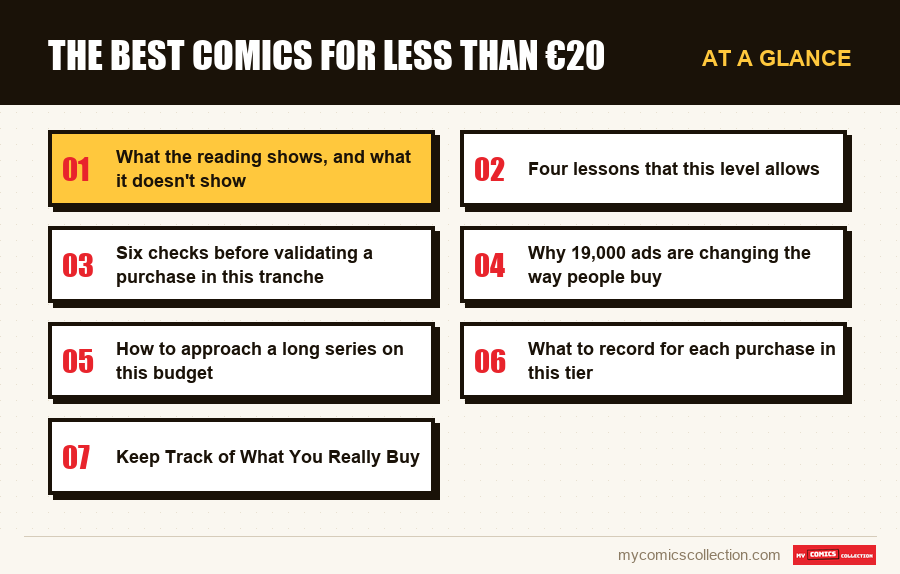
What the reading shows, and what it doesn't show
Let's take the measurement as it was taken, without dressing it. On August 30, 2026, a search for “Marvel comics” filtered between €10 and €20 on a French general marketplace displays 19,071 ads. Two hundred of them were opened and noted. The lowest amount recorded is €10.00, the highest €20.00, the median value €15.00. None of the two hundred objects mentions a verified copy.
First precaution, and it is structuring: these three numbers (10, 15, 20) describe requests, not outcomes. No one guarantees that a single one of these fascicles has found a buyer. An ad is a sales intention; it expresses what an individual hopes to obtain at the moment he writes his text. Confusing the two is like taking the price displayed on a label for the amount written on a receipt.
Second precaution: the minimum and maximum are not market extremes, they are the edges of the filter. Since the search was limited to €10 and €20, it was mechanically impossible to find anything else. These two values therefore say nothing about the generosity or greed of sellers. Only the median carries information: inside the window, requests are concentrated in the middle rather than crashing against one of the two walls.
Third precaution, the most important to remember over time: a reading carried out on a single date does not describe any movement. There is no rise, fall or trend here. A photograph taken on August 30, 2026 tells what the supply looked like that day, period. To speak of evolution, we would need a second photograph taken later under the same conditions, with the same query and the same filter, and compare it honestly, even when it shows nothing.
Four lessons that this level allows
Seniority ceases to be a wall
Two ads at €10.00 relate to the same series devoted to Spider-Man: one for number 109, the other for number 378. Several hundred issues separate them, therefore several decades of publication, and the two sellers are asking for exactly the same amount. This is the signature of this level: the age of an issue alone is no longer enough to make it unattainable, and it is also not enough to make it expensive.
The country of publication finally appears
Four announcements relate to the same series devoted to Thor, with neighboring numbers. Two of them are announced “uk vo”, two others “us vo”. These sellers understand that a number published in the United Kingdom and the corresponding American number are not the same object. This is the most useful mention in the entire survey, and it is only present in two advertisements out of the nine noted.
The state is never declared
None of the advertisements noted say what condition the booklet put up for sale is in. No note, no description, no reservation. At this price level, the buyer therefore works exclusively from the photographs provided, or gives up. This is the level where it becomes normal, and even expected, to request additional images before committing.
External verification is absent
Zero copies checked out of two hundred advertisements examined. This is not an oversight on the part of the sellers: having an issue authenticated and encapsulated costs several times what the item is requested here. Certification belongs to another segment of the market, and wanting to apply it to this segment would mean paying much more for the packaging than for the content.
A methodological remark on these nine announcements cited by name: nine is very few. We can read them for what they illustrate (the coexistence of different eras, the presence or absence of a mention of country) but we cannot derive a price level per series or per character. To say “such and such a security is worth €20” based on four lines would be an abusive extrapolation. The only figures that support an overall reading are those based on the two hundred observations, that is to say the median and the observation of the absence of verified copies.
The distinction between American edition and British edition is the central technical point of this level. The same story could appear on both sides of the Atlantic in separate issues, with a different printed cover price, sometimes an adapted pagination or layout. The number displayed on the cover may be identical; the object is not.
Concretely, this means that a collection sheet must never be satisfied with “series + number”. Without the country of edition, two different copies occupy the same line, and the inventory becomes false without anything indicating it. When the seller does not specify anything, the photograph on the bottom cover, where the printed price appears, almost always settles the question.
Six checks before validating a purchase in this tranche
Require interior pages
Since no ad declares status, coverage alone is not enough. Ask for photographs of the interior, especially the centerfold and back pages, where the weaknesses of an old booklet are first seen. A seller who refuses to photograph more is also giving you information.
Date the object, not the series
An announcement like that of the French collection dedicated to Hulk mentions September 1981. This date belongs to that edition, not to the original series. Note the date of the item you are purchasing, without confusing it with that of the corresponding American publication.
Read the country mention to the end
“us vo” and “uk vo” are not decorative synonyms. When the notice exists, copy it. When it doesn't exist, ask the question before purchasing rather than after receipt, where the correction becomes a negotiation.
Add the shipping to the requested amount
On items priced between €10 and €20, the shipping of a protected booklet represents a significant portion of the total. Always compare postage included amounts; two listings at the same listed price can result in significantly different totals.
Vérifier le numéro exact
The titles noted are very similar: four advertisements from the same series can only be distinguished by their number. A single digit entry error is enough to buy something other than what you thought. Read the number again in the cover photograph, not just in the title of the ad.
Spotting effect hedges
Two announcements indicate lenticular coverage, on series devoted to the X-Men and Black Panther. These effect covers are technical variations: they react differently to handling and light, and photograph poorly. They deserve explicit mention in your file.
Collecting this series?
Track what you own, what you are missing and what your collection is worth. 7 day trial.
Start my trial →Why 19,000 ads are changing the way people buy
The number announced by the search engine (19,071 results in the bracket) deserves to be taken seriously, even if it must be handled with caution. A counter of this type includes duplicates, batches, misclassified objects, and it has not been verified ad by ad beyond the two hundred examined. But the order of magnitude speaks for itself: the offer in this range is not rare. It's massive.
The practical consequence is immediate. When supply is plentiful, second-hand scarcity does not exist. There is no reason to buy in a hurry, no reason to accept an ad without interior photographs because "it's the only copy available", no reason to pay €20 for an object that appears a hundred times elsewhere. Patience costs a few days; a poorly informed purchase costs the price of the item, plus shipping, plus the time for possible resale.
This abundance has a second virtue: it allows us to compare announcements with each other instead of comparing an announcement to an intuition. Open five or six offers for the same issue, look at what each one shows and what each one leaves out, notice that one specifies the country of publication and the others do not: this work requires no expertise, only a few minutes, and it eliminates the majority of unpleasant surprises.
Finally, abundance implicitly explains the total absence of verified copies. A market where supply far exceeds demand at this price level does not justify any authentication expense. The question of certification does not arise in this section, and a seller who mentions it to justify his price should be listened to with a certain reserve.
How to approach a long series on this budget
A series that lasted several hundred issues is not collected in the same way as a short, closed story. The two Amazing Spider-Man ads noted-issues 109 and 378-belong to two different editorial worlds, separated by creative teams, formats, circulation policies, and curation habits that no longer have much in common. Claiming the same amount for both is not an inconsistency on the part of the seller: it is a sign that neither is, to date, a number that the market particularly distinguishes.
For a buyer starting out in this bracket, the most solid strategy therefore consists of choosing a period rather than a list of isolated numbers. A period is recognized, documented, and gradually completed; a list of numbers gleaned at random from advertisements produces a collection without a backbone, difficult to evaluate and not very pleasant to read. The guide dedicated to key issues of Amazing Spider-Man and the one who traces the history of the series servent exactement à ce repérage préalable.
The same logic applies to the other titles crossed in the statement. The four announcements devoted to Thor concern neighboring issues from an ancient period: this is typically the kind of block that is better to put together number by issue, monitoring the consistency of the edition, rather than buying all at once without knowing what you are putting together. The hub dedicated to the character et celui de Jack Kirby allow you to place these fascicles in a set before taking out the bank card.
For the mutant series, the approach is identical and the budget is reasoned in the same way: it is better to aim for coherent issues than to collect spectacular isolated covers. The guide dedicated to purchase of X-Men at a low price details this block approach, which remains valid in the €10-20 range.
What to record for each purchase in this tier
Le pays d'édition, systématiquement.“us”, “uk” or France: this is the field that distinguishes two objects with the same cover number. The report shows that only two sellers out of nine specify this spontaneously, which means that in the majority of cases you will have to establish it yourself, from the printed cover price or from a question asked to the seller. A record without this field is ambiguous, and the ambiguity cannot be repaired retrospectively.
The exact series and the exact number. The ad titles are basic and look the same: four almost identical lines differ only by one number. Note the number as it appears on the cover, and relate it to the specific series, not to a character. A character appears in several simultaneous series; only the series + number pair identifies a booklet unequivocally.
The condition you observe yourself upon receipt. Since no announcement in this statement declares condition, yours will be the first ever written on this copy. Do this in daylight with the booklet open flat, noting the cover, spine and center fold separately. It is this note, and not that of the seller, which will serve as your reference if you resell or if you compare two copies of the same issue.
The presence of a cover effect. Two of the advertisements noted indicate lenticular coverage. This type of finish modifies the way in which the booklet is stored, photographed and ages; it also differentiates the copy from a classic cover version of the same issue. Check it at the time of recording, not six months later when the memory has faded.
The amount actually paid, including shipping. The price shown in an ad is not what the purchase cost you. Record the total taken out of your account, with the date. This is the only data that will allow you, later, to compare what you paid to what the market demands, and to do so on identical bases, since the amounts noted in this guide are also sums requested on a specific date, not recorded transactions.
No, and the statement clearly shows it. An old number and a much more recent number claim the same amount in the same list. Age is not, in itself, a criterion of value: the condition, edition and place of the issue in its series weigh more. At €10 displayed, the object deserves to be looked at, not bought with your eyes closed.
When the seller indicates it, which remains a minority, the mention appears directly in the title of the ad. Otherwise, the cover price printed on the booklet is the most direct clue: an edition intended for the United Kingdom does not display the same. Ask for a clear photograph of the top or bottom of the cover before closing.
This is the case for all the announcements examined here, so the situation is normal rather than exceptional. The response is to request additional images, including interior pages and centerfold, and consider failure to respond as a refusal. No written description replaces a photograph that can be enlarged.
No. None of the two hundred objects examined was a verified example, and the reason is arithmetic: the cost of verification by an external organization far exceeds the amounts claimed here. Certification concerns other market segments; at this level, it would transform a purchase of €15 into an expense unrelated to the object.
Neither, and that’s important. Everything shown here comes from a single observation, carried out on August 30, 2026 on the French market. An isolated measurement describes a state, never a movement. It would take at least a second reading, carried out later with exactly the same query and the same filter, to start talking about variation.
Keep Track of What You Really Buy
Country of edition, exact number, condition noted upon receipt, effective cover, price paid including shipping: these five fields make the difference between a documented collection and a pile of booklets. My Comics Collection saves them for each copy, with your photographs, and shows you at a glance what is missing from your current series.
The full scale of budgets
- Previous level: less than 10 €
- Next level: less than €50
- Less than €5
- Less than €100
- Less than €250
- Moins de 500 €