Between €50 and €100, the French market changes its nature. On August 30, 2026, out of 200 advertisements examined in this tranche (21,065 were announced by the auction site's search engine), 16 concerned a copy verified by an independent organization. This is the first time in this entire series of budget guides that only one appears: the previous four levels had zero out of 200, each. The bottom of the bracket, at €50, is occupied by first appearances announced as such; the top, at €100, switches to lots of nine to twenty-three issues. Please note: all these amounts are prices displayed by sellers on the day of the statement, not completed transactions.
Four budget levels have already been screened on this same market, with the same method and on the same day: €1 to €5, €5 to €10, €10 to €20, €20 to €50. Each time, two hundred advertisements were opened one by one, and each time the counter of copies verified by an independent body remained stuck at zero. Four times zero over two hundred. This is not a statistical detail: it is the signature of a market where no one considers it profitable to authenticate what they are selling. The fifth measurement, that of the €50 to €100 bracket, breaks this regularity. Sixteen out of two hundred advertisements mention a copy passed through the hands of a verification body. Switching is the subject of this article, and it deserves to be explained rather than celebrated.
Before going any further, a reading precaution that applies to everything that follows. What I noted on August 30, 2026, were the sums that sellers were asking for that day on a general auction site, in euros, from a French public. No one has demonstrated that a buyer had accepted them. An ad for €100 can stay online for six months without finding a buyer; yet it weighs exactly the same weight in the statement as a booklet that leaves in an hour. And as this photograph was taken on a single date, it strictly says nothing about a movement: I cannot affirm either that these prices are rising, nor that they are falling, nor that they are stagnating. We would need at least a second measurement, at a distance, constructed in the same way, to start talking about evolution. This statement describes a state, not a trajectory.
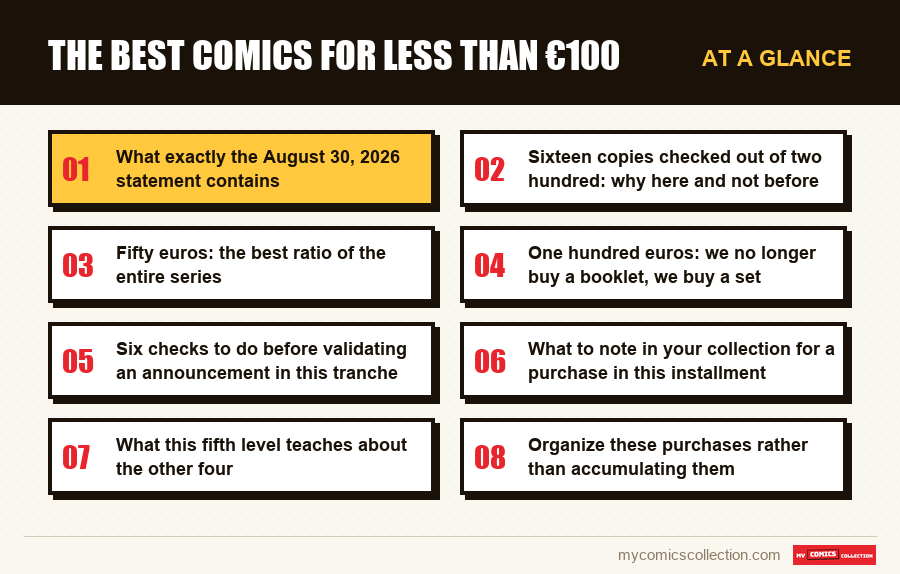
What exactly the August 30, 2026 statement contains
The query is deliberately broad: the word “comics”, a price filter between €50 and €100, no publisher or period filter. The site engine announced 21,065 results. Two hundred were opened and read. In this sample, the lowest price is €50.00, the median value is €70.00, the highest price is €100.00. The minimum and maximum here are artifacts of the filter itself: I cut the slice at these terminals, so finding them at the ends doesn't teach anything. The median is informative: it indicates that half of the advertisements are below €70, the other half above, and that the bracket is not compacted against one of its limits.
A word about the maximum, because it's the most common reading error. Seeing €100.00 at the top of the table does not mean that a booklet is worth one hundred euros. This means that a seller, that day, was hoping for one hundred euros. A posted price is a unilateral request; it only becomes market data when someone accepts it. As long as we only observe live announcements, we measure the optimism of the offer, not the exchange value. This is true at €100 as it was true at €5 in the first guide in the series.
Voici les annonces effectivement relevées, telles qu'elles étaient libellées par leurs vendeurs. À 50,00 € : « Amazing Spider-Man Marvel Comics #101 2nd Print; 1st Appearance Morbius », « Amazing spider-man n° 144 1st (full) app of the Gwen Stacy clone comics us vo », « Amazing spider-man n° 149 1st app Spider-Man Clone comics us vo », « Amazing spider-man n° 76 comics us vo », « Amazing spider-man n° 35 comics us vo ». À 100,00 € : « Lot 23 COMICS POCKET ou bien vente en 5 séries », « THE DEFENDERS x 9 Comics Marvel Hulk Dr. Strange DC 1979 », « X MEN XMen Marvel Comics Originaux Lot 11 USA ». Ces libellés sont reproduits parce qu'ils portent eux-mêmes une information : ce que le vendeur choisit de mettre en avant révèle ce qu'il pense vendre.
One last thing appears in the statement, and it should be noted: a collectible card dated 2026. It is not a booklet. It slipped into the results because the word “comics” appears in its title. Eight identified comic book ads and one object that isn't one is not much, but it's a reminder that no measured set is clean by default, even at the fifth level of a series of guides.
Sixteen copies checked out of two hundred: why here and not before
A calculation, not a rule
No standard prohibits having a three-euro booklet verified. What prevents this is arithmetic: shipping, delivery, return and immobilization cost a fixed sum, indifferent to the value of the object. Under a certain price, this sum exceeds what the audit can yield. The observed threshold is therefore not decreed, it is calculated: by each seller, separately, and they arrive at the same place.
Sixteen out of two hundred remains a minority
This figure must be read both ways. Compared to four levels at zero, sixteen is a clear break. Compared to the sample, this means that more than nine out of ten advertisements in this tranche still concern a copy whose condition is only described by its own seller. The certification appears here; she does not dominate.
Price does not verify
The opposite reasoning is false and costly: an ad displayed for eighty euros is not verified because it is expensive. The causality runs the other way. It is because the seller already estimated the item above the break-even point that he initiated the process. The high price of an unverified ad does not take away from the credibility of the sixteen others.
Two markets in the same bracket
Concretely, this slice superimposes two populations of advertisements which do not compare. On one side, copies whose condition is certified by a third party and sealed. On the other, the vast majority, where the condition is based on a free description and a few photos. Putting both in the same price table produces an average that describes neither.
This shift has an immediate practical consequence for those purchasing in this bracket: for the first time, the question “has this copy been verified by a third party?” » has an answer that may be positive, so it's worth asking. At the four previous levels, asking it meant wasting your time, the answer always being no. Here, you have to ask it and record the answer, because it separates two objects that do not have the same risk profile, even when they have the same number and display the same price.
A nuance that it would be dishonest to keep quiet: sixteen announcements is a low number of people. Sufficient to establish a qualitative fact (verified copies exist in this tranche, whereas they were completely absent from the previous four) but much too thin to derive a price level. I cannot say what a verified copy “costs” in this range, nor how much verification increases a listed price.
To find out, we would need a survey constructed differently: targeting verified advertisements, gathering several dozen of them on the same number, and comparing to unverified advertisements of the same number in an equivalent declared state. This work has not been done here, and nothing in this statement allows us to circumvent it.
Fifty euros: the best ratio of the entire series
The bottom of this slice is the most interesting place of the five levels studied. At €50.00, we no longer find anonymous booklets sold by weight or theme, but numbers that the seller precisely identifies and announces what is happening there. Three of the five listings at this price claim a first appearance. Two others are content with a number and the mention "us vo", that is to say the American edition in the original version: a precision which counts on the French market, where the same story also circulates in translated editions which are not priced in the same way.
This is a stark contrast to the lower tiers, where the buyer mostly pays for reading and accumulation. Here, for fifty euros, he buys a named number, with an explicit search reason. For someone building a collection around Spider-Man and wants identified numbers rather than volume, this is the first level where the offer really corresponds to the intention. The fact remains that “claimed” is not “verified”: what the seller claims in his title must be cross-checked number by number before any purchase, exactly as described in the method of estimating a precise fascicle.
This cross-checking is all the more necessary as one of the five fifty-euro advertisements, by its very title, concerns a second printing: “Amazing Spider-Man Marvel Comics #101 2nd Print; 1st Appearance Morbius.” The seller is perfectly honest here, the words “2nd Print” appear in full. But it is found in the middle of a title which mainly highlights the first appearance, and a reader in a hurry will remember the second information rather than the first. The result is that a second printing ends up displayed at exactly the same price as booklets for which there is nothing to indicate that they are not original.
The lesson is simple to formulate and easy to forget: in this section, the mention of draw must be actively sought, not expected. When it is absent from an advertisement, this does not mean that the booklet is original; this means that the information was not given. It is up to the buyer to go and find it, asking for photos of the inside cover and the bottom of the first page, where the edition indications usually appear.
One hundred euros: we no longer buy a booklet, we buy a set
The top of the slice tells a completely different story. The three ads listed at €100.00 are all lots: twenty-three pocket-sized booklets in the first case, nine issues of The Defenders series in the second, eleven issues of X-Men in the third. No single copy at this price in the sample. It's a structural shift: at the bottom of the tranche you pay a named number, at the top you pay a volume.
The apparent unit price of these lots is derisory, a few euros per issue, and this is precisely what makes the reasoning dangerous. A batch is almost never homogeneous. It generally contains one or two numbers which alone justify the price, and a remainder of the series whose individual value is close to that of the one or two euro levels studied at the beginning of this series of guides. Dividing one hundred euros by eleven to obtain an average price does not describe any of the eleven fascicles. The only calculation that makes sense is to identify the numbers you are really interested in, give them the full price of the prize, and treat the rest as an extra with no monetary value.
These wordings pose another, more insidious problem: they are vague. “THE DEFENDERS x 9 Comics Marvel Hulk Dr. Strange DC 1979” lists a quantity, names and year, but no number. It's impossible to know, before asking, which nine numbers make up the lot, and the difference between nine unremarkable consecutive numbers and nine chosen numbers can represent the entire value. The same title mentions both Marvel and DC, which is inconsistent for a series published by a single publisher and signals rough editing. If you are interested in the lot for Doctor Strange, the only useful step is to request the complete list, number by number, before committing.
Same remark for « X MEN XMen Marvel Comics Originaux Lot 11 USA ». Eleven fascicles, the word « Originaux », the word « USA », and nothing else. A collector who follows les X-Men knows how much the value varies within the same series depending on the period and the number; this wording does not allow any evaluation. The buyer's role here is to demand the missing data, not to fill the void with favorable hypotheses. An advertisement which does not give its numbers must be treated as an advertisement whose content is unknown, regardless of the apparent unit price.
Six checks to do before validating an announcement in this tranche
Le tirage, systématiquement
A second printing appears in the statement at the same price as issues whose origin is not disputed. Look for the print mention in the title, in the description, then on the photos. Its absence is not proof, it is a blank to fill in.
Posting date, not sale date
Everything measured here was observed on August 30, 2026, on current announcements. A price displayed for a long time without a buyer is a price that has not found its market. Look at how long the ad has been online before taking it for a reference.
Vérifié ou déclaré
Sixteen out of two hundred advertisements concern a copy controlled by a third party. For the other one hundred and eighty-four, the condition comes from the seller himself. This is not disqualifying, but the two categories are not comparable and should not be placed together.
The actual contents of the lot
At one hundred euros, the statement only contains batches of nine, eleven or twenty-three fascicles. None of these titles detail the numbers. Claim the full list: A lot without inventory is a purchase for which you do not know the purpose.
L'édition et la langue
Several titles carry the words “us vo”, others do not. On the French market, the same story exists in the original American edition and in local editions. They are different objects, and a silent announcement on this point leaves the question open.
That the object is indeed a comic
The statement contains a collectible card from 2026, marked with the simple word “comics”. Even in a two-digit range, a search result is not a list of issues: it is a list of things whose titles contain your keyword.
Collecting this series?
Track what you own, what you are missing and what your collection is worth. 7 day trial.
Start my trial →What to note in your collection for a purchase in this installment
The draw, in full. First draw, second draw, or information unavailable: all three values are useful, including the third. The statement contains a “2nd Print” displayed at the same price as the original issues; if you don't note this distinction at the time of purchase, it disappears. Two years later, you will have two identical lines in your inventory for two items that are not identical, and no way to know which is which without opening the cover.
The organization and the note, when the copy is checked. This is the first level where this field has a chance of being filled: sixteen times out of two hundred. Note who checked, what grade was given, and the number on the seal. This reference is what makes the check replayable by a third party later, and it is the only data on your file that you will never have to defend yourself. For other copies, explicitly write “condition declared by the seller”: an empty field is incorrectly read as an empty field.
Details of the lot, number by number. A group purchase should never enter a collection as a single “lot of eleven” line. Break it down: one entry per issue, with its number, series and state. This is the only way to know later what you really have, to spot duplicates when a second batch arrives, and not to repurchase an issue that you already had without knowing it because it was sleeping inside a never stripped set.
The reason the number is being searched for. The titles of the survey announce the first appearances: that of Morbius for one, that of the clone of Gwen Stacy for another, that of the clone of Spider-Man for a third. Copy this pattern into your form, and also note that it comes from the seller until you have cross-checked it. A number that you have forgotten why it counts becomes an ordinary booklet in your own inventory, and you will treat it as such the day you sort.
The actual unit price when the purchase comes from a lot. Do not copy the displayed price of the lot on each of the lines you create: you would enter eleven times one hundred euros for a purchase that cost one hundred. Also don't divide mechanically, that would assign the same sum to a wanted number and a fill number. Assign the value based on what motivated the purchase, and keep the total price of the lot and its date in the form: it is this raw information that will allow you to redo the calculation differently later.
What this fifth level teaches about the other four
Read alone, this €50-100 bracket looks like an ordinary collector's market: identified numbers at the bottom, lots at the top, a handful of verified copies. Read after the four previous levels, it says something stronger. It shows that the lower tranches were not cheaper versions of the same market, but a different market, in which the trust infrastructure simply did not exist. No independent verification of eight hundred cumulative announcements; this is an observation on the organization of the market, not on the quality of the booklets.
This invites us to return the usual question. Rather than asking “how much does a verified copy cost?” ", it is better to observe at what price the sellers themselves find the operation profitable, and to model one's vigilance on this threshold. Below, the buyer must assume that he will judge the condition on photos and on the reputation of the seller, without recourse. Above that, he can start to demand better, and the reading shows that part of the supply is already ready to provide him. It is this reasoning, and not a ready-made grid, that is detailed in the guide dedicated to relationship between condition and price.
This step-by-step reading also has its limits, which must be kept in mind. Two hundred ads per slice is a narrow window out of tens of thousands of results: 21,065 for this slice alone. A sample of this size is sufficient to establish clear-cut facts, such as the presence or absence of verified copies, or the switching of isolated copies to the batches at the top of the tranche. It is not enough to establish a reference price for a given issue, and it never replaces the examination of a specific issue at a specific time.
Finally, all of the above describes a national market and a currency. The amounts are in euros, the ads are aimed at French buyers, and domestic shipping costs weigh differently from those of an order from abroad. An equivalent survey carried out elsewhere would give other figures, and above all other tipping thresholds towards certification, since the cost of the operation is not the same everywhere. Nothing here should be transposed as is to another market.
Organize these purchases rather than accumulating them
One last point, which follows directly from the structure of the tranche. When the high end of a budget is occupied by lots, the collection grows in packages and not in units. Eleven issues come in at once, twenty-three come in at once, and the workload shifts from purchasing to filing. This is where most collections go wrong: lots pile up without being counted, and the inventory no longer reflects what is actually in the boxes.
The parade is mechanical. An arriving lot is opened, listed and entered before another is purchased. Each issue receives its number, its series, its declared or verified condition, its edition when known, and a link to the original purchase. It's tedious once, and it avoids having to repurchase a number you already own for the second time: the most common scenario among those who buy in batches in this bracket.
The classification by series remains the most readable for locating a hole, but it is not the only useful angle. A connection by character allows you to see at once what you have around a given figure, and a connection by creator: the Stan Lee for example: groups together the numbers associated with the same name, which the numbering of the series alone never shows. The two readings coexist without contradicting each other, provided that the cards are entered one by one rather than in batches.
Finally, keep track of what you searched for and discarded, not just what you bought. An ad for fifty euros that you let pass because the drawing was not confirmed deserves a line in your notes: the day the same number reappears, you will immediately know what question to ask the seller, and you will not redo the verification work from the beginning.
Questions fréquentes
Because the operation is not profitable. Having a booklet verified by an independent organization costs a fixed sum, which does not depend on the value of the object: sending, delivery, return, and immobilization during the processing time. Below a certain resale price, this cost exceeds what the process can bring in, and no seller commits to it. This is not a ban, it is a calculation that each seller makes on their own and which leads them all to the same conclusion. The statement of August 30, 2026 shows the result: zero verified advertisements out of two hundred in each of the four brackets under fifty euros, sixteen out of two hundred between fifty and one hundred euros.
This statement does not provide an answer. Sixteen verified ads out of two hundred is too small a number to establish a price difference, and I have not matched these ads with comparable unverified copies of the same issue. What I can say is that verification removes uncertainty: the state ceases to be an assertion by the seller and becomes the observation of a third party. What this less uncertainty is worth in euros on the French market requires a specific measurement, built on dozens of matched announcements, which has not been made here.
Start with the title of the ad: in the statement, one of the fifty-euro ads bears the words “2nd Print” in plain text. Then read the entire description, then ask for photos of the inside cover and the bottom of the first page, where the edition markings usually appear. The important point is to consider the absence of a mention as missing information and not as a guarantee of origin: many sellers do not specify this, without intending to deceive. On a sought-after number, the question must be asked systematically before purchasing.
It depends entirely on what the lot contains, and the three lot announcements noted do not give any list of numbers. The apparent unit price of a lot is misleading because it assumes a uniform value, whereas a set almost always contains a few numbers that carry the price and a remainder of low individual value. The only way to evaluate a lot is to get the full list of numbers, identify which ones you really wanted, and verify that those alone justify the expense. If the seller does not provide this listing, you are purchasing unknown content.
Nothing in this work allows us to say that. The survey was made on a single date, August 30, 2026: it photographs a state of supply, it does not measure any movement. To speak of evolution, we would need at least a second measurement taken later, on the same market, with the same query and the same sampling method, and to compare the two. It would also be necessary to work on concluded sales rather than on current announcements, since a displayed price reflects the expectation of a seller and not an agreement. Any assertion of trend from the numbers presented here would be an unsupported extrapolation.
Keep track of what you buy, lot by lot
Edition, verified or declared condition, detailed content of a lot, price actually paid: these are the fields that distinguish a documented collection from a pile of booklets. My Comics Collection allows you to enter each issue individually, attach a group purchase to its issues and instantly find what you already own before purchasing.
The full scale of budgets
- Palier précédent : moins de 50 €
- Palier suivant : moins de 250 €
- Moins de 5 €
- Moins de 10 €
- Moins de 20 €
- Moins de 500 €