The best comics for less than €500: the supply is becoming scarcer, verification is progressing
Between €250 and €500, the French market changes its nature. On August 30, 2026, the tranche displayed 2,162 announcements, compared to 7,543 just below and 21,065 two levels lower: the offer is divided by ten in two steps. Of 200 listings reviewed that day, the lowest amount claimed was €250.00, the middle of the pack at €322.22, the highest at €500.00. Twenty-four of these 200 copies were verified by an organization, an increase compared to lower levels but still a very small minority. Please note: these are prices asked by sellers at a given time, not completed transactions, and a single reading does not show any trend.
It is necessary to say from the outset what these numbers are and what they are not. They come from a scan carried out on August 30, 2026 on a general auction site, on the French side, with amounts denominated in euros. Each line corresponds to what a seller hopes to obtain, displayed on their file, and not to an amount actually collected. Nobody signed. Nobody paid. An ad can stay online for months at the same amount without ever finding a buyer, and another can go lower after negotiation without the statement keeping track of it. Confusing the two is like mistaking a billboard for a bill.
Second point, just as important: a photograph taken on a single date does not tell any story over time. I will therefore not write anywhere that this level “goes up” or “goes down”, because I only have one measurement point and a point does not trace a curve. What this survey allows, however, is to compare several slices observed on the same day, under the same conditions, with the same method. This horizontal comparison is solid. It reveals two clear facts about the €250-500 range: the supply suddenly becomes scarcer there, and the proportion of copies passed by a verification body reaches its highest level of the entire series of measures.
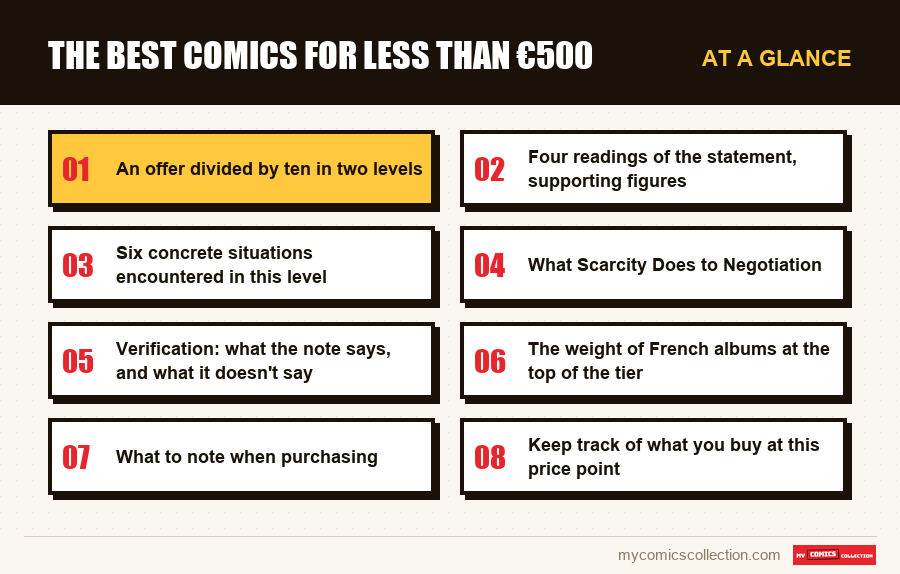
An offer divided by ten in two levels
The most telling figure in the statement is not a price, it is a number. In €50-100, the “comics” query brought back 21,065 ads. In 100-250 €, it brought back 7,543. In 250-500 €, 2,162. From one level to another, the offer drops by two thirds, then by another two thirds. On two steps, it is divided by ten. This contraction is not a statistical anecdote: it completely transforms the buyer's experience. At the lower levels, looking for a title means choosing between dozens of competing proposals, ruling out talkative but vague sellers, and making comparisons. Here, we no longer compare ten sellers. We found two. Sometimes just one. And when there is only one announcement, the very notion of “market price” loses its anchor: there is no second point to corroborate it.
This rarefaction changes the nature of the decision more than it changes its amount. On an abundant level, making a mistake costs little and is quickly corrected: the same piece will come back again. On a sparse landing, the buyer loses his net. He can no longer tell himself that he will see better next week, because he does not know if he will see anything. This is exactly the context that pushes us to accept an insufficient description, to not insist on obtaining an additional photo, to quickly conclude “before someone else takes it”. Scarcity of supply breeds eagerness, and eagerness is the most expensive thing in this range.
The answer lies in a simple inversion: the fewer ads there are, the more you should demand from each ad. Where abundance made it possible to sort by elimination, scarcity requires each file to be examined individually. The sole seller has no competitor disciplining him, so it is up to the buyer to ask the questions that the market no longer asks for him.
Four readings of the statement, supporting figures
A clean floor, a flat top
Of the 200 ads examined, the lowest amount was exactly €250.00 and the highest was exactly €500.00. The two terminals of the section questioned. This is not a market accident: it is the filter itself which sets them. The real information is elsewhere, in the middle of the pack at €322.22, clearly closer to the floor than the ceiling. The mass of requests is in the first third of the range, and the ads at €500 form a small group apart.
Verification reaches its highest
Twenty-four copies verified out of 200. Compared to the lower brackets, the progression is clear: zero out of 200 in €1-5, in €5-10, in €10-20 and in €20-50, sixteen out of 200 in €50-100, thirteen out of 200 in €100-250, then twenty-four here. Going through an organization only appears above a certain amount, which is understandable: the process has a fixed cost that only fairly expensive parts absorb.
But the overwhelming majority remains on their word
Twenty-four out of two hundred is also one hundred and seventy-six ads without any independent verification. Certification is not the norm at this level, it is the minority exception. In other words: at this price level, the advertised condition is almost always based on the seller's declaration alone. It is a fact of structure, not a process of intention, and it must guide the way in which we read each file.
The top of the slice speaks French
The highest amounts recorded that day were not occupied by American issues but by French albums from Lug editions: a “Strange Album #4 (11/12/13)” at €500.00, next to an “STRANGE ALBUM N°22 (LUG) EO 1975” at €250.00. On the French market, the expensive object is a local object. The collection logic which structures this level is therefore first and foremost heritage and editorial, not only linked to the characters.
These four readings are being held because they are based on sufficient numbers: two hundred files examined, several thousand announced. On the other hand, as soon as we go down to the level of a particular title within the level, the numbers become tiny: one, two, three announcements. At this scale, no amount can be presented as a reference level. Two listings don't make a deal, they make two sellers' opinions.
The progression of the verification rate does not mean that a graded copy is mechanically worth more. What the statement shows is that from this level, more sellers finance the process, not that the note creates value. The direction of causality is not measured here.
And a note is never read alone. An advertisement for €250.00 presented a copy rated 9.6 with signatures; another, for the same amount, announced a VF/NM state and a signature without going through an organization. Same asking price, two completely different proof regimes.
Six concrete situations encountered in this level
The announcement of two words
A sheet for €500.00 entitled “strange 1”, without a line of description. Maximum amount of the level, zero information. This is the worst possible scenario, and it actually exists. No commitment should be made on such a form until photographs and written text have been obtained.
The old dated album
A Strange album n°22 presented as an original edition from 1975, in very good condition. The announced seniority can be verified on document: printing details, completion of printing, appearance of the paper. It must be confirmed by the image, never accepted on the title line alone.
The manufacturing defect reported
The same ad mentions a poster still attached and a trimming fault. A seller who spontaneously describes a minor defect applies a requirement for precision that silence never offers. This transparency is in itself a signal, regardless of the amount requested.
The undifferentiated lot
An entry price of €250.00 announcing “25 Comics Diabolico”. A lot cannot be compared to anything: we ignore the numbers, the states, any possible duplicates. The overall amount says nothing about the unit value, and the actual inventory is only known after receipt.
The collection of several issues
An album linking three issues: No. 4 bringing together 11, 12 and 13: is not equivalent to the three separate issues. It is a separate editorial item, with its own binding and cover. Confusing it with the original fascicles distorts any comparison.
The duplicate appearance
Two advertisements at €250.00 concerned publications from 1994 with similar titles, one an annual, the other a separate issue. Similar labels can refer to different objects; only the vintage, the type of publication and the exact number allow us to decide.
What Scarcity Does to Negotiation
At a level of 2,162 advertisements, the buyer loses the most effective weapon he had at his disposal lower down: the possibility of leaving. When twenty sellers offer the same thing, refusing a poorly described sheet costs nothing. When there is one, refusing means giving up, at least for an indefinite time. This asymmetry explains why the records with the poorest information survive precisely where the amounts are the highest: they are not subject to any competitive pressure that would force them to improve.
However, there is a lever that does not depend on the number of sellers: the written request. Asking the seller for a description in full (condition of the cover, spine, staples, corners, presence or absence of inserts, known defects) only costs one message. It produces three effects. She documents the item before purchase. It gives an enforceable reference if the package received does not correspond. And it filters: a seller who refuses to write what he is selling already provides a lot of information about what he is selling.
The unit evaluation method takes on its full meaning here, more than the general grids. When only one copy is available, it is no longer the title that we evaluate, it is this copy, with its condition, its history and its defects. The approach detailed in the guide on estimation of a specific number applies verbatim to this situation. And when the sale takes place in the form of an auction rather than a fixed price, the mechanics of the rise change the benchmarks: the points of attention specific to this format are brought together in the guide dedicated to the purchase at auction.
Collecting this series?
Track what you own, what you are missing and what your collection is worth. 7 day trial.
Start my trial →Verification: what the note says, and what it doesn't say
Twenty-four copies checked out of two hundred is enough for the question to be seriously raised, not enough for it to resolve itself. A copy passed by an organization provides one specific thing: a third party has examined the object and recorded its condition on a public scale, under a traceable reference. This removes the most subjective part of the description from the debate. This says nothing, however, about the relevance of the amount requested. A verified part may be overpriced exactly like another.
The statement contains a useful example: a 1994 copy advertised rated 9.6 with signatures, at €250.00. Three distinct pieces of information are superimposed on it (a verified condition, a vintage, the presence of signatures) and each is checked separately. The rating is up to the organization. The vintage depends on the piece. The signatures are part of their own chain of proof and which is not automatically covered by the state notation. Taking the block as an indivisible whole is the most common way to make a mistake at this price level.
The majority case remains: the one hundred and seventy-six unverified files. They are not inherently suspicious: the market largely works that way. But they rely entirely on the quality of the description and the photographs. This is why reading the note and the condition, as explained in the guide on the relationship between grade and price, becomes more useful here than anywhere else: it gives criteria for judging a free description, where no body has decided.
The weight of French albums at the top of the tier
The two highest amounts in the statement are carried by Lug albums. This observation deserves to be taken seriously by anyone building a collection from France. A bound album brings together several publications under its own cover, with specific pagination and production; it constitutes a piece in itself, and its condition is assessed with its own criteria: spine, binding, detachable elements. The presence of a poster still attached, mentioned in one of the advertisements, belongs to this family of criteria: it is an original element whose absence or separation modifies the object.
This has a practical consequence for maintaining a collection: a French album and an American booklet do not follow the same logic of monitoring. The first is described by its album number and the releases it contains, the second by its series and its number. Mixing the two in the same inventory line produces phantom duplicates and imaginary holes. The serial markers, which can be consulted next Batman, side X-Men or side Silver Surfer, serve precisely to link each piece to the correct reference, including when several publications are found together in the same volume. The same vigilance applies to pages devoted to creators, such as that of Stan Lee, where the connection is made by work and not by physical object.
What to note when purchasing
The written description obtained from the seller prior to purchase. Copy it as is into your form, with the date you received it. This is the only document that will allow you, later, to know what was promised to you. At a level where one hundred and seventy-six sheets out of two hundred are not covered by any organization, this text is your reference document.
The condition of the poster or any detachable element, for a French album. Explicitly note whether it is present, attached or separated, intact or damaged. One of the advertisements noted specified “poster attached”: this is a characteristic which distinguishes the copy, and which must appear in your file in the same way as the condition of the cover.
The grade AND the organization that issued it, when the copy is verified. A “9.6” without mention of the organization or the reference number is worthless upon rereading, because it is no longer linked to the original document. Record the scale, entity, reference, and separately any additional information such as signatures.
Manufacturing defects reported, including minor ones. A trimming fault, a printing offset, a poorly placed staple: these elements belong to the copy and not to the edition. They must be copied into your file with the seller's words, because they explain a discount as they can explain a conservation choice.
The price paid, shipping included, and the exact date. On a level where there is sometimes only one seller, your own history becomes your best reference: it is the only amount which you know corresponds to a transaction actually concluded, unlike the amounts displayed in the advertisements.
Because the supply becomes scarcer very quickly as the amount increases. On the same day and on the same market, the €50-100 bracket had 21,065 ads and the €100-250 bracket had 7,543. The drop is of the order of two-thirds at each level. Direct consequence: on a given title, you will often only find one or two offers, which makes comparison between sellers difficult, if not impossible.
The survey does not allow this to be confirmed. It only shows that the share of verified copies increases with the price level: none out of 200 in the four lowest brackets, sixteen out of 200 in €50-100, thirteen out of 200 in €100-250, twenty-four out of 200 here. We observe coexistence, not causality. And a copy rated 9.6 was priced at €250.00, at the very bottom of the range.
Do not commit to anything. The statement contains a sheet entitled “strange 1”, two words, at the maximum amount of the level. Ask the seller for clear photographs of the cover, spine, spine, and corners, as well as a written description of the condition and any known defects. If these elements do not come, the absence of a response is itself a response.
It's quite the opposite. The 1975 album announcement mentioned a trimming defect while presenting the copy in very good condition. Spontaneously describing a minor defect requires careful examination and a desire not to surprise the buyer. Silence does not prove the absence of defect: it only proves the absence of description.
No, and for two reasons. These are prices claimed on August 30, 2026, not concluded sales: there is no indication that a buyer accepted them. Then, a statement taken on a single date does not describe any evolution; he photographs a state of supply, he does not draw a curve. For resale, only amounts actually collected, on comparable items, constitute a serious basis.
Keep track of what you buy at this price point
At a level where supply is rare and where more than eight out of ten copies are not covered by any organization, your personal inventory becomes your best source. My Comics Collection allows you to record the declared condition, the defects reported, the note and its organization, the price paid including shipping and the date: for each copy, French album or booklet.
The full scale of budgets
- Previous level: less than €250
- Next level: less than €1,000
- Less than €5
- Less than €10
- Less than €20
- Less than €50