The best comics for less than €1,000: the last level where the French market is still holding
Between €500 and €1,000, the French market of a large general auction site displayed 663 advertisements on August 30, 2026. Of the 200 that I examined one by one, the lowest asking amount was €500.00, the median amount was €650.00 and the highest was €1,000.00. Forty of these two hundred announcements concerned a copy verified by a third party: this is the highest proportion noted across all the French issues studied in this series. Please note: all these amounts are prices réclamés by sellers on a single date, not completed transactions, and nothing in a statement taken on a single day allows us to speak of an increase or decrease. Another important signal: four of the objects found are not booklets: a figurine, an original drawing, a painting and a batch of recent collections.
This eighth installment of the budget series stops at a border. Until now, each level remained populated with issues: isolated issues, albums, partial series, with sellers numerous enough for a buyer to be able to compare. From €500 something moves. The number of advertisements plummets, the proportion of copies documented by an external organization rises suddenly, and above all the very nature of the objects offered begins to change. It is no longer just a comic book market: it is a market where the comic book coexists with the derived object, the original board and the painted canvas.
It is for this reason that I qualify this level as a coherent last floor. Beyond that, the question will no longer be “which comic can I buy at this price” but “what is still a comic in what I am looking at”. This article describes what 663 ads say, and more importantly what they don't say. A single statement measures a supply at a given time. It does not measure a value, a trend, or a rating. We will maintain this distinction until the end.
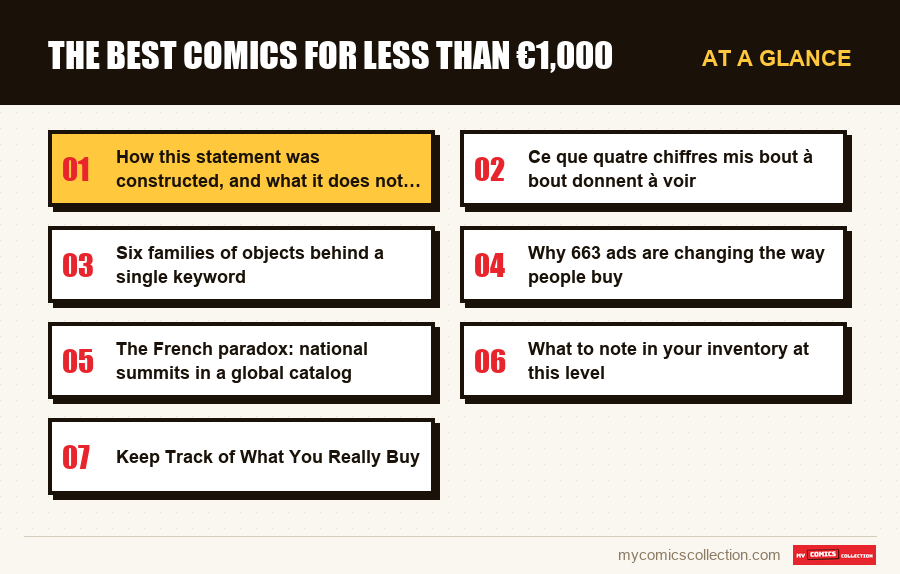
How this statement was constructed, and what it does not prove
On August 30, 2026, I queried a general auction site on its French market with the query “comics”, filtering the €500 to €1,000 bracket. The platform announced 663 ads. I opened 200 of them, taken in the order in which they appeared, and I noted for each the amount displayed, the title, and the presence or absence of a mention of verification by an external organization. The amounts are in euros, on the French market, which is not trivial: the same object can appear quite differently on an English-speaking market, with an unrelated depth of offer.
One point deserves to be weighed heavily, because it conditions everything else: these 663 lines are requests from sellers. A seller who displays €1,000.00 expresses hope. It does not demonstrate that a buyer paid this amount, or even that a buyer exists. None of these numbers are closed sales. The median amount of €650.00 therefore summarizes where expectations lie in the middle of the pack, nothing more.
Second precaution, of the same order: I only noticed it once. A measurement taken on a single date does not contain any movement information. If I wrote that this level “rises” or “settles”, I would be purely and simply inventing, since I have no previous point of comparison in my data. All I can say is what the deal looked like that Sunday. A second statement, in six months, with the same query and the same filter, would produce a comparison. A single reading produces none.
Third precaution: the query “comics” is a wide mesh net. It brings back everything that the sellers have chosen to label as such. On the lower levels, it remained mainly booklets and albums. Here, the same request brings back a crystal figurine, a painting and an original drawing. This is not a defect in the statement: it is precisely the information that the statement provides. The word “comics” ceases, at this price level, to designate a homogeneous object.
Ce que quatre chiffres mis bout à bout donnent à voir
The offer is reduced by a factor of thirty
The same day, on the same market: 21,065 ads between €50 and €100, 7,543 between €100 and €250, 2,162 between €250 and €500, and 663 here. Each step divides the supply approximately by three. With 663 lines for a slice of €500 wide, a buyer looking for a specific title may very well find nothing at all in France, for months. Rarity does not only relate to the object: it relates to the opportunity to buy it.
One in five copies is documented
Out of 200 advertisements examined, 40 highlight verification by an external organization. The progression is clear from one level to the next: none below €50, 16 between €50 and €100, 13 between €100 and €250, 24 between €250 and €500, 40 here. This is the peak of the series on the French side. But look at the figure the other way around: four out of five listings still rely entirely on the seller's description.
French albums still occupy the top
A “STRANGE 3 LUG Marvel Album Original Edition TBE” asking €999.99 and a “Marvel Hardcover Album Nº4 (3 Comics In 1: Nº11 TO Nº13) | 1970 | Lug » requested €500.00 limit the landing from the top and from the bottom. As in the two previous installments, it is the original French editions which hold the top. The French market remains, until now, a market for French editions.
The booklet ceases to be alone on the trail
Four of the objects noted are not booklets: a “DC Comics Swarovski Superman Figurine” at €500.00, a “DAVID MACK original art sketch drawing” at €500.00, a “Painting by Thomas Frisano CONAN THE BARBARIAN” at €1,000.00, and a “DC Omnibus: Green Lantern / Wonder woman / Knightwing Rebirth” lot at €500.00 composed of recent collections. Four different families of objects, a single keyword to bring them together.
Taken separately, each of these observations is banal. Placed end to end, they form a seesaw. The €500-1,000 level is the point where the offer becomes too thin for us to still be able to speak of a fluid market, and where the “comics” category begins to fill up with objects that are not comics. The two phenomena are linked: when the available booklets become scarce in a price range, what remains under the label are the related objects. The next level, the one that will be covered in the following article, will see these objects become the majority. Here, they are still only a foretaste, but a very visible foretaste.
Pay attention to reading the highest amount. The maximum recorded, €1,000.00, corresponds to the upper limit of the filter: it does not indicate a market ceiling, only the place where I stopped looking. And an isolated amount at the top of a list reflects the hope of a seller, never an actual price.
Likewise, the median amount of €650.00 does not indicate what a comic in this category is “worth”. It says where is the middle of a heterogeneous set of announcements, which mixes French albums, modern collections, noted copies and objects which are not fascicles. A median calculated over a disparate basket does not describe any particular object.
Six families of objects behind a single keyword
The verified and signed copy
« Darth Vader #3 1st Dr. Aphra Larroca variant 1:25 & Signature CGC 9.8 2015” reaches the top of the range at €1,000.00. The announcement combines three characteristics: a rating of 9.8 awarded by an external organization, an alternative cover with a limited edition, and a signature. They add up, and nothing in the statement makes it possible to say which one is the amount.
The original French album
The 1970 Lug bound album bringing together three issues in one volume, like the Strange album announced in the original edition, belong to a family specific to the French-speaking market. These are edition objects, dated, whose value is based on the history of the French publication and not on that of the original publication.
The limited edition cover
The mention of a print ratio, here 1:25, describes an alternative cover distributed in proportion to standard copies. This is a verifiable characteristic in principle, but which, in an advertisement, is only an assertion by the seller until a third party has recorded it on the label of a sealed box.
The batch of recent collections
The omnibus lot Green Lantern et Wonder Woman asking €500.00 is not an old piece: it is a set of modern, reissued bound volumes. Its amount comes from the number of volumes collected, not from the rarity of a single copy. Two opposing logics come together at the same price.
The derived object
The figurine Superman Swarovski crystal asking €500.00 bears the label “DC Comics” but is not a comic book. It falls into a separate collectible market, with its own markers of condition, completeness and original packaging. Placing it in an inventory of comics distorts any subsequent reading.
The unique original work
The original drawing by David Mack at €500.00 and the painting by Thomas Frisano on Conan the Barbarian at €1,000.00 are unique pieces. No notion of circulation, standardized state grade or number applies to it. These are works of art, governed by the practices of the art market, which have almost nothing in common with a printed booklet.
Why 663 ads are changing the way people buy
On the lower tiers, a buyer could afford to wait. With more than twenty thousand ads between €50 and €100, refusing an offer cost nothing: another would follow. At 663 announcements for an entire tranche, this reasoning is reversed. The question is no longer “is this the best price” but “is there another opportunity available within a reasonable time frame”. These are two different problems, and the second cannot be solved by comparing amounts.
Concretely, this means that a buyer who is targeting a specific title at this level must agree to wait without knowing how long, or to broaden their horizon beyond the French market. Neither option is comfortable. The first immobilizes a purchasing intention without a deadline. The second adds shipping costs, delays and transport risk to an object whose condition is precisely what justifies the price.
This rarity also explains why third-party verification carries more weight here. When twenty comparable ads coexist, a buyer can discard the one whose description worries him. When there is only one announcement, dismissing it means giving up. A rating awarded by an external organization then transforms a bet on the word of a stranger into a searchable fact, which is exactly what a market with a small workforce lacks. The relationship between rating and price deserves to be understood for its own sake, and not just suffered: this is the object of the guide to rating and states.
However, we must be careful not to conclude too quickly that this level would be “safer” than the previous ones. Forty verified ads out of two hundred, this remains a minority. One hundred and sixty advertisements out of two hundred present no external supporting documents, even though the amounts requested exceed the price of one month's rent in certain cities. The rise of verification is real and measured; it is not yet the norm.
Collecting this series?
Track what you own, what you are missing and what your collection is worth. 7 day trial.
Start my trial →The French paradox: national summits in a global catalog
A fact comes back from level to level and is confirmed here: it is French editions which occupy the top of the bracket. The album Strange at €999.99 and the bound album Lug from 1970 at €500.00 are not original American issues, they are objects made for the French-speaking readership, which bring together several episodes in the same volume. Their interest lies in the history of publishing in France, the quality of conservation of paper and binding, and the local rarity of these prints.
This observation has a practical consequence for those who keep an inventory. A French album that contains three numbers does not fit together as three separate numbers. It constitutes an entry in its own right, with its own publisher, its own date, its own numbering, and content that must be described in order to find what it contains later. Confusing the container and the content produces an inventory that does not overlap with anything: neither with the original catalog, nor with a list of shortages.
Besides this, the batch of modern omnibuses illustrates the opposite situation. These are recent, bound collections, widely available upon release, the price of which is explained by the number of volumes collected in a single announcement. Nothing old, nothing rare in the unit. The same price of €500.00 therefore covers, in this statement, two realities which have no connection: a rare old object and a stack of new books. This is the best possible illustration of the fact that a price alone describes nothing.
Finally, the presence of a painting and an original drawing reminds us that the same character circulates on several parallel markets. A reader who follows a hero through his booklets, his collections, his adaptations and the fiches des créateurs who shaped it do not meet the same rules depending on the medium they purchase. The printed comic book obeys a logic of circulation and state. The original work follows the logic of a unique piece and provenance. Mixing them in the same budget leads to comparing the incomparable.
What to note in your inventory at this level
The exact nature of the object, above all else. Original fascicle, French album linking several issues, modern collection, original plate, derived object: these five families appear in the survey and have nothing in common. Write it clearly in a dedicated box, not in the title. An inventory where a crystal figurine and a Lug album from 1970 share the same type of record becomes illegible as soon as it exceeds a few dozen lines, and above all impossible to honestly total.
The state rating and the organization that assigned it. Forty out of two hundred advertisements highlight external verification; if your copy is one of them, the note alone is not enough. Note the number, the name of the organization, and the identification number on the box, which allows you to find the form online. A note copied without its source cannot be verified, and a sealed box without its number recorded somewhere loses half of what makes it useful.
The restricted nature of a print run and what attests to it. A term such as “variant 1:25” describes alternative coverage distributed in a given proportion. Record where the information comes from: is it on the label of a verified item, in the catalog, or just in the ad copy? The difference is decisive on the day of a resale or an insurance declaration, and it disappears from memory much faster than you might think.
The signature, and whether it is verified or not. The top-tier announcement associates a signature with a rating given by a third party, which is not the same as a simply stated signature. Distinguish the two cases in your file: signature recorded by an organization during a supervised deposit, or signature presented by the seller without supporting documents. Also note who signed and, if the information exists, under what circumstances.
The price actually paid, including shipping, and the date. The amount displayed in an advertisement is a request; what counts in your inventory is what came out of your account, including shipping and any selling fees. Record the total and the exact date of the transaction. Without this, you will never be able to tell if your collection cost you more or less than you think, nor build a solid foundation to ensure it.
No, and the statement does not allow us to say so. The €1,000.00 figure is an amount claimed by a seller on August 30, 2026, not the result of a sale. It indicates where this seller places his hope. As long as no transaction has come to confirm this level, it does not constitute a usable reference. It is also the upper limit of the applied filter, therefore the place where the observation stops, not a market limit.
Because the offer contracts with each price step: 21,065 advertisements between €50 and €100, 7,543 between €100 and €250, 2,162 between €250 and €500, then 663 between €500 and €1,000. The French market, at this level, simply no longer has enough sellers for a given item to be permanently available. A specific title can remain undiscovered for months without this saying anything about its value.
In a serious inventory, no. The crystal figurine, the original drawing and the painting noted here bear the “comics” label on the platform, but fall under other markets, with other criteria of condition and authenticity. It is perfectly legitimate to collect them; On the other hand, it is misleading to count them in a total of comics. Separate them as soon as you enter them, you will save yourself a painful rethink later.
The survey shows that this is still a minority: 40 ads out of 200. Four buyers out of five, at this level, rely on the seller's description. Third-party verification reduces uncertainty, it does not eliminate it, and it says nothing about the reasonableness of the asking price. What it really provides is information that a future buyer can consult, which is all the more important if the item is expensive.
He doesn't show anything like that. All data comes from a single day, August 30, 2026. To observe a movement, you would need at least two comparable readings, separated in time, with the same query, the same filter and the same market. Any claim of increase or decrease based on a single measurement would be an invention. What the statement describes is the form of the offer at a specific time.
Keep Track of What You Really Buy
At this price level, what distinguishes a French album from 1970, a modern collection and a verified copy is contained in a few well-filled fields. My Comics Collection allows you to record the nature of the object, its grade and organization, its printing characteristics and the price paid including shipping, then find everything at a glance.
The full scale of budgets
- Palier précédent : moins de 500 €
- Palier suivant : less than €1,500
- Less than €5
- Moins de 10 €
- Moins de 20 €
- Moins de 50 €