
The best comics under €1,500: the level where we stop buying unverified stuff
At this level, the French market no longer provides anything to choose from: on August 30, 2026, the €1,000-€1,500 bracket had only 144 ads for the query “comics”, including eleven verified copies, and the lot mixed an original plate, signed lithographs, an Italian album and a piece of industrial faucet without the slightest connection with comics. The usable offer is therefore on the American market, in dollars: out of 200 ads examined in the $1,000-$1,500 bracket for the query “key issue comic”, the minimum was $1,000.00, the median was $1,217.50, the maximum was $1,500.00, and 163 copies out of 200 were checked. These are amounts claimed by sellers that day, not completed transactions; to these sums are added the conversion, delivery and costs linked to importation, which this statement does not measure.
The eight previous levels in this series were all recorded in the same place: the French market, in euros, with the same query and the same counting method. This continuity stops here, and it stops for a reason that can be measured. Between €1,000 and €1,500, the French market no longer offers a comics market: it offers a residue of heterogeneous advertisements where the word “comics” serves mainly as a storage label. One hundred and forty-four announcements are already few; eleven copies checked out of all, this is an offer which does not allow comparison, nor arbitration, nor even to get an idea of what a budget of this size really buys.
The shift towards the American market is therefore not an editorial preference nor a collector's vanity. This is the consequence of a numerical observation: at this budget level, the French buyer who wants to see booklets aligned, comparable to each other and mainly controlled by a third party must look elsewhere. It then changes currency, time zone, shipping rules and tax regime, and this switch has a cost that none of the figures below contain.
What the August 30, 2026 statement measures, and what it does not measure
A point of method, because it governs everything else. The amounts cited in this article were observed only once, on August 30, 2026, and they correspond to what sellers were asking at that time. None of them prove that a transaction took place at this price. A single reading does not draw any trajectory: it does not say whether these amounts are rising, falling or stagnating, because it would take at least two measurement points to talk about it, and there is only one. The $1,500.00 maximum merits special caution: an isolated upper bound reflects what a seller hopes to get, not what a buyer has agreed to pay. The median of $1,217.50 is the strongest indicator of the lot, because it cuts the population into two equal halves and is resistant to extreme announcements. Finally, the counting of verified copies, 163 out of 200, was done separately from the measurement of prices: these are two distinct pieces of information, and mixing them would produce false reasoning.
The reversal: the unverified becomes the exception
This is the highlight of this level, and it changes the nature of the purchase. Let us recall the progression noted on the same day on the French market, in number of copies verified for 200 advertisements examined: zero under €50, sixteen between €50 and €100, thirteen between €100 and €250, twenty-four between €250 and €500, forty between €500 and €1,000. Verification remained in the minority everywhere, even at the top of the scale. On the American market, in the $1,000-$1,500 bracket, we go to 163 out of 200. The proportion is reversed: it is no longer verification that is the exception, it is its absence.
The practical consequence is direct. At the lower levels, buying an unverified copy was commonplace, sometimes inevitable, and it was assumed as an ordinary risk-taking. Here, refusing verification amounts to voluntarily placing oneself in the least informed minority in a market where the majority has an outside opinion on the condition of the object. The buyer who accepts a free description then enters into competition with buyers who read a rating given by a third party and a sealed box. However, he does not pay less: he simply pays with less information.
This does not mean that an unverified copy is necessarily overvalued or misdescribed. This means that nothing in the announcement allows us to decide, and that at this amount the possible margin of error between two condition assessments represents a considerable sum. A half-point difference on a rating scale does not have the same consequences at forty dollars as it does at twelve hundred.
Why is the French market stalling at this level?
The detail of the French survey is more eloquent than its number. Out of 144 ads in the €1,000-€1,500 bracket, we find an original plate: that is to say a unique object, which does not follow the same logic as a printed booklet:, a set of signed lithographs, an Italian album, and a piece of industrial faucet which has nothing to do there. In other words, the “comics” category includes at this price level objects that do not compare with each other, plus some outright classification errors.
Eleven copies verified out of one hundred and forty-four advertisements is too small a number to draw the slightest conclusion on a French price level at this level. We can neither calculate a credible median, nor say that a given issue is “worth” a certain amount in France, nor assert that the French market would be more expensive or less expensive than the American one. The only statement that these data authorize is this: the offer does not exist in sufficient quantity to arbitrate. It's a lack of supply, not a price level.
This rarity has a simple structural explanation, which has nothing to do with a value judgment: the issues which reach this amount are old American issues, and they circulate mainly where they were published, in a dense resale circuit, equipped and accustomed to verification. France remains a market for bound albums and reissues, where the original issue from the 1960s only appears in small numbers. The French collector who increases his budget therefore automatically ends up leaving his domestic market.
Seven American announcements, seven ways to spend the same budget
Two Fantastic Four milestones at $1,000.00
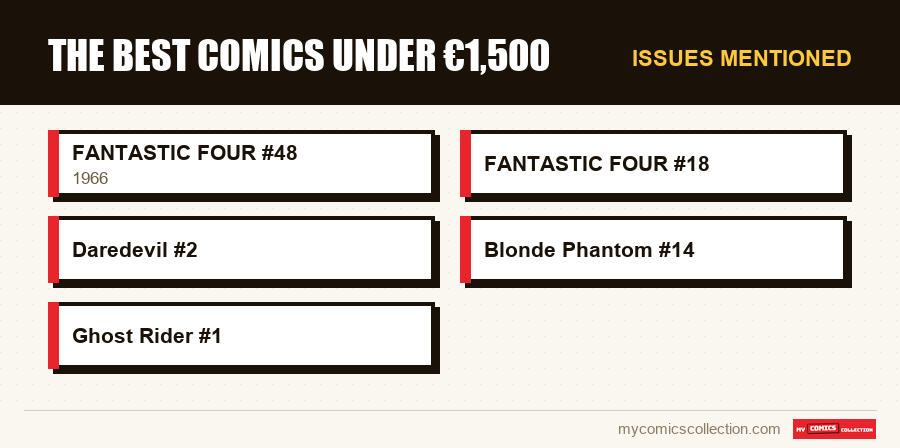
The statement shows "FANTASTIC FOUR #48 (1966): GRADE 5.5 - MARVEL 1ST APP GALACTUS SILVER SURFER" and "FANTASTIC FOUR #18 VF- 7.5 [...] 1st SUPER SKRULL", both claimed at $1,000.00. Two first appearances, two very different notes, the same amount displayed: this is the clearest illustration of the fact that at this level the price cannot be read on the note alone. The series is followed on the hub Fantastic Four.
Daredevil #2, verified in 7.0
“Daredevil #2 CGC 7.0 Marvel Comics 1964 Key Issue White Pages” is listed at $1,000.00. The advertisement combines three pieces of information that the buyer must not confuse: a rating assigned by a third party, a year of publication, and a statement on the appearance of the paper. Only the first is a formalized external opinion. The series numbers are listed on the hub Daredevil.
Blonde Phantom #14, a 1947 Timely
“BLONDE PHANTOM #14 (1947): GRADE 6.0: TIMELY,” fetched $1,000.00, is the only title on the record from before the 1960s. It occupies the same budget as the Marvel milestones of the following decade, with a mid-range rating and a significantly less popular title. This is exactly the type of trade-off that this level imposes: seniority versus notoriety.
Ghost Rider #1, signed and verified
« Ghost Rider #1 [...] 8.0 EXCEPTIONAL WHITE! Signed by Gary Friedrich” is asking $1,000.00. It is the only announcement in the statement which bears an author's signature, and the only one where the verification must be read on two levels: the condition on the one hand, the authenticity of the initials on the other. The character has his own hub, Ghost Rider.
The two remaining listings in the statement sit at the top of the bracket, at $1,500.00 each: "X-Men 58 1969 Marvel Comics CGC NM- 9.2 1st App Havok in Costume" and "Strange Tales 89 1961 Marvel Comics CGC VG/F 5.0 1st App Fin Fang Foom." They deserve to be read together, because they show the same amount applied to two opposing profiles: on one side a copy rated 9.2, of a title from the late sixties; on the other a copy rated 5.0, of a title from the very beginning of the decade. The budget is identical; what we buy is not at all. These mid-century Marvel issues all belong to the same editorial period, which can be followed on the hub Jack Kirby.
All these amounts are denominated in dollars and requested by sellers located outside France. To the displayed amount are added at least the currency conversion, the delivery of the package and the costs related to importation. This survey does not contain any of these values: they have not been measured, and it would be dishonest to put forward an order of magnitude.
The practical rule is therefore simple. The total cost is calculated before purchase, not after receipt, and is checked with the competent customs and tax services, the only ones authorized to indicate what applies to a given package. A buyer who thinks solely on the displayed price is thinking on a fraction of the amount that he will actually have to pay.
Central arbitration: good condition on secondary number, or average condition on major number
What the survey shows unambiguously is that the $1,000-$1,500 range corresponds, for the most part, to important first appearances in the 1960s in intermediate states. The observed scores range from 5.0 to 9.2, and the two ends coexist at close amounts. A budget of this size therefore does not buy “a copy in good condition of a sought-after issue”: it buys one or the other, and the buyer must choose which of the two criteria he agrees to degrade.
This choice does not have a universal right answer, but it has very different consequences depending on what we expect from the object. A low-rated copy of a high-demand issue will remain a high-demand issue, with the visible flaws that go with it, and it will always compare to higher-rated copies of the same issue. A high-rated copy of a less popular title offers a pleasant object to look at and to keep, but its resale market is narrower, therefore slower and more dependent on the moment when one seeks to part with it.
There is a third way, often neglected: give up the emblematic issue and buy, for the same sum, several less tense issues of the same series. This option does not appear in the statement, which concerned individual announcements, and it is therefore not judged on these figures. It deserves to be put on the table before deciding, if only to verify that the choice of a unique object for twelve hundred dollars is a choice, and not a reflex.
Collecting this series?
Track what you own, what you are missing and what your collection is worth. 7 day trial.
Start my trial →When the signature is added to the state
Only one ad in the survey bears a signature, that of Gary Friedrich on a copy of Ghost Rider #1 otherwise rated 8.0. This configuration deserves an explanation, because it is easy to misread. The note concerns the material condition of the booklet: cover, spine, pages, flatness, absence or presence of gaps. It says nothing about the origin of the initials drawn on it.
The authentication of a signature is a separate service, carried out according to a different protocol, and which is not included by default in a status note. A copy can therefore be checked as to its condition without anything having been established about the signature, and the advertisement does not always specify this. This is the first point to clarify to the seller: does the verification cover only the condition, or the condition and the signature?
The question has direct financial weight. An authenticated signature and a simply stated signature are not the same object, although they look perfectly similar in a photograph. At a four-figure amount, relying on the seller's good faith on this point amounts to paying a supplement whose substance cannot be guaranteed.
What to note before validating, and save after receipt
The note and its issuer
Note the exact figure, the scale used and the organization that assigned it. A note copied without its transmitter cannot be compared to anything.
The date of the reference statement
The amounts cited here date from August 30, 2026. Noting the date on which you consulted the market yourself avoids reasoning later on an expired photograph.
The scope of the audit
State only, or state and signature? The distinction cannot be seen in a photo and changes what you buy.
The country of the seller
It determines the routing, the deadline, the possible recourse and the regime applicable to entry. This is purchasing data, not an administrative detail.
The amount claimed, not a market price
Record the amount requested, indicating that it is a seller's request, and not a concluded sale.
L'identité complète du fascicule
Title, number, year, and the particularity which justifies the amount. A number alone is not enough to designate a copy.
Five pieces of information to record for each copy of this level
The rating and the organization that issued it. Reporting announcements display values like 5.5, 7.0, 7.5, 6.0, 8.0, 9.2, or 5.0, sometimes accompanied by a status abbreviation. These figures only have meaning when associated with the scale and the entity which produced them: recording “7.0” without specifying where this 7.0 comes from makes the information unusable as soon as one wants to compare two copies of the same booklet, or justify an insurance value.
The exact scope of what the audit covers. For the signed copy of Ghost Rider #1, the question is explicit: does the external opinion relate only to the material condition, or also to the authenticity of Gary Friedrich's signature? These are two different services. The form must contain the answer in writing, because a subsequent buyer, or an insurer, will ask exactly this question.
The country of the seller and the delivery circuit. All usable ads at this level come from the American market. Noting the origin of the package, the carrier and the shipping date is not bureaucracy: it is what allows, in the event of a dispute, to know what recourse exists, and it is what explains a posteriori the difference between the price displayed and the amount actually taken out of the account.
The total cost incurred once the item is received. The amount displayed: $1,000.00, $1,217.50 median, $1,500.00 statement maximum: is never the final amount. Conversion, transportation and import costs are added, and none of these items have been measured here. You must therefore have them calculated before purchasing from the competent services, then enter the actual total in the form. It is this total, and not the announcement price, which serves as the basis for any subsequent decision to retain or resell.
The date of the statement which was used to decide. A purchasing decision is based on a state of the market observed on a given day. Without this date, we can no longer say, six months later, whether we paid an amount consistent with what was asked at the time. Writing “market consulted on August 30, 2026” next to the price transforms an impression into a verifiable element, and avoids confusing a memory with a measurement.
Document, not just buy
At this level, each copy represents a significant part of a collection, and its value is based entirely on written elements: a note, a box, an invoice, proof of importation. A booklet for which we have lost track of the certificate, or for which we no longer know what entry into the territory cost, once again becomes an object whose value is debatable. The documentation is not an organizational supplement: it is part of what we have purchased, and it is also what makes possible a insurance coverage based on justifiable values rather than on memory estimates.
Because the French market no longer provides a usable offer at this level. On August 30, 2026, the €1,000-€1,500 tranche had 144 advertisements for query « comics », including eleven verified copies, and the lot included an original plate, lithographs, an Italian album and an unrelated industrial object. The American market, in the $1,000-$1,500 bracket, offered 200 usable ads for the query « key issue comic » on the same date. The change of currency follows the change of market, it is not a choice of presentation.
No. This median describes the middle of the amounts requested on August 30, 2026 in a price bracket chosen in advance, out of 200 advertisements. It does not say what a booklet is worth, since none of these announcements is a concluded sale, and it says nothing about a market movement: a measurement taken on a single date cannot show either an increase or a decrease. It is used to situate an offer, not to set a value.
It's possible, but this becomes an assumed minority case: 163 of the 200 advertisements examined concerned verified copies. Forgoing verification, here, means buying with less information than the majority of other buyers, on an object for which a difference in condition appreciation amounts to hundreds of dollars. If you undertake it anyway, you must at least obtain detailed photographs and document precisely what has been observed for yourself.
This statement does not allow this: it does not contain any data on conversion, transport or costs linked to importation, and it would be wrong to put forward an estimate. These amounts depend on the carrier, the declared value and the rules in force at the time of customs clearance. They are calculated by the competent customs and tax services before validating the purchase, never after receipt of the package.
Not mechanically. The statement shows two ads at $1,500.00, one for a 9.2 rated copy, the other for a 5.0 rated copy of an older title: the same amount buys very different profiles. Conversely, two numbers from the same series appear at $1,000.00 with ratings of 5.5 and 7.5. The note is heavy, but it is combined with the rarity of the issue and what is at stake in the editorial history. Deciding requires having decided in advance what you favor.
Keep track of what you really paid
Note, organization, scope of verification, country of the seller, total cost after importation, date of the statement consulted: at this level, these six pieces of information are worth as much as the booklet itself. My Comics Collection saves them copy by copy, so that the value of your collection remains demonstrable rather than told.
The full scale of budgets
- Palier précédent : less than €1,000
- Next level: less than €2,000
- Moins de 5 €
- Moins de 10 €
- Moins de 20 €
- Moins de 50 €