
To buy on ComicConnect and Heritage Auctions from France, calculate your net max bid by factoring in the 20% Buyer's Premium (Heritage) or 19.5% (ComicConnect), $80-150 international shipping, the 20% import VAT, and customs. Bid Tuesday-Wednesday evening US time, snipe the final 30 seconds on Heritage (no anti-snipe), and avoid pure sniping on ComicConnect since its auto-extension prolongs the auction.
Buying comics at US auctions from France demands a budgetary and procedural discipline that few French collectors master on their first buyer consignment. Between ComicConnect (founded by Stephen Fishler in 2003) and Heritage Auctions (started by James Halperin and Steve Ivy in Dallas back in 1976), the bidding rules, hidden fees, shipping timelines, and anti-sniping practices diverge radically. A buyer who wins a piece at $5,000 on Heritage actually pays $7,900 once the premium, FedEx Priority shipping, and French VAT are factored in. The same math on ComicConnect can swing by $200-400 depending on the shipping method chosen.
This hands-on guide breaks down the exact mechanics of both platforms for a French buyer targeting pieces in the $500-$50,000 range: hidden fee structure, realistic max bid calculation, optimal time window to bid, effective sniping versus anti-snipe protection, and the best weekly slot to pick. A full case study on a Hulk 181 CGC 9.0 won on Heritage illustrates the gap between hammer price and total net cost on delivery to Paris. Customs clearance and import VAT are often the main nasty surprise for the first-time French buyer.
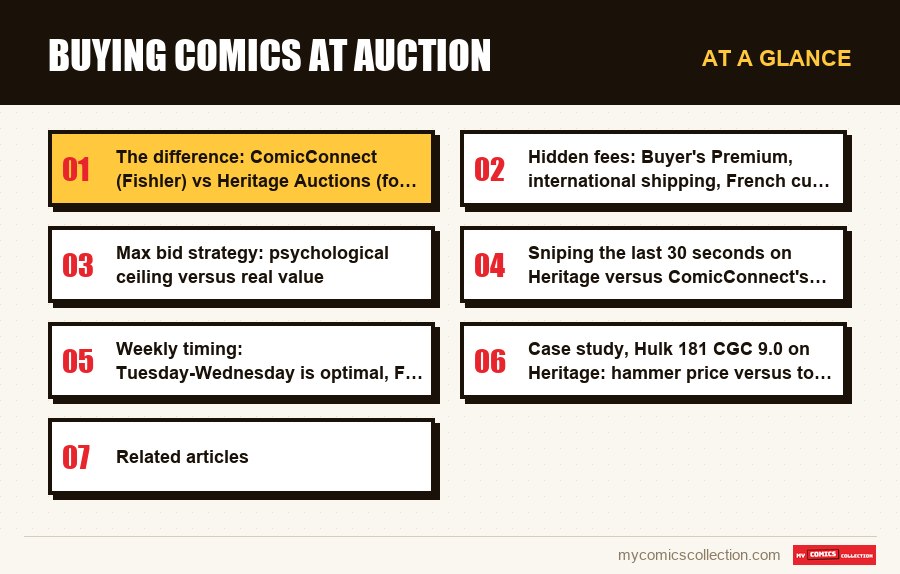
The difference: ComicConnect (Fishler) vs Heritage Auctions (founded 1976)
Each house's DNA shapes the buyer experience well beyond the posted fees. Heritage Auctions was co-founded in Dallas in 1976 by James Halperin and Steve Ivy as a numismatic house (rare coins), and it opened its comics division in the 1990s under the leadership of Lon Allen and Ed Jaster. Today, Heritage employs more than 600 people spread across Dallas, New York, Chicago, Beverly Hills, and Hong Kong. The operation is industrial in scale, the processes are dialed in, and the platform handles several thousand comics a week between the Sunday Comics Auctions and the Weekly Wednesday Auctions.
ComicConnect operates at the opposite end. Founded in 2003 by Stephen Fishler and Vincent Zurzolo (themselves co-founders of Metropolis Collectibles in Manhattan back in 1999), the house cultivates a boutique feel with a dozen specialists at most. The quarterly Event Auctions focus attention on 200-400 carefully presented premium lots, complete with an illustrated editorial catalog and historical essays. Between Events, the Weekly Auctions offer more accessible lots in the $100-$2,000 range. This difference in tempo radically reshapes the buyer's calendar: Heritage calls for continuous weekly monitoring, while ComicConnect demands an intense push four times a year.
For the French buyer, the practical takeaway is threefold. First, the interface: Heritage offers a polished mobile app with push alerts you can customize by title, CGC grade, and price range. ComicConnect relies mainly on the web browser with email notifications, which takes more discipline to avoid missing a closing. Second, customer service: an email to ComicConnect typically gets a reply within 24 hours from a named human (often Fishler or Zurzolo on premium pieces), whereas Heritage runs a more impersonal but trackable ticketing system. Third, the transparency of results: the Heritage Auction Archives are public and indexed back to 2001, which lets you calibrate your max bid against comparables. ComicConnect publishes far less detailed results, which makes pre-bid analysis harder for the novice.
This information asymmetry translates directly into strategy: on Heritage, a buyer can do serious homework before each session by reviewing the last 5-10 comparable sales of a Hulk 181 CGC 9.0, for example. On ComicConnect, a buyer has to lean more heavily on external sources like GoCollect or the CGC Census, and even pay for an independent appraisal when a piece is out of the ordinary. Keeping a personal tracking file with Comics Manager or a dedicated spreadsheet becomes necessary beyond 5-10 purchases a year.
Hidden fees: Buyer's Premium, international shipping, French customs
The hammer price is only a fraction of the real cost. Three layers of fees stack up before the comic lands in your hands in Paris, Lyon, or Marseille. Anticipating these layers at the moment you bid is the difference between a controlled investment and a budget letdown.
The Buyer's Premium is the buyer-side commission charged by the auction house. At Heritage Auctions, the standard rate on comics is 20% of the hammer price with no cap, plus a flat minimum of $19 per lot. At ComicConnect, the Buyer's Premium is officially 19.5% on most lots, but it can climb to 22-25% on premium Event Auctions and certain Internet Bid Sales depending on the catalog's specific terms. For a comic won at $4,000 on Heritage: an $800 premium, $4,800 total to pay. For the same hammer on a ComicConnect Event Auction at 22%: an $880 premium, $4,880 total. Always read the Terms and Conditions of the targeted auction, because the premium can vary from one session to the next.
International shipping to France is the second layer. Heritage charges FedEx International Priority shipping at roughly $80-120 for a single CGC slab, and $150-300 for a lot of 3-5 high-value insured slabs. Insurance is mandatory above a certain declared value and is included in the rate. ComicConnect favors USPS Priority International Express with insurance, around $60-100 for a slab, or FedEx on request at a rate comparable to Heritage. For ultra-valuable pieces ($10,000+), both houses offer specialized shipping (Brink's, Malca-Amit) in the $300-800 range with secure transport. Calculating shipping to France remains a headache, since FedEx rates fluctuate with the fuel surcharge and the rate zone.
French customs and VAT close out the bill. Any comic imported from the US above €150 in declared value triggers: VAT at 20% on the declared value + shipping (the CIF base), customs duties at 0% for comics since they're classified as literary printed matter (TARIC code 4901), and a carrier customs-clearance fee of €15-30 charged by FedEx or DHL. A Hulk 181 CGC 9.0 won at $6,000 with $150 FedEx shipping represents a VAT base of $6,150, or roughly €5,650 at the 2026 average exchange rate, which generates €1,130 of VAT to pay before delivery, plus €25 in FedEx fees, for an extra €1,155 paid to the carrier at customs clearance. The import VAT mechanism is laid out in detail, but the rule is constant: add 22-25% to the USD cost to get your net France figure.
Max bid strategy: psychological ceiling versus real value
Setting a max bid before placing your first bid is the cardinal discipline of the serious buyer. Without a predefined ceiling, the commitment effect (the sunk cost fallacy) pushes you to overbid past market value out of pride or in the heat of the moment. The rigorous method rests on four documented steps.
Step 1: objective market value. Check three independent sources to calibrate the Fair Market Value of the targeted comic. The Heritage Auction Archives give the hammer prices from the last 12 months for the exact grade (a Hulk 181 CGC 9.0 saw 8 sales in 2026 between $5,200 and $7,800). GoCollect or CovrPrice provide 90-day moving averages that smooth out outliers. The public CGC Census shows how many copies exist at the targeted grade (relative rarity). Set your FMV in the middle of the observed range, adjusted upward if the census shows the grade thinning out.
Step 2: tally the all-in costs. From your gross FMV, subtract the 20% Buyer's Premium, the estimated $100-150 shipping, and the 20% French VAT on the CIF base. For a Hulk 181 CGC 9.0 whose FMV is $6,500 with a projected total cost around $9,500, your max hammer should be $6,500 × (1 / 1.20) ÷ 1.22, roughly $4,435, to stay under $6,500 all-in. This reverse equation often shocks the novice: to avoid going over €6,500 all-in, your Heritage max bid has to cap out around $4,435-4,500. Investing in graded comics demands this arithmetic rigor, or you'll systematically overpay.
Step 3: personal psychological threshold. Beyond market value, set your emotional ceiling: at what total France figure do you walk away from the lot, regardless of FMV? This threshold depends on your monthly comics budget, your related financial commitments, and your tolerance for post-purchase regret. Write that number on a sticky note kept in view during the session. If the bidding crosses that threshold, physically step away from the screen (close the laptop, leave the room). That gesture heads off impulse bids. Many experienced buyers set their Heritage MaxBid a few hours before closing to force themselves to physically step out of the process.
Step 4: an inflation margin. If the targeted comic is on an upward trend (a cover recently announced as appearing in an MCU film, a creator's death, an editorial anniversary), tolerate 10-20% above your calculated FMV. If the piece is flat or declining (an oversupply of recently certified slabs), stay 5-10% below FMV. Tracking 2026 trends by title and by grade is necessary for this adjustment. A simple method: compare the CGC census for the targeted grade 12 months apart. If the number of graded copies has jumped more than 20%, the value will probably drop, which is reason to hold a cautious max bid.
Sniping the last 30 seconds on Heritage versus ComicConnect's anti-snipe
Sniping (a last-second bid) remains the most effective buyer technique for avoiding emotional overbidding, provided the platform allows it. The two houses apply diametrically opposed rules that change the entire tactic.
Heritage Auctions has no anti-snipe protection on its Internet Only auctions (Weekly Wednesday) and certain Sunday Comics: the closing is firm at the announced time. This absence opens the classic window for effective sniping: placing your MaxBid through the Heritage Live interface in the final 10-30 seconds to keep competitors from climbing. Heritage handles proxy bidding automatically, so if you place $4,500 as a MaxBid at 30 seconds, the system bids for you in increments ($50, $100, $250 depending on the range) up to your ceiling, beating out lower competing MaxBids. If three rivals have placed $3,800, $4,200, and $4,400, you win at $4,450 (one increment above the second-highest MaxBid). This mechanic is publicly documented by Heritage.
The technical constraint of Heritage sniping: your internet connection has to be stable, and you have to be physically present. The FR-US time difference works against you: the Sunday Comics Auctions typically close at 10 p.m.-2 a.m. Paris time, which means staying up late. One alternative: schedule your MaxBid 24 hours in advance as a firm figure. You enter your ceiling, close the tab, and Heritage bids for you in regular increments. The downside: if a surprise bid shows up late, you don't have the flexibility to react.
ComicConnect applies systematic anti-snipe protection: if a bid is placed within the final 5 minutes before the announced closing, the timer automatically extends by another 5 minutes. This extension repeats as long as bids keep arriving within that rolling window. In practice, an auction set to close at 9 p.m. can stretch to 9:45 or 10 p.m. if activity stays heavy. This protection completely neutralizes pure sniping: placing your bid at 30 seconds gives you no advantage because the timer restarts. Whatnot uses a similar anti-snipe mechanic on its live auctions.
The effective ComicConnect strategy is therefore to place your real MaxBid several hours before closing and accept that proxy bidding will do its job. If you place $4,500 as a MaxBid three hours before closing, ComicConnect automatically bids for you against competitors as long as you don't exceed your ceiling. When the anti-snipe extension kicks in during the final minutes, the system keeps bidding up to your MaxBid. You win or lose based on the real MaxBid of the most determined competitor. This mechanic rewards discipline on the ceiling rather than speed. eBay's mechanics differ again, with a partial 5-second anti-snipe buffer on certain categories.
Collecting this series?
Track what you own, what you are missing and what your collection is worth. 7 day trial.
Start my trial →Weekly timing: Tuesday-Wednesday is optimal, Friday-Sunday best avoided
The day of the week an auction closes directly affects the average hammer price, because the mix of active bidders shifts depending on the moment. The empirical data observable in the Heritage Archives and GoCollect analyses converge: auctions closing Tuesday-Wednesday evening US time fetch, on average, an 8-15% lower hammer price than those on Sunday evening, for an equivalent comic and grade.
Why Tuesday-Wednesday? Hobbyist collectors, who are predominantly American, are less available on weeknights to follow an evening closing: work, family dinner, TV schedule. The remaining bidders are mainly professional dealers who coldly calculate their resale margin. This dealer population won't bid past wholesale value (typically 60-70% of retail value), which mechanically caps the bidding. The Heritage Weekly Wednesday closes on Wednesday evening and shows exactly this dynamic: more measured prices, fewer emotional overbids, buyer opportunities if you accept the timing.
Why avoid Friday-Sunday? The weekend mobilizes the hobbyist collector population at peak availability: kids in bed, the evening free, no work the next day. The Heritage Sunday Comics Auctions close on Sunday evening precisely, which maximizes their consumer audience and drives hammer prices up. For a seller, it's ideal; for a buyer, it's the worst moment. If you're targeting the same Hulk 181 CGC 9.0 available in two different sessions (Wednesday vs Sunday), always favor the Wednesday to save $500-1,000 on the hammer.
The France-USA time difference adds a layer of complexity. Heritage closings are announced in CT (Central Time, Dallas) or ET (Eastern Time, New York depending on the division). A closing announced at 10 p.m. CT corresponds to 5 a.m. in Paris. A 10 p.m. ET closing corresponds to 4 a.m. in Paris. French buyer discipline means scheduling your MaxBid ahead of time via proxy bidding rather than attempting a live snipe at hours incompatible with healthy sleep. A spreadsheet tracking scheduled closings with automatic time-zone conversion is necessary. Excel or Google Sheets with the formula =A1-TIME(7,0,0) (for CT to Paris in winter time) or =A1-TIME(6,0,0) (for ET) simplifies the organization.
ComicConnect also publishes its Event Auction closings in ET. The main sessions traditionally concentrate on Wednesday-Thursday evening US time, which places the closings around 3-4 a.m. in Paris. Scheduling a MaxBid via proxy bidding is even more necessary than on Heritage, since the anti-snipe mechanic makes a French live session impractical. Place your final MaxBid the night before, double-check your emotional limit, and move on.
Case study, Hulk 181 CGC 9.0 on Heritage: hammer price versus total France cost
Let's take a concrete example to make all the preceding concepts tangible. Incredible Hulk 181 (Marvel, November 1974) is the first full appearance of Wolverine, graded CGC 9.0 White Pages, no signature, no pedigree. The 2026 FMV hovers around $6,500 with a $5,500-$7,500 range depending on the current census and MCU momentum. The French buyer consults the Heritage Auction Archives and identifies the lot won at the October 2026 Sunday Comics Auction.
Final hammer price: $6,200. The French bidder placed his MaxBid at $6,400 via proxy bidding 48 hours before closing, after carefully calculating his envelope. The most determined rival pushed to $6,100 before giving up. Heritage applies the next increment ($100) to award at $6,200. The bidder wins with a $200 margin under his technical ceiling.
Buyer's Premium at 20%: 6,200 × 0.20 = $1,240. Total paid to Heritage: 6,200 + 1,240 = $7,440. Heritage also charges a flat minimum of $19 per lot, included in the premium, so the math holds.
FedEx International Priority shipping with a declared $7,500 insurance: $145 charged. Intermediate total: 7,440 + 145 = $7,585. Heritage applies an insurance policy proportional to the declared value, here roughly $25 included in the overall shipping rate.
EUR conversion at the day's rate: $7,585 × 0.92 = €6,978 (a hypothetical average rate of 1 USD = 0.92 EUR). Heritage payment is made in USD by bank card or wire transfer, so the exchange spread applied by your French bank genuinely weighs in. With a traditional bank like BNP or Société Générale applying a 2% spread + €25 in SWIFT fees, the real cost rises to €7,117. With a Wise multi-currency account pre-funded in USD, the cost stays €6,978 + €5 in conversion fees, or €6,983.
French customs clearance on arrival: CIF base = declared value $7,585 + transport already included = $7,585 converted to EUR via the official customs rate, or roughly €6,978. VAT at 20% = €1,396. FedEx flat customs-clearance fee: €25. Total clearance: €1,421.
Final total France cost: €6,983 (Heritage payment via Wise) + €1,421 (FedEx clearance) = €8,404 all-in. This cost represents 35.5% above the gross $6,200 hammer price (€5,704 equivalent). This 35% inflation is constant across every Heritage purchase bound for France: build it into your max bid calculation every time. On premium comics of $50,000+, the France surcharge adds €17,500+ on top of the hammer value, which can put certain pieces out of reach for the French buyer.
The operational lesson: for a piece whose resalable France FMV is €8,000 (a probable future resale hammer of $5,800-6,000 before premium), never pay more than €8,400 all-in. The break-even is marginal and the future appreciation uncertain. If your goal is investment with resale projected in 3-5 years, always target 20-30% below the France FMV to keep a margin in case of stagnation. The CGC vs CBCS choice also impacts future resale, with an observed CBCS discount of 10-20% depending on the title.
FAQ: Buying comics at auction on ComicConnect and Heritage
How does proxy bidding work on Heritage and ComicConnect?
Proxy bidding is the automatic mechanism that lets you place your MaxBid once and have the system bid for you in regular increments up to that ceiling. If you place $5,000 as a MaxBid on Heritage and the highest competitor has placed $4,200, Heritage awards in your favor at $4,300 (one increment above). If a competitor overbids live at $4,400, Heritage bumps you back to $4,500 automatically, and so on up to your $5,000 ceiling. ComicConnect applies the same mechanic. This automation frees you from being present live and disciplines your emotional ceiling. Schedule your MaxBid a few hours before closing to avoid the temptation to overbid in real time.
Can I reclaim the French VAT if I resell the comic later?
No, the VAT paid on import is permanently lost for a private buyer-collector. Only VAT-registered professionals (registered dealers with an intra-EU VAT number) can reclaim that VAT through their quarterly return. For the private individual, build the 20% VAT into your total cost and calculate your future gain on that all-in basis. If you then resell via eBay France or a French platform, you don't charge VAT either (below the professional threshold). Reselling to the US, on the other hand, is VAT-neutral, since exports fall outside the French tax scope.
What is the most economical payment method on Heritage?
A direct bank wire transfer in USD remains the cheapest option on Heritage: no 3% surcharge like the one applied to bank cards. Open a Wise or Revolut Business multi-currency account, pre-fund it in USD at an opportune exchange rate, and pay Heritage by a free domestic US wire. Typical saving: 3% on the total invoice, or $200-300 on a $7,000 sale. A bank card stays practical for small lots under $500, where the surcharge is negligible. Absolutely avoid PayPal for large lots: Heritage applies a specific surcharge and you stack on unfavorable PayPal exchange fees.
Are there hidden storage fees on ComicConnect?
Yes, ComicConnect charges storage fees if you don't collect your won lot within 30 days of payment, typically $5-10 per lot per additional month. Heritage applies a similar policy with a generally longer grace period (60-90 days). For a French buyer who depends on international shipping, arrange payment and the shipping request within 7 days of winning. Explicitly ask to combine several simultaneously won lots into a single package to save on consolidated shipping. Heritage combines automatically on request; ComicConnect requires an email confirmation.
What do I do if the comic arrives damaged in France?
The CGC slab is designed to withstand transport, but knocks can happen. On receipt, open the package while filming continuous video from the moment you open it through to inspecting the slab. If the slab is cracked or the comic is damaged, contact the auction house within 48 hours with photos and video. Heritage and ComicConnect activate their shipping insurance to reimburse the declared value. Processing takes 30-90 days. Keep the original box and all the packaging for any potential appraisal. The comic can't be sent back to CGC for reslabbing at your expense; the auction house either handles the procedure or compensates you, at its discretion.
Related articles
- ComicConnect vs Heritage Auctions: seller comparison
- Buying comics at auction: a general guide
- Importing US comics into France: customs and VAT
- The most expensive comics sold in 2026
- Raw vs graded: which investment in 2026