Of the two hundred US listings examined on August 30, 2026 between $1,500 and $2,000, two hundred are verified copies. No exceptions. The median amount claimed is $1,799.99, the floor is $1,500.00 and the ceiling is $2,000.00. The statement is American and denominated in dollars because the French market no longer provides, at this level, a usable offer: only one hundred and three advertisements, nine of which are verified, and content which is not even comics. These amounts are what sellers were asking for that day, not completed transactions, and a measurement taken on a single date says nothing of an increase or decrease.
The previous stages of this series read like sorting exercises: it was necessary to separate the copy described seriously from that which was based on a blurry photograph and a promise. At two thousand euros, this sorting work no longer needs to be done, because it has already been done upstream by the market itself. Two hundred advertisements out of two hundred carry a verified copy, that is to say sealed, noted and identified by a verification body. This is not a preference that I recommend that you adopt, it is a constraint that you are subject to: the seller who hopes to obtain fifteen hundred dollars from a raw issue, without being sealed or graded by a third party, no longer finds a buyer at this level and has stopped trying.
This shift changes the nature of the questions to be asked. At the lower levels, the buyer spent most of their energy determining whether the item matched their description. Here, the description is produced by a third party and the hull identification number makes it controllable. The energy therefore moves elsewhere: towards the intermediary who sells, towards the return conditions which he accepts, towards transport insurance, and, for a French reader who buys in dollars on a foreign market, towards the real cost of the object once it arrives at home. I have no figures on conversion, delivery or import duties, and I will not invent any: these costs exist, they are added to the amount displayed, and they are checked with the customs services before the purchase, never after.
What exactly the August 30, 2026 statement contains
The measurement concerns two hundred American advertisements displaying an amount between $1,500.00 and $2,000.00, questioned on the wording “comic cgc key issue”. The observed floor coincides with the lower limit of the request and the ceiling with its upper limit, which means that the slice is full from side to side: there is no hole, no deserted zone between the two ends. The median, $1,799.99, is well above the arithmetic midpoint of the interval. The upper half of the ads therefore crowd against the ceiling, which is the expected behavior of a slice cut arbitrarily in a continuum: sellers align their requests with round psychological thresholds, and $2,000.00 is one of them.
One point deserves to be asked bluntly, because it conditions everything else: these amounts are claimed, not collected. An announcement is a unilateral proposal. It reflects what a seller believes he can get, never what a buyer actually paid. The maximum of $2,000.00, in particular, should not be read as an established price: it reflects an expectation, and there is no guarantee that it has been met. The median is a more robust indicator because it absorbs extreme values poorly, but it remains a median of requests.
Finally, this reading was taken on a single day. He photographs a state of supply, he does not describe any movement. I cannot write that this level goes up, nor that it goes down, nor that it stabilizes, because a single point does not draw a trajectory. Any statement of trend would require at least two comparable surveys spaced over time, constructed on the same query and the same perimeter. What I am asserting, however, is the composition of the offer on that date, and it is unambiguous.
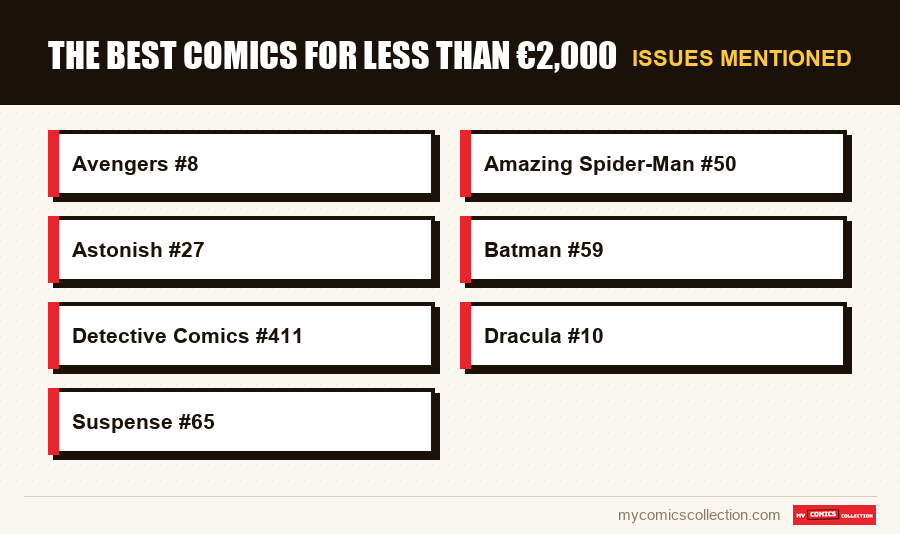
Eight announcements that summarize the level
Avengers #8, note 8.5, 1 500,00 $
Described as the first appearance of Kang the Conqueror, this 1964 copy occupies the exact floor of the installment with a high rating. This is the most legible configuration of the level: a sought-after document, a comfortable state of conservation, and a claimed amount which remains at the lower limit. It serves as a useful point of comparison for everything that follows.
Amazing Spider-Man #50UK, note 7.0, 1 500,00 $
A 1967 British prize variant, associated with the Kingpin's first appearance, checked and sealed like the others. Its presence at this level indicates that the country of publication is no longer a source of ambiguity: it appears in the identification of the copy, it is documented, and it does not penalize the amount claimed.
Tales to Astonish #27, rating 1.5, $2,000.00
This 1962 copy, presented as the first appearance of Ant-Man, carries a rating of 1.5, therefore a very degraded condition, and yet claims the upper limit of the installment. This is the clearest illustration of the reversal described below: on the most popular issues, the note ceases to be the dominant factor in the amount.
Strange Tales 110, rating 3.0, $2,000.00
Dated 1963 and described as the first appearance of Doctor Strange, this copy also commands $2,000.00 with a low grade. Placed side by side with Avengers #8 rated 8.5 at one thousand five hundred dollars, it shows that at this level two copies can be separated by more than five rating points without the amount requested following the same hierarchy.
Four other announcements complete the picture and deserve to be cited as they are. A 3.5-rated Batman #59, dated 1950 and described as the first appearance of Deadshot, at $1,500.00. A Detective Comics #411 from 1971, rated 9 and featured as Talia al Ghul's first appearance and first cover, also at $1,500.00. A 1973 Tomb of Dracula #10, rated 9.0, associated with the first appearance of Blade, at $2,000.00. A Tales of Suspense #65 rated 2.5, described as first appearance of the Red Skull and bearing a signature, at $2,000.00. These eight lines cover a range of notes which goes from 1.5 to 9, for a range of amounts which does not exceed five hundred dollars.
Two copies rated 1.5 and 2.5 appear at the top of the tranche, while one copy rated 8.5 occupies the floor. A low rating means a very damaged booklet: detached or weakened cover, marked folds, altered paper. That such objects demand more than an example in good condition is not a measurement anomaly.
This is a sign that we are no longer paying for the quality of conservation but for access to the object itself. On the most sought-after issues, the number of copies available in good condition is so low that collectors focus on degraded copies, and the amount requested is based on the rarity of the title, not on its condition. This mechanism is specific to the most popular titles; it does not generalize to the rest of the market.
The French market does not exist at this level
The same slice queried in euros on the French market, with the broadest possible wording: “comics”:, only comes up with one hundred and three advertisements, nine of which are verified. One hundred and three is a low number. Nine copies verified, this is a number from which we cannot draw any conclusions on a price level: the dispersion of such a small number of advertisements makes any median unstable and any deviation interpretable in any direction. I therefore refrain from deducing anything about what a verified comic in France is “worth” in this installment.
The content of this French statement is more instructive than its figures. There we find original plates, that is to say unique drawings and not printed booklets. There are works signed by Franco-Belgian comic book authors. There is a manga there. In other words, the query “comics” on the French market at two thousand euros does not mainly return American comics: it returns everything, in high-end illustrated print, which reaches this amount. The two markets do not sell the same thing under the same word.
The practical consequence is direct. A French collector aiming for this level will, in the vast majority of cases, have to buy abroad and in foreign currency. This adds three items to the displayed cost: conversion, shipping, and import costs. I have no figures on these three positions and I am not going to guesstimate them. They obtain information from the competent customs services before committing, and they must appear in the budget in the same way as the amount of the announcement.
We must also accept what this situation implies in terms of delay and recourse. A cross-border purchase lengthens transport, increases the number of intermediaries and complicates the resolution of a dispute. This is not a reason to give up, it is a reason to select the intermediate with the same rigor as we selected the specimen at the lower levels. The hubs dedicated to the characters concerned:Docteur Strange, Ant-Man ou le Caïd: at least allow you to locate a booklet in its series before getting started, and the page Steve Ditko brings together the titles associated with this author in the catalog.
Six points to check before validating a purchase at this level
Hull number
Each verified copy carries a unique identifier that can be consulted by the organization that rated it. It allows you to confirm that the rating displayed in the ad corresponds to that recorded. At two thousand euros, this check takes a few seconds and is the only independent proof you have.
L'année d'édition annoncée
The issues in the survey range from 1950 to 1973. The same issue may have undergone subsequent reprints whose value is in no way comparable. The year on the case label must correspond to that of the original print you believe you are purchasing.
The nature of the notice given
One copy of the statement is signed, which is a distinct feature of the condition note. An attested signature and a simply asserted signature do not have the same status. Check what exactly the label says, and don't infer anything from the photograph alone.
The planned packaging and its insurance
A sealed copy remains fragile: the shell cracks, the object travels. Ask before payment what packaging is planned and what insurance covers transport, for what amount. A shipment without coverage equal to the price paid transforms a logistical incident into a deadweight loss.
The variant and its country of edition
The statement contains a UK price variant. It is perfectly legitimate and verified, but it constitutes a separate object from the American edition of the same issue. Make sure you know which one you are purchasing, and record this information upon receipt.
The seller's written description
Verification is based on physical condition, not the editorial claims of the ad. Mentions of first appearance relate to the text written by the seller. Cross-check them in the catalog before purchasing, especially when they justify most of the amount requested.
Collecting this series?
Track what you own, what you are missing and what your collection is worth. 7 day trial.
Start my trial →The seesaw that defines this level
The central fact of this installment can be summed up in one sentence: the unverified market has disappeared. Two hundred advertisements out of two hundred, without exception, carry a sealed and noted copy. At the lower levels, the choice between buying raw and buying verified still arose, and it was reasoned according to budget and intention. Here, this choice no longer arises: the market does not offer it. This is neither a recommendation nor a value judgment, it is a state of affairs that the buyer notes and to which he adapts.
This uniformity produces an interesting side effect. Since all the copies are described according to the same scale by third parties, the comparison between two advertisements finally becomes possible on common bases. We can put a Detective Comics #411 rated 9 and a Tales of Suspense #65 rated 2.5 side by side and know precisely what separates them in terms of condition. What the audit doesn't say, however, is why the second is asking for five hundred dollars more than the first. This response relates to the request for the title, not the subject.
The second switch concerns the country of publication. At the lower levels, a foreign edition was often indicated by a confusing description and became a factor of doubt. In this survey, the British variant is identified, documented and cataloged in the same way as the rest. The country of publication once again becomes a neutral characteristic among others, to be recorded as one records a note. This is progress in readability that can only be measured by comparing it to what is happening further down the market.
The third shift is that of the object of attention. When the exemplar is described by a third party, the variable that remains open is the intermediary. Its return policy, the way it packages, the precision of its written description, its responsiveness in the event of a dispute: this is what now distinguishes two advertisements bearing the same issue at the same note for the same amount. I will not name any companies, because that would be a comparison that I cannot substantiate; I describe the criterion, it’s up to you to apply it.
What to note and record
The note and identification number of the verified copy. These two pieces of information form the pair that uniquely identifies your object. The note alone is not enough: several copies of the same issue share the same note. The number on the label only designates yours, and it is this which will allow us to reconstruct the history of the object, to resell it without dispute or to declare it in the event of an accident. Record them together, upon receipt, even before putting the item away.
The country of publication of the received booklet. The statement contains a UK price variant alongside US editions, at the same amount level. These objects are not interchangeable and their respective markets do not behave identically. Explicitly note which one you are holding, rather than assuming that a number is enough to describe it. This precision, trivial at the time of purchase, becomes very costly to find several years later on a sealed copy stored in a crate.
Return conditions accepted by the seller. They are appreciated before payment and kept afterwards. How many days, at whose expense, with what procedure, and above all: is the return still possible from France to the seller's country? A return policy posted for a domestic buyer does not necessarily apply to a cross-border shipment. Record the exact wording at the time of purchase, not your memory of it.
Transport insurance and its amount of coverage. A two thousand euro item traveling without equivalent coverage is a gamble. Note who purchased the insurance, how much, and what it excludes. Also note the condition of the packaging on arrival: a cracked shell noted and documented immediately can be treated; the same crack reported three weeks later can no longer be treated. The subject is developed in the guide dedicated to insurance of a collection according to its value.
The total cost incurred once the item is received. The amount of the ad is not the price paid. Added to this are the conversion from the dollar, the delivery and the costs linked to importation, of which I have no measurement and which I take care not to estimate. Really add them up, on invoice, and record this total rather than the displayed price: it is this figure, and this alone, which will serve as a reference the day you compare what the item cost you to what it is offered to you. The applicable amounts can be checked with customs services.
Because the same section surveyed on the French market only shows one hundred and three advertisements, nine of which are verified, and this survey contains original plates, dedications from Franco-Belgian comics and a manga. At this level, there is no sufficient French comic book offering to be measured. The American survey, with its two hundred announcements, is the only one which allows usable observation.
The statement shows it: a Tales to Astonish #27 rated 1.5 demands $2,000.00, while an Avengers #8 rated 8.5 demands $1,500.00. These are two different issues, which explains the difference: on the most requested titles, the rarity of the issue weighs more than the condition of the copy. This does not mean that a low note is not important within the same booklet.
No, and nothing in this data allows us to say so. The measurement was taken on August 30, 2026, only once. A single point describes a state, not a trajectory. To talk about an increase or a decrease, there would need to be at least two comparable surveys, built on the same request and the same perimeter, separated in time. This median only describes where requests were concentrated that day.
No. That of the statement, an Amazing Spider-Man #50UK rated 7.0, is verified and demands the same amount as American editions of the tranche. The point of emphasis is not the legitimacy of the item but its identification: a UK variant and the US edition of the same issue are two separate items, and you need to know which one you are purchasing and then register it as such.
Currency conversion, shipping and import fees. I do not have any figures for these three items and I am not going to estimate them: their amount depends on the declared value, the carrier and the regulations in force at the time of purchase. They are checked with customs services before committing, and they must be budgeted for from the start.
A copy at this price deserves a record, not a souvenir
Note, identification number, country of edition, return conditions, insurance and total cost: six pieces of information that are lost in a few months if they are not recorded somewhere. My Comics Collection allows you to attach these elements to each copy in your collection and find them instantly, whether for resale or for a statement.
The full scale of budgets
- Previous level: less than €1,500
- Next level: less than €5,000
- Less than €5
- Less than €10
- Less than €20
- Less than €50