Between $2,000 and $5,000, the most hotly contested first appearances cease to be theoretical: they become accessible, but in average condition. Of the two hundred US listings examined on August 30, 2026, the low was $2,000.00, the midpoint was $2,724.99, and the high was $5,000.00. These are amounts claimed by sellers that day, not settled transactions; a single reading, taken on a single date, says nothing about the direction in which this level is moving. One hundred and ninety-nine of these two hundred copies were certified and graded. On the French side, the same section brings together only 79 advertisements whose content has almost nothing comical: this market does not exist at this level, and any purchase therefore requires conversion, transport and import costs of which this statement says nothing.
Previous budget levels forced us to choose between ambition and reality: we aimed for a big first appearance, we left with an adjacent issue, a secondary episode or a reissue. From two thousand dollars, the arbitration changes in nature. The booklets that appear in the manuals, the ones that everyone cites when talking about sought-after comics, finally appear in the ads, but they appear there as they have survived, that is to say often worn, sometimes treated, rarely impeccable. The $5,000 level isn't where you buy well: it's where you start having to explicitly choose what you sacrifice.
The statement of August 30, 2026 makes this arbitrage visible because it contains, at the same amount, opposing configurations. The same booklet appears twice, once in honorable condition and once in frankly degraded condition, and both sellers ask for exactly the same amount. One copy is described as having undergone conservation treatment. An annual issue slips in among the regular issues. Each of these situations costs money for anyone who doesn't spot them before paying, and none of them show up in a cover photo.
What the August 30, 2026 statement actually contains
Two hundred American advertisements were examined in the $2,000-$5,000 bracket, based on a query for certified key numbers. The lowest amount reached exactly the floor of the bracket, $2,000.00; the central amount was $2,724.99; the highest touched the ceiling, $5,000.00. This concentration deserves a remark: the central value is significantly closer to the bottom than the top of the range, which means that most of the supply is located in the first third of the level and that the top is occupied by a small number of advertisements. An isolated maximum reflects a seller's expectation, not an observed level.
Certification is the rule here and not the exception: 199 copies out of 200 were verified and noted by an organization, encapsulated, carrying an identifier. The only unverified batch appears to be a statistical anomaly. This is methodological information as much as market information: at this price level, the buyer no longer compares descriptions written by sellers, he compares ratings given by third parties. This removes a lot of the vagueness, and it creates another: that of knowing what exactly the note covers, a question to which we return later.
The contrast with the French market is brutal. In the equivalent bracket in euros, a broad search on comics brings together only 79 advertisements, of which only ten presented a verified copy. The content of these announcements is enough to conclude: there is a vintage t-shirt, Japanese trading cards, a hardcover book offered for pre-sale and a collection of 19th century prints. With such a small workforce and such a heterogeneous composition, no French price level can be deduced: there is simply no French offer at this level. Buying at this level therefore means buying in the United States, with all that this implies in terms of currency conversion, shipping and import formalities. The statement does not measure any of these costs, and we will therefore not provide any figures for them.
The booklets that make up this level
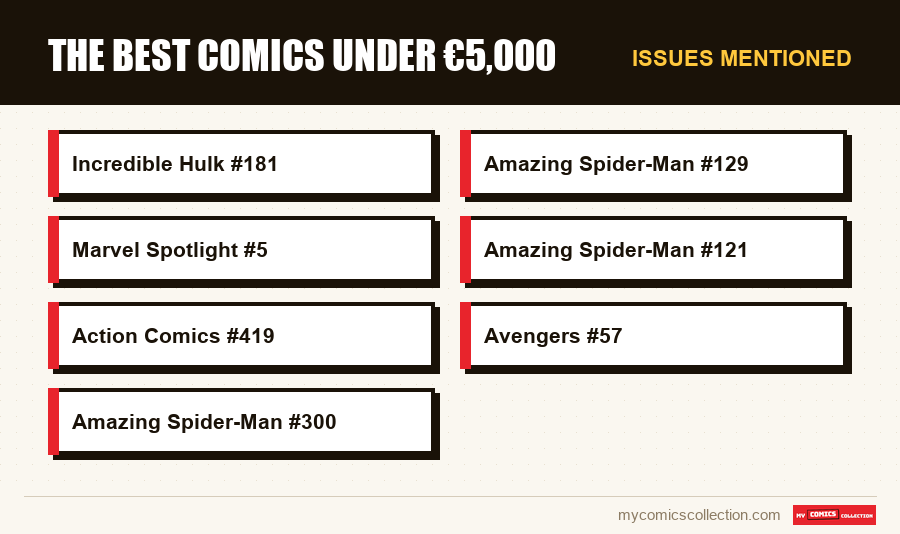
Incredible Hulk #181, the upper limit
Wolverine's first full appearance occupies the two most expensive listings on the survey, both at $5,000.00. One carries a rating of 8.0, the other a rating of 4.0. The booklet is dated 1974. It is the only title in the survey to appear twice at the top of the range, which makes it the natural marker of the level.
Amazing Spider-Man #129, The Punisher's Entrance
Offered at $2,000.00 in grade 8.0, this copy bears an additional notice: it is described as “preserved”, that is to say having been the subject of treatment. The same number in the same state without this mention is not the same object, and cannot be directly compared.
Marvel Spotlight #5 and Amazing Spider-Man #121
Two listings at $5,000.00 each. The first corresponds to the first appearance of Ghost Rider in rating 8.0; the second to a 1973 example rated 9.8, one of the highest grades that the certification scale allows to achieve. Two different logics for the same amount.
The bottom of the range at $2,000.00
Four ads share the floor: Action Comics #419 from 1972 in 9.8, the first appearance of Human Target with a cover by Neal Adams; Avengers #57 from 1968 in 8.0, first appearance of Vision, signed; Amazing Spider-Man #300 in 9.4, also signed; and the 1964 annual mentioned below.
This panorama shows that the level is not homogeneous. It is home to both very high scores on moderately sought-after numbers: a 9.8 on a 1972 booklet is at the bottom of the range, and mediocre scores on massively sought-after numbers, a 4.0 sufficient to occupy the top. In between, signed copies, covers of identified authors and intermediate states. The budget therefore does not determine what we get: it only determines the set of possible combinations, within which we still have to choose.
The most instructive fact in the statement is contained in one line. Two copies of the same booklet, separated by four status points on the grading scale, are claimed at the same amount: $5,000.00 for grade 8.0, $5,000.00 for grade 4.0. These are requests posted on the same day, no sales concluded, and there is nothing in the ads to tell which of the two sellers is wrong.
What we can say, however, is that they cannot both be right. Four points of difference on the same reference describe two very different objects: one presentable, the other visibly worn. If the amount requested for the damaged copy is fair, that of the clean copy is too low; if it is the opposite, the buyer of 4.0 pays an amount which does not correspond to what he receives. Faced with this kind of configuration, the only useful reaction is to refuse to conclude based on the announcement alone.
Six checks before committing this amount
The same price does not mean the same object
When two ads from the same number appear for the same amount with far apart ratings, don't look for which one is "the good deal." First look for what, outside the note, could justify the discrepancy: a signature, a particular pagination, a mention of treatment. If nothing appears, the question remains open and the purchase premature.
A single date does not make a trend
This reading was taken on August 30, 2026 and on this date only. It describes an offer at a given moment, not a trajectory. Nothing in these two hundred announcements allows us to say whether this level is rising, falling or stagnating, and no one should present these figures as an evolution.
“Preserved” is not neutral
A copy of the statement explicitly bears this mention. It indicates a material intervention on the object. This is neither a hidden defect nor a guarantee: it is a distinct category, which must be identified before purchase and which makes the comparison with a never touched copy largely ineffective.
The price displayed is not the final cost
The offer is in the United States, in dollars, and the French market has nothing to offer at this level. Added to this are currency conversion, delivery and import formalities. This survey does not measure them; they must be calculated before thinking about a budget, never afterwards.
Regular or annual, it's not the same number
The statement contains a 1964 annual, graded 6.0, claimed $2,000.00. Annuals follow their own numbering, parallel to that of the monthly series. An annual “number 1” and a regular “number 1” do not designate the same issue, and the confusion survives up to this price level.
A signature is a statement to be verified
Two ads at the bottom of the range mention a signed copy. A signature only has significance if it has been affixed, noted and recorded under traceable conditions. On an ad, it’s text; on a verified copy, this must correspond to a statement made by the organization and attached to the identifier.
The trap of the annual number
The presence of an annual from 1964 in this survey is not anecdotal. This issue concentrates several first appearances and is, as such, worth as much as many well-known regular issues. But it has a low number, the same as a first serial number, even though it belongs to an entirely separate sequence. A poorly informed catalogue, an abbreviated advertisement title, a hastily formulated search are enough to confuse the two.
The consequence is asymmetrical and that is what makes it dangerous. Thinking you are buying an annual and receiving a regular issue is a disappointment; thinking you're buying a regular issue and receiving an annual is sometimes a nice surprise. In both cases, we paid for an object that we had not identified, and we cannot defend our price afterwards. At two thousand dollars, the confusion cannot be made up for by simply returning it to the seller.
The parade is purely documentary. Each issue of a catalog has a complete identity: exact title of the publication, sequence to which it belongs, number in this sequence, year, and where applicable mention of special publication. Until these elements are all aligned between the ad, the certification label and your own reference, the line remains incomplete and the purchase must wait.
Collecting this series?
Track what you own, what you are missing and what your collection is worth. 7 day trial.
Start my trial →What the status note doesn't say
At this level, the score awarded by a verification body is the main instrument of comparison, and 199 out of 200 copies carried one. It regulates many things: it prohibits the seller from qualifying their item themselves, it makes the advertisements comparable with each other, it links the object to an identifier that can be found. It doesn't solve everything.
First, a rating summarizes in one number a set of defects that are not interchangeable. Two similarly graded copies may have very different weaknesses: one folded, the other discolored, the other still fragile on the spine. The rating does not say which will age best, nor which will withstand handling. Then, a note says nothing about the price: it orders the copies in relation to each other, it does not set any amount. The two ads at $5,000.00 for the same reference demonstrate this.
Finally, the note must be read with its additional information. A treated copy, a copy whose signature has been noted, a restored copy do not fall into the same category as an ordinary copy, even with the same grade. The statement provides an explicit example of this with the announcement bearing the mention of conservation. This is precisely the kind of detail that disappears from a poorly designed monitoring table, and that we regret not having noted two years later, when comparing with another offer.
What to record for each copy of this tier
The rating and certification ID. At this level, almost the entire market is verified: the note alone is therefore no longer enough to distinguish two examples, since thousands of objects share the same one. It is the unique identifier carried by the label which individualizes yours and allows, later, to link it to the original ad, its rating and its history. Save the two together; one without the other is useless.
The mention of a treatment or restoration. The announcement of number 129 indicates a preserved copy. This precision belongs to the file in the same way as the note, because it changes the category of the object and not only its degree of wear. Note the exact wording used by the seller and that used by the organization if they differ: it is this difference that will help you decide the day someone asks you to compare your copy to another.
The type of publication. Regular or annual: the distinction must appear explicitly, not be inferred from the number. The statement contains an annual from 1964 whose bottom number can be confused with the beginning of the series. A card which bears the title of the publication, the sequence and the number in this sequence makes confusion impossible; a sheet which only bears a number makes it inevitable as soon as the collection exceeds a few dozen references.
The signature and what it was evidenced by. Two announcements at the bottom of the range mention signed copies, one of which names the signatory. Record who signed, on what part of the copy, and above all through what channel this signature was noted and attached to the copy. A signature whose traceability is not noted on the day of purchase becomes, a few years later, an unverifiable statement which will carry no weight.
The total cost actually incurred. The amount displayed in the ad is in dollars, in a foreign market, and it only represents a part of what you will have spent. The conversion applied on the day of payment, the delivery and the import formalities are added to this, and this statement does not provide any order of magnitude on their subject. Write down each item as you paid for it: this is the only number that will make sense the day you want to know what this item cost you.
Arbitrating between state and rarity
The statement offers, with an equal budget, two opposing and perfectly readable strategies. The first is to aim for a high state on a moderately contested issue: a 9.8 on an issue from 1972, or a 9.4 on a later issue, are at the bottom of the range. The second is to aim for a highly sought-after issue by accepting a degraded state: a rating of 4.0 on Wolverine's first full appearance occupies the top of the range.
Neither is better in absolute terms, and the reading does not allow us to decide: it only shows that the two options coexist at the same price on the same day. What separates them depends on the use we intend to make of the copy. A high state deteriorates less quickly, is handled with more serenity and is more easily compared to others. A highly sought-after booklet, even damaged, remains identifiable to anyone and occupies a specific place in a thematic collection.
The only advice the data allows is methodological: decide which of the two logics you follow before watching the ads, not during. The five thousand dollar threshold is large enough to offer both, and that's exactly what makes it tricky: you always find something to justify after the fact the purchase you wanted to make.
No. These are amounts claimed by sellers on August 30, 2026, as they appeared in the advertisements that day. A requested sum only binds the person who asks for it: nothing says that a buyer has accepted it, nor at what amount a transaction could have been concluded. This is particularly true at the ends of the range, where an isolated number primarily expresses a seller's hope.
Because the French offer does not exist at this level. The equivalent tranche in euros produced only 79 advertisements, including ten verified copies, and their content does not even relate to comics: vintage clothing, Japanese collectible cards, a pre-sale of a bound book, old engravings. With such a small and heterogeneous workforce, we cannot draw any conclusions about a French price level: other than that there is no market to observe.
Nothing in the ads explains it. The statement simply notes that the same issue is claimed for $5,000.00 in note 8.0 and $5,000.00 in note 4.0 on the same day. As these are requests and not sales, each seller freely sets their amount without any mechanism forcing them to converge. The practical conclusion is that an isolated announcement never constitutes a price reference.
The notice indicates that the copy has undergone material processing. She places it in a category distinct from that of copies never touched, regardless of the note it bears. This is not a value judgment: it is a factual characteristic that must be identified before purchasing, because it makes the comparison with an untreated copy of the same grade largely misleading.
The statement shows both terms of the alternative, not an answer. We find very high marks on moderately contested fascicles at the bottom of the range, and low marks on highly sought-after fascicles at the top of the range. Putting the two together, a major number in a high state, does not appear in these two hundred announcements. At this level, the trade-off between condition and rarity is explicit and you have to decide it yourself.
Track what your copies actually cost you
Note, certification identifier, processing mention, type of publication, traceability of a signature, total cost converted and transported: at this level, it is these six pieces of information that make the difference between a documented collection and a pile of objects. My Comics Collection keeps them up to date for each copy, with the history of the readings and the complete identity from the catalog.
The full scale of budgets
- Previous level: less than €2,000
- Next level: less than €10,000
- Less than €5
- Moins de 10 €
- Moins de 20 €
- Moins de 50 €