Between $5,000 and $10,000, the nature of the purchase changes: it is no longer the booklet that decides, it is the seller. Of two hundred U.S. ads examined on August 30, 2026, the lowest claimed amount is $5,000.00, the highest is $10,000.00, and the value that cuts the series into two equal halves falls to $6,972.50. One hundred and ninety-eight of these two hundred copies are accompanied by verification by an external organization. This is also the first level in this series of guides where a 1948 issue appears, in average condition, at the same price level as a title from the 1970s in very good condition. All these amounts are prices asked on a single date, never completed transactions.
This guide closes a series devoted to budget levels, and it does so on the highest step. The previous eleven described a market where the buyer still chooses between several comparable copies of the same issue: we decide between a slightly lower rating and a saving of a few hundred euros, we wait for the next lot, we compare three advertisements of the same title. From five thousand dollars, this mechanism seizes up. The copies become too few in number to form a range, each bears characteristics which make it difficult to substitute, and the question which decides the purchase is no longer "which one to take" but "from whom, and under what conditions".
A clarification of method is necessary before going into detail. The survey which serves as the basis for this article was carried out on the American market, in dollars, because the French market simply does not present an offer at this price level for this type of object. A buyer based in France who would target these advertisements would therefore have to add to each amount the currency conversion, the international transport of a fragile and insured object, and the costs linked to importation. These costs exist, they are far from negligible, and I have no figures concerning them: they do not appear anywhere in the data collected, and I will not invent them. Just remember that the price displayed is not the price paid, and that the difference must be calculated before the auction, not after delivery.
What the August 30, 2026 statement really says
Two hundred ads responding to a search for so-called key numbers and the presence of verification were examined in the range from five thousand to ten thousand dollars. The minimum amount observed is exactly $5,000.00, the maximum $10,000.00: these are the limits of the slice itself, which means that announcements exist in sufficient numbers to saturate both ends. The midpoint, at $6,972.50, is slightly below the arithmetic center of the range, indicating a somewhat denser concentration in the lower half. Of these two hundred advertisements, one hundred and ninety-eight describe a copy accompanied by third-party verification; two don't.
A word about what these numbers don't say. They were recorded only once, on August 30, 2026. A single measurement has no direction: it can neither go up nor down, due to lack of a previous point of comparison taken under the same conditions. Any sentence like “the prices of this bracket are increasing” would therefore be a pure invention, and you will not read it here. In the same way, an isolated maximum: these ads at $10,000.00 sharp: reflects the amount that a seller has decided to include in his ad, which is a hope, not a transaction. The only firmly established fact is this: on this date, on this market, a budget of this order gave access to this type of objects, with this distribution.
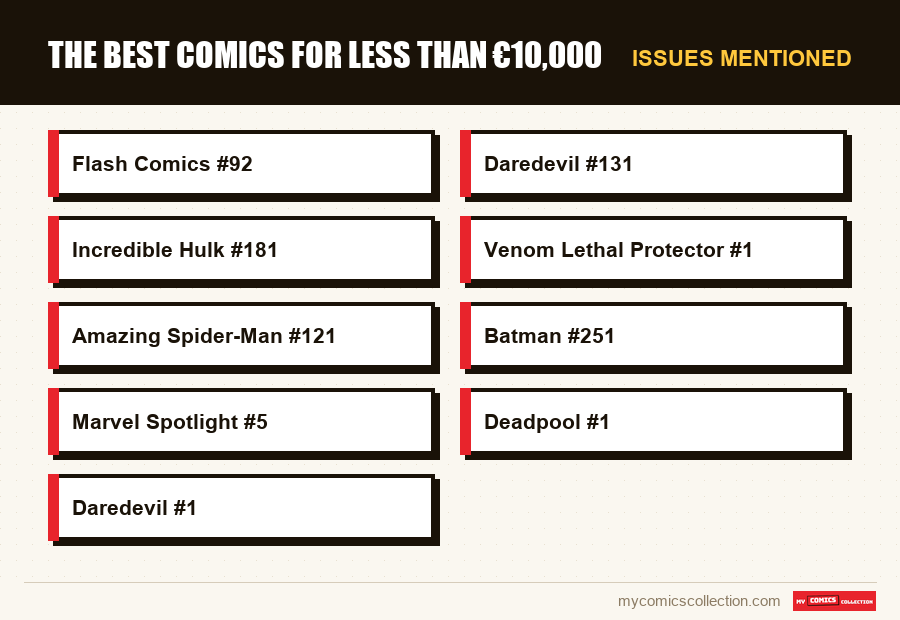
Four copies which summarize the level
Flash Comics #92-10 000,00 $
A 1948 booklet, verified at grade 5.0, claimed to carry Black Canary's first cover and first solo story. This is the entry into the oldest period of the medium, and it is done from the top of the section, in an average state of conservation. There is no illusion: at this price, on this title, the good condition is not in the field.
Daredevil #131-10 000,00 $
A verified 9.8 copy, described as having a double cover, and associated with the origin and first appearance of Bullseye. The double cover is an accident during assembly: two covers ended up linked to the same issue. What should have been left out of print is here part of the sales pitch.
Incredible Hulk #181-5 000,00 $
Checked 8.0, billed as the first full appearance of Wolverine, this 1974 issue sits at the exact floor of the installment. It illustrates a simple rule of this level: a highly sought-after title enters with intermediate notes, while a less popular title enters with high notes.
Venom Lethal Protector #1-5 000,01 $
Verified 9.8 and described as bearing nine signatures. A booklet from this period, in this note, is normally found much lower down; it is the accumulation of signatures that builds the requested amount. The cent added to the round price is a process of ranking in the results lists, nothing more.
The other announcements noted complete the picture without contradicting it. A 1973 Amazing Spider-Man #121 verified 9.8, a 1973 Batman #251 verified 9.4 with a Joker cover by Neal Adams, and a Marvel Spotlight #5 verified 8.0 given as Ghost Rider's first appearance and bearing a signature all three occupy the floor at $5,000.00. At the top, a 9.8 verified Deadpool #1 with signed cover, presented as the character's first solo issue, and a 6.5 verified Daredevil #1 signed and advertised as "one of one" reach the ten thousand dollar cap. What is striking is the heterogeneity: five decades of publishing, scores ranging from 5.0 to 9.8, and yet a narrow price range.
Instinctive reasoning (“I increase my budget, so I get the same number in better condition”) stops working here. A 1948 issue in 5.0 and a 1974 issue in 8.0 share the same budget box without sharing anything else. Comparing their notes makes no sense: they do not measure the same thing on papers, bindings and prints that have nothing in common.
At this level, the right question is therefore not “what grade for my budget”, but “what period, what type of rarity, and what proof”. A clear answer to these three points is worth more than half a point of extra grade.
1948 enters the field, and through the back door
This is the most notable fact of this level. Until now, the series of guides evolved in a universe of post-1960 booklets, where we discuss the whiteness of the paper and the sharpness of the angles. A 1948 headline changes the nature of the conversation. These booklets have survived nearly eight decades, often unprotected, in ordinary homes. The paper used at the time ages poorly due to construction. The examples that have survived in good condition are, by necessity, extremely few in number, and lie well beyond the range examined here.
So what that ten thousand dollars buys is access to the period: not the ideal version of it. A rating of 5.0 describes an object that has lived: the reader sees a marked booklet, whose cover bears the traces of its age. You have to know this before looking at the photographs, otherwise you will be disappointed. For many collectors, this compromise is perfectly acceptable: owning an object printed in 1948 is a different motivation from that which leads to seeking the perfect preservation of an issue from 1974.
This entry via the average state has an important practical consequence. On an old booklet in intermediate condition, the written description weighs much more than on an almost new copy. Two identically graded copies may have defects of very different natures: one worn evenly, the other intact except on a specific point. The note summarizes, it does not detail. Asking the seller for additional photographs and a full description of the defects is not a sign of distrust: it is the only way to know what you are buying.
We must also accept that these objects cannot be replaced. On a recent title, if the purchase is disappointing, another equivalent copy will quickly reappear. On a 1948 issue in this price bracket, the frequency of appearance is low and unpredictable. This encourages patience before purchasing, and caution in handling afterwards. The character concerned by this announcement also has a long editorial history that can be browsed from the page consacrée à Black Canary, useful for placing this number in a whole rather than considering it in isolation.
When the manufacturing defect becomes the argument
The double coverage deserves attention, because it illustrates a complete reversal of logic. This is a workshop incident: during assembly, two covers were attached to the same block of pages. When it came off the press in 1975, such a copy was a reject: something that should have been passed over for inspection, and which, if it reached the newsstand, would have been seen as a failed copy.
Half a century later, this waste is sold at the ceiling of the tranche. The reason can be summed up in one word: rarity. Surviving manufacturing accidents are few and, unlike a fine print, cannot be reproduced. The market has therefore carried out a silent conversion from default to singularity. It is a general mechanism, which is found on many other collector's items, and which has a direct consequence for the buyer: it makes the evaluation significantly more difficult, since there is no series of comparable examples on which to rely.
This anomaly here concerns a number already sought for its content: the origin and first appearance of a lasting adversary of Daredevil. Two reasons of value therefore overlap on the same object, and nothing in the ad allows us to know which weighs more in the amount requested. This is precisely the kind of situation where you have to be wary of your own reasoning: mentally adding two justifications does not produce an estimate, only an impression of solidity.
Finally, let us note that the same series saw the birth, a few years later, of one of the most commented creative periods of the title, the thread of which we can follow from the page consacrée à Frank Miller. A buyer who aims for this title without the requirement of a manufacturing anomaly therefore has other possible entries, on other numbers, at other price levels.
“One in one”: a statement that cannot be verified
One of the advertisements noted presents itself as a unique example of its kind. We must understand exactly what this type of formulation covers, without accusing anyone of bad faith.
The asserted uniqueness results from a combination of characteristics: a title, a number, a note, one or more signatures, possibly a material particularity. Taken as a whole, this combination may actually exist in only one copy. But it is mechanically true of any sufficiently detailed combination: it is enough to add a criterion for a set of objects to be reduced to just one. The assertion is therefore structurally unverifiable: not false, but impossible to confirm or deny by a third party.
The course of action follows from this. Do not treat the statement of uniqueness as pricing information. Instead, ask what precise criteria make up the claimed uniqueness, and evaluate each separately: the score is verifiable; the presence of a signature is also, if it has been checked; overall, no. If the seller details his suit without difficulty, that's a good sign. If he sticks to the formula, the argument remains decorative.
The reasoning also applies to the copy bearing nine signatures. Nine is a lot, and it raises a simple question: was each of these nine signatures affixed in the presence of a third party authorized to attest, and does this attestation appear on the copy? Status verification and signature verification are two separate services, with different requirements. A copy can perfectly be checked as to its condition without its signatures having been subject to the slightest check. The distinction can be read in the documents, not in the title of the announcement. The character concerned here and that of solo issue raised to the ceiling of the section have in common that they belong to a period when signed copies greatly multiplied, which makes the question of certification all the more central.
Collecting this series?
Track what you own, what you are missing and what your collection is worth. 7 day trial.
Start my trial →Six checks before committing to this level
Le numéro de l'exemplaire
Each verified copy carries its own identifier, which can be consulted by the organization that issued it. Check that the identifier visible on the photographs corresponds to the title, number and note announced. This is the quickest and most decisive check.
The date of the verification
An old check describes the condition of the object at the time it was made. In the meantime, the copy could have been handled, transported, exposed to light. The shell protects, it does not freeze time.
What the label covers
Read precisely what is attested: the statement alone, or the statement and signatures. On a copy bearing several initials, this distinction completely changes the value of the proof provided.
Transport and its insurance
An international shipment of a five-figure item is handled with explicit insurance coverage, a declared value and a signature on delivery. Have these three points confirmed in writing before paying.
The total cost, not the displayed price
Currency conversion, delivery, import formalities: these items are added to the amount of the announcement and must be estimated before commitment, with the competent contacts.
Return conditions
Obtain in writing the return deadline, the condition in which the item must be returned, and who bears the costs if the description proves inaccurate. A verbal agreement is worthless at this level of commitment.
At this level, the object counts less than the transaction
This is the most useful conclusion of this tier, and it contradicts intuition. The higher the amount, the less the discussion focuses on the booklet itself. Of the two hundred advertisements noted, one hundred and ninety-eight copies are verified: the question of condition, which occupies most of the lower levels, is largely settled by a third party. What remains open are the conditions under which the object changes hands.
A complete written description, return conditions formulated in black and white, insured transport up to the declared value, a payment method which leaves a trace and offers recourse: these are the four elements which determine whether the purchase is reasonable, well before the qualities of the booklet. A remarkable copy purchased under unclear conditions remains a bad purchase; an ordinary copy purchased outright remains a good purchase.
We must add a fifth element, often overlooked: what happens after reception. An object of this value enters a category where the conservation and insurance coverage of the home cease to be theoretical subjects. THE guide to insuring a collection details the questions to ask; The main thing is to ask them before purchasing, because an unfavorable response can legitimately call the transaction into question.
Finally, keep in mind that the tranche examined says nothing about the market beyond. Two hundred ads taken between five and ten thousand dollars describe this slice and nothing else. What is happening below obeys other balances, and what is happening above is part of an even different market, with its own circuits. This series of guides stops here because beyond that, an article no longer replaces professional advice.
What to note for each copy of this level
L'identifiant de l'exemplaire vérifié. It is the only data that physically links the object placed on your shelf to the document issued by the verification body. Record it along with the title, number and note, and keep a clear photograph of the label. Without this identifier, a verified copy becomes, on paper, an ordinary booklet.
The exact nature of the singularity. Write in full what makes the copy special: an assembly accident such as a double cover, a precise number of signatures, a printing characteristic. A year after purchase, “rare copy” will tell you nothing; “two covers linked to the same booklet” will allow you to find, explain and have the object evaluated.
The precise scope of the verification. Note whether the certification relates only to the state of preservation or whether it also covers the authenticity of the signatures, and, in the latter case, whether it covers all or only some of them. On a copy bearing nine initials, the difference between “all attested” and “state only” is the very heart of what you paid.
Return conditions obtained in writing. Keep with the copy sheet the accepted withdrawal period, the state required for return and the distribution of costs in the event of an inaccurate description. These elements fade from memory in a few weeks and become untraceable at the precise moment they would be needed.
The total cost incurred, once the item is received and insured. Add up the amount paid, the actual conversion, the shipping, the import formalities and the cost of subsequent protection. It is this total, not the price shown in the ad, that is your real reference point: the one against which any future valuations should be compared.
Because the French market does not offer an offer at this price level for this type of object. The two hundred listings reviewed on August 30, 2026 come from the US market and are denominated in dollars. A French buyer must add conversion, transport and import costs, no amount of which appears in the data collected.
The listed ad places such a copy at the upper limit of the bracket, at $10,000.00. But this is an amount requested on a given date, not a completed sale, and the number in question is otherwise searched for its content. It is impossible, from a single announcement, to isolate the part attributable to the manufacturing anomaly.
Ask for the exact list of criteria that make up this uniqueness, then evaluate them one by one. Any fairly detailed combination of characteristics is unique by construction: the assertion is therefore not verifiable as such. What remains verifiable are the elements taken separately: the note, the identifier, the attestation of signatures.
No. The two hundred announcements were observed only once, on August 30, 2026. A single measurement has no sense of variation, due to the lack of a comparable previous reading. It describes a situation at a specific moment, and nothing more.
The two intersect in this section: a title from 1948 verified 5.0 and a title from the seventies verified 9.8 coexist there. The choice is a matter of motivation, not technical arbitration: seniority and conservation are not compared on the same scale. Decide what you're looking for first, price will follow.
Keep track of what you buy
Verification identifier, scope of the certificate, return conditions, total cost actually incurred: at this budget level, this information is worth as much as the object. My Comics Collection allows you to save them copy by copy, with your photographs, and find them instantly on the day they matter.
The full scale of budgets
- Previous level: less than €5,000
- Next level: le sommet du marché
- Less than €5
- Moins de 10 €
- Less than €20
- Moins de 50 €