A survey carried out on August 30, 2026 on a general American auction site, limited to listings above $10,000, shows a market top in two pieces. On one side, a handful of isolated and improbable requests: an original drawing plate posted for $9,499,999.99, a copy at $2,500,000.00, four advertisements each asking for $1,000,000.00: including a completely ordinary booklet from 1992. On the other, a coherent and readable offer: booklets from 1939 and 1940, verified by an organization, claimed between $95,000.00 and $249,999.99. None of these amounts were paid by anyone. These are prices asked, not prices obtained.
There are two ways to look at the top of the comic book market, and they don't tell the same story. The first is to read the results: what actually changed hands, for what amount, under the hammer. The second is to open current listings and read what sellers are asking for today, right now, for copies that no one has bought yet. This article deals exclusively with the second. Not a figure of concluded sales appears there, not a ranking of records, not a historic amount. The subject is the offer: what is placed on the stall, and for how much.
The distinction is not academic. A sale price is a fact: two parties have agreed, the money has circulated. An asking price is an assumption: a seller typed a number into a form, and that number will remain displayed until someone disputes it. Nothing requires a seller to be realistic. Nothing stops him from demanding a million dollars for a booklet that can be found in any dollar bin. This is exactly what the August 30, 2026 reading highlights, and this is what makes the exercise informative for anyone keeping an inventory.
What the statement contains, and what it does not contain
The reading was carried out on August 30, 2026, on a general auction site, on the American market, in dollars. Three separate queries were placed, each filtered to only retain listings above $10,000. The first, relating to the Golden Age booklets accompanied by a certification, brought up 46 advertisements: maximum $297,500.00, central value $19,500.00, minimum $10,000.00: the minimum being simply the threshold of the filter, it says nothing about the market. The second, focused on certified key numbers, revealed requests at $165,000.00. The third, the largest, examined 200 listings with a central value of $52,243.00.
One point deserves to be raised immediately, because it conditions everything else: a measurement taken on a single date shows no movement. This statement is a photograph. It doesn't say whether asking prices are going up, down or stagnant, and no one can deduce that from a single snapshot. To talk about evolution, we would need two comparable surveys, separated in time, made with the same filters. We only have one. Any sentence of the form “the top of the market is progressing” would be a pure invention here, and you will not read it here.
The visible summit: six announcements that structure the offer
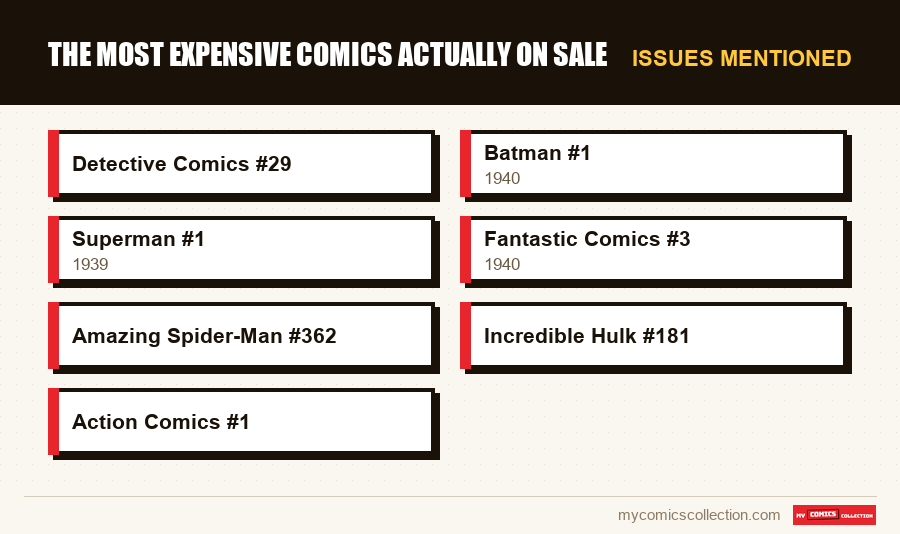
Detective Comics #29-249 999,99 $
An agency-verified Golden Age booklet billed as the first appearance of the character Doctor Death. This is the highest demand of the “certified golden age” set once the maximum gross is set aside, and the only one to approach a quarter of a million. The amount is demanded, not obtained.
Batman #1 (1940): $198,000.00
Rated 7.5 by the verification body, with the mention of restoration. The ad is the most expensive with this title in the statement. A second copy of the same issue, graded 6.0, also restored and described with blank pages, is asking $95,000.00.
Superman #1 (1939): $155,000.00 and $145,000.00
Two separate announcements for the same title: one rated 5.5 with mention of conservation treatment, the other rated 7.5 with mention of restoration. The higher note here carries the lower amount of the two. Two announcements don't make a rule.
Fantastic Comics #3 (1940): 150 000,00 $
A 1940 booklet whose announcement highlights a robot cover and the rarity of the title. It is the only one of this level not to belong to the two emblematic series which occupy the rest of the top of the table, which makes it the most interesting point of the whole.
Put end to end, these six amounts draw a range: from $95,000.00 to $249,999.99, for booklets published in 1939 and 1940, all verified by an organization. This is what we can call the real offer at the top of the market: not because these prices are fair, but because they are mutually consistent, carried by objects of the same nature, and because they are repeated from one announcement to another. When several independent sellers converge on the same order of magnitude, the order of magnitude becomes information. When a single seller deviates by several zeros, it is the seller who becomes the information.
The maximum of the « âge d'or certifié » set stands at $297,500.00, the central value at $19,500.00. The gap between these two numbers is the real story: out of 46 listings, half are under twenty thousand dollars, while a handful occupy the entire top of the scale.
An isolated maximum does not describe a price level. It describes the hope of a salesman. The central value is much more resistant to the presence of an extravagant announcement, and this is the reason why we systematically cite it next to the maximum.
The improbable summit: when the ad is no longer an offer
The broadest query in the survey, the one that covers all comics above $10,000, shows a central value of $52,243.00 on 200 ads examined. This number is already much higher than that of the “certified golden age” set, which is explained simply: the broad query catches objects that are not fascicles. But it is the top of this set which deserves attention, because it does not resemble anything that has been described so far.
There is an original drawing board asking for $9,499,999.99. There is a copy priced at $2,500,000.00. Above all, there are four separate advertisements each demanding, exactly, $1,000,000.00. Among them: a completely ordinary issue from 1992, a Amazing Spider-Man #362 presented as signed, and an adult parody advertised as the only copy in existence. A 1992 booklet printed on an industrial scale, available in abundance, demanded a million dollars. This is the clearest demonstration that we can make of the thesis of this article: an announcement is not a transaction, and an amount displayed only binds the person who displays it.
The round number is not a coincidence. Four ads all landing on the same perfectly round number isn't market convergence, it's psychological convergence. A million dollars is a number you choose, not a number you calculate. None of these sellers added grade, rarity and condition to arrive at this result; they typed in the largest number that came to mind. These ads can stay online for years without ever finding a buyer, and their presence in search results distorts the perception of anyone who takes them seriously.
The six pitfalls of reading an ad list
The maximum is not a price
The highest amount on a list is almost always the least informative. It reflects a unique seller, often alone in his opinion. Read the central value first, the maximum second, and never the maximum alone.
A single date does not make a trend
August 30, 2026 is a snapshot. It establishes neither rise nor fall. To speak of movement, we would need at least a second reading made with the same filters, on another date.
The (R) mention changes everything
Three of the highest advertisements bear the mark of restoration, another that of conservation treatment. A restored copy and an untouched copy cannot be compared, even if the grade is identical.
A lot is not a booklet
A statement ad claims $99,999.00 for an entire collection. Counting this amount alongside that of an isolated number is like adding a basket and an apple.
A low workforce concludes nothing
Two or three announcements of the same title are not enough to establish any price level. They are enough to describe what is on offer that day, and nothing more. Refuse to draw a rule from this.
An original board is another market
The request at $9,499,999.99 is not for a printed booklet but for a unique drawing. Leaving it in the same table would be like measuring two different things with the same meter.
The same title, three notes, amounts that do not follow
The survey reveals a scenario that must be described with great caution. The same title from 1939 appears at three different rating levels in the results: 1.5, 5.5 and 7.5. The amounts claimed are $165,000.00, $155,000.00 and $145,000.00 respectively. In other words, in these three specific announcements, the amount requested decreases as the rating increases: the opposite of what intuition suggests.
It would be easy, and completely false, to draw a theory from this. Three listings do not constitute a sample. Each is carried by a different seller, with their own negotiating margin, their own urgency and their own reading of the market. One bears a conservation mention, another a restoration mention; these mentions modify the nature of the object and render the comparison of note by note largely ineffective. The only thing that can honestly be written is this: the classification of the amounts requested does not reproduce the classification of the notes. This is an observation, not a rule.
This observation nevertheless has immediate practical value. He points out that the note is a description of condition, not an automatic price scale. Two identically noted copies may differ in restoration, in the whiteness of the pages, in the provenance, and in the presence of a signature. The subject is covered systematically in our guide on the relationship between rating and price, and it is worth returning to it before comparing two ads from the same number.
Collecting this series?
Track what you own, what you are missing and what your collection is worth. 7 day trial.
Start my trial →Why are these titles at the top of the offer?
A reading of the statement is necessary without having to invent anything: the top of the offer is massively occupied by two series from 1939 and 1940. This is not a surprise, but the way in which this manifests itself deserves to be noted. These titles are not just there; they are present several times, at different notes, from different sellers. A market where the same number appears in several simultaneous advertisements is a market where the object is circulating, and where the seller knows that it will be compared.
Conversely, Fantastic Comics #3, claimed $150,000.00, appears alone. No other copy of the same number appears in the statement to serve as a point of comparison. This is precisely the type of situation where the collector needs to slow down: without a second copy on offer, the amount requested has nothing to measure against, and it must be treated as a one-sided proposition rather than a market benchmark.
For readers who wish to explore each of these two universes, we maintain dedicated pages: the one devoted to Superman, the one dedicated to Batman, and a page bringing together our articles around Joe Shuster. The character whose appearance is highlighted in the most expensive ad in the survey, Doctor Death, belongs to the same editorial group and illustrates a constant mechanism: the first appearance of a secondary character can carry a considerable amount as long as it is housed in an old and verified issue.
The statement also shows, in the “certified key numbers” set, a request for $165,000.00 for Incredible Hulk #181 rated 9.8, described with blank pages and presented as the first appearance of Wolverine. It is the only issue not from the golden age to reach this level in the set examined, and it achieves this through a different combination: not seniority, but a very high rating on a very popular issue.
What to note and record about this market level
The mention of restoration or treatment is part of the identity of the copy. In the survey, three of the highest advertisements bear the mark of restoration and another that of conservation. This information is not presentation details: it changes what the object is. An inventory that records “rated 7.5” without recording “restored” describes an item that does not exist. Note the statement as it appears on the label, in full, in its own field.
The identification number assigned by the verification body is the only reliable key. At this level of amount, a copy is never “a Batman #1”: it is a precise copy, bearing a unique identifier, associated with a note and a searchable description. Report this identifier in your file. It is this which will allow you later to verify that the copy offered is indeed the one you believe, and to distinguish two advertisements of the same number.
Explicitly separate fascicles, original plates and entire collections. The statement mixes the three: a drawing board claimed $9,499,999.99 and a complete collection claimed $99,999.00 appear in the same set as isolated issues. These objects do not obey the same logic and are not measured together. In an inventory, they must have a distinct type, otherwise any statistics you get from them will be meaningless.
Date the statement that serves as a reference, systematically. All amounts cited here are those of August 30, 2026, and this date is part of the information in the same way as the amount. A number without a date cannot be verified, compared, or expired, and a number that cannot become outdated ends up deceiving its owner. Write the consultation date next to each amount you note.
A claimed amount must never be entered as a value in an inventory. This is the practical conclusion of the whole article. Reporting $1,000,000.00 in the “value” box of a 1992 booklet because a seller displays it would amount to copying an expectation and treating it as a fact. If you want to keep these amounts, store them in a field clearly named, observed asking price, separate from any estimate. OUR copy-by-copy estimation method details how to move from one to the other.
What to do, concretely, when you come across a six-figure ad
The first thing to do is look for a second copy. If the same number, at a neighboring note, is offered elsewhere, you have a point of comparison; if he's alone, you only have one opinion. The August 30 statement shows the two cases side by side: two titles appear in several copies, a third appears isolated.
The second is to read the label before reading the price. Note, restoration or treatment mentions, page color, identifier: these elements determine what you are looking at. An amount only has meaning when attached to a precisely described object, and the order of reading matters: starting with the price leads to then rationalizing everything we read.
The third is to refuse to conclude on a low workforce. Of the 46 listings in the “certified golden age” set, only a small fraction exceeds one hundred thousand dollars. This is enough to describe what is offered, not to establish a price level. When you only have a few ads, the only honest statement is to say that there are too few to decide.
The fourth, finally, is to treat separately the cases where the round price and the total absence of justification combine. A running number calling for a million dollars is not a weak or strong market signal; it is noise, and it must be excluded from the calculation before it even begins. Our factsheets dedicated to the value of Action Comics #1 and to that of Batman #1 (1940)approach this sorting work on specific cases.
Frequently Asked Questions
The questions that come up most often concern the reliability of the amounts displayed, what can legitimately be deduced from them, and how to record them without making a mistake yourself.
No, none. These are exclusively sums claimed by sellers on August 30, 2026, on current advertisements. An ad can remain displayed indefinitely without ever finding a buyer, and nothing in the statement indicates that a transaction took place at these amounts.
Because a single extravagant announcement is enough to distort an average. In the “certified golden age” set, the maximum reaches $297,500.00 while the central value stands at $19,500.00. The central value remains representative of what half of the sellers ask for; the average would be pushed upwards by a few isolated announcements.
The restoration is noted precisely because it distinguishes the object from a never-touched example; the two do not fall into the same category and cannot be compared directly, even with the same rating. The August 30 statement does not contain enough matched advertisements to quantify this difference, and we will therefore not estimate it here.
This statement does not provide an answer. It was taken on a single date, August 30, 2026, and a single measurement shows no movement. At least a second reading, carried out with identical filters on another date, would be necessary to speak of an evolution in one direction or the other.
Yes, if the objective is to measure the price asked for booklets. A single drawing board and an entire collection are not isolated issues; leaving them in the same set is like measuring three different markets with a single instrument, and the result is not interpretable for any of the three.
Record what you observe, not what you are asked
My Comics Collection allows you to save each copy with its rating, special mentions, verification ID, and the date of your statements: keeping asking prices separate from your estimates, just as this article recommends.
The full scale of budgets
- Previous level: less than €10,000
- Less than €5
- Less than €10
- Less than €20
- Less than €50