
To find the best Cannonball comics (Sam Guthrie) and where to start, begin with his debut in Marvel Graphic Novel #4 (1982), by Chris Claremont and Bob McLeod. Continue with the The New Mutants series, then X-Force (1991), where he becomes field leader. The recent reads are Zeb Wells' New Mutants (2009), Al Ewing's U.S.Avengers (2017) and the 2019 New Mutants, which devotes a whole arc to the search for him in space.
Sam Guthrie comes from a family of Kentucky coal miners, and his power reveals itself in a collapsing mine tunnel. He converts thermochemical energy into thrust to fly and wraps himself in a force field that absorbs impacts. His career is rare among mutants: he goes from the New Mutants to X-Force, the X-Men, then the Avengers, keeping the same role everywhere as the reliable friend. This page ranks seven reads where he truly matters.
As always in this guide, only verified facts (creators, issue numbers, dates) are stated as fact; the analysis is our own, with no reproduction of protected pages or dialogue.
His first appearance
In Marvel Graphic Novel #4, an album dated 1982, Chris Claremont and Bob McLeod place the Kentucky boy in the middle of a class of young mutants. The same album introduces the whole class of young mutants at Charles Xavier's school, which explains why the issue is sought after for the entire team as much as for Sam. The regular series The New Mutants then starts in 1983 with the same duo at the outset.
This issue is detailed on our page Marvel Graphic Novel #4: read it before buying, because the album format, the reprints and the condition of the spine weigh more than on an ordinary single issue. Keep the collecting principle in mind here: the album holds the character's priority, the series holds his reading.
A second landmark completes the picture. The 100th issue of The New Mutants, dated April 1991, introduces the team X-Force, of which Sam is a member. It is the bridge between the school period and the commando period, and we come back to it below in the entry on the handover.
How we ranked the seven reads
Cannonball is a teammate before he is a solo hero, and most of his best pages are collective. We therefore set aside the stories where he walks through the frame without changing anything, and kept the ones where he leads, where he is the engine of the plot or where he is the one the others come looking for. The order favors the reader who has not followed three decades of X-books: we start from what reads on its own and end with what assumes prior knowledge.
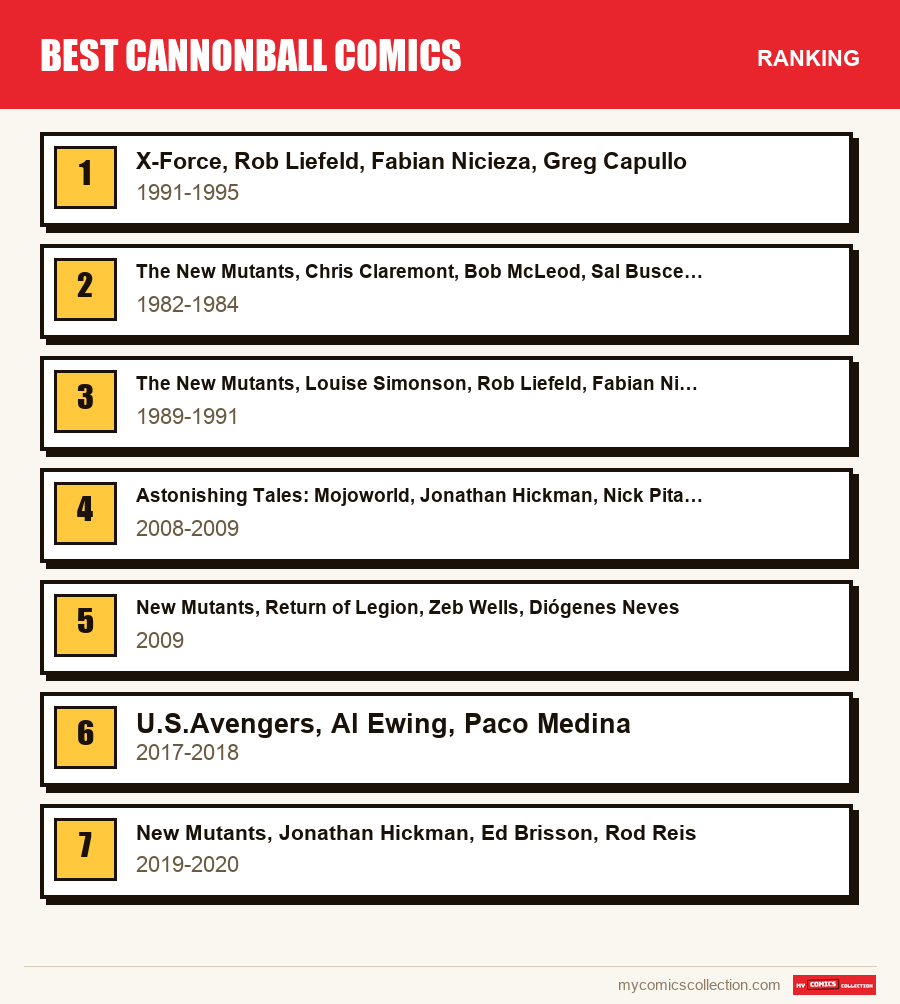
1: X-Force, Rob Liefeld, Fabian Nicieza, Greg Capullo (1991-1995)
Issue #1 of X-Force carries the date August 1991: Rob Liefeld plots and draws, Fabian Nicieza writes the dialogue over those plots. Liefeld draws issues #1 to #9, the eighth being the work of Mike Mignola, then Nicieza takes control of the series, with Greg Capullo on art for issues #15 to #25. Sam is Cable's lieutenant there, then he takes the lead of the team in the field after X-Cutioner's Song (1992).
What this period gives the character is decisive: the slightly well-behaved boy of the New Mutants becomes a leader, with decisions to make and comrades to protect. He stays on the roster until issue #43; Jeph Loeb writes him out of the series in issue #44, which opens his move to the X-Men in 1995.
Who should read it? The reader who wants to see Sam in command of a team with frayed nerves. How to read it? In order, from issue #1 to issue #43, keeping in mind Liefeld's very dated style. The key issues are listed on our page on X-Force #1 and in the profile of Boom-Boom.
2: The New Mutants, Chris Claremont, Bob McLeod, Sal Buscema (1982-1984)
The series begins in 1983: Claremont writes every issue of this period, Bob McLeod draws issues #1 to #3, then Sal Buscema takes over for issues #4 to #17. Bill Sienkiewicz then draws issues #18 to #31, and his darker, freer line sets the image the series leaves with readers.
Sam is the Kentucky boy thrown into a world of powers and dangers, and it is in this series that he becomes co-leader of the team with Dani Moonstar. He is not the star of every episode, but he belongs to the core lineup, which justifies his place here.
Who should read it? Anyone who wants the foundation of his character and the atmosphere of a teenage team at Marvel. How to read it? In blocks, album included: our selection of the best New Mutants runs shows which blocks stand best on their own.
3: The New Mutants, Louise Simonson, Rob Liefeld, Fabian Nicieza (1989-1991)
Louise Simonson writes the series from issue #55 (September 1987) through issue #97; Rob Liefeld draws issues #86 to #91, #93 to #96 and then #98 to #100, with Fabian Nicieza joining on the writing near the end. Cable appears in issue #87, dated March 1990, as the team's mentor, and the series swings toward a more martial tone.
For Sam, the transition is what counts: a school co-leader becomes the second-in-command of a man from the future. The last three issues (#98 to #100, in 1991) stage the New Mutants' exit and X-Force's entrance. You also meet Deadpool in issue #98, which explains the price of that single issue, covered on our page on New Mutants #98.
Who should read it? The reader who wants to understand how the group of students becomes the group of soldiers. How to read it? From #86 to #100, straight through, or following entry 2.
4: Astonishing Tales: Mojoworld, Jonathan Hickman, Nick Pitarra (2008-2009)
The story begins in 2008 as a digital comic, written by Jonathan Hickman and drawn by Nick Pitarra, then it is published in the six-issue Astonishing Tales miniseries of 2009. Sam and his friend Roberto da Costa, alias Sunspot, shoot movies in Mojoworld, Mojo's world.
The contribution is unexpected: a light adventure story that shows Sam alongside Roberto, a friendship that U.S.Avengers would later place at the center of its team.
Who should read it? Anyone who already knows the duo and wants a lighter tone than in the team series. How to read it? In an afternoon, in the miniseries, with no prerequisite other than having read entry 2.
Do you collect this series?
Track what you own, what you are missing and what your collection is worth. 7-day trial.
Start my trial →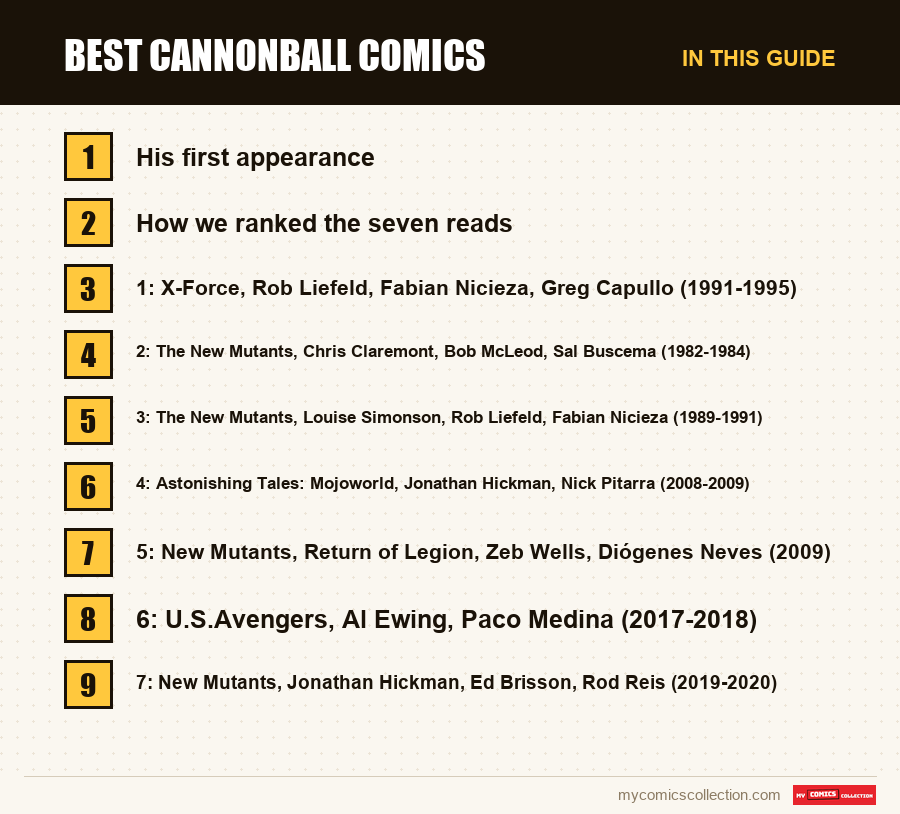
5: New Mutants, Return of Legion, Zeb Wells, Diógenes Neves (2009)
The third New Mutants series is written by Zeb Wells, with Diógenes Neves on art for issues #1 to #4 and #6 to #8 and Zachary Baldus on issue #5. The Return of Legion arc fills issues #1 to #5: Cannonball, Sunspot, Magma, Magik and Dani Moonstar set out to retrieve Karma, trapped in Legion's mind.
Sam is part of the lineup until he leaves the team in issue #25. We see a readable revival of the original group, suited to anyone who has not followed the previous decades.
Who should read it? The reader of the 2009-2011 period who wants a simple entry point. How to read it? As the collected edition of the five issues, then continuing as you wish. Find the writer on the Zeb Wells page.
6: U.S.Avengers, Al Ewing, Paco Medina (2017-2018)
The series is born in January 2017 with Al Ewing on script and Paco Medina on art, with Juan Vlasco on inks. Roberto, under the name Citizen V, forms with Sam, Squirrel Girl, Red Hulk, Enigma and Iron Patriot a team backed by the U.S. military, after the merger of A.I.M. and the U.S. military. Sam is therefore a founding member.
The Cannonball Run collection gathers issues #7 to #12, where Medina makes way for other artists. Its title plays on the character's nickname and sets the tone: a team adventure with a light touch that does not aim for dramatic grandeur.
Who should read it? Anyone discovering Sam through the Avengers who enjoys ensemble comics. How to read it? In order, in two collections. For context, go through the Avengers hub and the page on author Al Ewing.
7: New Mutants, Jonathan Hickman, Ed Brisson, Rod Reis (2019-2020)
The November 2019 New Mutants, launched with Dawn of X, brings together Magik, Sunspot, Wolfsbane, Mirage, Karma, Chamber and Mondo. Jonathan Hickman writes issues #1, #2, #5 and #7, Ed Brisson issues #3, #4, #6 and #8, Rod Reis draws issues #1, #2, #5 and #7, with Flaviano Armentaro and Marco Failla on other episodes.
The team leaves Krakoa for space with the Starjammers to find Cannonball, so Sam is the goal of the quest rather than its actor: he is the friend they go to get. The arc has the charm of science fiction, far from the horror that defined the original series, and it rewards readers who already know Sam from his earlier series.
Who should read it? The reader of the Krakoa period, curious about a space entry point. How to read it? In the collected edition of the opening issues, after our New Mutants selection. The other works of Jonathan Hickman are gathered on his page.
Where to start based on your profile
If you want the origins, read the 1982 album then issues #1 to #17 of The New Mutants (entry 2). A reader who prefers action will choose X-Force (entry 1), which gives Sam his leader's face and which many current readers have not followed in full. Someone arriving from the Avengers will go straight to U.S.Avengers (entry 6) before going back in time.
For a reader drawn to the Krakoa period, the right door is the 2019 New Mutants (entry 7), which reads better after skimming entry 5 to get to know the team. If you only have one evening, take the Astonishing Tales miniseries (entry 4): it fits in six issues and requires no prior reading. To place Sam among his comrades, browse the pages on Colossus, Psylocke and Kitty Pryde.
The key issues to know
The method is the same for the whole character: spot the first appearance, then the turning points that make the role last. For Sam, everything plays out in a team: the value of an issue lies in the series it opens or closes, not in a single panel.
- Marvel Graphic Novel #4 (1982): the debut of the character and of the whole team, by Claremont and McLeod.
- The New Mutants #1 (1983): the start of the regular series.
- The New Mutants #87 (March 1990): the arrival of Cable, who changes the tone and sets up X-Force.
- The New Mutants #100 (April 1991): the introduction of X-Force, last issue of the original series.
- X-Force #1 (August 1991): the launch of the commando team where Sam becomes field leader.
- X-Force #44 (1995): his exit from the team to join the X-Men.
- U.S.Avengers #1 (January 2017): his role as a founding member with the Avengers.
- New Mutants #1 (November 2019): the space arc where they go looking for him.
Before any purchase, check the print run and look at the condition of the spine and corners: on a team single issue, that is what separates two copies of the same issue.
Frequently asked questions
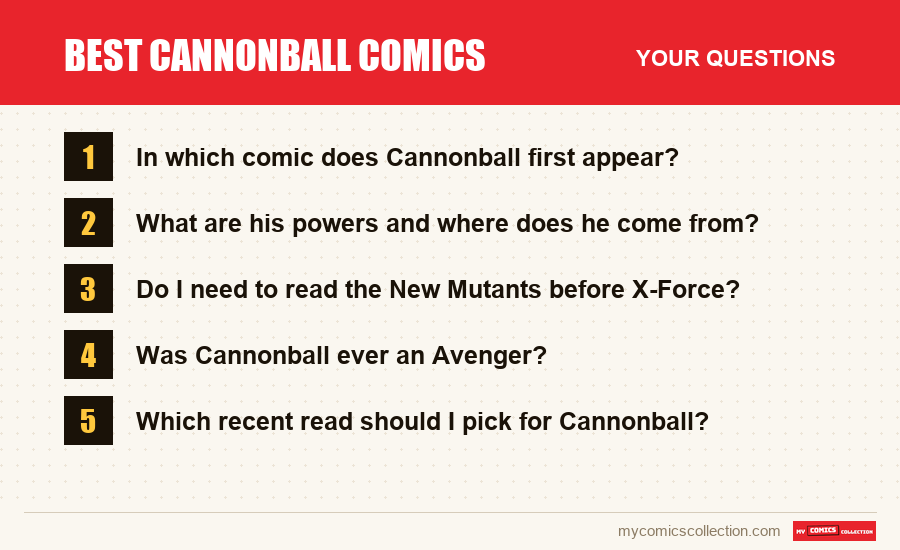
The Kentucky boy bursts onto the scene in the 1982 album, Marvel Graphic Novel #4, written by Claremont and drawn by McLeod. The regular series The New Mutants then starts in 1983. To read rather than collect, begin with issues #1 to #17 of the series.
Sam Guthrie comes from a family of Kentucky coal miners, and his power manifests during a tunnel collapse. He turns thermochemical energy into thrust that lets him fly, and he wraps himself in a force field that absorbs impacts. These abilities are consistent from one series to the next.
It is not required. X-Force (1991) works without prior reading, and its stakes are clear from issue #1. That said, reading issues #86 to #100 of The New Mutants helps you see why Sam follows Cable, and it costs only fifteen single issues.
Yes. He joins the Avengers in the 2010s and is a founding member of the U.S.Avengers team, launched in January 2017 by Al Ewing and Paco Medina with Sunspot as Citizen V. That series remains the simplest entry point.
The New Mutants launched in November 2019 by Jonathan Hickman, Ed Brisson and Rod Reis is the most recent in our selection: the team leaves Krakoa to find Sam in space. For an afternoon read, prefer Astonishing Tales (2009), in six issues.
Is a New Mutants or X-Force single issue sitting in your boxes? Have it appraised before deciding what to keep.
Appraise my comic