
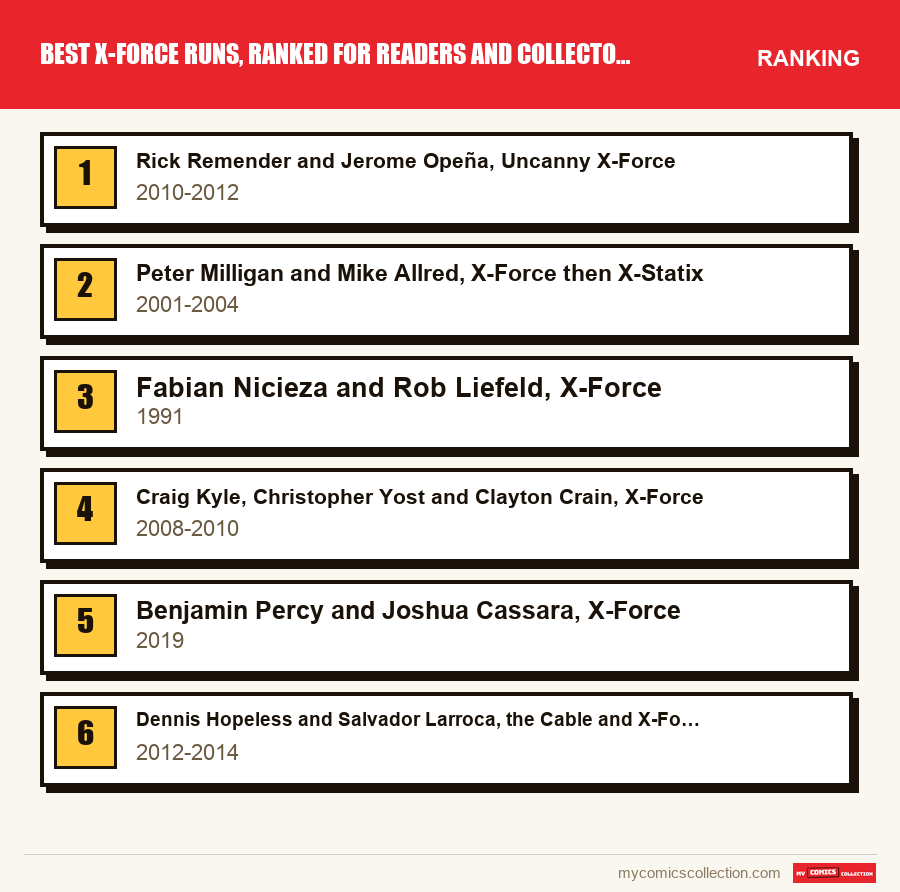
The best X-Force run is Uncanny X-Force (2010-2012), written by Rick Remender and launched with Jerome Opeña: mutants who assassinate before the catastrophe and pay the moral cost. Next come Peter Milligan and Mike Allred's X-Force and X-Statix, Fabian Nicieza and Rob Liefeld's 1991 debut, then the series by Craig Kyle and Christopher Yost, Dennis Hopeless and Benjamin Percy.
X-Force is a name that covers at least four teams, four ambitions and a single principle: mutants who act where the X-Men refuse to go. A reader who opens an issue at random can therefore land on a futuristic western, a celebrity satire or an espionage thriller. This ranking sorts these series from the point of view of reading, not nostalgia.
As always on this guide, only verified information (creators, issue numbers, dates) is stated as fact; the analysis is our own, with no reproduction of protected art or dialogue.
Four teams under one name
The series is born in 1991 with Cable, a former soldier from the future, leading young mutants drawn from New Mutants. Ten years later, a change of creative team sends it off toward a satire of celebrity, renamed X-Statix. In 2008 it returns to its original definition, the secret squad, and then Rick Remender delivers its most accomplished version in 2010. With so many successive identities, no single issue works as a universal way in.
To break ties, we asked each period a simple question: is it still readable without having gone through the other five? The advantage goes to self-contained sets, signed by a clear creative team, and gathered in volumes that are easy to find. For each one we also mention the most suitable collecting format, without ever giving an amount.
Top 1: Rick Remender and Jerome Opeña, Uncanny X-Force (2010-2012)
Wolverine, Archangel, Psylocke, Fantomex and Deadpool form a cell whose existence is denied. Their mission: eliminate threats before they act, even when that means taking down an enemy who has not done anything yet. Rick Remender writes all thirty-five issues of the series, which unfolds in big sagas with clear titles: the Dark Angel Saga, The Apocalypse Solution, Deathlok Nation, then Final Execution.
The interest of this stretch is that it takes the premise seriously and never lightens it. Every mission leaves scars, every comrade wears down, and the saga that brings a former enemy back in a child's form raises the question any team of this kind ends up facing. Jerome Opeña opens the series with a density of detail rare for a monthly, before several artists, including Esad Ribić, carry on. The contrast in styles even gives an unexpected unity.
It is for those who like moral tales, team dilemmas and endings that cost something. It suits less those looking for light entertainment, since the tone stays dark throughout. Count on our pages for what follows: the Rick Remender at Marvel file places the series within the writer's career.
For collecting, the complete series fits in a few big bound volumes or in a stack of recent single issues, fairly common on the market. The collected edition is the most sensible format for reading; the single issue is mainly justified for issue #1 and the alternate covers, which we mention only when their existence is certain.
Top 2: Peter Milligan and Mike Allred, X-Force then X-Statix (2001-2004)
In 2001, Peter Milligan and Mike Allred take over X-Force from issue 116 and change its nature. The members become sponsored celebrities, filmed live, bound to die for the ratings. The series then takes the title X-Statix and runs to twenty-six issues, with an irony that the earlier issues gave no hint of.
This run matters because it uses the codes of the superhero against themselves. The death of characters is a spectacle, mourning a marketing object, and the mockery leans on the pop culture of the 2000s. Mike Allred's clean, colorful line sharpens the dissonance: what looks like an advertisement becomes a big story about fame.
It is for those who enjoy satire, offbeat humor and auteur comics. It baffles fans of pure action. We place it second because it reads on its own, without knowing the 1991 version, and because it is one of the rare superhero series whose form is inseparable from its point.
How do you collect it? The collected editions reprint the series in separate volumes, X-Force then X-Statix, and read in order with no effort. The single issues are inexpensive and common.
Top 3: Fabian Nicieza and Rob Liefeld, X-Force (1991)
The first issue, dated August 1991, was sold in polybag with one of the planned trading cards; we devoted a detailed page on the polybag and the five cards to it. Rob Liefeld handles the plot and the art, Fabian Nicieza the dialogue. The team is Cable's: Boom-Boom, Domino, Shatterstar and their companions go from the classroom to the war.
This run matters because it fixes the image of the decade: hypertrophied silhouettes, science-fiction weapons, characters with murky pasts. You can see the excess, you can recognize the energy of an era, but you cannot get around it if you want to understand how a mutant series became a mass-market product. Nicieza's writing, more attentive to the bonds between characters than the art lets on, deserves a re-read.
It is for those who collect by debuts and first appearances, or who want to measure what this period changed. It is less suited to a reader who wants a polished story: the series is still looking for its form. For the context around the character of Tabitha, the file on Boom-Boom and her key issues is a useful complement.
To collect it, the original single issue is tempting but heavily printed, so scarcity comes from condition and from the question of a sealed or opened polybag. A modern collected edition covers the start of the series and is enough for reading. Keep in mind that the first issues, printed in immense quantities, are never hard to find: a flawless copy is.
Top 4: Craig Kyle, Christopher Yost and Clayton Crain, X-Force (2008-2010)
Relaunched in February 2008, the series entrusts Craig Kyle and Christopher Yost with a squad that gathers Wolverine, Warpath, Domino, X-23 and, later, Cable. Clayton Crain draws the opening in a painted, dense style, closer to a video game than to the traditional page. The title slots into the big crossovers of the time, including Messiah War, which links it to the Cable series.
This run matters because it restores the idea of a team acting in secret, after years of absence, and prepares the ground for what Remender will push further. It offers a rhythm of chases and fights, well-used supporting characters and an effective use of recent continuity. Its weakness is a dependence on neighboring events.
It is for those who enjoy sustained action and want to follow the aftermath of Messiah Complex. Readers looking for a fully standalone story will find it incomplete. To understand its ties to the central character, our ranking of Cable runs helps spot the shared passages.
In a collection, the series runs about thirty issues with comfortable regularity, and its collected editions are common. The single issue suits those attached to painted covers; otherwise, the bound volumes spare you from buying the crossovers one by one.
Do you collect this series?
Track what you own, what you are missing and what your collection is worth. 7-day trial.
Start my trial →
Top 5: Benjamin Percy and Joshua Cassara, X-Force (2019)
Launched in the wake of Jonathan Hickman's relaunch of the X-Men, this series follows an espionage team tied to Krakoa. Benjamin Percy sets its rules: intelligence is gathered, outside threats are foiled, and choices are made that the mutant state prefers not to see. Joshua Cassara brings a clean line, suited to infiltration and action scenes.
This run matters because it takes up the logic of a clandestine team in a new political context, where mutants have a nation. There are good ideas, such as the use of a setting where death and resurrection change the nature of the stakes. It does, however, require having read at least the essentials of the relaunch around it.
It is for the reader who has followed or wants to follow the Hickman period and wonders where it led the characters. It is not designed as an entry point. For these Percy single issues, the market value is still to be built: the length of the series, reprints and a possible adaptation, if one is ever confirmed, will make the difference.
On the collecting side, these single issues are easy to complete. Collected editions have followed at a steady pace and cover the series in order. If you love the object, check the alternate covers carefully before hunting for them, because the full list calls for an issue-by-issue verification.
Top 6: Dennis Hopeless and Salvador Larroca, the Cable and X-Force series (2012-2014)
The series begins in 2012 with Dennis Hopeless on script and Salvador Larroca on art. Cable forms an improvised team there that includes characters as different as Forge, Domino or Colossus depending on the arc. The tone is tenser and more personal than that of the usual team series.
This run counts for its use of the character of Cable: an adoptive father on the run, who must repair what he himself set in motion. It links the secret team of the previous years to the following period, but it reads less easily without knowing the 2008 Cable series. That is why we ranked it last.
It is for those who loved the Cable of Duane Swierczynski's series and want to extend the story. We do not recommend it as a first purchase. For collecting, the series is short and its collected editions are affordable; the single issue is only justified if you already read the crossovers alongside.
Which one to start with, depending on your profile
If you are after the summit, open Rick Remender's Uncanny X-Force: its sagas are short, its characters well drawn and the reading stands on its own. For a singular read, funnier and crueler, pick up the issues by Peter Milligan and Mike Allred.
If you collect the debuts of a series, the 1991 issue #1 is the obvious choice, with the precaution of checking the condition of the polybag. If you like the 2000s, the Kyle and Yost team will connect you to the big crossovers of the era. Finally, if you want contemporary continuity, Percy's X-Force, or Hopeless's Cable and X-Force, should only be approached after the earlier readings.
A practical rule: read the series by creative team rather than by issue order, because the numbering of a title that has changed name, form and meaning does not help.
What these runs are worth in a collection
The value of these series is not read the same way everywhere. The 1991 issues were printed massively: the gap between an average copy and a flawless one is the only lever there. The series of the 2000s and 2010s sell at a price close to their cover cost, which makes a complete collection low-risk. The most recent series have no established market value.
The sensible method is to decide the goal before buying: read, complete or preserve. To read, favor collected editions, often cheaper than an equivalent stack of single issues. To preserve, target a few pivotal issues in fine condition and cross-check completed sales at the same condition, rather than trusting a single listing.
One last practical tip: file your X-Force by creative team in your inventory, with the series name and the starting year. You will avoid confusing the five series that have carried this title.
Frequently asked questions
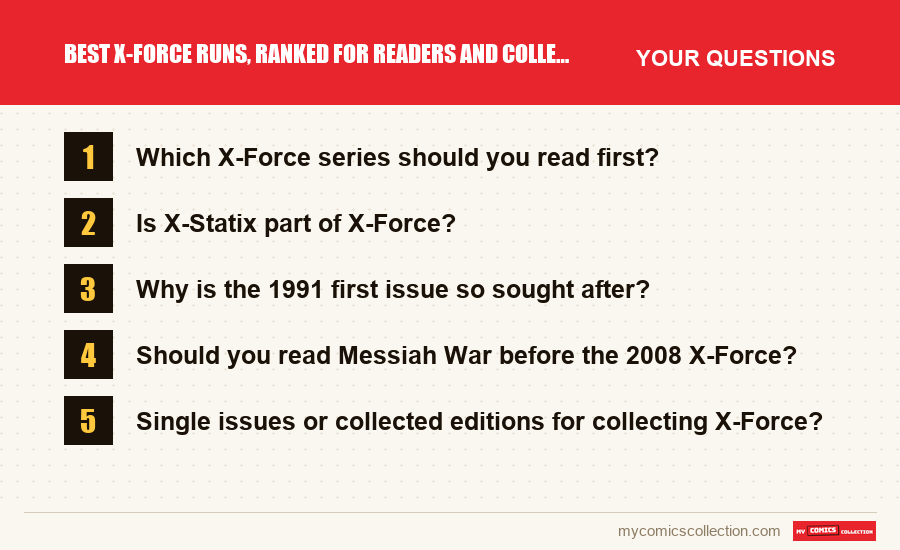
Rick Remender's Uncanny X-Force, published from 2010 to 2012. It runs thirty-five issues that read without knowing the earlier periods, with Wolverine, Archangel, Psylocke, Fantomex and Deadpool. Its sagas (Dark Angel, Deathlok Nation, Final Execution) are short and neatly separated.
Yes, through editorial lineage. Peter Milligan and Mike Allred take over X-Force from issue 116, in 2001, then the title is renamed X-Statix and runs twenty-six issues. The satirical tone is very far from the 1991 version, but the series reads on its own.
Because it was sold in polybag with one of five trading cards, which creates three distinct conditions: sealed, opened with the card, or the issue alone. It was nonetheless printed in immense quantities, so scarcity lies in condition, not quantity.
No: the Kyle and Yost series reads from its first issue, with no prerequisite. On the other hand, Messiah War crosses it with the Cable series and is worth reading in full afterward, through the collected edition devoted to that event.
For the series published between 2008 and 2019, the bound volume wins: it already puts each crossover in its place and costs less. For the 1991 issues, the original single issue remains the only collecting format, with the question of condition and polybag to examine.
Do you have a 1991 X-Force #1, sealed or opened, or a stack from Remender's series? Estimate them by comparing completed sales at the same condition.
Estimate my comic