Rick Remender's period with the big publisher is a series that counts: his stint on the team of clandestine mutants, drawn by Jerome Opeña. It was there that he made a name for himself among the general public, and there that the collaboration was established that he would continue ten years later on his own fantasy. His other works for the publisher (a new symbiote bearer, an iconic soldier, several team series) are more constrained and can be read separately.
Many readers discover this author through his independent series and are unaware that he spent several years writing superheroes. Others do the opposite and don't know that the man who wrote their favorite mutant series is publishing graphic novels about self-destruction elsewhere.
This article connects the two sides: what he did in this context, what he gained from it, and what a collector should know before buying.
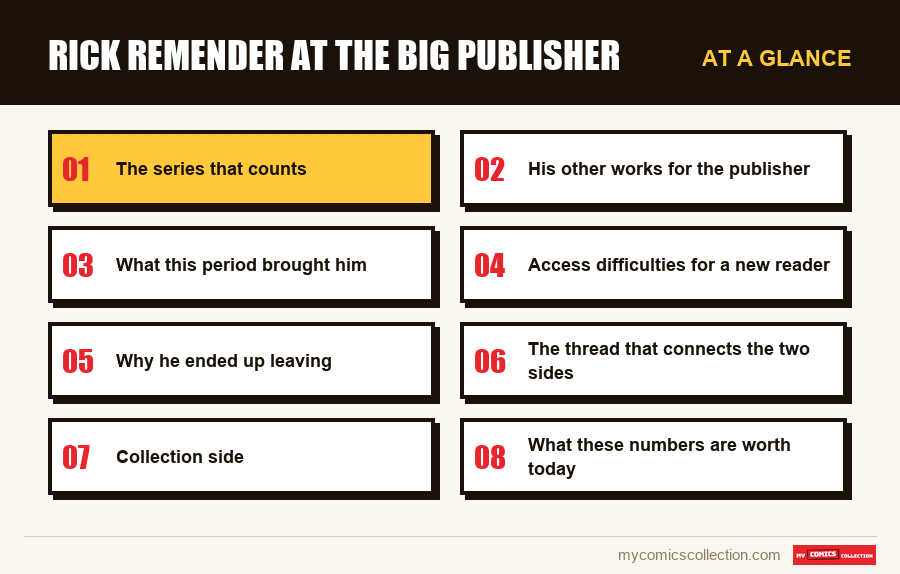
The series that counts
His time on the team of mutants responsible for operations that others cannot take on is unanimously considered the peak of his period at the publisher.
The premise of the series suited it: a small team, a morally indefensible mission, and characters forced to live with what they did. This is exactly his terrain, the fault that contaminates everything else, transposed into a superhero framework.
The final arc, in particular, is regularly cited among the best stories ever written about its main character. He pushes to the end a logic established from the first issue, and he refuses the comfortable exit that editorial continuity would have allowed.
It is also the series that made Jerome Opeña known well beyond the independent readership. The drawing achieves an unusual density for a monthly publication, and it bears a good part of the title's reputation.
His other works for the publisher
A new symbiote carrier
He took a secondary character to make him the bearer of a creature that was associated with another. The bet was based on an image: a mutilated soldier returning from the front, who is given the use of his legs in exchange for a servitude that he has not measured.
This is his most recognizable motif-the gift that enslaves-applied to an existing character. The link with his later fantasy is striking.
An iconic soldier
His revival of the character sent him into a hostile dimension for a long period, far from the expected patriotic register. A divisive and accepted choice.
Several team series
He wrote training courses bringing together mutants and non-mutants, in an editorial context dense with intersecting events. These are his most constrained and least autonomous stories.
What to remember
An essential series, two interesting covers but dependent on their context, and team series difficult to approach in isolation.
What this period brought him
It would be simplistic to treat these years as a dietary interlude before returning to personal series. Three achievements are clearly visible.
Le rythme mensuel. Writing one chapter per month, with continuity constraints and firm dates, imposes a construction discipline. His later independent series are better cut than those preceding this period.
Le réseau graphique. It is there that he works with designers whom he would not have met otherwise, and whom he will later meet on his own projects. His most lasting collaboration was born here.
Visibility. An author who has written a successful series for a major publisher launches his personal titles under completely different conditions. The success of its independent series owes something to this notoriety.
Access difficulties for a new reader
A presupposed continuity
These series are part of an ongoing universe. Some reversals require knowledge of events recounted elsewhere, which is never the case with his personal titles.
Mandatory crossover events
His team series were crossed by major editorial events. Entire chapters refer to series that he did not write.
Revamped numbering
Reruns, double numbering and title changes along the way complicate the identification of a copy, much more than with an independent series.
Several designers per series
Unlike his freelance practice, the designer changes frequently, sometimes from one issue to another. The graphics unit suffers.
What to buy, and what to skip. His mutant series can be read in its entirety and is largely sufficient in itself: it is the only one from his period with the publisher that we can recommend without reservation to a reader who does not know the universe.
Other titles assume a minimum of familiarity with the current continuity. They benefit from being approached in bound volumes, which group together the relevant chapters and exclude some of the references.
Why he ended up leaving
He left this framework to devote himself almost entirely to his own series, and the reasons for this choice illuminate the difference between the two sides.
The first is ownership. An author who writes a character belonging to a publisher does not derive any lasting rights from it: the series stops, someone else picks it up, and the work ceases to belong to him. On a title created by him, each reprint and each adaptation continues to concern him.
The second is freedom of purpose. A publisher’s run doesn’t end: it changes hands. An author cannot conclude what he has started, only pass the baton at a time decided elsewhere. However, his personal stories are all based on an ending written as such.
The third is the choice of the designer. As a freelancer, he works with a unique artist from the first to the last chapter. In the other framework, replacements are frequent and rarely decided by the screenwriter.
These three differences do not pass judgment on the quality of the stories produced by either side. On the other hand, they explain why his independent series have a coherence that his commissioned works do not have, and why it is reasonable to approach them differently.
Collecting this series?
Track what you own, what you are missing and what your collection is worth. 7 day trial.
Start my trial →The thread that connects the two sides
A motif runs through all of his work, and it appears with particular clarity in this setting.
The character to whom we give back the use of his legs in exchange for servitude is already the tyrant of his fantasy who grants wishes to create obligators. The gift that enslaves is his central idea, and he tried it out in a superhero series before making it the entire subject of a story of his own.
Likewise, the team that commits the irreparable in the name of a greater good announces the groups of its independent series, where no one is entirely right. This framework served as a laboratory, and this is perhaps the best reason to read this period.
A reader coming from his personal series will therefore recognize familiar ideas in an unexpected guise. The opposite is also true: those who loved these superhero series will find the same questions in their independent titles, addressed without constraint.
Collection side
This period poses identification problems that its independent series do not, and it is best to know them before purchasing.
Numbering alone is not reliable. Between reminders and double numbering, the same number can designate several different issues. The year of publication is essential to remove ambiguity.
The screenwriter is not given by the title. A long series has often had several authors. Searching for “his” series by the title alone returns issues written by others.
Bound volumes cut differently. As with its older independent titles, several presentations coexist and do not group the same chapters.
Cross-over events blur the collections. An arc can continue in a neighboring series and then return. Noting the actual reading order, and not just the numbers possessed, avoids believing in a gap where there is none.
The consequence is that a catalog must bear here, more than elsewhere, the year and the name of the screenwriter. Without these two fields, a list of numbers cannot complete or estimate anything.
What these numbers are worth today
A structural difference separates this segment from its independent series, and it works in the opposite direction to what one might believe.
Series from major publishers are printed at much higher print runs than an author's title, and they are reprinted more often. A first issue is therefore rarely rare, even when it opens a celebrated period.
What we are looking for in this segment are rather the numbers bearing a specific event: a first appearance, a death, a change of costume. They are markers of continuity, and their value lies in their place in a collective narrative rather than in their author.
The practical consequence is clear. Looking for a number because it’s “by the good writer” doesn’t make much sense in this segment.: this information does not determine the price. On his independent series, conversely, the author is precisely what makes the market exist.
Should we read this period?
Yes for the mutant series, which stands alone and is among its best stories in all settings. She is also the best meeting point between her superhero audience and her indie audience.
Optional for character covers: they will interest those who already know these figures and want to see what he does with them, but they are not a gateway.
Dispensable, as a first approach, for team series crossed by crossed events. They are difficult to understand in isolation, and a new reader will especially see confusion where there is a context that he does not have.
Questions fréquentes
No, it is more than sufficient in itself. A few references to the characters' past will pass over a new reader without detracting from understanding, and the story itself provides what needs to be known about its team.
Basically, yes, more than one would expect: his usual motives are there, sometimes formulated more clearly than in his personal series. In terms of form, no: the imposed continuity and frequent changes of designer produce less homogeneous stories.
Because he treated a team of superheroes like a group of people who had done something irreparable, without offering them any convenient redemption. It was unusual in this setting, and the very dense drawing that accompanied it gave the whole thing a gravity that the genre rarely practices.
By the inside credits, never by the title of the series. These long series have had several successive writers, and an announcement which only mentions the name of the series says nothing about the author of the proposed issue. The year of publication is the best starting filter.
It depends where you're from. A superhero reader will find here a natural gateway to an author that they would not have read otherwise, and the transition to their personal series is then effortless since the themes are the same. Someone who discovers comics through author stories would do well to do the opposite and start with their independent, more autonomous titles, without prior context to possess and without numbering to untangle. In both cases, the detour to the other side ends up being worth it.
The year and the screenwriter, not just the number
On long series with multiple reminders, a single number does not designate any specific issue.