Start with Deadly Class if you want to understand Rick Remender in one volume: it is his most accessible, most personal book, and the one which condenses everything that makes him unique. If you prefer science fiction, Black Science is the other good door. Book Fear Agent, his founding work, for a second time: it is excellent but rougher, and it is better understood when you already know the author.
Rick Remender has written nearly ten series that he owns, plus several years with major publishers. The bibliography is vast, and nothing indicates where to approach it.
This article offers three entries depending on what you're looking for, explains what connects all these series together, and points out the collecting pitfalls specific to this author: including one that is expensive for buyers in a hurry.
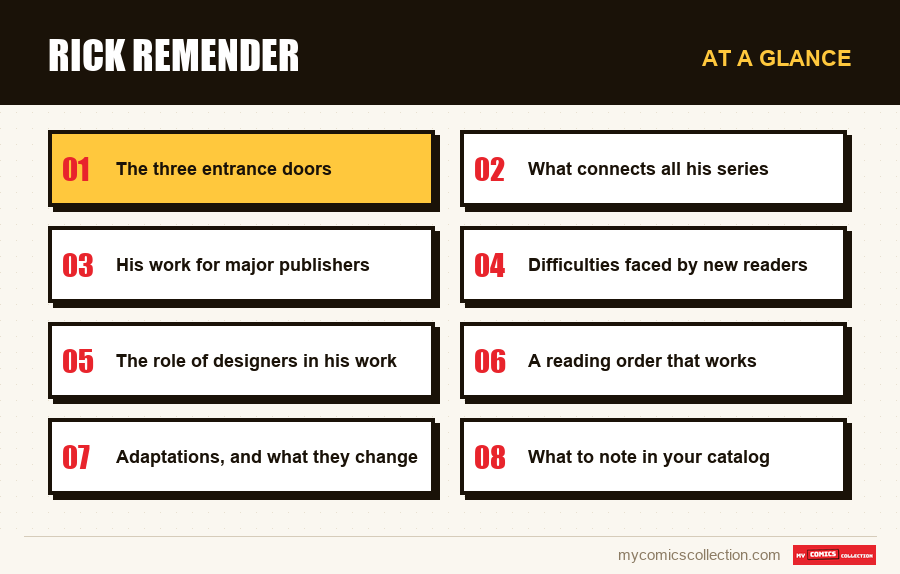
The three entrance doors
Deadly Class: la porte principale
A school for assassins in the 1980s, populated by teenagers who conscientiously destroy themselves. Wes Craig's drawing is nervous, the layout often fragmented.
It is the most immediately readable title of his production, and the most autobiographical in its substance: punk adolescence, marginality, guilt. The first volume is enough to know if the author speaks to you.
Black Science: la porte science-fiction
A scientist drags his family and team from dimension to dimension, paying for each jump with disaster. Drawing by Matteo Scalera, saturated colors.
The concept allows for a complete change of setting with each arc, making the series very easy to read in volumes. It is also his most explicit reflection on authorship and irresponsibility.
Seven to Eternity: la porte fantasy
A world in ruins, an impossible pact, and the drawing of Jerome Opeña: probably the most spectacular of all his series.
The pace is slower and the story denser. Reserved for those who like demanding fantasy, but graphically it is the peak of his production.
Fear Agent: the foundation, second
An alcoholic alien exterminator, in an unapologetic pulp science fiction. This is his first significant series of his own.
Everything he does next is in the making there. But the tone is more raw and the object has seen several successive editions: two reasons to come here later.
What connects all his series
Beyond the settings, we find the same obsessions from one title to another, and recognizing them helps you choose what comes next.
Protagonists who sabotage themselves. Its main characters are almost systematically responsible for their own misfortune. Alcohol, flight, cowardice and pride do more damage than the antagonists.
The family as a field of ruins. Père absent, enfant abandonné, fratrie dysfonctionnelle : le motif traverse Black Science, Deadly Class et Seven to Eternity without ever quite repeating itself.
Violence that costs. His stories are violent, but the violence leaves consequences: physical and moral. This is what separates them from the pure entertainment to which their pitches might reduce them.
One designer per series, never two. Each of its titles is identified with a unique designer who accompanies it from start to finish. It is a rare choice in the monthly edition, and it gives each series a clear graphic identity.
His work for major publishers
Before devoting himself mainly to his own series, he signed for several years with a major publisher, and this period deserves to be known.
His most celebrated passage remains his series of mutant superheroes drawn by Jerome Opeña, whose final arc is regularly cited among the best stories of the main character. It was also there that his collaboration with this designer began, whom he would later find on Seven to Eternity.
He also wrote a long run on a well-known symbiote, imagining a new wielder, as well as several team-up series. These stories are more constrained by the continuity of the publisher, therefore less personal, but they constitute an interesting entry point for those coming from superheroes.
The collection trap specific to this author. Several of his series have been reissued in different formats and numbering. Fear Agent in particular has had successive editions, from more than one publisher, with divisions into volumes which do not correspond.
Consequence: two copies bearing the same title and the same volume number may contain different chapters. Always note the edition, never just the title and volume. This is the only information that allows you, months later, to know whether the volume offered to you completes your series or duplicates it.
Difficulties faced by new readers
Series interrupted then resumed
Several of its titles have had long breaks between two arcs. A reader who discovers the series in the middle may believe that it has been abandoned when in fact it has simply gone on hiatus.
Reissues with different cuts
The same story sometimes exists in thin volumes and thick integrals, with volume boundaries that do not coincide. Mixing the two formats creates gaps or duplicates.
A tone that does not suit everyone
Nihilism, addiction, suicide, violence against young characters: his stories tackle tough subjects head-on. Better to know this before buying five volumes at once.
Continuity between its own series
Some of his titles discreetly share elements. They are not required reading, but spotting them changes the perception of the whole thing.
The role of designers in his work
For this author, the choice of designer is not a production detail: it is a writing decision, and it explains why his series are so little alike.
He clearly writes For someone. The pages intended for Wes Craig on Deadly Class use an exploded layout that the story would make illegible for another designer. Those intended for Jerome Opeña on Seven to Eternity on the contrary, provide large descriptive spaces, because this drawing supports contemplation.
This loyalty has a practical consequence for the collector. The designer identifies the series as surely as its title, and often better: on second-hand markets, advertisements are frequently indexed under the artist's name, especially when the artist is better known to the general public than the screenwriter.
It also has a reading consequence. If you don't like a title, it's not necessarily the author who is to blame but the association: moving to another of his series often means changing the experience completely.
Collecting this series?
Track what you own, what you are missing and what your collection is worth. 7 day trial.
Start my trial →A reading order that works
There is no obligatory continuity between its independent series: each can be read alone. The order proposed here is an order of discovery, no chronology.
First time. Deadly Class, first volume. It is the fastest and most representative test. If the tone passes, everything else will pass.
Deuxième temps. Black Science, to see what it does with a pure sci-fi concept, or Seven to Eternity if you prefer fantasy. These two titles show the extent of his register.
Troisième temps. Fear Agent, having identified the edition before purchasing. You will recognize there, in a rougher way, everything that the following series will refine.
Ensuite, au choix. His shorter and more recent series, or his work with major publishers if you are interested in superheroes. At this point you will know what you are looking for in him.
Adaptations, and what they change
One of his series was brought to the screen, which had two effects on its availability.
The first is fortunate: the volumes have been reprinted in quantity and are easily found, often at a modest price. An adaptation almost always makes a series more accessible in bookstores, the publisher anticipating demand.
The second is less so for a collector: the very first issues were not reprinted identically. The gap between the abundance of volumes and the relative rarity of the first issues has therefore widened instead of narrowed.
This is a general diagram for this segment, and it is useful to know: an adaptation makes the story easier to read and the first booklet more difficult to find. The two movements are simultaneous and go in opposite directions.
What to note in your catalog
On this author more than others, a title and a volume number are not enough to identify a copy.
L'édition et l'éditeur. This is the decisive precision on the reissued series. Without it, it is impossible to know if the volume 2 you have contains the same chapters as the one we are offering you.
Le dessinateur. Since it doesn't change within a series, it's a reliable identifier, and often the keyword under which sellers index their listings.
Le format. Booklet, thin or integral volume. The three coexist for several of its titles, and are arranged differently.
A catalog which records “Fear Agent, volume 2” will leave an ambiguity that nothing will resolve later. The same specifying the edition and format immediately answers the question “what am I missing?” ".
Should we start in installments or in volumes?
To discover, the volumes are safer: they bring together a complete arc, cost less per chapter, and avoid the risk of coming across a series with missing numbers.
The papers remain of interest for two reasons. They carry the original covers, often absent from reissues, and they constitute the actual collector's market in this segment.
The most economical approach therefore consists of reading in volumes, then looking in booklets only for the series of which you really want the first issues. Buying both systematically means paying twice for the same reading.
Questions fréquentes
No, none of its independent series involves reading another one. The order of publication is only of interest if you wish to observe the evolution of his writing, which is a project for an informed reader rather than a necessity.
Because it is rougher than the following ones and it exists in several editions with different layouts, which complicates the purchase. It is best enjoyed when we already know the author's style and can appreciate what he had already put in place.
Yes, in particular his mutant superhero series, regularly cited among the best of the main character. These stories, however, remain more constrained by the continuity of the publisher, and therefore less personal than his own series.
It depends on the titles, and several have experienced long interruptions between two arcs without being abandoned. Before purchasing an ongoing series, check the date of the last issue published rather than relying on the stopping print.
To a reader who is put off by the darkness. Addiction, self-destruction and violence against young characters run through most of his production, and it's not a cover-up: it's the subject. An attractive pitch (a school of assassins, a ship that jumps from dimension to dimension) should not make us forget what the story is really going to be about. Also not recommended for those looking for characters to become attached to without reservation: theirs are designed to disappoint.
On this author, the edition counts as much as the title
Publisher, format and designer: three fields that avoid buying the same chapters twice under two covers.