
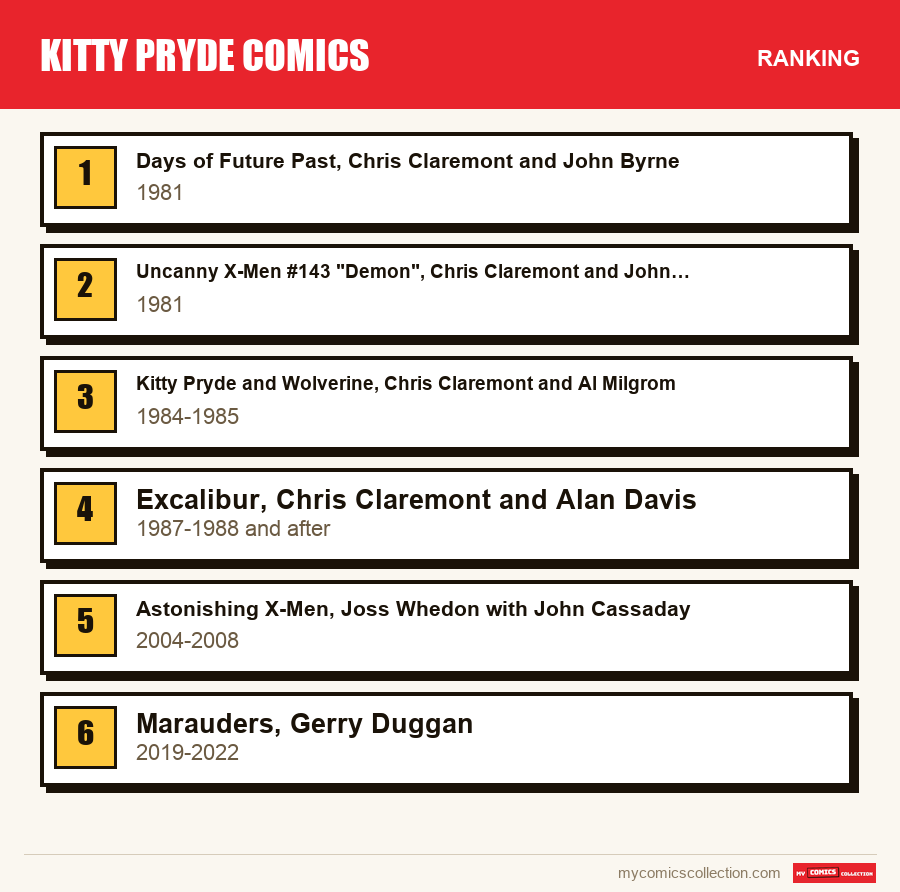
The best Kitty Pryde (Shadowcat) comics start with the "Days of Future Past" two-parter (The X-Men #141 and Uncanny X-Men #142, 1981), then move on to Astonishing X-Men, where Whedon and Cassaday show her as an adult (2004-2008). Where to start is simple, and the key issue is The X-Men #129 (January 1980), her first appearance, by Claremont and Byrne.
Kitty Pryde is the youngest recruit of Chris Claremont's X-Men and, for many readers, the character who serves as the way into the book: an ordinary schoolgirl facing adults who have been fighting for years. That teenager's point of view has run through forty years of publishing, from student to ship captain by way of a stint with Excalibur, and each era has picked a different angle to tell her story.
As always in this guide, we only state verified facts (creators, issue numbers, dates); the analysis is our own, with no reproduction of artwork or protected dialogue.
Her first appearance
For Kitty Pryde, it all begins with The X-Men #129 (January 1980), the work of the Claremont, Byrne and Austin trio on script, pencils and inks. She is a teenager from Deerfield, Illinois, picked up by Cerebro as a newly emerged mutant. The issue also introduces Emma Frost, which is why it has a double reading; we gave it a whole page of its own, so we will not repeat it here.
What matters for your reading is the path that follows. Kitty joins the team a few issues later, in The X-Men #139, under the code name Sprite, and her status as the youngest member immediately becomes a narrative engine: she learns, she asks the questions the reader is asking, and she shifts the balance of a team that had been very adult until then.
1: Days of Future Past, Chris Claremont and John Byrne (1981)
Claremont and Byrne tell their story across two single issues, The X-Men #141 (January 1981) and Uncanny X-Men #142 (February 1981), which became a classic of the series. An adult Kate Pryde, from a future controlled by Sentinels, sends her mind back into the body of the 1980 Kitty to prevent a political assassination that set off the catastrophe. In this story, Kitty is the piece that makes the plot work: without her, the future cannot be prevented.
This entry point suits everyone, including readers who have never opened an X-Men book, because the plot stands on its own. Reading it in a trade paperback is the easiest route, since the story runs across two issues and the second one changes the title of the series. To understand this catalog trap, our guide to X-Men #141 explains it in detail, and the 2014 movie is compared to the comic on this page.
2: Uncanny X-Men #143 "Demon", Chris Claremont and John Byrne (1981)
In issue #143 (March 1981), the creative team is the same as in the previous two-parter: Claremont on text, Byrne on pencils, Austin on inks. Kitty is left alone in the mansion facing an N'Garai demon, a creature the series had already met in the mid-1970s. The issue plays out almost like a chamber piece: one teenager, a far superior enemy, and the need to manage without any help from the team.
This is the issue where Kitty stops being "the new kid" and becomes a full-fledged fighter. It appeals to anyone who prefers a human scale to big sagas, and it needs no major prior reading. It also marks the end of Byrne's run as the series artist, which gives it a special place in the history of the period. You will find it in the collected editions that follow Days of Future Past, so you can read it right afterward.
3: Kitty Pryde and Wolverine, Chris Claremont and Al Milgrom (1984-1985)
Six issues, Chris Claremont on script, Al Milgrom on art: that is the miniseries. It follows Kitty after her breakup with Colossus, which happens in Uncanny X-Men #183, and pits her against Ogun, a master ninja who takes control of her mind. Wolverine, her mentor, plays the protector, which extends the bond that has tied them together since the early issues.
The story is for readers who enjoy more intimate, darker adventures and want to follow the link between the two characters. It reads on its own in a trade paperback, although knowing about the breakup with Colossus helps in grasping the stakes. We suggest placing it after Days of Future Past and before Kitty's British years. The Wolverine hub gathers his other reading from the period.
4: Excalibur, Chris Claremont and Alan Davis (1987-1988 and after)
After a launch special, Excalibur: The Sword Is Drawn, dated December 1987, the regular series Excalibur begins in October 1988 with Chris Claremont on script and Alan Davis on art. Kitty is a member of a UK-based team there, alongside Nightcrawler, Captain Britain and Meggan, with her dragon Lockheed, and she finds a lighter, more whimsical tone, far from the wars of the X-Men.
This entry point suits readers who want to see Kitty outside Xavier's school, in a team book with very readable art. The first issues are easy to read, since the series was designed to welcome new readers. We recommend it as a trade paperback or omnibus rather than single issues, because the start of the series forms a coherent block. For the writer's role in the whole mythos, the guide Chris Claremont: where to start gives the big picture.
Do you collect this series?
Track what you own, what you are missing and what your collection is worth. 7-day trial.
Start my trial →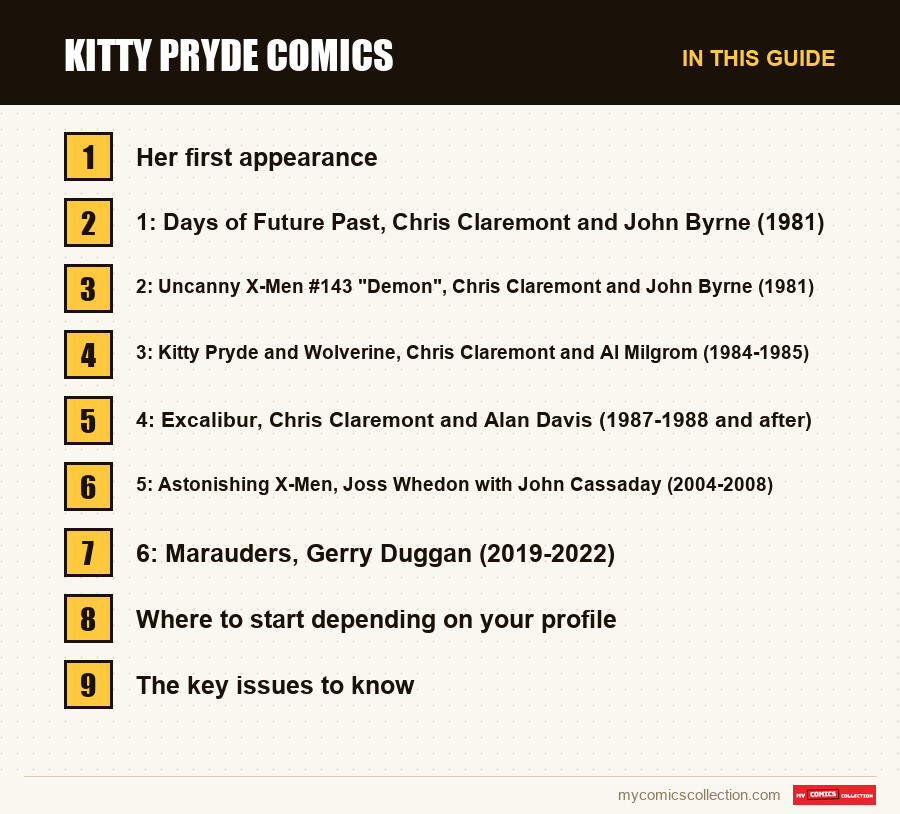
5: Astonishing X-Men, Joss Whedon with John Cassaday (2004-2008)
Joss Whedon writes and John Cassaday draws twenty-four regular issues, from 2004 to 2008, plus a Giant-Size Astonishing X-Men #1 that closes the cycle. The series opens with the "Gifted" arc and ends with "Unstoppable". Kitty is one of the central characters there, with a lively relationship with Colossus whose return structures the start of the series, and a leading role in the final issues.
It is probably the best contemporary way in: the story reads like a season of a TV show, with its twists and end-of-chapter cliffhangers, and it requires no knowledge of the 1980s. It is for readers who prefer the pace of modern stories to Claremont's classics. Read it in publication order, in trade paperbacks, without trying to interleave other titles. Our page on Emma Frost also describes its team dynamic as seen from the other character.
In Kitty's journey, these twenty-four issues close a loop. The youngest recruit of 1980 becomes, in 2008, the one who holds the group together, and John Cassaday's polished art, very clear from page to page, makes the reading pleasant even for a reader who is not used to the American format. The collected editions cover the twenty-four issues and the giant-size issue in publication order, which saves you from hunting for stray single issues.
6: Marauders, Gerry Duggan (2019-2022)
Launched in October 2019 as part of "Dawn of X", the series Marauders is written by Gerry Duggan, with Matteo Lolli on art for the first issue. Kitty becomes Kate Pryde there, captain of a ship, operating under a letter of marque from the Hellfire Trading Company. She keeps her humor, but she now has the stature of a leader.
This is the read that shows most clearly what Kitty has become: an adult who owns her authority. It is for readers who already know a little of the "Dawn of X" era and want an adventure X-Men book, almost a piracy tale. To follow it without getting lost, it is better to read House of X and Powers of X first, whose structure is laid out in our key issues guide.
Marauders also draws on a deeper idea: Kitty has always been the character who watches the team from the outside before becoming its heart, and piracy is an embraced version of that, a leader who chooses her crew rather than having it imposed on her. Emma Frost, whom Kitty already rubbed shoulders with in Astonishing X-Men, is part of the adventure too.
Where to start depending on your profile
If you are new to the X-Men, start with Days of Future Past: two single issues, a closed story, and a heroine you get to know in one evening. If you prefer modern comics, open Whedon and Cassaday's Astonishing X-Men, which requires no prior knowledge. Claremont fans will take Kitty Pryde and Wolverine and then Excalibur to follow the character outside the main team.
If you want the most recent version, Marauders remains the best choice, provided you have read House of X. Finally, if you want to understand the context, go back to The X-Men issues #129 through #139, for which the Uncanny X-Men collecting guide gives the landmarks. Each profile thus finds an entry point that does not assume you have read the others. The reader in a hurry can even stick to three reads, Days of Future Past, Astonishing X-Men and Marauders, which on their own cover the student, the teammate and the leader.
The key issues to know
The first landmark is The X-Men #129 (January 1980), her first appearance. Next come #139, where she joins the team, then #141 (January 1981) and #142 (February 1981) for "Days of Future Past", and #143 (March 1981) for her fight against the demon. For the later eras, the first issue of Kitty Pryde and Wolverine (1984), that of Excalibur (October 1988) and the first of Marauders (October 2019) mark the changes in her role.
The buying method is the same everywhere: ask yourself whether an issue is a first appearance, a turning point or simply a good read, because these are not the same demand. A pair like #141 and #142 is judged together, since it cannot be understood separately. For recent stories, a trade paperback is plenty; for 1980s single issues, the original printing and its condition make the difference. Our page on the French edition of Days of Future Past helps you choose between volumes.
Frequently asked questions
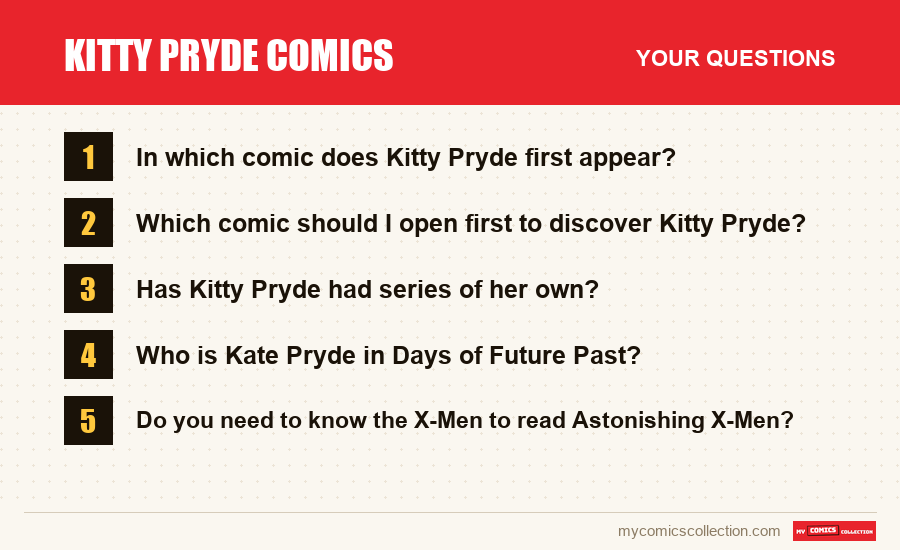
Her first appearance is The X-Men #129, January 1980, an issue by Chris Claremont and John Byrne. She is a teenager from Illinois picked up by Cerebro. The issue also introduces Emma Frost, which gives it a double importance.
Start with "Days of Future Past", in The X-Men #141 and Uncanny X-Men #142, by Chris Claremont and John Byrne. The story fits in two issues and reads with no prerequisites. A taste for the modern will point you toward Astonishing X-Men, by Whedon and Cassaday.
Yes, miniseries, including Kitty Pryde and Wolverine (1984-1985), six issues written by Claremont and drawn by Al Milgrom. She has also held leading roles in team books such as Excalibur and Marauders, where she leads a mutant crew.
Kate Pryde is the adult Kitty of a future controlled by Sentinels. She sends her mind into the body of her teenage 1980 self to prevent a political assassination. The story takes place in The X-Men #141 and Uncanny X-Men #142, in 1981.
No. This series, twenty-four issues from 2004 to 2008 plus a giant-size issue, is aimed squarely at newcomers. Kitty is one of its central characters, and the story reads in publication order, in trade paperbacks.
Do you have a Kitty Pryde single issue, from The X-Men #129 to Excalibur #1? Get it appraised before having it graded or selling it.
Estimate my comic