To read Days of Future Past in French without spreading yourself thin, take the Panini album "X-Men : Futur antérieur", published in September 2023 in the Must-Have line, which gathers American issues 138 to 143. Anyone aiming for the very first French edition should look for two Lug magazines, Spécial Strange 35 (March 1984) and 36 (June 1984). The Panini omnibuses and the Epic Collection suit those who want what comes next.
Two American single issues from 1981 produced one of Marvel's most reprinted stories, and France discovered it in two stages, three months apart, in a newsstand magazine. Since then, the story has changed title, apparent translator and context with each reissue: this guide puts these objects back in order.
As always in this guide, only verified information (creators, issue numbers, dates) is stated as fact; the analysis is our own, with no reproduction of protected artwork or dialogue.
The original US run in brief
The story fits in two issues of the series launched in 1963. The first, dated January 1981, is cataloged under the title The X-Men; the second, dated February 1981, under the title The Uncanny X-Men, although the word "Uncanny" had appeared on the covers since the late 1970s. The credits: Chris Claremont on script, John Byrne on pencils and layouts, Terry Austin on inks, Glynis Wein on colors. The story plays out across two eras: a future held by the Sentinels, and 1980, where the mind of an adult Kate Pryde takes over her teenage body in order to foil a political assassination, the origin of the hunt for mutants.
This starting point weighs on the French bibliography. On one hand, a reader searching for "Days of Future Past" in a catalog finds albums whose scope varies: some stop at #142, others bring in the episodes before or after. On the other hand, the French titles of these two episodes have changed from one edition to another, which misleads buyers. Our page on The X-Men #141 covers the American side and the pitfall of the series title change; here we limit ourselves to what can be bought in French.
The French editions, in order of publication
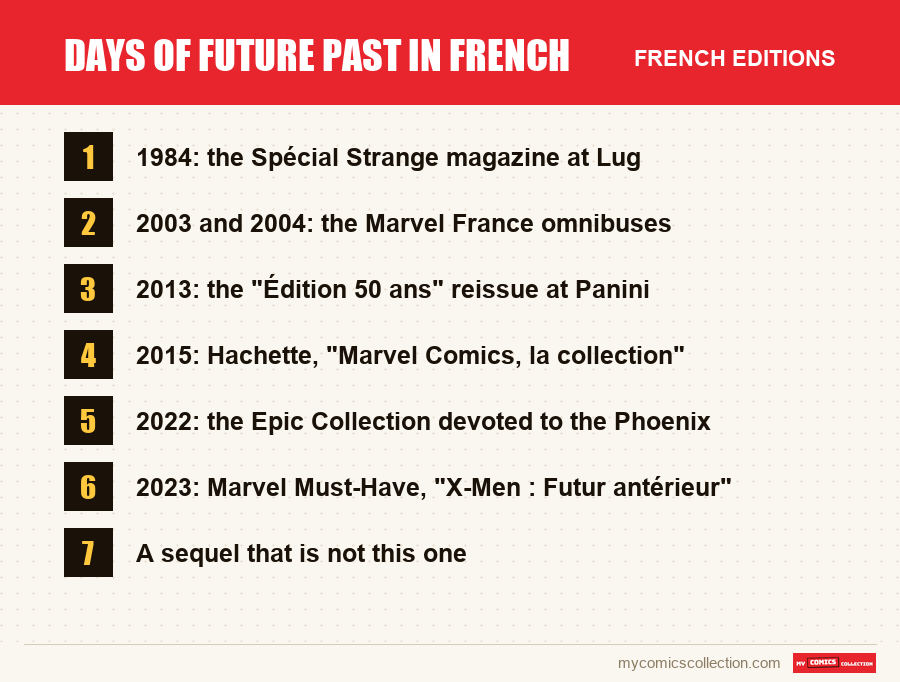
1984: the Spécial Strange magazine at Lug
It is still the newsstand that welcomes the story. Lug, then distributor of Marvel superheroes in France, publishes the first part in issue 35 of Spécial Strange, dated March 1984, titled "Futur antérieur". The second part follows in issue 36, dated June 1984, under the title "Quelle ère est-il ?". Both French titles come from an encyclopedic entry, cross-checked for issue 36 by a catalog record of the magazine, which confirms Lug, June 1984 and the presence of #142.
These magazines are composite objects. A catalog record indicates that issue 36 also reprints the next American episode, #144, centered on Cyclops; we found only one source for this, and we do not detail the rest of each table of contents. For issue 35, we could not cross-check the full list of stories: just note that it opens the story. To place this magazine in the publisher's collection, our Spécial Strange collecting guide gives the reference points for the whole series.
2003 and 2004: the Marvel France omnibuses
In the early 2000s, Marvel France launches a series of hardcover albums called "X-Men : l'intégrale", one volume per year of American publication. The "1980" volume, released in 2003, gathers issues 129 to 140 of Uncanny X-Men; a library record credits the translation to Geneviève Coulomb. The next volume, "1981", carries the date 2004 in a Paris library's catalog and continues the previous volume, which stops at #140; the story therefore very likely appears in it, but we could not consult its detailed table of contents or confirm its translator, and we do not assert them.
2013: the "Édition 50 ans" reissue at Panini
For the X-Men's fiftieth anniversary, Panini republishes the omnibus series in 2013. The "1981" volume, fifth in the series, is dated May 15, 2013: 328 pages, about 27 by 18 centimeters, illustrated cover with dust jacket. A library record indicates that it contains episodes 141 to 152, plus an annual. The story we are following therefore opens the volume, and the rest is the immediate continuation of the regular series.
An encyclopedic entry cites another printing of this volume, dated 2020 and with a different ISBN, with the titles "Où sont les futurs d'antan ?" and "Le Pont de la rivière temps" for the two episodes and a translation by Geneviève Coulomb. This printing remains unverified on our side and the sources contradict each other; check the ISBN printed on the back before paying.
2015: Hachette, "Marvel Comics, la collection"
Hachette published, in its "Marvel Comics, la collection" line, a title "X-Men : Futur antérieur", numbered 024 in 2015 by a collector's listing. We found only this listing: the table of contents, the page count and the translator are not cross-checked, and we do not give them. If you come across this volume, compare its contents with the 2023 Panini album before concluding that they are equivalent.
2022: the Epic Collection devoted to the Phoenix
Panini publishes in 2022 volume 7 of its Marvel Epic collection, "X-Men : le destin du Phénix" (X-Men: The Fate of the Phoenix), which covers the years 1980 and 1981 of the series. The 2023 album's listing indicates that its material had already appeared in this book: it therefore contains the episodes of our story. This thick hardcover reads straight through starting from the Dark Phoenix; if you already own it, there is no need to buy the arc again, and the key issues of that saga show what comes before.
2023: Marvel Must-Have, "X-Men : Futur antérieur"
On September 13, 2023, Panini releases "X-Men : Futur antérieur" in the Must-Have line of the Best of Marvel collection: a 27 by 18 centimeter hardcover, by Claremont and Byrne, which reprints American issues 138 to 143. A library record credits Geneviève Coulomb as translator. The publisher specifies that the material has already appeared in the Phoenix Epic Collection and in a collection titled "Les Trésors de Marvel", in volume 7 devoted to 1981; we do not detail the latter, for lack of a cross-checked listing.
The scope is wider than the title suggests. The two future episodes are framed by those before them (the aftermath of Jean Grey's death, Kitty Pryde's first days at the school) and by those after (the attack of the new Brotherhood of Evil Mutants). On the page count, the sources differ: the publisher announces 152 pages, a bookseller announces 176.
A sequel that is not this one
Semic published in 1994 "Rescapé du futur", which translates Days of Future Present, an American sequel from 1991. It is not the original story: a similar title is not enough to conclude.
US / French correspondence
| French edition | Publisher and date | US issues contained |
|---|---|---|
| Spécial Strange no. 35, "Futur antérieur" | Lug, March 1984 | First part (#141) |
| Spécial Strange no. 36, "Quelle ère est-il ?" | Lug, June 1984 | Second part (#142); one listing also cites #144 |
| X-Men : 1981 | Marvel France, 2004 | Contents not cross-checked |
| X-Men : l'intégrale 1981 (Édition 50 ans) | Panini, May 15, 2013 | #141 to #152, plus an annual |
| X-Men : Futur antérieur (ref. 024) | Hachette, 2015 | Contents not cross-checked |
| Marvel Epic : le destin du Phénix | Panini, 2022 | Contains the episodes of the story; full scope not detailed here |
| X-Men : Futur antérieur (Must-Have) | Panini, September 13, 2023 | #138 to #143 |
Issue 35 corresponds to #141 by deduction: the entry that gives it the title "Futur antérieur" makes it the start of the story, and issue 36 carries the end. The exact day of publication of the magazines is not given by the sources, only the month.
Do you collect this series?
Track what you own, what you're missing and what your collection is worth. 7-day trial.
Start my trial →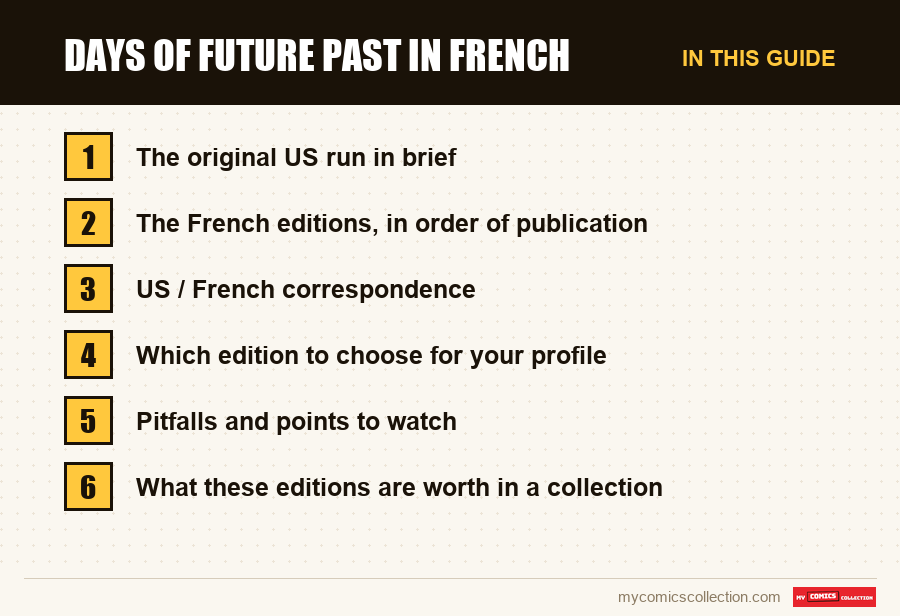
Which edition to choose for your profile
You just want to read the story
The 2023 Must-Have album is the most direct choice: one volume, six American issues, an ordinary book price and a format that fits on a regular shelf. It also has the advantage of not forcing you to buy half a series for a single arc. If you prefer a longer narrative, the Epic Collection or the 1981 omnibus extend the reading, each in a different direction: the Epic goes back toward the Dark Phoenix Saga, the omnibus runs on to the following episodes.
You collect the first French edition
Aim for the pair of Spécial Strange 35 and 36. It is judged like any newsstand magazine: spine, corners, cover, presence of all the interior pages and of the staples. As with the American version, the pair counts for more than each issue alone, since the story is split in two parts. Unlike an American single issue bagged from release, a French magazine from 1984 was often read, folded, put away in a box: a complete, clean copy takes patience.
You like omnibus series
If you are building a shelf year by year, the 1981 volume of the omnibus series is yours, in its Marvel France version or in the 2013 reissue. It has the advantage of belonging to a sequence, but is not limited to our story: the reissue's contents run up to #152.
You are looking for a large format
We found no large-format or boxed-set French edition devoted to this story. The Epic Collection is a collector's hardcover, but not a deluxe format; if you want one, do not trust a seller who promises one without a publisher's listing. To compare Panini formats in general, see our comparison of Omnibus and Absolute at Panini.
Pitfalls and points to watch
French titles change
"Futur antérieur" is the title of the 1984 magazine and of the 2023 album, but not of the omnibus volumes, which adopt other episode titles according to the entry that cites them. A seller who copies an issue title can therefore steer you to the wrong edition. Rely on the contents in American issue numbers, when given.
The scope varies
The scopes are staggered: two episodes in the magazines, six in the Must-Have album, twelve in the 1981 omnibus. No edition contains exactly the same pages. Before paying, check that issue 142 is indeed in the volume and that you are not buying again what you already own.
A frequent confusion with the film
The 2014 film is inspired by this story, but its plot differs markedly. The French editions published at that time are not adaptations: they reprint the original comic. Our comparison of the film and the comics helps avoid expecting from the album what the screen showed.
Dates differ
A magazine's cover month sometimes precedes its newsstand release, and bibliographic databases do not always agree. For album reprints, the legal deposit date, the cover date and the on-sale date are distinct. We give the months observed and leave out the days when they are not cross-checked.
What these editions are worth in a collection
Three parameters structure the value: format, condition and completeness. The 1984 Spécial Strange magazines are newsstand objects, printed to be read; the complete pair, without cuts and without a marked fold, sells better than two mismatched issues. On the Panini side, recent albums circulate widely in bookstores: their value is that of a second-hand reading book, which rewards overall condition and, for the omnibuses, a dust jacket that has stayed intact.
The estimation method stays the same whatever the edition. Compare your copy with completed sales of the same reference, not with those of a neighboring book with a similar title. For an album, watch the corners, the spine and the dust jacket; for a magazine, the spine, the cover and the completeness of the pages. If in doubt about a term (reprint, first edition, printing), the French-edition collector's glossary fixes the meaning used here.
Finally, keep in mind that the value of the American edition is not that of the French one. The original American edition follows its own rules; French editions are valued for their local scarcity, their place in the history of French publishing and their condition.
Frequently asked questions
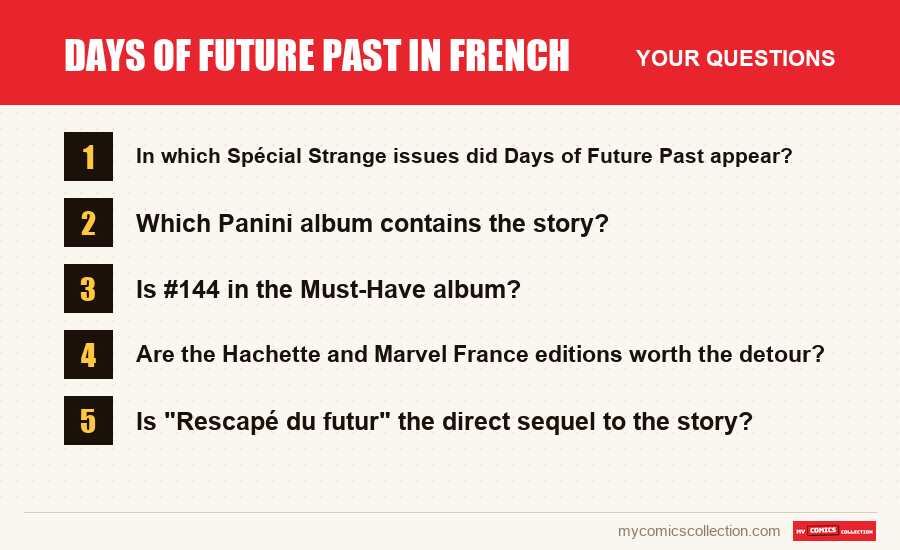
In issue 35, dated March 1984, for the first part under the title "Futur antérieur", and in issue 36, dated June 1984, for the conclusion under the title "Quelle ère est-il ?". Both are Lug magazines that contain other stories.
"X-Men : Futur antérieur", released on September 13, 2023 in the Must-Have line, reprints American issues 138 to 143. The story also appears in the 1981 volume of the omnibus (141 to 152) and in the 2022 Epic Collection, which covers a wider period.
No. The album stops at issue 143. A catalog record indicates that #144 appeared in the magazine Spécial Strange 36 with the end of the story, but we have only one source for this. To read it in album form, look instead at the 1981 omnibus, which runs to #152.
They exist, but we could not cross-check their exact contents: the Marvel France volume dates from 2004, the Hachette one from 2015. If you find one second-hand, compare its contents with the American issue before buying, and do not take it for a duplicate of the 2023 album.
It translates Days of Future Present, an American sequel from 1991, published by Semic in 1994. It is not the 1981 story and does not reprint it. For the original story, turn to the Lug magazines or one of the Panini albums.
A pair of 1984 Spécial Strange, a Panini album or an omnibus volume on your shelf: have its value established.
Estimate my comic