
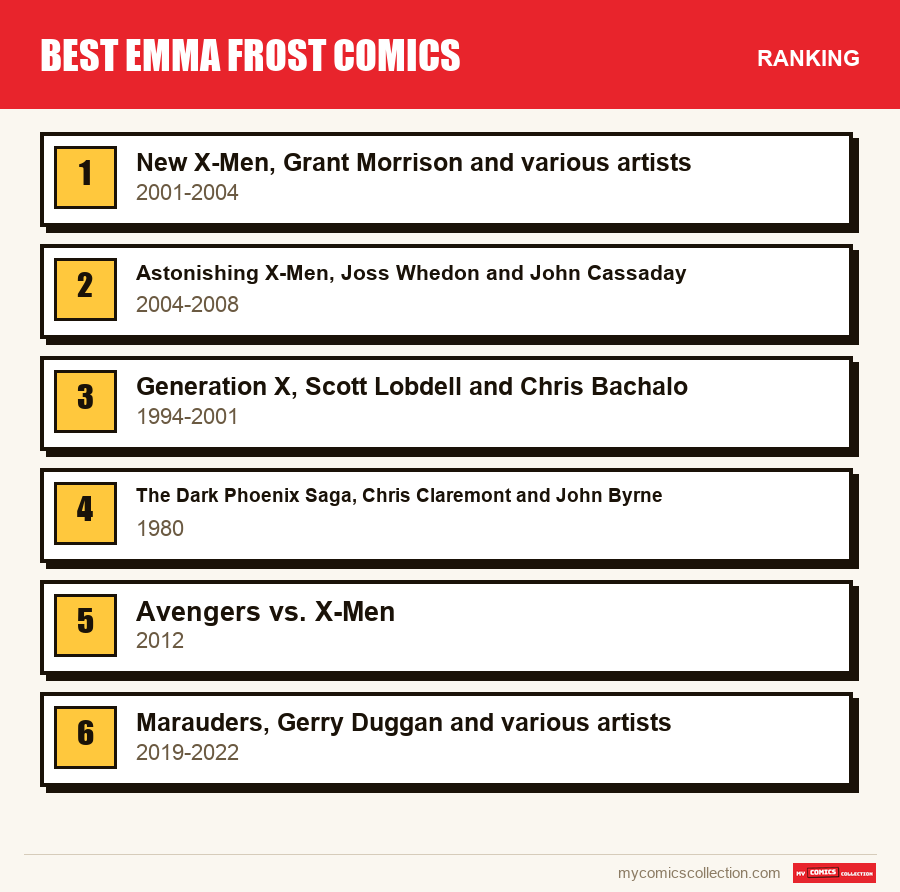
The best Emma Frost comics to start with are New X-Men, Grant Morrison's series from 2001 to 2004, followed by Astonishing X-Men by Joss Whedon and John Cassaday (2004-2008). Then go back to her debut as the White Queen of the Hellfire Club in The X-Men #129 (January 1980), by Chris Claremont and John Byrne, and continue with Gerry Duggan's Marauders (2019-2022).
Few Marvel characters have switched sides as radically as Emma Frost. A telepath at the head of an elite organization, an enemy of the X-Men at first, she ends up teaching, leading, then governing, without ever losing her irony or her sense of power. Reading Emma means following forty years of the mutant universe through a single trajectory, and it is also an excellent way to choose your reading in a very dense bibliography.
As always in this guide, only verified facts (creators, issue numbers, dates) are stated as fact; the analysis is our own, with no reproduction of protected art or dialogue.
Her first appearance
Issue 129 of The X-Men, cover-dated January 1980, sees the birth of Emma Frost under John Byrne's pencils, on a script by Chris Claremont. She appears as the White Queen of the Hellfire Club, a closed circle of New York high society whose members hide an ambition to dominate. Kitty Pryde appears in the same book, which makes it an issue with a double reading. We devoted an entire guide to this dual nature, on our page about X-Men #129; it details what is at stake in the issue, so there is no need to repeat it here.
For the reader looking for Emma, what matters is what this debut sets up: a character who does not seek destruction for its own sake but control, and who treats the X-Men as adversaries worth her attention rather than mere enemies. That ambiguous stance is what will let her switch sides, twenty years later, without betraying her character.
1: New X-Men, Grant Morrison and various artists (2001-2004)
In New X-Men, from #114 to #154, Grant Morrison remakes the X-Men series for the turn of the century, and Emma Frost is one of its centerpieces. She is a teacher at Xavier's school, forms a much-discussed couple with Cyclops, and reveals a secondary mutation, her diamond skin, which makes her both mentally fragile and nearly indestructible physically. Morrison gives her a voice, an inner life, and places her at the center of the series' stakes, well beyond the society-presence role the Hellfire Club had assigned her.
The series is for readers who like auteur-driven stories, dense with ideas, and who accept that the art changes from arc to arc. It reads very well in trade paperbacks, in publication order, with no mandatory prior reading of the classic X-Men. To place the writer in his wider bibliography, the Grant Morrison hub offers a path through his other work.
2: Astonishing X-Men, Joss Whedon and John Cassaday (2004-2008)
When Joss Whedon, known for his television series, takes over the X-Men with artist John Cassaday, he makes Emma Frost a full member of the team, in a dynamic of comedy and tension with Kitty Pryde and Cyclops. The series runs twenty-four regular issues, plus a giant-size issue, and reads like a television season, with its cliffhangers and reversals. Emma gains a sharp humor and the role of a pragmatic conscience that will become one of her defining traits.
It is probably the most accessible read on this list for a reader who knows little about mutants. The four or five trade paperbacks cover the whole run in order, and John Cassaday's line makes it an immediate visual pleasure. Who is it for? Those who want a team story without having to go back twenty years of continuity, and who like a supporting character to illuminate the group as much as the historic figures do.
3: Generation X, Scott Lobdell and Chris Bachalo (1994-2001)
Launched in November 1994, Generation X features a school of young mutants run by Banshee and Emma Frost, set in the Massachusetts academy. Scott Lobdell writes the beginning and Chris Bachalo draws it, with a nervy line that marks the series. This is where Emma leaves the antagonist position for good to become an educator, with all the ambiguity that role implies: she protects her students, but in her own way, never letting go of her authority.
This entry suits readers interested in the character's transformation, and those who like the atmosphere of 1990s Marvel. It reads in single issues or in selective trade paperbacks, the series being longer than the others. If you are in a hurry, concentrate on the first issues to grasp the school's premise, then jump to other reads in this ranking rather than following the whole series.
4: The Dark Phoenix Saga, Chris Claremont and John Byrne (1980)
The Dark Phoenix Saga spans The X-Men #129 to #138, and Emma Frost holds the function she is given at the time: that of the White Queen, an elegant and dangerous adversary. She is not the center of the story, which remains Jean Grey's, but the presence of the Hellfire Club is what sets the machinery in motion: at that circle's invitation, Jean Grey is exposed to a manipulation from which the saga draws its consequences. It is therefore a read for understanding where Emma comes from, more than for following her there.
The saga is for any comics reader, because it is one of the founding texts of the mutant universe. As a trade paperback, it reads in one volume; as single issues, it demands a budget and a method. To spot the single issues that carry weight in the saga, open the page on the key issues of the Dark Phoenix Saga; to go back to the origin of the cosmic force, the one on X-Men #101 presents it.
Do you collect this series?
Track what you own, what you are missing and what your collection is worth. 7-day trial.
Start my trial →
5: Avengers vs. X-Men (2012)
In this event, the Phoenix Force returns to Earth, and five mutants, including Cyclops and Emma Frost, become its hosts: the group nicknamed the Phoenix Five. Emma reaches a power level no earlier story had given her, which raises the question of what she would do with near-absolute power. The crossover is written by several hands: Brian Michael Bendis, Jason Aaron, Ed Brubaker, Matt Fraction and Jonathan Hickman.
This read is more targeted than the previous ones: it is for readers who have already followed Emma and Cyclops since New X-Men and Astonishing X-Men, because the event assumes that attachment. As a trade paperback, it is one main volume to read, to begin with, without the many tie-in issues. If the event interests you, then check the Jason Aaron hub to continue in the same vein.
6: Marauders, Gerry Duggan and various artists (2019-2022)
In Marauders, Gerry Duggan puts Emma Frost at the head of a company that mixes navigation and trade, against the backdrop of Krakoa. Gerry Duggan turns her into a businesswoman and power broker, flanked by Kate Pryde, with a freedom of writing that lets him push the character's irony further than ever. It is one of the few series to place her, durably, as the headliner.
It is better to have read House of X and Powers of X beforehand, because the series assumes their rules of the game: our page on the key issues of House of X sums up what you need to know. Kieron Gillen then extends this political role in Immortal X-Men (2022), where Emma sits on the Krakoan Quiet Council; the Kieron Gillen hub places that series in the rest of his work for Marvel. In trade paperbacks, the read flows well; in single issues, it requires following the calendar of the events of the moment.
A word on reading order among these six entries: the ranking above is a ranking by interest, not a chronological order. Reading in publication order is an excellent second path, once you have tasted the character through one of her best periods. The four series that matter most for Emma, Generation X, New X-Men, Astonishing X-Men and Marauders, each have their own entry point and do not block one another.
Where to start based on your profile
If you are starting out with the X-Men, favor Astonishing X-Men, which reads almost like a standalone season, then New X-Men to go deeper. If you want the classic version, the one that explains why Emma is a reference figure, go back to the Dark Phoenix Saga. For a reader seeking the most contemporary version, Marauders is the best choice, provided you have skimmed House of X.
If your interest is in psychological evolution, follow with publication order: X-Men #129, Generation X, New X-Men, then Astonishing X-Men. This path shows how a villain becomes, in twenty years, a central figure of the team. For the collector who wants to assemble a thematic set, the same path logic works: an opening issue, a transitional series, a moment of glory, then a recent example.
The key issues to know
The first landmark is The X-Men #129 (January 1980), her first appearance, shared with Kitty Pryde. It is an issue sought by two audiences, which puts it in a category of its own in the collection of any reader of the Claremont and Byrne era. The second landmark is Generation X #1 (November 1994), which marks her move to teaching. The third is New X-Men #114 (July 2001), which launches the Morrison era, where she reaches her full scope.
Then come Astonishing X-Men #1 (2004), for the takeover by Joss Whedon and John Cassaday, and Marauders #1 (2019), for her role as leader. The method is the same for each: ask what the issue contributes to the character, check for variant covers, then compare copies in the same condition. A first issue of a series is not a key for Emma if it adds nothing new to her path, and this way you avoid buying single issues for the wrong reasons.
For the reader who prefers the reading to the object, all these landmarks exist in trade paperback, and publication order is the best guide. For the collector, each landmark has its own logic: the 1980 one for history, the 1994 one for the turning point, the 2001 one for the golden age of the British writer. If you own one of these issues, our free appraisal tool gives a first read before any decision.
Frequently asked questions
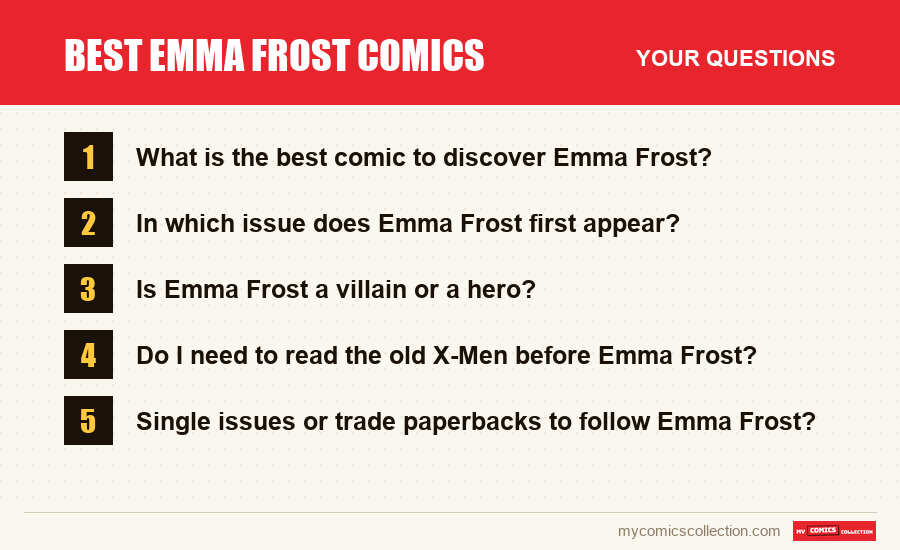
The simplest door is Astonishing X-Men: you follow Emma in a self-contained team adventure by Joss Whedon and John Cassaday that a few trade paperbacks cover. For a more ambitious read, Grant Morrison's New X-Men deepens her journey.
In The X-Men #129, with a January 1980 cover date, where Claremont and Byrne show her for the first time. She is the White Queen of the Hellfire Club. The same issue introduces Kitty Pryde, which makes it a much-sought double first appearance.
Both, depending on the era. An antagonist at first with the Hellfire Club, she becomes an educator in Generation X, then a full member of the team in New X-Men and Astonishing X-Men. Her ambiguity is part of her appeal: she has never stopped thinking like a strategist.
No. Astonishing X-Men and New X-Men read without heavy prerequisites, because each series lays down its own foundations. The Dark Phoenix Saga is an enriching read, but it remains optional if the goal is to follow the character rather than the team's complete history.
For reading, trade paperbacks are enough: New X-Men, Astonishing X-Men and Marauders exist in collected volumes. Single issues matter mainly for the 1980 first appearance and for first issues that mark a turning point, where the condition of the copy weighs in the choice.
Do you own a copy of The X-Men #129 or a first issue of a series featuring Emma Frost? Get a first read on its condition.
Appraise my comic