
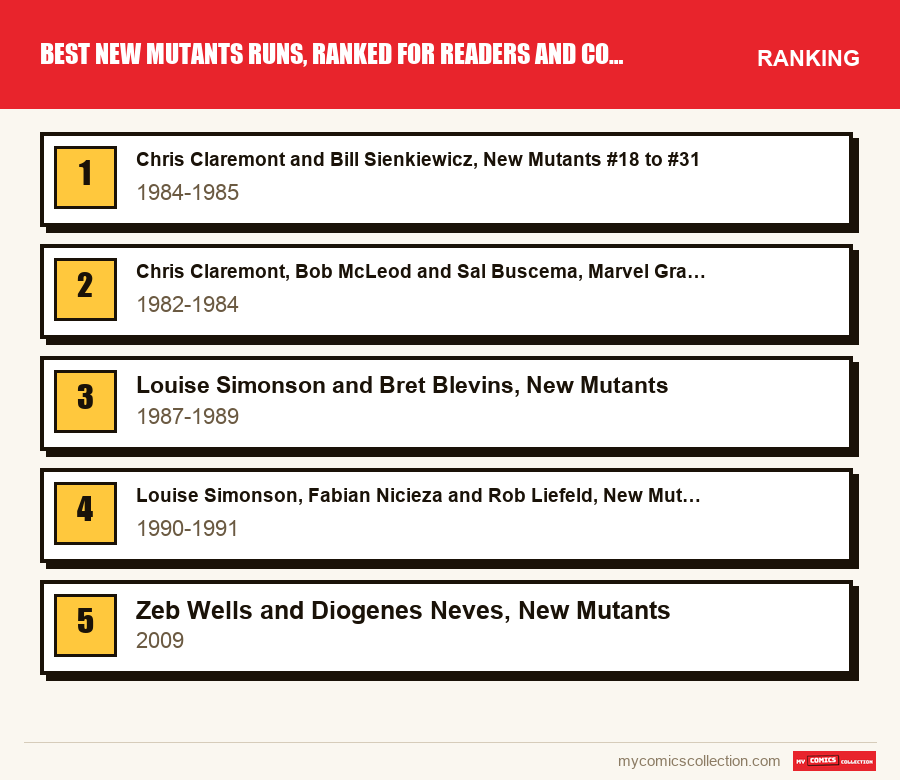
The best New Mutants run is Chris Claremont and Bill Sienkiewicz on New Mutants #18 to #31 (1984-1985), where the series stops being a remedial class for teenagers and becomes a graphic laboratory. Next come Claremont's debut stretch with Bob McLeod and then Sal Buscema, the Louise Simonson era, the shift to X-Force with Rob Liefeld, and finally Zeb Wells's 2009 relaunch. Collected editions are enough for reading; single issues are best kept for the pivotal numbers.
In the mutant library, The New Mutants holds a singular place: a title born as a school-age spin-off of the X-Men that served as a testing ground for three very different sensibilities in under ten years. So you have to choose your period before you choose your issues, and that choice is what this ranking aims to clarify.
As always on this guide, only verified information (creators, issue numbers, dates) is stated as fact; the analysis is our own, with no reproduction of protected art or dialogue.
How to read a title that changed its look three times
The series begins in 1982 with a graphic novel, Marvel Graphic Novel #4, written by Chris Claremont and drawn by Bob McLeod. The monthly title then launches with an issue #1 dated 1983 and ends at issue #100, in 1991, when the team becomes X-Force. Between those two markers, four visual identities follow one another, and each calls for a different reader.
Our ranking does not measure fidelity to continuity but standalone reading value: can a period be read without having read everything else, is there a story that holds together, and does the art age with dignity? We also took into account which issues each period leaves behind that collectors hunt for, without ever giving a price. The original lineup is always the same: Karma, Wolfsbane, Cannonball, Sunspot, Magik and Moonstar form the core, shaken up by arrivals like Warlock or Cypher.
Top 1: Chris Claremont and Bill Sienkiewicz, New Mutants #18 to #31 (1984-1985)
This is the period that made the series something other than an annex. With New Mutants #18, Bill Sienkiewicz takes over the art, and the line changes abruptly: heavy inks, collage, backgrounds that fragment, panels that burst. Claremont, meanwhile, drops the school story for tales of horror and dark fantasy, with teenagers facing fears they cannot name.
The Demon Bear arc, spread over issues 18 to 20, is the natural way in: a supernatural threat haunting Danielle Moonstar, and the backbone of the 2020 film. Issue 25 introduces Legion, a character whose role goes far beyond the series. What follows mixes a Norse tale, standalone issues and shifts in tone that were rare for the mainstream of the time.
Its importance comes from fixing the identity of the New Mutants against the X-Men: with them, fear has a place. It speaks first to the reader who enjoys the page-layout daring of 1980s comic books. It sometimes puts off those who want a classic monthly superhero title, because the art takes a little time to get used to.
To collect it, there are two routes. The original single issues exist in large quantities, which makes them accessible on modest budgets, except in high grades where supply tightens. The modern collected editions of the series, in big bound volumes, gather this period well and suit anyone who only wants to read.
Top 2: Chris Claremont, Bob McLeod and Sal Buscema, Marvel Graphic Novel #4 and New Mutants #1 to #17 (1982-1984)
The origins deserve their place, even if they are more restrained. The 1982 graphic novel sets out the premise: teenage mutants gathered in Professor Xavier's mansion, discovering their powers under the watch of overwhelmed adults. Bob McLeod, the founding artist, gives the series a cleaner, clearer identity than the one that follows. Only the very first issues of the monthly are drawn by McLeod, however: Sal Buscema takes over the pencils and handles most of the run up to #17.
These first seventeen issues tell the building of a group more than a grand story. We see the team clash, learn to cooperate and cross paths with familiar figures from the rest of the X-Men family. The pleasure is that of a coming-of-age tale: everyone has a secret, a loss or a shame, and the series takes the time to establish them.
This run matters because it fixes the core of the cast and the overall tone, on which every later creator embroiders, contradicts or breaks free. It is for anyone who wants to understand where the characters come from before tasting the more eccentric periods. Hurried readers may find it slow, and that is true: the ranking puts it behind Sienkiewicz precisely for that reason.
For collecting, the 1982 graphic novel and issue #1 are the coveted pieces of this period. They are bought as single issues, while the contents of the following numbers read comfortably in collected editions. If your priority is reading, a first collected volume covering this period is enough.
Top 3: Louise Simonson and Bret Blevins, New Mutants (1987-1989)
When Claremont leaves the title, Louise Simonson takes it over in 1987 and gives it a more sentimental, more epic color. Bret Blevins, an artist with a slightly elliptical elegance, becomes the visual voice of this period. The characters grow up, leave school, switch sides: the team that appears in the following years no longer resembles the one from 1982.
This run is worth reading for its crossover shocks. The New Mutants meet several of the big events of the era, including Inferno, which brings them back to Magik and her demons. Louise Simonson knows how to write relationships that move: friendships strain, romances come apart, loyalties shift. The reading pleasure is more soap opera than fresco.
It is for the reader already familiar with the team who wants to see what the characters become. It works less well for the curious newcomer with no background, since understanding several issues depends on neighboring titles. In our grid, that is the reason it sits in third place despite its qualities.
For collecting, these issues are the cheapest of the series, a sign of lukewarm demand: it is a good zone for completing a collection without pressure. Collected editions reprint part of this period, but less systematically than for the early years; the single issue remains the most complete format here.
Do you collect this series?
Track what you own, what you are missing and what your collection is worth. 7-day trial.
Start my trial →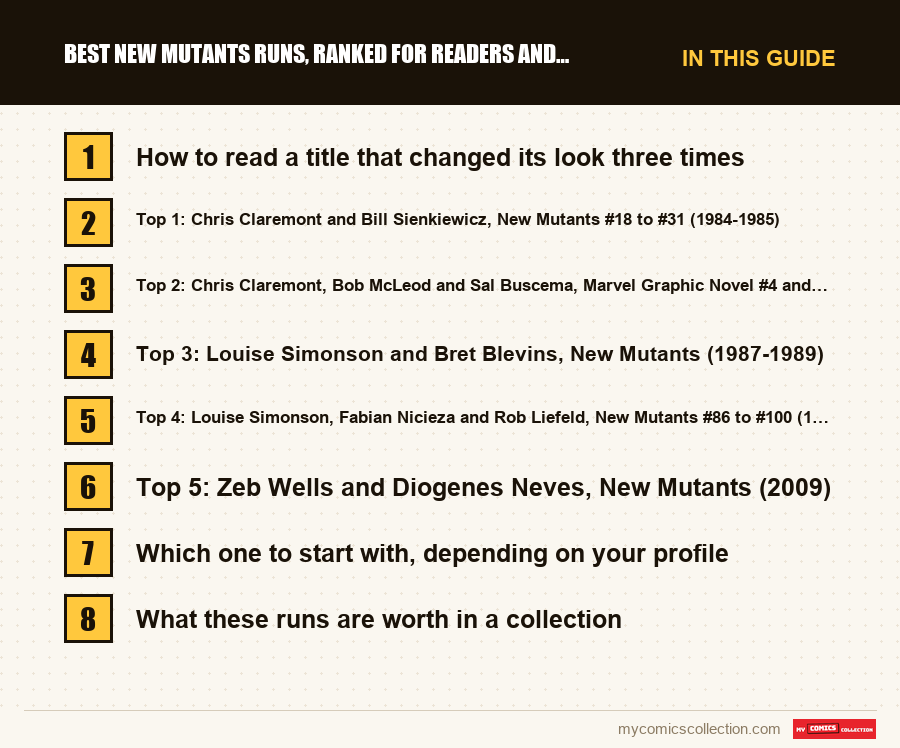
Top 4: Louise Simonson, Fabian Nicieza and Rob Liefeld, New Mutants #86 to #100 (1990-1991)
This is the end of the series, and the most talked about. Rob Liefeld arrives with issue 86 and turns the team's look into an imagery of muscles, pouches and guns. In this final stretch, issue 87 reveals Cable, issue 98 introduces Deadpool, and the title closes at issue 100 before being reborn as X-Force.
This run matters because it manufactures, almost before our eyes, the raw material of the following decade. Fans of the modern age see the birth of a style that will dominate the 1990s; its detractors read a break with the original vein. Both views are defensible, and that is why this stretch is more interesting to study than to read for pleasure.
It is for those who collect by first appearances rather than by stories. Our detailed pages on issue 87 and issue 98 explain what each contains, and it would be redundant to copy them here: read the page on #87 and the first appearance of Cable and then the one on #98, value and condition for the details.
How do you collect it? These single issues were printed in the hundreds of thousands, so scarcity never comes from the paper but from the condition. The sensible method is to aim for a clean copy rather than a promised grade, then compare completed sales rather than listings. To read without that worry, a collected edition covering the transition to X-Force does the job.
Top 5: Zeb Wells and Diogenes Neves, New Mutants (2009)
After years of scattering, Marvel relaunches the title in 2009 with Zeb Wells on script and Diogenes Neves on art. The proposition is simple: reunite the original team, now grown up, and make it face painful reunions. The former students find themselves in a world where loyalty to their past is no longer self-evident.
This run matters because it reminds us that the strength of the concept lies in the characters and not only in a line or an era. It contains a saga built around the return of a former team member, which serves as the backbone for several issues. The art, smoother than in the 1980s, follows the taste of the early part of the following decade.
It is for those who want to read the New Mutants as adults, with nostalgia turned low. It suits poorly anyone who has never read the original period, since the emotions rest on what you know about the characters. We place it fifth because it reads well but changes neither the form nor the substance.
For collecting, the single issues of this relaunch are recent and affordable, and collected editions reprint the logical sequence of the arcs. The choice of format therefore depends only on your available space and your appetite for physical issues.
Which one to start with, depending on your profile
If you want the best, and if the author's name intrigues you (our portrait of Chris Claremont traces the career), start with Claremont and Sienkiewicz, even if it means beginning at the Demon Bear and working back toward the origins. It is the most rewarding way in, and the 2020 film is its distant echo.
If you like coming-of-age stories, read the 1982 graphic novel first and then the start of the series with Bob McLeod. You will better understand what Sienkiewicz's work comes to shake up.
If you collect by first appearances, focus on the Liefeld period, keeping in mind that it is the most heavily printed. If you mostly follow Cable, our ranking of the best Cable runs extends this path. If you want an adult, contemporary read, the Zeb Wells run, after going through the origins, is the easiest to follow. Finally, if you want to continue beyond issue 100, move on to X-Force, which our dedicated ranking covers in detail.
What these runs are worth in a collection
One point dominates: these single issues are abundant, and what you pay for is mostly condition, never a title. Demand is concentrated on a few pivotal issues, the 1982 graphic novel, issue #1, the start of Sienkiewicz, #87 and #98, while most of the rest sits at a very favorable price-to-pleasure ratio. Collected editions, for their part, resell at a steady discount.
The method we recommend is the ratio: compare the price of a key issue with the price of a lot of fifteen neighboring single issues from the same period, then ask yourself whether your goal is to read, to complete or to preserve. To estimate a specific copy, cross-check three completed sales at the same condition before trusting a posted listing.
Also note that a late single issue deserves a close look: the 1990 and 1991 numbers were often handled at the comic shop counter, and their corners show it. Keep them in a neutral sleeve, away from light.
Frequently asked questions
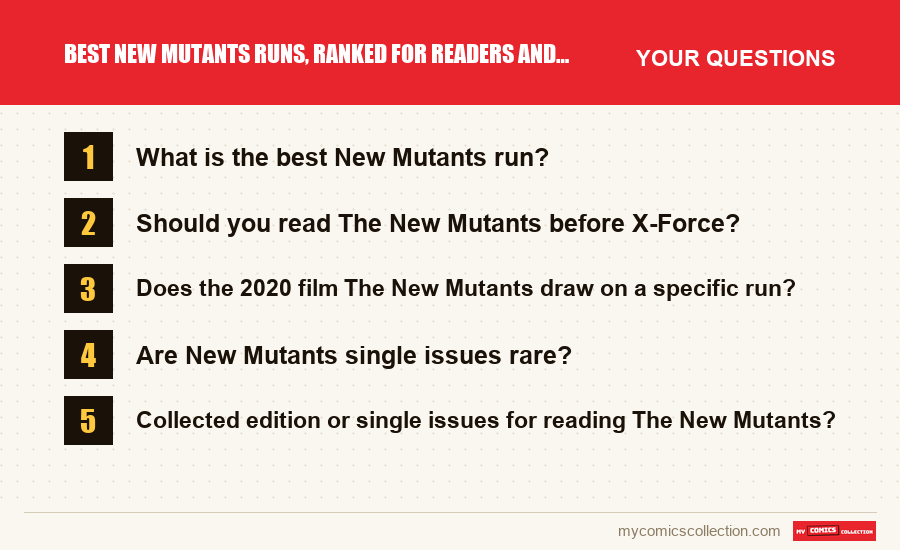
The one by Chris Claremont and Bill Sienkiewicz, from New Mutants #18 to #31 (1984-1985), is the most often cited. Sienkiewicz's line moves the series toward horror and fantasy, with the Demon Bear arc and the introduction of Legion in issue 25. It is the entry point we recommend first.
It is not mandatory, but it helps. X-Force is born from issue 100 of The New Mutants, in 1991, and carries over several characters. Reading the last three or four issues of the series, including #87 and #98, lets you understand the origin of Cable and Deadpool before opening the first issue of X-Force.
It draws on the original team and on the Demon Bear arc, published in New Mutants #18 to #20 in 1984 by Claremont and Sienkiewicz. The closed-door setting is an invention of the film. Our comparison details the differences between Josh Boone's adaptation and the comics.
No. Marvel printed this title in large quantities from 1983 to 1991, and copies still circulate in abundance at specialist shops. Scarcity comes from condition, not paper. The pivotal issues, such as the 1982 graphic novel or #87, concentrate the demand.
To read the Sienkiewicz era, the bound collected edition is more comfortable and reproduces the inks better than many worn single issues. For event issues or first appearances, favor the original single issue, taking care to check the condition and the issue number before buying.
Do you own a 1980s New Mutants or an issue from the Liefeld period? Estimate it by comparing completed sales at its condition.
Estimate my comic