
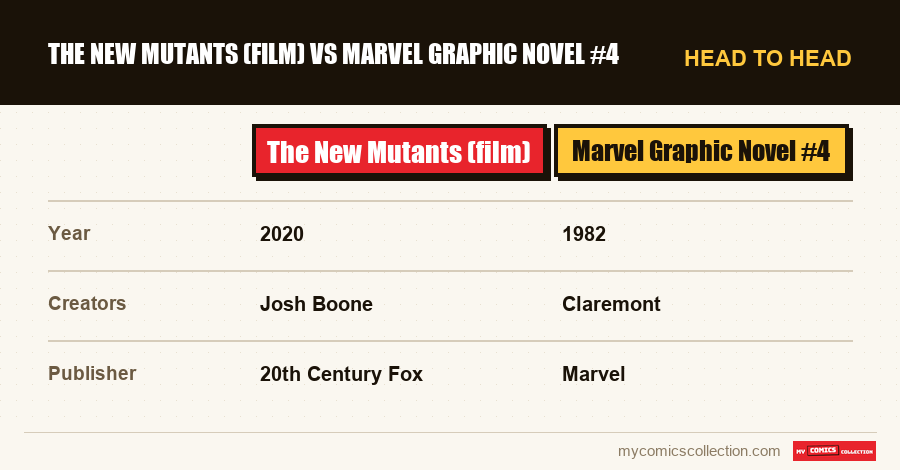
The New Mutants (2020) Josh Boone adapts the team of young mutants born in Marvel Graphic Novel #4 (1982) by Chris Claremont and Bob McLeod. The film, tinged with horror, features Mirage , Wolfsbane , Cannonball , sunspot and Magik , and is inspired by the saga of the Demon Bear (New Mutants #18-20, 1984). Faithful to the characters, he reinvents the setting behind closed hospital doors. Here is the detailed comparison, film versus comics.
A separate adaptation in the X-Men saga, The New Mutants swaps the superhero film for adolescent horror. It draws from the team of young mutants Claremont created and one of his darkest tales. Source-by-source decryption.
As in each article in this series, only verified information (creators, distribution, dates, comic numbers) is stated; the comparative analysis is ours, without reproducing dialogue or protected images.
Title : The New Mutants (2020)
Director: Josh Boone
Actors: Maisie Williams (Wolfsbane), Anya Taylor-Joy (Magik), Blu Hunt (Mirage), Charlie Heaton (Cannonball), Henry Zaga (Sunspot)
Exit : August 2020
Studio: 20th Century Fox
Marvel Graphic Novel #4 (1982): First appearance of the New Mutants
New Mutants #18-20 (1984): the saga of the Demon Bear
Mirage, Wolfsbane, Cannonball, Sunspot: the Claremont team
Magik (Illyana Rasputin): the sister of Colossus, linked to Limbo
- The team of young mutants in training.
- Mirage and its illusions stemming from deep fears.
- L'Demon Bear, a nightmare inherited from the comics.
- Magik, his magical powers and his connection to Limbo.
- The powers of Wolfsbane, Cannonball and Sunspot.
- The frame becomes a hospital-closed doors distressing.
- The tone is that of teenage horror.
- The team is isolated, with no direct connection to the X-Men.
- The plot is tight on five characters.
- La mythology (Limbo, the Bear) is condensed.
Marvel Graphic Novel #4 (1982): The New Mutants
The New Mutants appear in Marvel Graphic Novel #4 (1982), created by Chris Claremont and Bob McLeod, before gaining their own series regular. The idea is to feature a new generation of teenage mutants trained by Xavier, younger and more vulnerable than the X-Men, still learning about their powers and themselves. The original team includes Mirage (Dani Moonstar), Wolfsbane (Rahne Sinclair), Cannonball (Sam Guthrie), Sunspot (Roberto da Costa) and Karma. This concept, centered on adolescence, emotions and fears, offered an intimate counterpoint to the adventures of the X-Men, exploring the training of young heroes far from major battles.
The film takes the heart of this concept (a team of young mutants in training, discovering their powers and their identities) and most of the original characters, adding Magik. He respects their abilities and their nature as adolescents in search of direction. The main freedom lies in the setting and the tone: the film transposes the team into an isolated hospital, behind closed doors, and adopts the register of adolescent horror. This approach, radically different from other X-Men films, seeks to renew the formula by focusing on fear and introspection rather than spectacular action.
The saga of the Demon Bear, source of horror
The film draws its atmosphere and its main threat from the saga of the Demon Bear (New Mutants #18-20, 1984), a cult story by Chris Claremont and Bill Sienkiewicz, considered a peak of horror in superhero comics. This saga features Dani Moonstar (Mirage), haunted by a demonic bear who killed her parents and stalks her through her dreams before emerging into reality. Sienkiewicz's experimental and nightmarish aesthetic left an impression on readers, making this story a reference in horror comics. The power of Mirage, which materializes the deepest fears, finds its most terrifying expression there.
The film takes up this figure of the Demon Bear and the power of Mirage, integrating them into its hospital setting. The threat arises from the fears of young mutants, materialized by Dani's illusions, culminating in the appearance of the nightmarish bear. This fidelity to one of the darkest tales of The New Mutants anchors the film in an authentic horror vein. By choosing this saga rather than a classic action story, the film assumes its unique identity. For the reader, it is an invitation to discover the saga of the Demon Bear, a visual masterpiece whose atmosphere even exceeds that of the film.
Magik, Mirage and a team of young mutants
The film highlights several emblematic characters from the New Mutants. Mirage (Dani Moonstar), of Native American descent, possesses the power to create illusions drawn from the fears and desires of others: a gift at the heart of the horror story. Magik (Illyana Rasputin), sister of the X-Man Colossus, is a witch linked to the demonic dimension of Limbo, from which she derives her soul sword and magical powers. Wolfsbane (Rahne Sinclair) transforms into a she-wolf, Cannonball (Sam Guthrie) propels himself like an invulnerable cannonball, and sunspot (Roberto da Costa) absorbs solar energy to increase his strength tenfold. The film faithfully respects these powers and the essence of each character.
This gallery of teenagers, each with their own traumas and doubts, embodies the spirit of the New Mutants: ordinary young people confronted with extraordinary powers and their own demons. The film explores their fears, their secrets and their difficulty in accepting themselves, in an intimate vein faithful to Claremont's series. Magik, in particular, benefits from a striking treatment, between magical power and traumatic past. For the reader, these characters are invitations to discover the New Mutants series, where their tormented adolescence and their training as heroes are developed with a sensitivity rare in superhero comics.
Collecting this series?
Track what you own, what you are missing and what your collection is worth. 7 day trial.
Start my trial →The characters, from paper to screen
- Mirage (Dani Moonstar): Creates illusions arising from deep fears at the heart of the horror story.
- Magik (Illyana Rasputin): Witch bound to Limbo, sister of Colossus, to the soul sword.
- Wolfsbane (Rahne Sinclair): Transforms into a wolf, torn by her faith.
- Cannonball (Sam Guthrie): Propels like an invulnerable cannonball.
- Sunspot (Roberto da Costa): Absorbs solar energy to increase its strength tenfold.
A horror film in the mutant universe
The New Mutants is radically distinguished from other X-Men films by its bias: that of adolescent horror. By locking its young mutants in an isolated hospital, haunted by their materialized fears, the film adopts the codes of the genre film rather than those of the superhero blockbuster. This bold approach draws on the intimate and sometimes dark nature of the original series, particularly the Demon Bear saga. It demonstrates a desire to renew the mutant formula, by exploring fear and introspection. This mixture of superheroes and horror, rare in cinema, gives the film a unique identity.
The film's troubled production, marked by numerous postponements and the end of the Fox franchise, however weighed on its initial ambition and its reception. Released late, in a difficult context, it was unable to fully deploy its potential. It nevertheless remains an interesting curiosity, the saga's only foray into the horrific register. For the reader, it is an invitation to discover the New Mutants in the comics, where the team and its stories, from the original series to the Demon Bear saga, offer a rich and sensitive exploration of mutant adolescence. The film only gives a glimpse, in an experimental format.
The troubled destiny of a long-delayed film
The New Mutants will remain famous as much for its content as for its chaotic production journey. Completed several years before its release, the film underwent numerous postponements, the victim of planned reshoots, the takeover of the Fox studio and finally a particularly unfavorable release context. This troubled destiny made it a curiosity, a long-awaited film that was regularly announced before being released in difficult conditions. It is also, in fact, the final production of Fox's mutant franchise, discreetly closing a twenty-year era. This context inevitably weighed on its reception and visibility.
This difficult journey should not obscure the interest of the approach. By daring adolescent horror in the mutant universe, The New Mutants attempted something unique in superhero cinema, building on the dark and intimate vein of Claremont's series. Even imperfect, this attempt demonstrates the richness of tones that mutant mythology can adopt, from the epic blockbuster to the distressing closed doors. For the reader, it is an invitation to explore the diversity of the stories of the New Mutants in the comics, where adolescence, fear and magic mingle with a rare sensitivity. The film, despite its thwarted fate, will at least have introduced these characters to a wider audience.
Where to start reading
To extend the film, Marvel Graphic Novel #4 (1982), by Claremont and McLeod, features the first appearance of the New Mutants. The saga of the Demon Bear (New Mutants #18-20, 1984), by Claremont and Sienkiewicz, is the horrific source of the film, a visual summit to discover. The regular series The New Mutants develops the team. This journey covers the sources of a film faithful to the intimate and dark spirit of young mutants.
Chronology of comics to know
- 1982: Marvel Graphic Novel #4: The first appearance of the New Mutants.
- 1984: New Mutants #18-20: the saga of the Demon Bear (Claremont & Sienkiewicz).
- 1980s: The regular series develops the team and Magik.
Collection side: what numbers to aim for after the film
The New Mutants points to keys from the 1980s. Marvel Graphic Novel #4 (1982, first appearance of the New Mutants) is a sought-after issue, important to mutant mythology. The numbers of the saga of the Demon Bear (New Mutants #18-20, 1984) are prime targets, driven by the cult of the Claremont-Sienkiewicz collaboration. The first issues of the regular series offer other avenues. These targets cover various budgets. As always, condition and gradation determine value; relying on real recent sales is strongly recommended.
Its place in the saga and for the collector
The New Mutants brought to the screen a team of young mutants in an unprecedented horrific register, despite a troubled production. For the collector, it brought attention to Marvel Graphic Novel #4 and the Demon Bear saga. It illustrates the effect of adaptations on the market. Beyond speculation, the film invites us to discover the New Mutants in the comics, this generation of teenage mutants whose stories, between intimacy and horror, have marked Claremont's series. By choosing horror, the film recalls the diversity of tones that mutant mythology can adopt.
The verdict: a mutant horror of its own
- Loyalty: the team of young mutants, Mirage and his illusions, the Demon Bear, Magik and the characters' powers come from the comics.
- Freedoms: the hospital setting, the horrific tone, the isolation of the team, the condensed mythology.
- Collectible numbers: Marvel Graphic Novel #4 (New Mutants), the Demon Bear Saga (New Mutants #18-20).
The New Mutants transposes a team of young mutants into a behind-closed-doors horror film, inspired by the Demon Bear saga. Faithful to the characters and their nature as tormented adolescents, the film reinvents the setting and the tone. For both the reader and the collector, it is an invitation to discover Marvel Graphic Novel #4 and the Demon Bear saga.
Frequently asked questions
From Marvel Graphic Novel #4 (1982), created by Chris Claremont and Bob McLeod. It is a team of young mutants trained by Xavier, younger than the X-Men. The film uses the concept and most of the original characters.
A nightmarish creature from the New Mutants saga #18-20 (1984), by Claremont and Sienkiewicz, which haunts Dani Moonstar (Mirage). The film makes it its main threat, faithful to this cult tale of comic book horror.
Director Josh Boone chose the horrific register to renew the mutant formula, relying on the dark vein of the series, notably the saga of the Demon Bear. The film locks its heroes in an isolated hospital, haunted by their fears.
Illyana Rasputin, sister of the X-Man Colossus, a witch linked to the demonic dimension of Limbo, from which she draws her soul sword. A notable character in the film, faithful to his magical powers and his traumatic past in the comics.
Marvel Graphic Novel #4 (1982, first of The New Mutants) is the most sought after key. Issues of the Demon Bear saga (New Mutants #18-20, 1984) are other prime targets.
Does the film make you want to collect? Estimate the value for free of your issues (Marvel Graphic Novel #4, New Mutants #18-20…) with our tool based on current eBay listings.