X-Men: Apocalypse (2016) Bryan Singer pits the mutants against the first of them, Apocalypse (In Sabah Nur), born in X-Factor #5-6 (1986) by Louise Simonson and Jackson Guice. The film takes on the immortal mutant god and his Four Horsemen, but reinvents their composition and anchors the story in the 1980s. Faithful to the spirit of the character, he simplifies the mythology. Here is the detailed comparison, film versus comics.
Third part of the “prequel” saga, Apocalypse confronts the young X-Men with a divine and ancient threat. It taps into one of mutants' most powerful enemies. Source-by-source decryption.
As in each article in this series, only verified information (creators, distribution, dates, comic numbers) is stated; the comparative analysis is ours, without reproducing dialogue or protected images.
Title : X-Men: Apocalypse (2016)
Director: Bryan Singer
Actors: Oscar Isaac (Apocalypse), James McAvoy, Michael Fassbender, Jennifer Lawrence, Sophie Turner (Jean Grey)
Exit : May 2016
Studio: 20th Century Fox
X-Factor #5-6 (1986): Apocalypse's first appearance (Simonson & Guice)
The Four Horsemen: the servants of Apocalypse
In Sabah Nur: the first mutant, immortal
Archangel: Angel transformed into Horseman of Death
- Apocalypse, the first mutant, immortal and super-powerful.
- His Four Horsemen, mutants that he rallies and amplifies.
- The philosophy of “survival of the fittest”.
- Angel transformed into a Metal-Winged Horseman.
- The origin ancient and Egyptian of the character.
- La composition of the Cavaliers differs from the comics.
- The story is anchored in 1980s.
- Apocalypse faces young X-Men (Jean, Cyclops, Tornado).
- La mythology of the character is simplified.
- The link with X-Factor and the comic origins are absent.
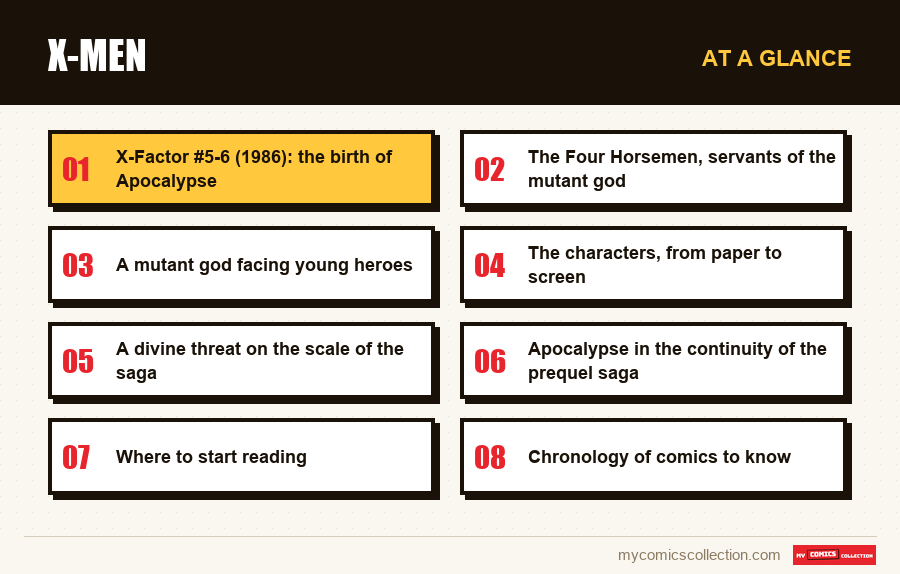
X-Factor #5-6 (1986): the birth of Apocalypse
Apocalypse appears in X-Factor #5-6 (1986), created by Louise Simonson and Jackson Guice. En Sabah Nur is presented as the first mutant in history, born in ancient Egypt, endowed with almost unlimited power and an immortality that spans the millennia. His philosophy is brutal: only the strongest deserve to survive, and he works to test humanity and mutants to let only the strongest prosper. A quasi-divine figure, Apocalypse rallies and "improves" mutants to make his Four Horsemen: Death, War, Famine and Pestilence -, in reference to the biblical horsemen of the Apocalypse. He is one of the X-Men's most formidable enemies.
The film faithfully captures the essence of the character: the first mutant, immortal, of ancient Egyptian origin, his philosophy of survival of the fittest, and his Four Horsemen. Oscar Isaac plays an imposing Apocalypse, driven by a desire to “purify” the world. The main freedom concerns the mythology and the context: the film anchors the story in the 1980s, without connection with the X-Factor team from the comics where the character was born, and simplifies its complex cosmogony. Apocalypse faces the young X-Men of the new chronology, in a story that favors spectacle over the mythological depth of the source.
The Four Horsemen, servants of the mutant god
One of the most iconic elements of Apocalypse is his court of Four Horsemen, mutants whom he rallies and whose powers he amplifies to make them his lieutenants. In the film, these Horsemen are Storm, Psylocke, Angel and Magneto, a composition unique to the adaptation. In the comics, the roster of Horsemen has varied over the decades, with Apocalypse recruiting different mutants depending on the era. The most famous remains Angel, transformed into Archangel, the Horseman of Death, with sharp metal wings and blue skin: a tragic metamorphosis of a historic member of the X-Men, faithfully reproduced by the film.
Magneto's rallying to the Horsemen is one of the dramatic springs of the film. Marked by a new personal tragedy, the master of magnetism gives in to the nihilism of Apocalypse, before changing his mind. This trajectory, specific to the film, is based on the tormented nature of the character, always tempted by despair. The composition of the Horsemen illustrates the film's approach: drawing on authentic characters (Tornado, Psylocke, Angel, Magneto) while freely rearranging their roles in the service of the story. This freedom, if it moves away from the comics, respects the central idea: Apocalypse as a corrupter who makes powerful mutants his instruments.
A mutant god facing young heroes
The film places the confrontation in the continuity of its prequel saga, pitting Apocalypse against young versions of known heroes. We discover the beginnings of Jean Grey, Cyclops, Tornado and Diablo, still teenagers, learning to master their powers. This approach, which shows the formation of the “new generation” of the X-Men, anchors the story in the logic of casting renewal initiated by First Class. It offers the film an initiatory dimension, these young mutants discovering their power in the face of an existential threat. The character of Jean Grey, in particular, hints at the power of the Phoenix, paving the way for future developments.
This confrontation between an ancient god and young heroes illustrates one of the themes of the X-Men: transmission and renewal. Apocalypse, a figure from the most distant past, faces the future embodied by these adolescents. The film plays on this contrast, opposing the nihilistic vision of the first mutant to the hope held by youth. For the reader, it is a variation on the mythology of the X-Men, where generations succeed one another and where Xavier's school constantly trains new heroes. The film, in showing these beginnings, captures the spirit of a saga based on youth and learning, even if it simplifies the complex mythology of Apocalypse.
Collecting this series?
Track what you own, what you are missing and what your collection is worth. 7 day trial.
Start my trial →The characters, from paper to screen
- Apocalypse (In Sabah Nur): First immortal mutant, faithful to X-Factor #5-6, but with a simplified mythology.
- The Four Horsemen: Tornado, Psylocke, Angel and Magneto, composition specific to the film.
- Jean Gray: Young mutant whose power announces the Phoenix.
- Magneto: Rallied then detached from the Riders, true to his tormented nature.
- Angel / Archangel: Transformed into a metal-winged Death Rider, true to the comics.
A divine threat on the scale of the saga
Apocalypse represents, for the cinematographic saga, a change of scale. After human (Stryker) or institutional (the Sentinels) threats, the film introduces a quasi-divine antagonist, capable of razing cities and manipulating matter. This rise in power, faithful to the status of Apocalypse in the comics, one of the mutants' most formidable enemies, offers the film a grandiose spectacle. The first mutant embodies a primordial force, a god who judges humanity and intends to rebuild the world according to his law. This spectacular ambition places the film in the register of a large-scale blockbuster.
This approach, however, was divisive. By favoring spectacle, the film abandons part of the mythological richness of the character, whose complexity, in the comics, is as much due to his philosophy as to his power. Apocalypse is a thinker of social Darwinism, a long-term manipulator, whose plans extend over centuries. The film gives a more frontal version, focused on the demonstration of force. For the reader, it is an invitation to discover the real Apocalypse in the comics, particularly in the stories where he tests the X-Men and shapes their destiny. The comic reveals an enemy whose depth goes beyond mere destructive power.
Apocalypse in the continuity of the prequel saga
X-Men: Apocalypse closes the triptych of origins started with First Class and continued with Days of Future Past. By introducing the first generation of X-Men that audiences know (Cyclops, Jean Grey, Storm, Nightcrawler) the film makes a transition to a future already familiar to viewers. This looping structure, where the prequel gradually joins the original chronology, illustrates the saga's ambition to cover several decades. Apocalypse, a divine and primordial threat, serves as a catalyst for this formation of the new team, offering the young mutants their baptism of fire against an adversary worthy of their potential.
This pivotal place in the saga explains certain choices of the film, more focused on the establishment of characters than on the mythological depth of Apocalypse. The first mutant fulfills a narrative function, bringing together and testing the young X-Men, as much as he embodies a threat in himself. For the reader, this treatment reminds us that the great enemies of comics, like Apocalypse, benefit from development over years, impossible to condense into a film. The comic strip reveals a character whose philosophical richness and longevity far exceed the role of catalyst given to him by the adaptation. This is where the first mutant displays its full dimension.
Where to start reading
To extend the film, X-Factor #5-6 (1986) features the first appearance of Apocalypse. The “Rise of Apocalypse” stories expand on his Egyptian origins, and the “Age of Apocalypse” saga (1995) imagines a world he dominates. The transformation of Angel into Archangel, in the X-Factor stories, sheds light on the Horseman of Death. This journey covers the sources of a film faithful to the spirit of the first mutant.
Chronology of comics to know
- 1986: X-Factor #5-6: Apocalypse's first appearance.
- 1980s: The transformation of Angel into Archangel, Horseman of Death.
- 1995: “Age of Apocalypse”: a world dominated by the first mutant.
Collection side: what numbers to aim for after the film
X-Men: Apocalypse points to keys to the 1980s. X-Factor #6 (1986, Apocalypse's first full appearance) is a sought-after issue, important to the mutants' gallery of enemies. X-Factor #5 (1986, cameo) is another target. The issues of “Age of Apocalypse” (1995) will interest fans of the character. These targets cover varied budgets within modern comics. As always, condition and gradation determine value; relying on real recent sales is strongly recommended.
Its place in the saga and for the collector
X-Men: Apocalypse brought one of mutants' most powerful enemies to the screen, changing the scale of threats in the saga. For the collector, it drew attention to X-Factor #5-6, keys from the 1980s. It illustrates the effect of adaptations on the market. Beyond speculation, the film invites us to discover the first mutant in the comics, a divine figure whose philosophy of survival of the fittest has nourished countless stories. By adapting it, the film recalls the richness of mutant mythology, even if it offers a simplified and spectacular version.
The verdict: a spectacular but simplified mutant god
- Loyalty: Apocalypse, his Four Horsemen, the philosophy of survival of the fittest and Angel as Archangel come from the comics.
- Freedoms: the composition of the Horsemen, the anchoring in the 1980s, the confrontation with young X-Men, the simplified mythology.
- Collectible numbers: X-Factor #6 (Apocalypse), X-Factor #5 (cameo), “Age of Apocalypse” (1995).
X-Men: Apocalypse brings to the screen the first mutant, immortal god of the Four Horsemen, changing the scale of threats in the saga. Faithful to the spirit of the character but simplifying his mythology and rearranging his Riders, the film favors spectacle. For the reader as well as the collector, it is an invitation to discover X-Factor #5-6 and the universe of Apocalypse.
Frequently asked questions
From X-Factor #5-6 (1986), created by Louise Simonson and Jackson Guice. En Sabah Nur is the first mutant, immortal and super-powered, born in ancient Egypt. The film faithfully reproduces the character and his Four Horsemen.
Mutants that Apocalypse rallies and amplifies to make them his lieutenants, in reference to the horsemen of the Apocalypse. In the film: Storm, Psylocke, Angel and Magneto. The composition varies depending on the era in the comics.
It keeps the essentials (the first immortal mutant, its philosophy of survival of the fittest, its Horsemen) but simplifies its complex mythology and anchors it in the 1980s, unrelated to the X-Factor team where it was born.
Angel, historical member of the X-Men, transformed by Apocalypse into the Horseman of Death, with sharp metal wings. This tragic metamorphosis, from the X-Factor comics, is faithfully reproduced in the film.
X-Factor #6 (1986, Apocalypse's first full appearance) is the most sought after key. #5 (cameo) and the “Age of Apocalypse” saga (1995) are other targets for fans.
Does the film make you want to collect? Estimate the value for free of your numbers (X-Factor #5-6…) with our tool based on current eBay listings.