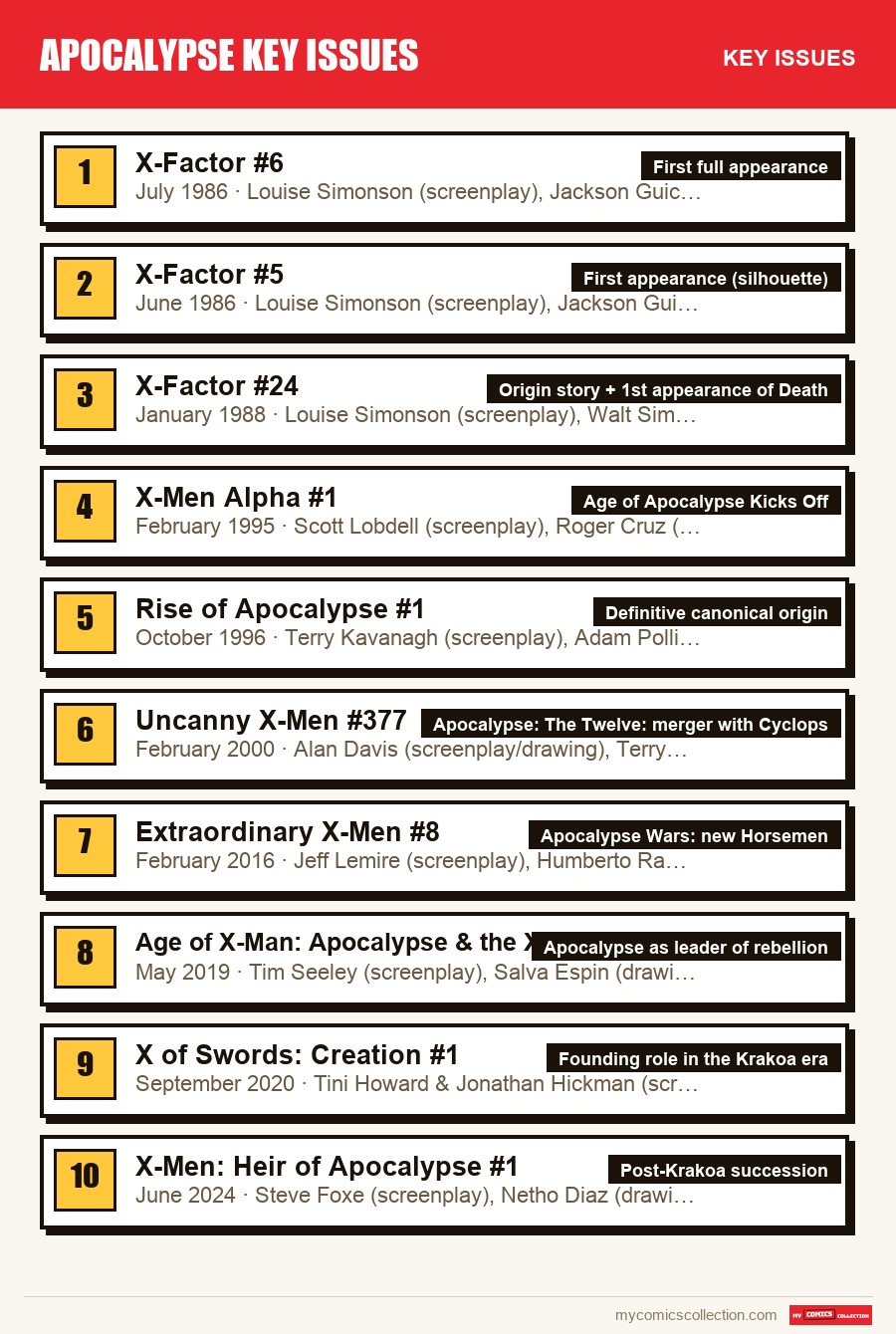
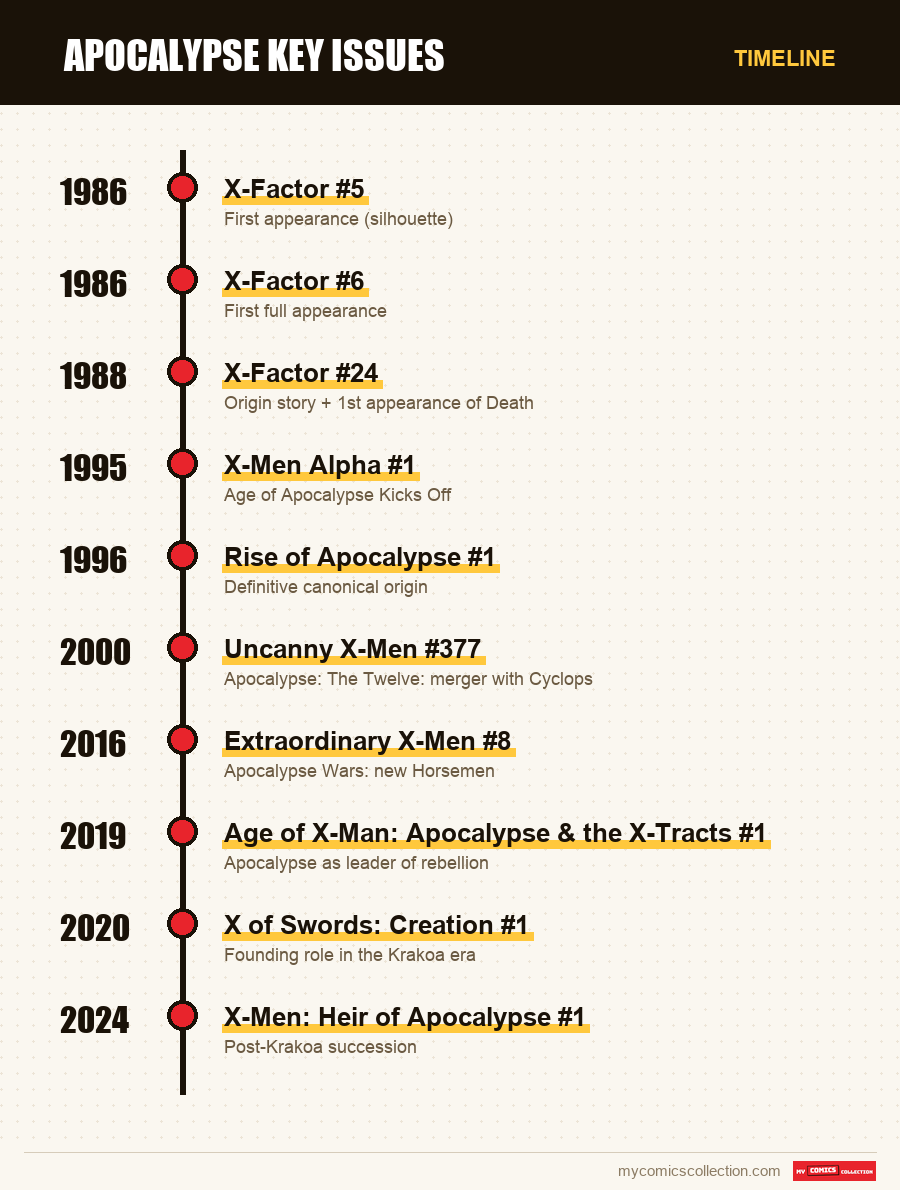
The key Apocalypse numbers for a collector are, in order: X-Factor #5 (June 1986, announcing silhouette), X-Factor #6 (July 1986, first full appearance and the character's true Holy Grail), X-Factor #24 (origin told and first appearance of Death/Archangel), then the milestones of major events: X-Men Alpha #1 (Age of Apocalypse, 1995), Rise of Apocalypse #1 (canonical origin, 1996), Uncanny X-Men #377 (merge with Cyclops, 2000) and more recent Krakoa era arcs like X of Swords: Creation #1 (2020). It is X-Factor #6 which concentrates most of the character's market value.
Apocalypse, his real name is Sabah Nur, is not one of those Marvel villains that we associate with a single founding issue. His collection of comics looks more like a jagged timeline: a handful of titles from the 1980s which established the myth, a 1990s marked by an uchronistic event which redesigned the entire X universe, then a series of regular returns which prove that a character designed to embody natural selection also survives all editorial relaunches.
This article focuses exclusively on the numismatic angle of the collection: which issues to buy as a priority, in what order of rarity and value, and why certain titles that are highly commented on in the mythology of the character are worth almost nothing on the secondary market. For the complete history of the character (his editorial creation, his in-universe mythology, his powers and the entirety of his narrative chronology) head to our file dedicated to the story of Apocalypse in the comics, which treats the subject from a biographical angle rather than an investment angle. Here, we talk about grades, draws, odds and buying strategy.
Before taking out the wallet, we must understand why the hierarchy of value of Apocalypse is so particular: a single number concentrates almost all of the demand, while dozens of others, although crucial for the continuity of the character, are negotiated for the price of a coffee.
Why Apocalypse's odds are based on a single number
Apocalypse owes its existence to a production accident. In 1986, screenwriter Bob Layton laid the foundations for a mysterious antagonist who pulls the strings of the Alliance of Evil in the first five issues of X-Factor; he plans to reveal, at the very end of X-Factor #5, that it is Daredevil's villain, the Owl. Layton left the series before the issue was published, and Louise Simonson inherited the title. She decides to start from scratch on this mystery and asks the designer Jackson Guice to redraw the last page to place, in Chinese shadow, the silhouette of a brand new character: Apocalypse. It's this last-minute rewrite that explains why X-Factor #5 and #6 compete for the title of "first appearance": the first shows a shadow, the second embodies it fully, in full light, on full page.
This cameo/full appearance distinction is not a cosmetic detail for collectors: it is exactly what makes the difference in rating between the two issues, a mechanism that we regularly find at Marvel and that we dissect in more detail in our comparison of CGC grades 9.0 to 9.8, essential to understand why half a grade point can multiply a value by three or four on this type of sought-after title.
The editorial continuation explains why the rest of the character's bibliography weighs so little compared to these two founding issues. Apocalypse remained a recurring second knife in X-Factor until 1988, before becoming the cornerstone of a much more ambitious event in 1995: the Age of Apocalypse, a thirteen-week uchrony which replaced the entire X-Men editorial line with alternative titles. This event produced an avalanche of comics, more than thirty issues just for the core of the crossover, which mechanically diluted the rarity of each of them. Many of these titles, printed in hundreds of thousands of copies in the middle of the speculative bubble of the mid-1990s, are today found in the one or two dollar bins despite their narrative importance. This is a classic trap for collectors who buy by the weight of history rather than the weight of the market.
X-Factor #6
The true Holy Grail of the Apocalypse collection. It is in this issue that the character finally emerges from the shadows: the reader discovers his face, his powers of molecular manipulation and his doctrine of mutant natural selection, presented from his first tirade as the driving force of his entire philosophy. The cover, which shows him in full page view dominating his environment, has become an iconic image of the Copper Age at Marvel and still serves today as a visual reference to represent the character. It is this number, and not #5, that CGC catalogs and labels refer to as the "first full appearance".
X-Factor #5
The last minute rewrite number. Apocalypse only appears in shadow play on the very last page, with no name or dialogue attributed with certainty to the character: a pure cliffhanger that was redrawn to replace the reveal initially planned around Daredevil's villain, the Owl. The market recognizes this number as the true chronological anteriority of the character, but the partial nature of the appearance, we only see an outline, places it structurally behind #6 in terms of desirability. It nevertheless remains essential for any collection that wants to be complete on the origins of the character.
X-Factor #24
X-Factor is teleported aboard Apocalypse's ship above Manhattan, where the mutant tyrant unfolds his thousand-year-old legend for the first time: revered as the god Set in ancient Egypt, known as Sauru among the Persians, likened to Huitzilopochtli among the Aztecs and Kali-Ma in India. It is also in this issue that the reader discovers, under the mask of Death, one of the Four Horsemen, the transformed body of Warren Worthington III, alias Angel, who became Archangel. An issue that is both narratively dense and graphically striking, signed by the Simonson couple in what remains one of the most respected runs of the series. It does not benefit from the “first appearance” bonus which boosts #5 and #6, which makes it a much more accessible entry to complete a collection on the origin of the character.
X-Men Alpha #1
The issue that shifts the entire X-Men universe into an alternate reality where Apocalypse has triumphed and reigns over a ravaged North America. It is here that several key figures from this parallel continuity appear for the first time, including Dark Beast, Holocaust and Abyss, one of the Horsemen of Apocalypse in this timeline. The issue benefited from a massive print run with a chrome cover, consistent with the marketing standards of the comics industry in the mid-1990s: a period of high speculation that saw print runs explode. Result: despite its role as a gateway to one of the most commented events in the history of the X-Men, its price remains very modest today, of the order of a few dollars in current circulation, abundant print runs oblige.
Rise of Apocalypse #1
This four-issue mini-series establishes for good the legend of the character: an infant found in the Egyptian desert by nomads, raised according to the law of natural selection by their leader Baal, in an Egypt then governed by the pharaoh Rama-Tut: who is none other than the time traveler Kang the Conqueror. This is the origin story to which all subsequent appearances of the character refer, including in audiovisual adaptations. Published at the end of the speculative comics bubble, with a high selling price for the time ($1.95), the series has never attracted strong demand from collectors and remains a core collection title rather than a quality piece sought by investors.
Uncanny X-Men #377
Culmination of the "Apocalypse: The Twelve" crossover, in which the mutant tyrant seeks to absorb the energy of twelve elite mutants (including Xavier, Storm, Cable and Magneto) to access a form of godhood via a dedicated machine. The plan fails because of an unexpected sacrifice: while Apocalypse tries to possess Nate Grey's body, it is Cyclops who takes his place to save the latter, causing a physical fusion between the hero and the villain. This story, spread over several titles in the X-Men line of the time (Uncanny X-Men, X-Men, Cable, X-Man), permanently modified the status of the two characters for the following narrative arcs. An important issue for those who want to follow the evolution of the character at the turn of the 2000s, without representing a piece with a high premium for first appearances.
Extraordinary X-Men #8
Opening number of the “Apocalypse Wars” arc, in which a team of young mutants led by Colossus is projected a thousand years into the future, on an “Omega World” entirely subject to Apocalypse. The marketing twist of this arc, which caused a lot of ink to flow at the time of its release, lies in the identity of its new Four Horsemen: Deadpool, the Venom symbiote, Moon Knight and Colossus himself. Published a few months before the release of the X-Men: Apocalypse film in theaters, this issue benefited from a spike in media attention linked to this editorial cross-marketing, without becoming a lasting speculative piece: demand was mainly focused on historical first appearance issues rather than contemporary arcs.
Age of X-Man: Apocalypse & the X-Tracts #1
A five-issue mini-series which takes the complete opposite view of the usual character: in this utopia imagined by X-Man where love has been erased from collective memories, it is Apocalypse who takes the lead of a rebellion: the An atypical storyline angle which illustrates the plasticity of the character, capable of taking on the role of the millennial tyrant as well as that of the romantic liberator. A niche title within the “Age of X-Man” event, it remains little sought after by first appearance-oriented collectors, but interesting for those who follow the thematic developments of the character.
X of Swords: Creation #1
First chapter of the 22-part crossover that closed the first phase of the Krakoa era. This issue develops the little-known role of Apocalypse in the ancient history of Okkara, the original land which split into Krakoa and Arakko, and reveals his links with the Four Horsemen of Amenth, literally his children in this continuity. At the end of the event, Apocalypse will choose to return to live in Amenth with his wife Genesis and his children, in exchange for Arakko's return to Earth: a turning point which has permanently changed his status within the Quiet Council of Krakoa. A key issue for readers in the character's modern era, at the intersection of ancient mythology and contemporary mutant politics.
X-Men: Heir of Apocalypse #1
Published just after the fall of the Krakoa nation in the "From the Ashes" editorial era, this four-issue miniseries shows an Apocalypse who believes he is no longer the necessary instrument for the advancement of the mutant species. He brings together twelve suitors (including Cable, Wolverine, Emma Frost, Exodus, Mister Sinister and Forge) and subjects them to a series of tests to choose the one who will inherit his mantle. A recent issue, still widely available in stores at the time of writing this article, which does not yet have the necessary perspective to judge its performance on the secondary market, but which marks an important storyline step: the possible end of the solitary reign of En Sabah Nur.
Collecting this series?
Track what you own, what you are missing and what your collection is worth. 7 day trial.
Start my trial →The impact of adaptations on the rating
Unlike characters like Wolverine or Deadpool, Apocalypse has not benefited from a proliferation of television or cinematographic adaptations capable of sustainably increasing its rating. His most notable appearance on the big screen remains X-Men: Apocalypse, ninth installment of the X-Men film saga, released in May 2016 and directed by Bryan Singer. The project was announced in December 2013 by Singer himself, even before the release of X-Men: Days of Future Past, and it was in November 2014 that Oscar Isaac was officially confirmed in the title role. This period of announcement and then filming, between 2014 and 2016, coincided with a gradual and measurable increase in demand for graded copies of X-Factor #6: the collectors' market anticipating, as is often the case, the media attention generated by a theatrical release.
This phenomenon nevertheless remains of limited magnitude compared to other Marvel characters adapted to the cinema: the mixed critical reception of the film, often considered to be behind the previous parts of the saga, did not produce the multiplier effect observed for other first appearances during the same period. The Apocalypse market therefore remains structurally driven by its place in comics continuity, the importance of the character for the X-Men mythology, rather than by the success of an audiovisual franchise. Marvel also took advantage of the film's release to republish several Age of Apocalypse collections in bookstores, which had the effect of broadening access to the readership without increasing the value of the original comics, already available in large numbers.
For a collector who wishes to bet on a potential adaptation effect, the reasoning to be followed is therefore the opposite of that which we apply to a character who is still little exploited in the cinema: Apocalypse has already had its cinematographic showcase, and its market has adjusted accordingly. The real rating dynamic to watch today comes more from within the comics themselves, the status of the character in the post-Krakoa era and the outcome of the “Heir of Apocalypse” storyline, than from a hypothetical new appearance on screen.
Buying guide
Building a coherent collection around Apocalypse requires a different strategy from that applied to a classic hero, precisely because the value of the character is concentrated on very few issues. Here are the points to check before buying.
- Never confuse X-Factor #5 and #6. These are two separate issues with two different statuses: #5 shows a silhouette, #6 shows the character in full appearance. Always check the exact number before bidding, including on poorly titled or approximate ads.
- Favor CGC graded copies for X-Factor #6. This is the only issue in the character's bibliography where the difference in value between grades is significant: always compare several recent sales rather than a single "buy it now" before setting your budget, keeping in mind that a 9.6 can be worth many times a 7.5.
- Locate price variants. X-Factor #5 and #6 exist in 95¢ versions, rarer than the standard direct edition at 75 cents and systematically better valued on the market: a detail that many occasional sellers are still unaware of.
- Do not pay a “first appearance” bonus on event numbers. X-Men Alpha #1, Rise of Apocalypse #1 or Uncanny X-Men #377 are narratively important but do not benefit from any structural rarity: their circulation was too high at the time to create lasting tension on the supply.
- Treat recent titles (2019-2024) as pillars for reading, not investing. Age of X-Man: Apocalypse & the X-Tracts, X of Swords: Creation or Heir of Apocalypse are still widely available in stores and on the secondary market; their long-term rating potential remains to be demonstrated, unlike the numbers from the 1980s.
- Complete your collection with X-Factor #24 for the origin story. This is the character's densest issue of mythological content for a very reasonable budget, without the premium of first appearance issues.
- Check the condition of the inside pages, not just the cover. Issues from 1986-1988 often have yellowing pages; a copy with a correct cover but “off-white” pages will lose one or two potential grade points once submitted to CGC.
- Track comparable sales rather than list prices. On a character with such concentrated demand for two or three issues, the sales prices achieved are much more reliable than the asking prices, which are often inflated on general platforms.
If you are unsure about the current price range for a specific item that you own or covet, the tool free estimate of the site cross-references current listings on eBay to give you a low, median and high price depending on the declared condition. And to follow your entire X-Men collection as you acquire it, the collection management application allows you to catalog each issue with its grade, date of purchase and estimated value.
Finally, keep in mind that the sheet Apocalypse character of the site lists all the series and appearances of the character if you are looking to broaden your reading beyond just the high-value issues discussed here.