Apocalypse, whose real name is En Sabah Nur, debuted in June 1986 in X-Factor #5 (cameo), then made his full reveal in X-Factor #6 (July 1986), created by Louise Simonson and Jackson Guice at Marvel Comics. A millennia-old mutant positioned as the first of his kind, he became the defining antagonist of the X-Men franchise through the Four Horsemen, the 1995 Age of Apocalypse arc, and the post-2019 Krakoa relaunch. This guide traces his creation , his complete biography , the series timeline , the key issues to know , and the major arcs worth collecting.
Apocalypse belongs to that narrow class of Marvel villains whose shadow stretches well beyond their own titles. Introduced in 1986 in the wake of the mutant craze sparked by Uncanny X-Men under Chris Claremont, he has since spanned nearly four decades of continuity, six major editorial relaunches, and a What If? premise that became partial canon through Age of Apocalypse. His first full appearance, X-Factor #6, remains one of the most sought-after 1986 books among Copper Age collectors, and the value of CGC-graded copies has climbed steadily since the announcement of X-Men: Apocalypse in 2014.
This guide covers the character's editorial creation, his in-universe origin as En Sabah Nur five thousand years before the common era, the complete timeline of his appearances within the X-Men, the top 10 key issues to target, the cult-favorite arcs, and the adaptations that shaped his current market value. For buyers on a tight budget, the natural companion read is our how to buy X-Men comics on a budget guide.
Apocalypse biography
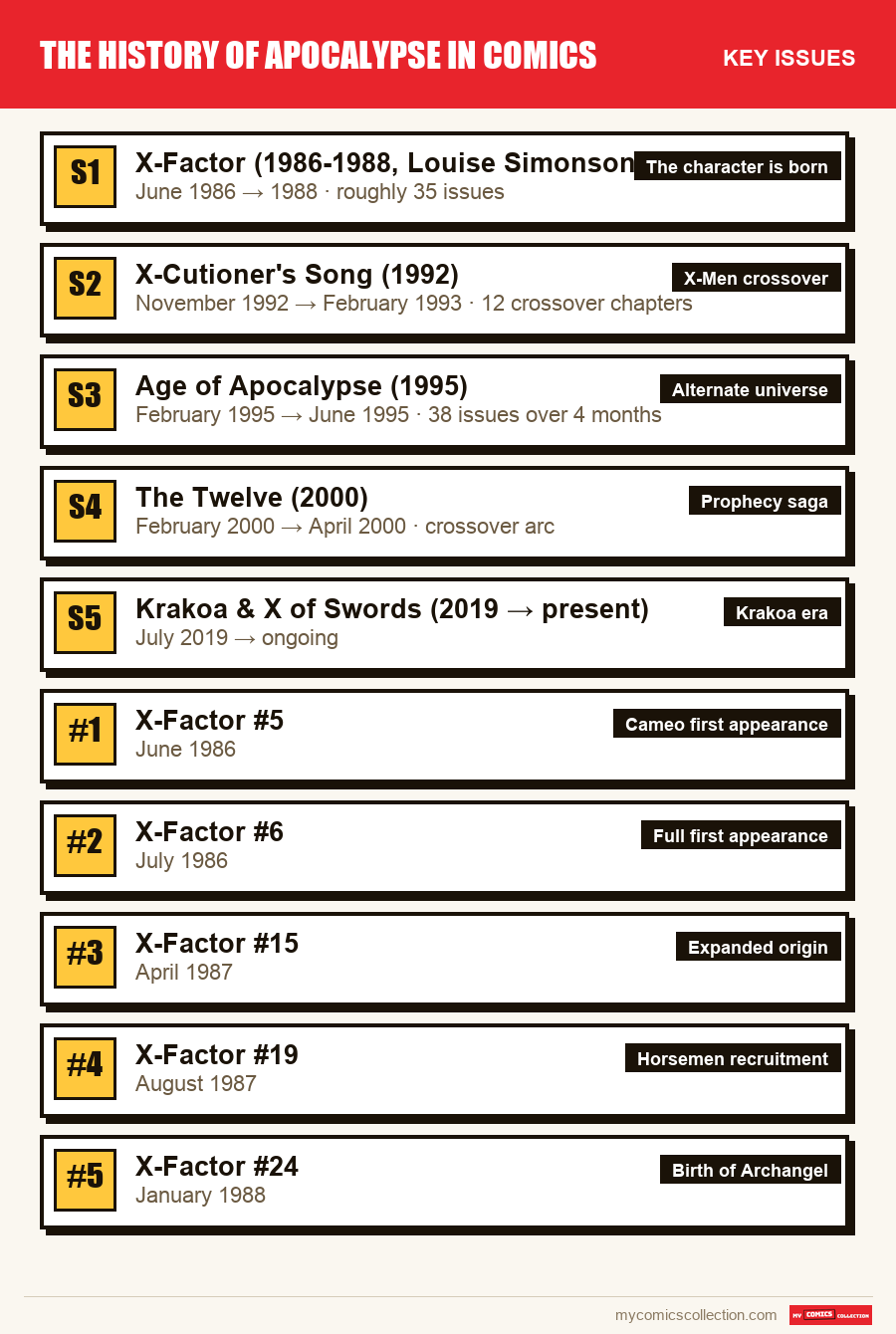
Apocalypse is a Marvel Comics character created by Louise Simonson and Jackson Guice. His first appearance came in X-Factor #5 (June 1986) as a cameo, then in X-Factor #6 (July 1986) as a full reveal. The character was conceived as the long-term antagonist of the X-Men franchise, a role he still held in 2024 through the Krakoa and Fall of X sagas.
Apocalypse (En Sabah Nur) character profile
- Real name: En Sabah Nur
- First appearance : X-Factor #5 (June 1986, cameo) and X-Factor #6 (July 1986, full first appearance)
- Creators: Louise Simonson and Jackson Guice
- Publisher: Marvel Comics
- Affiliations: Four Horsemen of Apocalypse (Death, Famine, Pestilence, War), Externals, Krakoa's Quiet Council
- Status: Major villain, occasionally an antihero in the Krakoa era
The character's origins
According to Marvel mythology, En Sabah Nur was born five thousand years before the common era in ancient Egypt, presented as the first mutant in human history. Abandoned at birth for his gray skin, he was taken in by Baal of the Sandstormers, leader of a nomadic clan who named him "En Sabah Nur": the morning one. The foundational story published in Rise of Apocalypse (1996), and rounded out in X-Men: The Adventures of Cyclops and Phoenix (1994), laid the groundwork for his Darwinian philosophy: only the strong deserve to exist. The editorial context is precise: in 1986, Louise Simonson was looking for an antagonist capable of carrying a long-running threat across X-Factor, the series reuniting the five original X-Men. Jackson Guice designed him (a massive frame, a blue-and-gray palette, a mechanical jaw) drawing directly on the cosmic aesthetics of Jack Kirby. The Celestial technology he co-opts after an encounter with a dormant Celestial would later retroactively justify both his lifespan and the scale of his powers.
Powers and abilities
- Molecular manipulation: total control over his cellular structure, changing size, shape, and density at will
- Advanced regeneration: rebuilds his body even when reduced to ash, sustained by the Celestial technology he carries
- Functional immortality: five thousand years of existence verified in continuity, with prolonged sleep in stasis chambers
- Psychic powers: telepathy, mental projection, and the ability to transfer his consciousness into another host
- Omega-level strength and durability: Omega-level classification in Marvel's post-2019 mutant taxonomy, with physical feats comparable to Krakoa's heavy hitters
Costume and visual identity
Apocalypse's design rests on three constants: blue-gray skin, mauve lips, and black organic armor inlaid with gold or copper Celestial circuitry. The massive frame, at least seven feet tall, varies by arc: a mechanized, jutting-jaw version under Jackson Guice (1986-1988), a more humanoid profile under Whilce Portacio (Inferno, 1989), a return to the monolithic under Joe Madureira (Age of Apocalypse, 1995), then a leaner, more restrained look under Pepe Larraz and R.B. Silva in the Krakoa era. The barred "A" of the Horsemen logo and the cross-shaped tribal mark over the eyes of converted servants remain the visual elements most often reused in merchandising.
Apocalypse series timeline
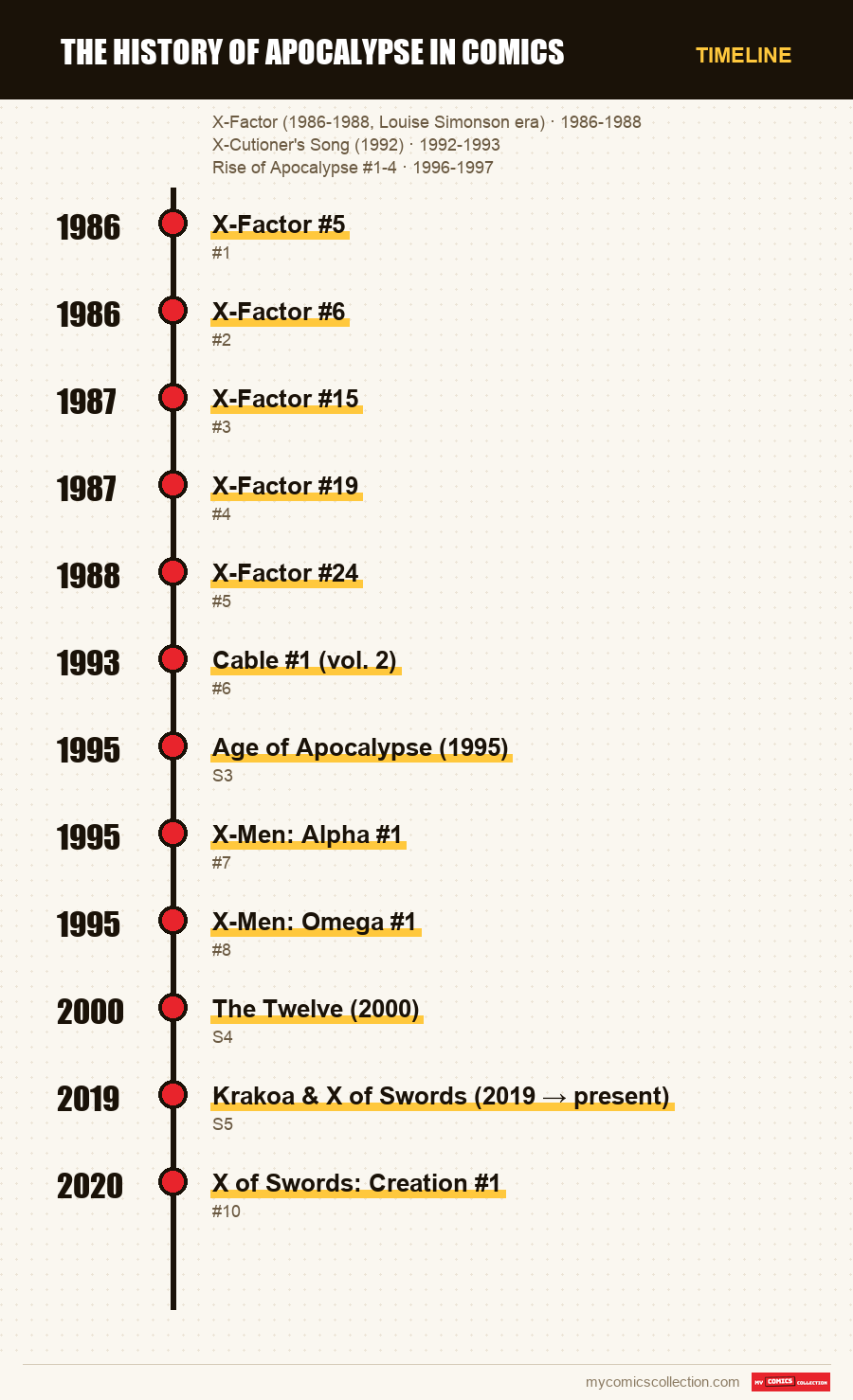
Apocalypse didn't headline a regular eponymous series until the 2000s, but his presence is massive across X-Factor , Uncanny X-Men , X-Men , X-Force , and the line-wide event Age of Apocalypse. Here's a rundown of the standout arcs.
X-Factor (1986-1988, Louise Simonson era)
Louise Simonson established Apocalypse as the series' central antagonist. The Four Horsemen are recruited over the course of several issues: Caliban becomes Death, and Angel is converted into Death after the Mutant Massacre arc. Walter Simonson joined his wife on writing duties starting with issue 18 and co-authored with her the foundational arc of Angel's transformation into Archangel.
X-Cutioner's Song (1992)
A crossover spanning Uncanny X-Men , X-Men , X-Factor , and X-Force under Scott Lobdell and Fabian Nicieza. Apocalypse is tied here to Stryfe in a plot of manipulation centered on Cable. The arc cemented the character's place in the X-Men editorial architecture of the early 1990s.
Age of Apocalypse (1995)
A major line-wide event. Every X-Men series was replaced for four months by its Age of Apocalypse counterpart (Astonishing X-Men , Generation Next , X-Calibre , Weapon X , Factor X, and more). The pitch (Xavier dead, Apocalypse having conquered North America) drove enormous commercial success and put the arc among the most sought-after X-Men key issues.
The Twelve (2000)
An arc orchestrated by Alan Davis that gathers the twelve prophesied mutants (Cyclops, Jean Grey, Cable, Bishop, Polaris, Iceman, Storm, Sunfire, Mikhail Rasputin, Magneto, Xavier, Living Monolith). The payoff: Apocalypse merges with Cyclops, paving the way for the X-Treme X-Men run and the Search for Cyclops arc.
Krakoa & X of Swords (2019 → present)
Under Jonathan Hickman, Apocalypse becomes a member of Krakoa's Quiet Council and carries the X of Swords arc (October-December 2020, 22 chapters). The run explores his ancient mutant past and his relationship with Genesha. The Krakoa continuity extends into House of X and Powers of X.
Collecting this series?
Track what you own, what you are missing and what your collection is worth. 7 day trial.
Start my trial →Top 10 Apocalypse key issues
A list of the ten issues to target for building a coherent Apocalypse collection. To dig deeper into the broader X-Men ecosystem, see our guide to Uncanny X-Men key issues.
X-Factor #5
A silent cameo of Apocalypse at the end of the issue. Retroactively recognized as the character's technical first appearance, which makes it a coveted book despite serving as a simple teaser. Its secondary-market value climbs steadily with every adaptation announcement.
X-Factor #6
The first full, named appearance. This is the benchmark issue for collectors: an iconic Jackson Guice cover showing Apocalypse in a full-page reveal. It remains the most expensive book in the X-Factor vol. 1 regular series.
X-Factor #15
The issue that develops En Sabah Nur's backstory and lays the groundwork for his Egyptian mythology. A mid-run book cheaper than #6 but essential for reading the character's early days in full.
X-Factor #19
A pivotal issue where Apocalypse confronts Angel in the depths of his despair after Mutant Massacre. The first act of the transformation that would culminate in Archangel. A book sought after by Angel fans as much as by Apocalypse enthusiasts.
X-Factor #24
The first appearance of Archangel, Horseman of Death. A double-key issue: Apocalypse plus Angel's new identity. Considered one of the three great Marvel "keys" of January 1988.
Cable #1 (vol. 2)
The first issue of the regular Cable series. Apocalypse is central here through the techno-organic infection Cable has carried since childhood. An affordable book to add to a collection, but key to understanding the long-running mythology.
X-Men: Alpha #1
The opening one-shot of the Age of Apocalypse arc. A chromium cover by Joe Madureira for the collector's edition. It remains the essential entry point to the crossover and one of the most sought-after 1995 books in a special cover.
X-Men: Omega #1
The closing one-shot of the same arc. Apocalypse is defeated here in a scene that became a reference point. The natural counterpart to X-Men: Alpha #1, indispensable to any complete AoA collection.
Rise of Apocalypse #1-4
A four-issue mini-series devoted to En Sabah Nur's Egyptian past. The go-to reference for readers who want the developed canon origin. Moderately sought after as single issues, and more affordable in trade paperback.
X of Swords: Creation #1
The opener of the X of Swords crossover under Jonathan Hickman and Tini Howard. Apocalypse carries the main plot here, with a direct link to his past and his Genesha family. A relatively recent book still easy to find, worth targeting in CGC 9.8 for long-term appreciation.
Major arcs and cult runs
Five arcs structure the Apocalypse mythology and deserve a complete read. The Fall of the Mutants (1988, crossing X-Factor , Uncanny X-Men , and New Mutants) completes Angel's transformation into Archangel and establishes the Horsemen as a systemic threat. X-Cutioner's Song (1992) weaves together Apocalypse, Stryfe, and Cable in a 12-chapter crossover under Lobdell, Nicieza, Greg Capullo, and Andy Kubert; a moderate collector impact but a central arc for anyone wanting to understand the Cable / Apocalypse thread. Age of Apocalypse (1995) remains the commercial peak: 38 issues, with teams led by Mark Waid, Scott Lobdell, Howard Mackie, and Warren Ellis, and art by Joe Madureira, Steve Skroce, and Andy Kubert. The Twelve (2000) under Alan Davis closes out the prophecy arc and tips Apocalypse into his merger with Cyclops. Finally, X of Swords (2020-2021, 22 chapters) by Hickman, Howard, and a collective of artists (Larraz, Schiti, Yu) brings Apocalypse back to the heart of the Krakoa continuity with an unabashed fantasy dimension. To sell off some of these issues once you've finished reading, see our guide to prepping comics for resale.
Adaptations and cultural impact
The most visible adaptation remains X-Men: Apocalypse (2016) by Bryan Singer, with Oscar Isaac in the title role. The film reignited the value of X-Factor #6 as soon as it was officially announced in 2014, with a measurable spike on CGC 9.8 copies between 2014 and 2016. On the television side, Apocalypse appears in X-Men: The Animated Series (1992-1997), where he carries the final arc, in X-Men: Evolution (season 4), and more recently in X-Men '97 (2024) on Disney+, which brought renewed attention to the 1986-1995 issues. In video games, the character is playable in X-Men: Children of the Atom , Marvel vs. Capcom , and Marvel Heroes. Every adaptation produces a measurable effect on eBay sales of the key issues, particularly on X-Factor #5 and #6.
Build your Apocalypse collection methodically
Catalog the Apocalypse series in one click, identify your missing key issues, and track eBay values, updated daily. Free 7-day trial.
🚀 Start your free 7-day trial