
For catalog your comic collection from scratch, start by choosing a digital tool (spreadsheet or specialized application), define the essential fields to track (series, number, state, value), then save your comics in batches of 20-30 per session. Getting started with a dedicated app from day one will save you hundreds of hours of migration later.
You've just started collecting comics, or you've been collecting for years without ever organizing anything. The result: boxes stacked in a closet, duplicates bought by mistake, and no idea what your collection is actually worth. You know you have to catalog. You don't know where to start.
This guide is designed specifically for beginners in cataloging, not in collection. Whether you have 30 or 3,000 comics, the method is the same. And the best time to start is now: because every comic added without being cataloged is an organizational debt that accumulates.
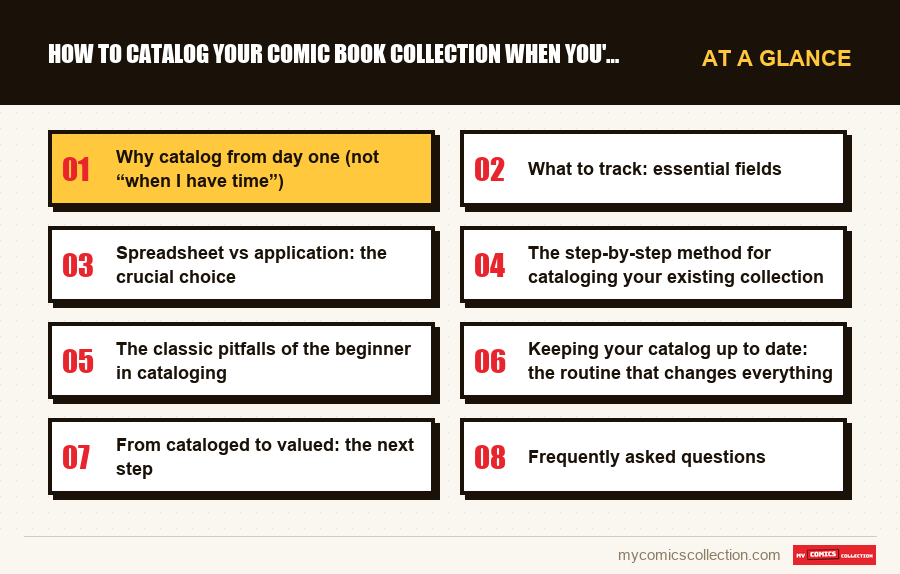
Why catalog from day one (not “when I have time”)
Every collector says the same thing to himself: “I will catalog when my collection is larger”. It is exactly the opposite that must be done. The longer you wait, the more monumental and daunting the task becomes.
The hidden costs of an uncatalogued collection
- Duplicates: without a catalog, a collector with 300 comics buys on average 8 to 12% of duplicates per year. At €5-10 per comic, that’s €150-360 wasted annually.
- Invisible missing numbers: you think you have a near-complete run of Uncanny X-Men #200-300, but you're missing 12 issues that you never identified. Without an inventory, it’s impossible to know.
- Unknown value: an Amazing Spider-Man #238 (first appearance of the Hobgoblin) can sleep in a box without you knowing that it is worth €150-300.
- Insurance impossible: in the event of a disaster (flood, fire, theft), your insurer will ask you for a detailed inventory. Without a catalog, you will get paltry compensation.
A collector who catalogs from the start invests 2 minutes per comic added. A collector who catches up 5 years behind will have to block off an entire weekend, and the motivation is often not there.
What to track: essential fields
Don't fall into the trap of perfectionism. Simple but comprehensive cataloging is infinitely better than a complex system that you'll abandon after three weeks.
The essential fields (the vital minimum)
- Series title: “Amazing Spider-Man”, “Uncanny X-Men”, “Batman”, etc.
- Number: the exact number of the fascicle.
- Volume / Start year: to distinguish Amazing Spider-Man vol.1 (1963) from vol.2 (1999) and vol.3 (2014).
- Editor: Marvel, DC, Image, Dark Horse, etc.
- Estimated Condition: Near Mint, Very Fine, Fine, Very Good, Good, or a numerical grade (9.4, 8.0, 6.5, etc.).
- Status: owned, missing (to build your wishlist), duplicate (for resale).
Recommended fields (to go further)
- Purchase price: to track your total investment and your capital gains.
- Estimated market value: updated regularly, this is the data that transforms your catalog into a management tool.
- Date of purchase and origin: "eBay, March 2024" or "Paris Convention, stand #42".
- Cover variant: regular, variant, incentive ratio, sketch cover.
- CGC data: if graded: certification number, grade, type of label.
- Physical location: “Box 3, top shelf”: essential when the collection exceeds 500 comics.
- Photo: at least for key issues and valuable comics.
Spreadsheet vs application: the crucial choice
The first choice determines everything else. There are two main approaches, and what you choose now will stay with you for years.
The spreadsheet (Excel, Google Sheets)
Benefits : free, flexible, you control the structure. Disadvantages: everything is manual. You must create your columns, enter each title, each number, each price. No auto-completion, no built-in database, no automatic value updates. For 50 comics, it's manageable. For 500, it's an ordeal. And for 2,000, that's just unrealistic.
The fundamental problem with the spreadsheet: it doesn't know what a comic is. It can't tell you that you're missing #87 in your run, or that a number is a key issue, or how much it's worth.
The specialized application
Benefits : pre-integrated catalog (more than 1,000 series in My Comics Collection), quick entry (check “owned” instead of typing everything), automatic valuation based on eBay sales, identification of missing items, export possible. Disadvantages: monthly subscription (a few euros per month).
The difference in time is massive: adding a comic into a spreadsheet takes 2-3 minutes (search for exact title, issue, publisher, year). In an application with an integrated catalog, it is 15-30 seconds. On 500 comics, that's the difference between 25 hours and 4 hours of input.
Our recommendation
If your collection is less than 50 comics and you don't intend to expand it much, a spreadsheet may be enough. In all other cases, start directly with an application. The time and effort you'll save in the first month more than justifies the subscription.
The step-by-step method for cataloging your existing collection
You have chosen your tool. Now, how do you tackle cataloging an existing collection without losing motivation?
Phase 1: physical sorting (30-60 minutes)
Before touching your application or spreadsheet, physically sort your comics. Make piles by publisher (Marvel, DC, others), then by series within each publisher. This preliminary sorting considerably speeds up the entry.
Phase 2: main series first
Start with your biggest sets: the ones where you have the most numbers. If you have 80 issues of Amazing Spider-Man, start there. In an application with a catalog, you open the series, browse the list of issues and check the ones you own. In 15-20 minutes, your 80 ASMs are cataloged and you immediately see which numbers you are missing.
Phase 3: 30 minute sessions
Don't try to do everything at once. Catalog in 30-minute sessions, 20 to 30 comics per session. At this rate, a collection of 300 comics is completed in 10 sessions, or one to two weeks at the rate of one session per evening. It's sustainable and you keep motivated.
Phase 4: state and value in second pass
During the first pass, just record possession (yes/no) and an approximate state. In a second pass, refine the grade and add the details (purchase price, variants, photos of key issues). Two quick passes are more effective than a single, exhaustive pass.
The classic pitfalls of the beginner in cataloging
The trap of perfectionism
You want to document everything perfectly from the start: condition to within 0.5 points, double-sided photo of each comic, detailed notes on provenance. Result: you spend 5 minutes per comic instead of 30 seconds, and you give up after 40 issues. An imperfect but complete catalog is infinitely better than a catalog that is perfect but abandoned at 10%.
The migration trap
You start on a spreadsheet, then move to an app six months later. Result: hours of data migration. Choose the right tool from the start to avoid this waste. If you're unsure, test the app for a few days before committing to a spreadsheet.
The trap of forgetting to update
You catalog your existing collection, then forget to add your new purchases. In six months you have 50 uncatalogued comics and the debt is piling up. The solution: catalog each new comic the same day of purchase. It takes 30 seconds on your phone and keeps your catalog updated effortlessly.
Keeping your catalog up to date: the routine that changes everything
A catalog is only valuable if it is up to date. Here's a simple routine that takes less than 5 minutes a week.
Daily routine (30 seconds)
Each new comic purchased is added immediately. On your phone, open the app, select the series, check the number, indicate the status. It's done.
Monthly routine (15 minutes)
Once a month, go through your catalog and check that nothing is missing. Check your monthly purchase receipts to make sure each comic is recorded. Update the status if a comic has been regraded or protected in new cover.
Semi-annual routine (1 hour)
Twice a year, do a quick physical inventory. Compare what's in your boxes with what your catalog says. This is also the time to update the values (automatic if you use an application with real-time tracking) and export a backup of your data.
From cataloged to valued: the next step
A catalog is an inventory. A catalog with values is a management tool. Once your collection is cataloged, the natural step is to add the valuation: how much each comic is worth, and how much your collection is worth in total.
With a spreadsheet, that means manually researching every price on eBay: dozens of hours of work. With an application like My Comics Collection, the valuation is automatic: The tool analyzes recent eBay sales and updates prices continuously. Your catalog becomes a living dashboard that shows you the value of your collection in real time.
Frequently asked questions
With a spreadsheet, allow 25-40 hours (3-5 minutes per comic with search and manual entry). With an application with a pre-integrated catalog, allow 4-6 hours (30 seconds to 1 minute per comic). The difference comes from auto-completion: the app already knows the series, numbers and publishers.
Yes. A comprehensive catalog allows you to manage your runs (missing numbers), avoid duplicates and prove the size of your collection for insurance. Furthermore, a comic that is “worthless” today may become sought after tomorrow: a film adaptation can multiply the price of a forgotten issue by 10.
The key criteria are: size of the integrated catalog (number of series and pre-referenced numbers), speed of entry, management of missing items, automatic valuation and possibility of export. My Comics Collection ticks all those boxes with a catalog of over 1,000 series and a valuation based on actual eBay sales.
Most comic management applications accept CSV import. Prepare your file with standardized columns (title, number, publisher, status) and follow the application's import guide. It's a one-off operation that takes 5-10 minutes and saves you having to re-enter everything.
Save the variant as an attribute of the issue: "regular", "variant", "incentive 1:25", "sketch cover", etc. Rare variants (1:100 incentive or higher) can be worth significantly more than the standard edition: for example, a 1:50 variant of Amazing Spider-Man can trade for 5 to 10 times the price of the standard cover.
No, not necessarily all. Prioritize photographing your key issues, your valuable comics (€50+) and your CGC pieces. For current comics, a photo is not essential for cataloging. On the other hand, if you are considering a future resale or if you need documentation for insurance, photos become essential.