
The best mutants in comics are, at the top, Wolverine , Magneto , Tornado (Storm) and Jean Gray / Phoenix. This tier list ranks the mutants of the Marvel universe according to their importance, their power and their stories. Facts (publisher, creation) verified, no invented ratings; each character refers to its file when it exists.
Mutants form one of the pillars of the Marvel universe, with the X-Men and their allegory of difference. This tier list classifies these homo superiors according to their narrative importance and their richness. Criterion: the weight of the character, not just its raw power.
Editorial Ranks, Facts verified. Each character refers to its file when it exists.
Collecting this series?
Track what you own, what you are missing and what your collection is worth. 7 day trial.
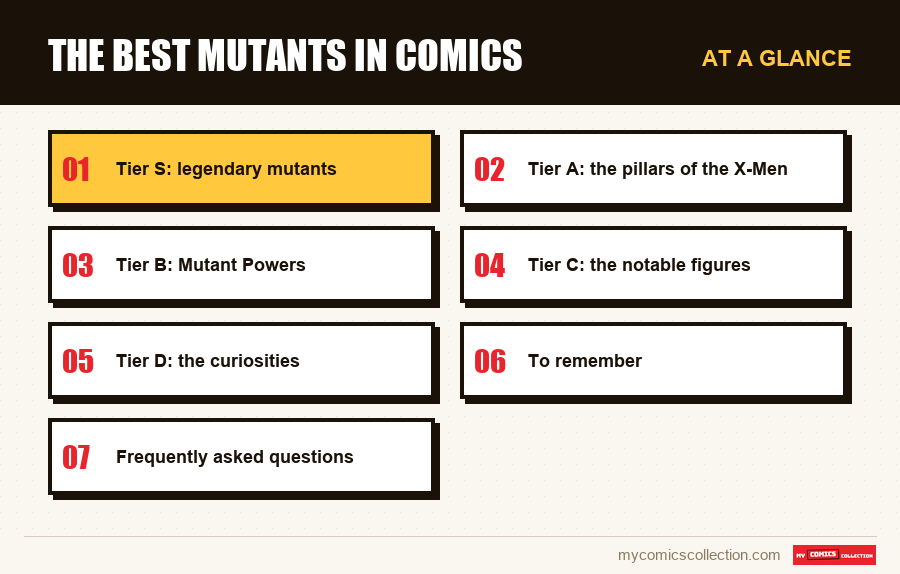
Start my trial →Tier S: legendary mutants
Wolverine is the most popular mutant, with a troubled past and adamantium claws. Magneto is the master of magnetism, tragic antagonist of the X-Men. Tornado, who controls the climate, has led the team for a long time, and Jean Gray, host of the Phoenix Force, reaches cosmic levels of power.
Tier A: the pillars of the X-Men
Cyclops, historical leader, the Professor, founder, Snape et Gambit form the emotional core of the mutant team.
Tier B: Mutant Powers
Apocalypse, millennial mutant, Cable, soldier from the future, Nightcrawler and Colossus are among the most striking mutants.
Tier C: the notable figures
Kitty Pryde , Emma Frost, Mystical et X-23 enrich the mutant gallery, between heroines and antagonists.
Tier D: the curiosities
Dazzler , Longshot and Maggott close this tier list: more atypical but very real mutants.
To remember
- Wolverine and Magneto are the most iconic mutants.
- Giant-Size X-Men #1 and Incredible Hulk #181 (Wolverine's 1st) are major key numbers.
- Mutants embody the allegory of difference, heart of the X-Men.
- Each character refers to its file when it exists.
Frequently asked questions
Wolverine is the most popular, Magneto the most complex. On the pure power side, Jean Gray (Phoenix) reaches cosmic levels.
In Incredible Hulk #181 (1974), a highly sought-after key issue, before Giant-Size X-Men #1 (1975) made him part of the mutant team.
By the Claremont run of the Uncanny X-Men or by House of X / Powers of X by Hickman, two excellent entry points into the mutant universe.
Do you own an Incredible Hulk #181 or another mutant key issue? Estimate its value for free with our tool based on current eBay listings.
Mutants by generation: landmarks to find your way
This tier list ranks characters, but to discover them it is more useful to look at them by creation wave. The dates in the list sketch four generations, and each matches a different moment in X-Men history.
1963: the founders
Magneto, Jean Grey, Cyclops and Professor X all date from 1963. They are the pillars of the original team and of its allegory of difference. Their first appearances are the oldest in the ranking and the ones that matter most to a collector attached to origins.
1974 to 1981: the relaunch
Wolverine first appears in Incredible Hulk #181 (1974), then joins the team in Giant-Size X-Men #1 (1975), which also introduces Storm and Nightcrawler, as well as Colossus. This is the period when the X-Men become the franchise we know, with Mystique (1978), Kitty Pryde (1980), Emma Frost (1980), Dazzler (1980) and Rogue (1981). If you had to remember only one period, it would be this one: it contains almost all of tier S and much of tier A.
1985 to 1997: the broadening
Longshot (1985), Apocalypse (1986), Gambit (1990), Cable (1990) and Maggott (1997) form a more heterogeneous generation, with major figures as well as curiosities. This is where the ranking stretches the most.
2004: the most recent
X-23 is the most recent creation on the list. She shows that the mutant gallery keeps growing.
How to use this to choose your reading
If you are discovering mutants, start from the 1974-1981 generation: that is where the characters meet and define themselves. Then go to the founders to understand the origins, then to the later generations according to your taste. For a modern overview, you can add House of X and Powers of X, mentioned above.
Collecting landmarks
For collecting, two issues dominate by their role: Incredible Hulk #181 and Giant-Size X-Men #1. They mark respectively Wolverine's first appearance and his entry into the team. For the other characters, always check which issue corresponds to the first appearance, because many mutants first appeared in a supporting role before getting an introductory issue. Finally, keep a list per character: the same issue can matter for several of them, which partly explains why prices do not always follow the editorial ranking.