The best deaths in comics history are, at the top, the death of Gwen Stacy (Amazing Spider-Man #121), the Death of Superman , the death of Jean Gray (Dark Phoenix Saga) and that of Captain America. This tier list ranks notable deaths according to their narrative and emotional impact. Facts (numbers, dates) verified, no odds invented; each entry refers to a record when it exists.
Death is one of the most powerful forces in comics: even if the character comes back often. This tier list classifies deaths according to their impact at the time of their publication and their posterity. Some have permanently changed their world. Criterion: dramatic force and shock wave.
Editorial Ranks, Facts verified. Each entry refers to a site file when it exists.
Collecting this series?
Track what you own, what you are missing and what your collection is worth. 7 day trial.
Start my trial →Tier S: the deaths that marked history
La death of Gwen Stacy (1973) is often cited as the end of the Silver Age: an absolute shocker. There Death of Superman (1992) made headlines around the world. The death of Jean Gray at the end of the Dark Phoenix Saga (1980) remains a tragic climax, and the assassination of Captain America (2007) shocked readers.
Tier A: the founding deaths
In Crisis on Infinite Earths (1985), the death of Supergirl and that of Barry Allen redefined DC. The death of Jason Todd (whose readers voted on the outcome by telephone) and that of Elektra had a profound impact.
Tier B: the great disappearances
La death of Wolverine (2014), those of Colossus , of Professor and of Bucky (1968, long definitive) each had a strong impact.
Tier C: the founding deaths
The death of Uncle Ben and that of parents of Bruce Wayne are the seminal deaths of two of the greatest heroes. Ferro Lad and Earth complete this tier.
Tier D: notable deaths
The death of Ted Kord (Blue Beetle), that of Bill Foster (Civil War) and that of Ultimate Peter Parker (who launched Miles Morales) close this tier list.
To remember
- The death of Gwen Stacy is the most cited in the history of the medium.
- Many heroes return: death in comics is rarely permanent.
- The “death” numbers (ASM #121, Superman #75) are sought after keys.
- Each entry refers to a site file when it exists.
Reading the great deaths in order: timeline and points of vigilance
A tier list ranks by impact, but it does not tell you in what order the deaths happened. Placing them in time shows how the genre evolved and helps organize a reading list or a collection. Beware: this section reveals key moments of the stories mentioned.
The big stages, decade by decade
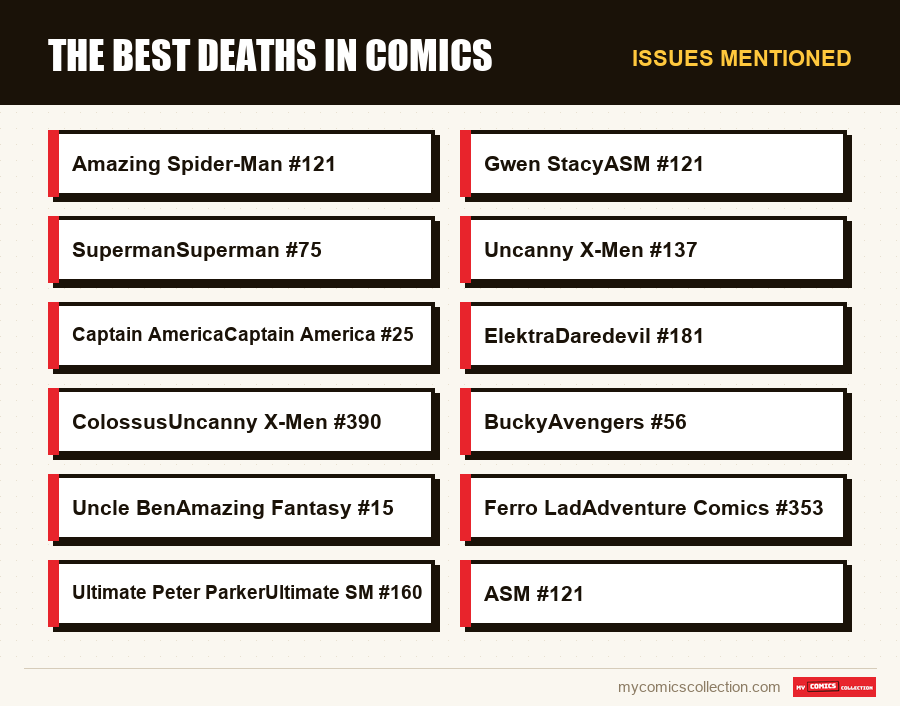
- 1930s and 1960s: the founding deaths. Bruce Wayne's parents date back to Detective Comics in 1939, Uncle Ben to Amazing Fantasy #15 in 1962. Bucky disappears in Avengers #56 in 1968, and Ferro Lad in Adventure Comics #353 in 1967.
- 1970s and early 1980s: the tone darkens. Gwen Stacy (Amazing Spider-Man #121, 1973), Jean Grey (Uncanny X-Men #137, 1980) and Elektra (Daredevil #181, 1982) mark a generation of readers.
- Mid-1980s: Crisis on Infinite Earths (1985) kills Supergirl and Barry Allen, and The Judas Contract (1984) kills Terra.
- Late 1980s and 1990s: Jason Todd's death in A Death in the Family (1988), then Superman's in Superman #75 (1992).
- 2000s and 2010s: Colossus (Uncanny X-Men #390, 2001), Blue Beetle (2005), Bill Foster in Civil War (2006), Captain America (2007), Professor X in Avengers vs X-Men (2012), Wolverine (2014) and Ultimate Peter Parker (Ultimate Spider-Man #160, 2011).
What the timeline reveals
The ranking brings out a common thread: founding deaths explain a hero (Uncle Ben, the Waynes), while later deaths are editorial events designed to shake up the universe. Gwen Stacy's death is often cited as the end of the Silver Age, which makes it a historical landmark as much as a dramatic moment.
How to read these stories
For a beginner, the simplest way is to start with the tier S entries, then move back or forward along the timeline as you wish. The deaths of Crisis on Infinite Earths are read with the complete event, Jason Todd's with A Death in the Family as a whole, and Wolverine's with its miniseries. A death cut off from its context loses much of its effect.
Points of vigilance for the collector
- Tell the death issue from the one that sets it up. The "death" issues, such as Amazing Spider-Man #121 or Superman #75, are the most sought after, but the story is sometimes built over several issues.
- Beware of massive print runs. Superman #75 had a very large print run: condition and edition matter more than the issue's fame alone.
- Check the edition. A heavily publicized event leads to reprints and several printings: always check which one you are buying.
- Remember that death is rarely permanent. Superman, Jean Grey, Captain America, Wolverine and Bucky all came back: an issue's interest lies in its historical impact, not in a permanent disappearance.
An idea to go further
Draw up your own list using the five tiers of the tier list and tick off what you have read or bought. You will quickly see which periods interest you most and which issues your collection lacks.
Frequently asked questions
La death of Gwen Stacy (Amazing Spider-Man #121, 1973) is the most iconic, often considered the end of the Silver Age. The Death of Superman (1992) is the most publicized.
Often, yes: Superman, Jean Grey, Captain America or Wolverine have all returned. The maxim “no one stays dead in comics except Uncle Ben and Bucky” is famous: even if Bucky eventually came back.
Some yes: Amazing Spider-Man #121 and Superman #75 are sought-after key issues. Always check the edition and condition, as Superman #75 has been heavily printed.
Do you own an ASM #121 or a Superman #75? Estimate its value for free with our tool based on current eBay listings.