The best plot twists in comics are, at the top, the revelation that Bucky is the Winter Soldier , the plan of Ozymandias in Watchmen, Jason Todd becomes Red Hood and the survival of Green Goblin. This tier list ranks major reversals according to their audacity and impact. Facts (stories, dates) verified, no invented odds; each entry refers to a record when it exists.
The plot twist is one of the great pleasures of comics: a revelation that recontextualizes everything. This tier list classifies twists according to their audacity and their shock wave at the time of their publication. Please note, this article discusses major revelations.
Editorial Ranks, Facts verified. Each entry refers to a site file when it exists.
Collecting this series?
Track what you own, what you are missing and what your collection is worth. 7 day trial.
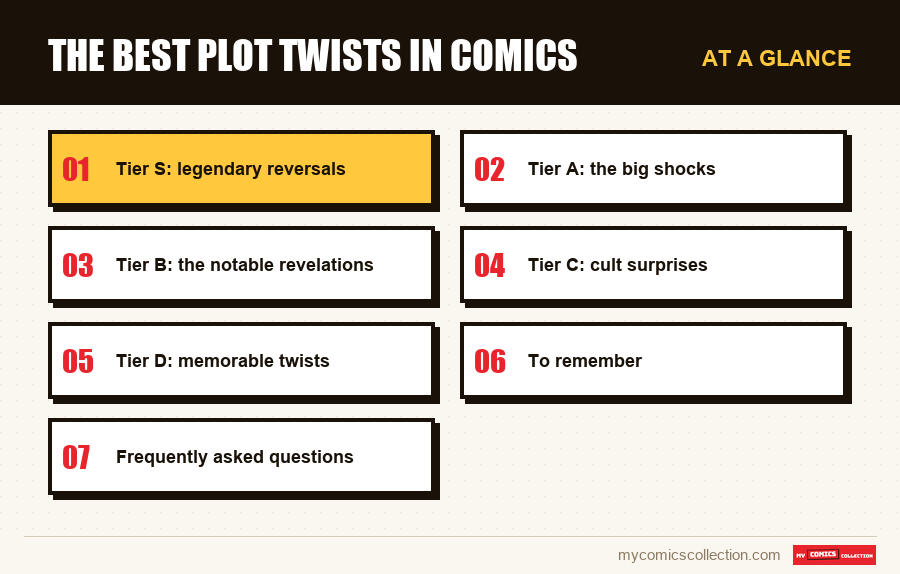
Start my trial →Tier S: legendary reversals
The revelation that Bucky is alive in Winter Soldier (2005) is one of the most successful twists, breaking a decades-old rule. The plan of Ozymandias subverts the entire plot of Watchmen. The return of Jason Todd in Red Hood and the survival of Green Goblin turned their worlds upside down.
Tier A: the big shocks
Secret Invasion reveals that Skrulls have replaced heroes. Onslaught, Hal Jordan becomes Parallax et Captain America agent of Hydra (very controversial) have each shaken readers.
Tier B: the notable revelations
Xorn revealed as Magneto, the Court of Owls, the Anti-Monitor and the origin of Vision (created by Ultron) are among the big twists.
Tier C: cult surprises
La betrayal of Terra, the revelation that the Phoenix was not Jean Gray, the secret existence of Illuminati and the Void of the Sentry complete the selection.
Tier D: memorable twists
Le Spider-Man clone (Clone Saga), Batman R.I.P. and Doctor Doom becomes Iron Man close this tier list: daring reversals, more divisive but striking.
To remember
- Bucky's return is often cited as the best modern twist.
- A big twist recontextualizes all of the above.
- Some twists are divisive (Captain America Hydra) but make people talk.
- Each entry refers to a site file when it exists.
Frequently asked questions
The revelation that Bucky is the Winter Soldier (Brubaker, 2005) achieves consensus, because it breaks an established rule while enriching Captain America. Ozymandias' plan in Watchmen is the other reference.
Yes, it's a classic spring of the superheroic soap opera. The best ones are prepared a long time ago; others, more opportunistic, divide readers.
Yes: the number that reveals a major twist (return of a character, first appearance of a new identity) often becomes a sought-after key number.
Four families of twists, and how to approach them
Beware, this section reveals major twists. Rather than going through the list, it groups the twists by mechanism, which helps choose what you want to read.
Unexpected returns. Bucky becoming the Winter Soldier (2005), Jason Todd coming back as Red Hood (2005) and the Green Goblin's survival (1996) rest on the same audacity: bringing back what everyone thought was definitively lost. This is the type of twist that touches an established rule of the character. It only works if you know that rule, hence the value of reading some earlier stories first.
Hijacked identities. Xorn revealed as Magneto, Hal Jordan becoming Parallax, Doctor Doom under the Iron Man armor (Infamous Iron Man, 2016): the mask hides someone else, or the friend becomes the enemy. These stories read better when you know the original hero, because the effect lies in the contrast.
Betrayals and infiltrations. Secret Invasion (2008), Terra's betrayal (Judas Contract, 1984) and Captain America as a Hydra agent (Secret Empire, 2016) play on trust. The reader is as deceived as the characters, which explains why some of these plot twists divide opinion.
Background manipulations. Ozymandias's plan in Watchmen (1987), the Illuminati (New Avengers, 2005), the Court of Owls (2011) and the Anti-Monitor (Crisis, 1985) reveal that a force had been acting in the shadows from the start. These are the ones that reread best, since you spot the clues afterward.
How to approach them. Always read in publication order: a twist is prepared in the issues that come before. For each twist, identify three issues: the one that sets it up, the one that reveals it, the one that draws the consequences. The reveal issue is the one readers look for, but the full effect is measured across the other two.
For the collector. The issue that reveals a major twist often becomes a key issue, as the FAQ above points out. But the market does not always value it when it appears: a twist appreciated in hindsight can be underrated for years. Draw up a list of reveal issues, check that you also own the issues that set them up, and favor copies in good condition, since these are heavily read issues.
A suggested path. For a first reading, start from one twist in each family: Bucky's return, Xorn, Secret Invasion and Watchmen. You will have met the four main mechanisms of the plot twist in comics.
Do you have a major twist key number? Estimate its value for free with our tool based on current eBay listings.