
To find the best Colossus comics and where to start, begin with Giant-Size X-Men #1 (1975) by Len Wein and Dave Cockrum, his first appearance, then Uncanny X-Men #183 (1984) by Chris Claremont and John Romita Jr., which ends his relationship with Kitty Pryde. Continue with Uncanny X-Men #390 (2001), his death, and Astonishing X-Men #1 to #6 by Joss Whedon and John Cassaday (2004), which brings him back. Save Colossus: Bloodline as a standalone read.
Piotr Rasputin is a gentle giant: the son of a Siberian farm, able to turn his body into organic steel, he remained for decades the moral backbone of a team full of doubt. Yet his bibliography lives less in a series with his name on it than in a string of specific moments, scattered across Uncanny X-Men, its miniseries, and its crossovers. This guide ranks six reads, says what each one really changes, and gives the order to take them in.
As always in this guide, we only state verified information (creators, issue numbers, dates); the analysis is our own, with no reproduction of protected art or dialogue.
His first appearance
The character was born in 1975 in Giant-Size X-Men #1, an oversized issue written by Len Wein and drawn by Dave Cockrum. He joins an international team, assembled by Charles Xavier to replace the original lineup, alongside Storm and Nightcrawler, who also make their debut in this issue. Piotr comes from a farm in Siberia. Our page on this issue details the makeup of that team.
The regular series then resumes its numbering with X-Men #94, where this lineup takes over. For a collector, the distinction is useful: the giant-size issue carries the first appearance, while the regular series establishes the character over the long run. Both are worth hunting, but not for the same reason.
A second landmark concerns his circle. Kitty Pryde, Piotr's partner for several years, debuts in X-Men #129 (January 1980), written by Chris Claremont and drawn by John Byrne. Colossus is already on the team by that date; we devote a page to this issue.
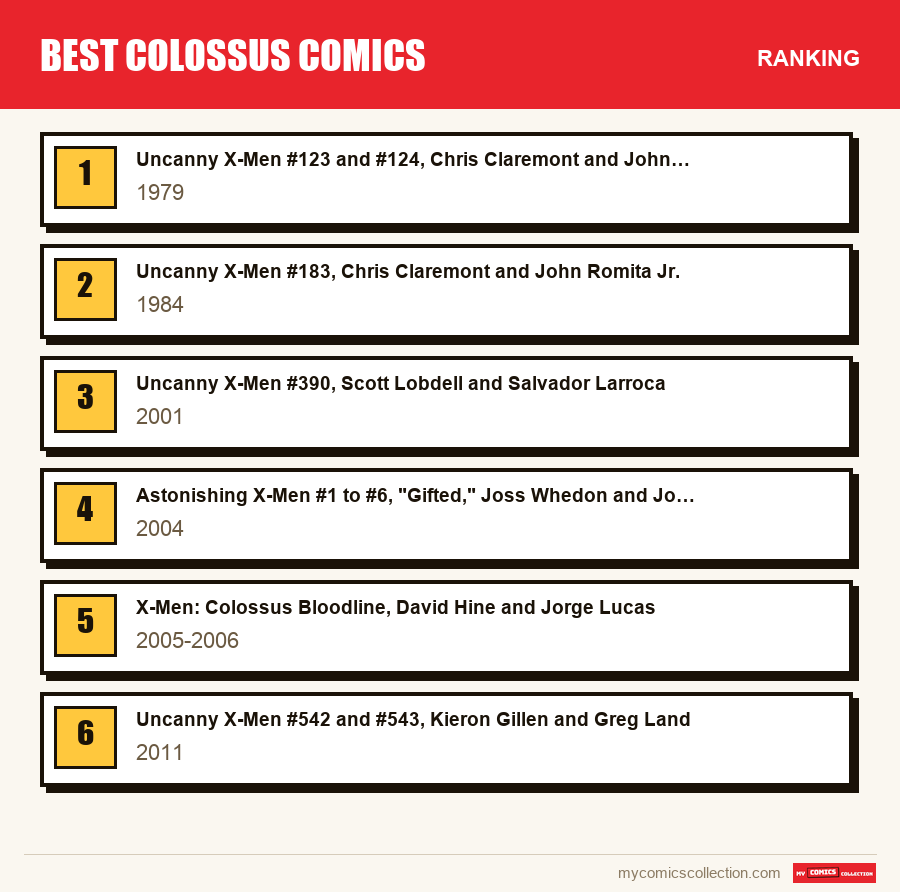
1: Uncanny X-Men #123 and #124, Chris Claremont and John Byrne (1979)
These two issues, dated July and August 1979, are written by Claremont and drawn by Byrne, with Terry Austin on inks. Arcade locks the X-Men inside Murderworld, a park of deadly traps. Colossus undergoes conditioning there that turns him into the "Proletarian," a submissive double who turns on his friends. The conditioning ends in issue 124.
What these issues bring is against-type casting: the gentlest giant on the team, presented as a weapon, with everything that implies for his guilt afterward. They pose a question the rest of the story will return to: what is strength worth when you do not control it?
This read is for the reader who already knows Claremont's team and wants to see this duo at work on a supporting character. To place the duo better, see the page on John Byrne. Since the two issues follow each other and the story ends in the second, buy them together.
2: Uncanny X-Men #183, Chris Claremont and John Romita Jr. (1984)
Dated July 1984, this issue is written by Claremont and drawn by John Romita Jr., with Dan Green on inks. Colossus confesses to Kitty Pryde that he has fallen in love with Zsaji, an alien healer he met on Battleworld during the Secret Wars. Their relationship ends and Kitty drifts away from the team.
The contribution is emotional and lasting: this issue makes Colossus a character who failed, in Kitty's eyes as in his own, and that gaze remains a key to the rest of their story. Our page on Secret Wars #1 explains the context of that meeting. For the Kitty side of things, see our guide to the best Kitty Pryde comics.
It is for the reader who wants a complete, moving story with no prerequisites: the issue stands on its own, even if knowing Secret Wars sheds light on it. It is the most accessible way in on this list for anyone looking for a human story rather than an adventure.
3: Uncanny X-Men #390, Scott Lobdell and Salvador Larroca (2001)
This 2001 issue is written by Scott Lobdell and drawn by Salvador Larroca. Hank McCoy has found a cure for the Legacy Virus, but it kills the first mutant who uses it. While the X-Men play basketball, Colossus injects himself and, using his power, releases it into the atmosphere, which heals the sick. He dies there.
The issue brings a conclusion: the character, defined by his sense of sacrifice, follows it all the way. The virus had killed his sister Illyana, which sheds light on his act. To understand that sister, our page on Magik collects the essential issues.
The read is for someone who already knows Colossus and wants his gravest turning point. It requires knowing the Legacy Virus, a virus that marked the mutant universe throughout the 1990s. Keep in mind that issue 390 is not an entry point: it is a destination read.
4: Astonishing X-Men #1 to #6, "Gifted," Joss Whedon and John Cassaday (2004)
The "Gifted" arc fills the first six issues of Whedon and Cassaday's Astonishing X-Men series, the fourth of which is dated October 2004. It proposes a simple idea: a lab claims to have found a "cure" for mutation, and the team investigates. In that fourth issue, Colossus is revealed to be alive, in the basement of Benetech, discovered by Kitty Pryde, while Ord attacks the Xavier Institute.
What the arc changes is a return. A few years after his death, Colossus comes back to the team, and his relationship with Kitty Pryde finds room again. Note that Colossus is not the center of the arc, which follows Cyclops, Kitty, and Emma Frost first: he is its big moment, not its hero.
The read is for anyone who has read the classics and wants to see the character brought back under a more modern eye. The six issues read in one sitting in the collected edition.
Do you collect this series?
Track what you own, what you are missing and what your collection is worth. 7-day trial.
Start my trial →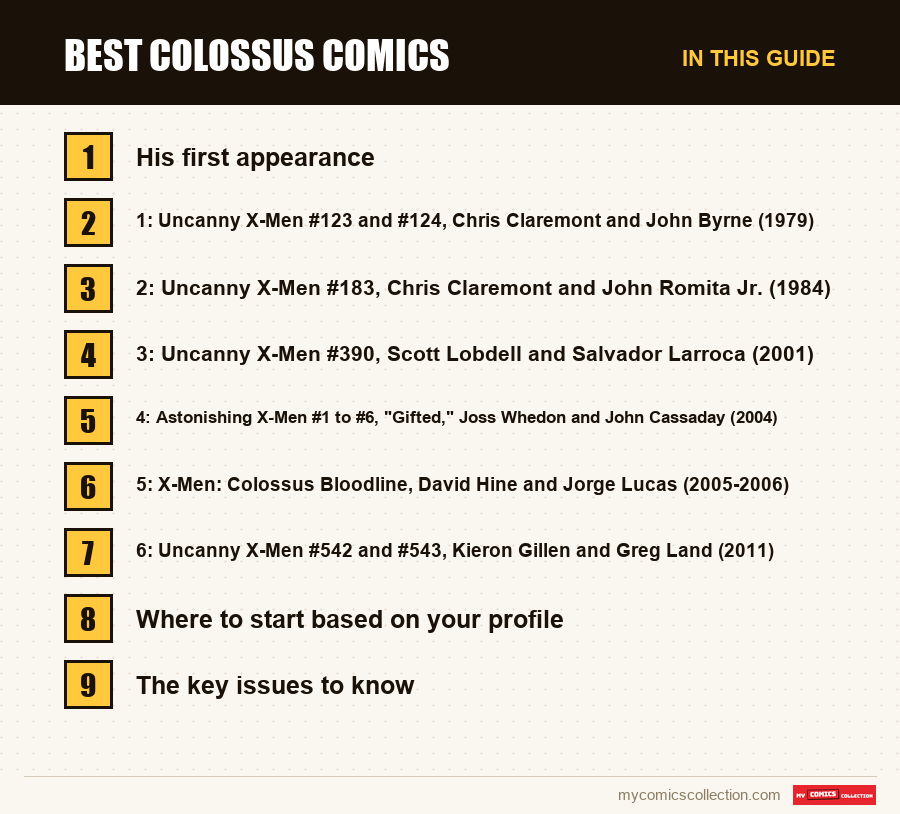
5: X-Men: Colossus Bloodline, David Hine and Jorge Lucas (2005-2006)
David Hine writes and Jorge Lucas draws these five issues, with a Chris Bachalo cover for the first; the issues went on sale from September 2005 to January 2006. Haunted by nightmares in which he sees himself as a monster, Colossus leaves for Russia, where his family is targeted by an assassin. His cousin Larisa tells him the Rasputins descend from Grigori Rasputin. Mister Sinister kills the descendants, and Piotr and his brother Mikhail are the main survivors.
The series gives Colossus what the crossovers deny him: an entire story in his name, centered on his family and on the fear of his own dark side. It is for the reader who has already read the classics and wants to see the character in a story of his own, far from the big teams.
6: Uncanny X-Men #542 and #543, Kieron Gillen and Greg Land (2011)
These two 2011 issues are written by Kieron Gillen and drawn by Greg Land. They form a tie-in to the Fear Itself event: Juggernaut, transformed into Kuurth, ravages San Francisco. In issue 542, Illyana summons Cyttorak, the demon that powered Juggernaut, and his powers pass to Colossus. In 543, Colossus, thus transformed, defeats Juggernaut.
The contribution is a change of power: Colossus becomes a different kind of force, more brute and dependent on a supernatural entity. The change weighs on the rest of the character's story. For the writer, see the page on Kieron Gillen.
The read is for anyone following the story of Juggernaut and the demon Cyttorak, or who wants to understand why Colossus was for a time able to face Cain Marko on equal terms. Take the two issues together; the second concludes the story of the first.
Where to start based on your profile
New to him and looking for a short way in? Read Uncanny X-Men #183, which stands on its own, then Astonishing X-Men #1 to #6. Both give a precise idea of the character without requiring the complete run of a series.
Love the classics? Start with Giant-Size X-Men #1, follow with Uncanny X-Men #123 and #124, then #183, before reading issue 390. This progression follows the character's life and culminates in his sacrifice.
Prefer full-fledged stories? Colossus: Bloodline is built to stand without a team. Following the crossover news? Finish with Uncanny X-Men #542 and #543.
The key issues to know
Here are the landmarks for Piotr Rasputin, in publication order. No figures here: we keep landmarks and a way of searching.
- Giant-Size X-Men #1 (1975): the first appearance of Colossus, along with those of Storm and Nightcrawler.
- Uncanny X-Men #123 and #124 (1979): Colossus conditioned into the "Proletarian" by Arcade.
- X-Men #129 (January 1980): the first appearance of Kitty Pryde; Colossus is already on the team.
- Uncanny X-Men #183 (1984): the end of his relationship with Kitty.
- Uncanny X-Men #303 (1993): the death of Illyana, Colossus's sister, a victim of the Legacy Virus.
- Uncanny X-Men #304 (1993): Colossus sides with Magneto, after Illyana's funeral.
- Uncanny X-Men #390 (2001): his death, when he releases the cure for the Legacy Virus.
- Astonishing X-Men #4 (October 2004): Colossus revealed alive.
- Uncanny X-Men #542 and #543 (2011): Cyttorak's powers pass to Colossus.
- Avengers vs. X-Men #5 (2012): Colossus is one of the five hosts of the Phoenix Force, but he is not the center of that series.
A storage tip for this character: sort your copies by cover date rather than by arc. Colossus spans five decades of series, and several of his important issues, such as #183 or #390, belong to periods whose covers, inserts, and reprint numbers differ. For each issue, note the publisher, the year, the creative team, and the condition, so you do not mix up an original printing with a reprint or a collected edition.
For a copy featuring Piotr Rasputin, note the exact edition and the grid of defects you find, then compare them with similar cases seen recently; the free valuation page serves as a second opinion.
Frequently asked questions
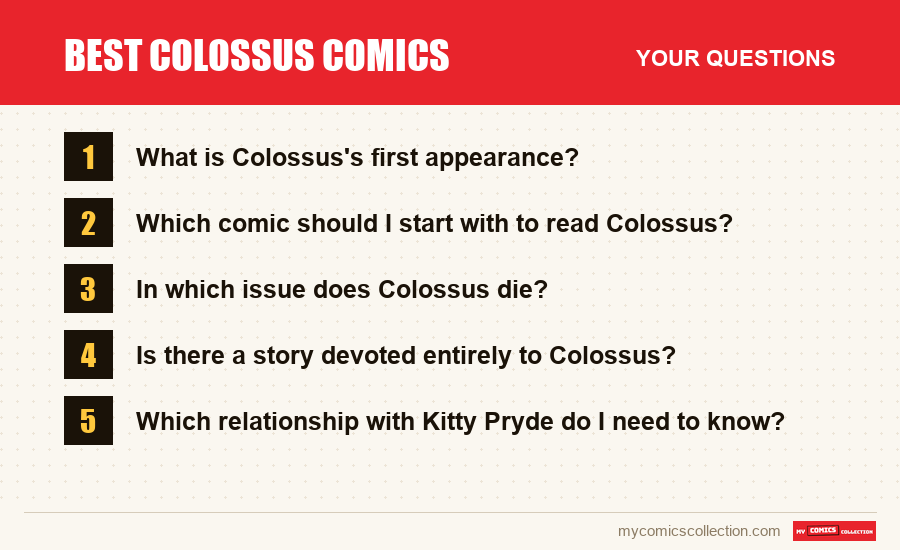
The duo of Len Wein and Dave Cockrum made Giant-Size X-Men #1 (1975), which carries the birth of Colossus. This giant-size issue relaunches the team with new members. The regular series then resumes with X-Men #94, which establishes this lineup for the long haul.
The simplest is Uncanny X-Men #183 (1984) by Chris Claremont and John Romita Jr., which stands on its own. For a more recent series, go with the first six issues of Astonishing X-Men (2004), by Joss Whedon and John Cassaday, which bring him back. The classics come after.
In Uncanny X-Men #390 (2001), written by Scott Lobdell and drawn by Salvador Larroca. He injects himself with the cure for the Legacy Virus, which kills the first mutant to use it, and releases it into the atmosphere. He is revealed alive in Astonishing X-Men #4, in October 2004.
Yes: the five-issue miniseries X-Men: Colossus Bloodline, written by David Hine and drawn by Jorge Lucas, on sale between September 2005 and January 2006. It follows Colossus in Russia against an assassin targeting his family. It can be read without knowing the X-Men as a whole.
Kitty Pryde appears in X-Men #129 (January 1980), and their romance ends in issue 183 (1984) by Chris Claremont and John Romita Jr., after the Secret Wars. These two landmarks are enough to understand their story before reading the more recent series that pick it up.
Own an issue of Uncanny X-Men featuring Colossus or a recent tie-in? Get its condition and value assessed.
Estimate my comic