
The best Psylocke comics start with Uncanny X-Men #213 (January 1987), by Chris Claremont and Alan Davis, where Betsy Braddock joins the X-Men. Then move on to Uncanny X-Men #256 (December 1989) and the Jim Lee era, and then to Rick Remender's Uncanny X-Force (from 2010). Where to start is easy to settle, and her first appearance remains Captain Britain #8, published by Marvel UK in December 1976, the key issue for collectors.
Few mutant characters have changed bodies, sides and missions as much as Psylocke. Sister of Captain Britain, a telepath turned fighter, long tied to ninja imagery, then split between Betsy Braddock and Kwannon, she forces readers to ask a question: which Psylocke are you looking for? This guide offers seven ranked reads, with what each one brings, to help you into a bibliography scattered across several series and several decades.
As always in this guide, we only state verified facts (creators, issue numbers, dates); the analysis is our own, with no reproduction of artwork or protected dialogue.

Her first appearance
Betsy Braddock is born in Captain Britain #8, dated December 1976, a single issue from Marvel UK, the publisher's British branch. The character is created by Chris Claremont, with Herb Trimpe on art. Twin sister of Brian Braddock, the title hero of the book, she plays a supporting role, very far from the fighter the X-Men will make of her.
This detail matters for your collection. A British issue from 1976 is not found like an American issue from the same year: the print run, the distribution and the original format all differ, and the first reflex is to check the exact nature of your copy. To place this issue in the history of the hero around her, our timeline of Captain Britain details the Marvel UK weeklies.
The name Psylocke, for its part, arrives ten years later: its first use under that name appears in The New Mutants Annual #2, dated October 1986. It is a second landmark, to be told apart from Betsy's own first appearance.
1: Uncanny X-Men #213, Chris Claremont and Alan Davis (1987)
Issue #213 of Uncanny X-Men, dated January 1987, is simply titled "Psylocke". Chris Claremont writes it, Alan Davis draws it, Paul Neary inks it. It closes the Mutant Massacre cycle, the first big mutant crossover event, and sees Betsy face Sabretooth before being accepted into the team. This is the moment she becomes a full-time X-Man.
This entry point supplies the template of the character: a British telepath, an aristocrat, thrown into a war that is not hers and forced to prove her worth in blood. It is for the reader who wants to understand why Psylocke matters before following her transformations. The issue reads on its own, as long as you accept a few allusions to the event that precedes it; in trade paperback, the period appears in the volumes devoted to Mutant Massacre.
2: Uncanny X-Men #256, Chris Claremont and Jim Lee (1989)
Issue #256 of Uncanny X-Men, from December 1989, is the one where Betsy's body changes: abducted by the Hand, she comes out physically transformed, with an Asian appearance, and given a new costume that Jim Lee designs with Chris Claremont. The full explanation is only given later, which makes this single issue a turning point whose meaning becomes clear in hindsight.
It is the read to favor if your Psylocke is the 1990s one: the image that sticks in most readers' minds, that of a fighter with a sword and a psychic knife, is born in this period. To place the artist in his career, the Jim Lee hub and our guide Jim Lee: where to start offer a frame. The issue is for readers who want to understand the character's visual shift, more than for a standalone story.
3: X-Men #17 and #31-32, Fabian Nicieza (1993-1994)
The second half of the puzzle comes from the 1991 X-Men series. In issue #17, dated February 1993, Fabian Nicieza and Andy Kubert introduce Revanche, a ninja of the Hand, that is to say Kwannon. Later, in issues #31 and #32 of the same series, Fabian Nicieza establishes that the change in issue #256 was a body swap between Betsy and Kwannon.
This is a read that explains rather than one for spontaneous pleasure: it gives retroactive meaning to what the reader saw in 1989. It is for those who want to know who is who before tackling the recent series, where this distinction becomes the narrative engine. In single issues, it is better to read these three issues back to back, using our X-Men reading guide for the surrounding chronology.
4: Uncanny X-Force, Rick Remender and various artists (2010-2012)
Launched in 2010, Uncanny X-Force is written from start to finish by Rick Remender, with Jerome Opeña, Esad Ribic, Billy Tan, Mark Brooks, Greg Tocchini and Phil Noto depending on the arc. Psylocke is part of the team for the whole volume, alongside Fantomex and Deadpool. The first arc, The Apocalypse Solution (#1 to #4), asks whether to kill a child to prevent a future; the next arc takes the series further, up to the Dark Angel saga, where Psylocke makes a decision that haunts her.
The series is for the adult reader, ready for moral violence more than spectacular fights, and it is probably the best starting point if you have read no older X-Men: it is understood almost without prerequisites. The arcs read well in trade paperbacks. To place the writer better, the Rick Remender hub and our page on Remender and X-Force detail his work at Marvel.
5: Excalibur, Tini Howard and various artists (since 2019)
In the 2019 relaunch of Excalibur, whose first issue is dated October 2019, Betsy Braddock takes over the title of Captain Britain and leads a new team alongside Apocalypse, Gambit, Rogue, Jubilee and Rictor. The context is that of Krakoa, whose ground rules the series assumes. Tini Howard writes this relaunch.
The read speaks to readers who like teams with a British accent, where adventure comes before drama, and it gives Betsy a leadership role she had never had. It is useful for anyone who wants to know where Betsy stands today. To go back to the origins of the team, the page on the best runs of Excalibur offers a path from 1987.
Do you collect this series?
Track what you own, what you are missing and what your collection is worth. 7-day trial.
Start my trial →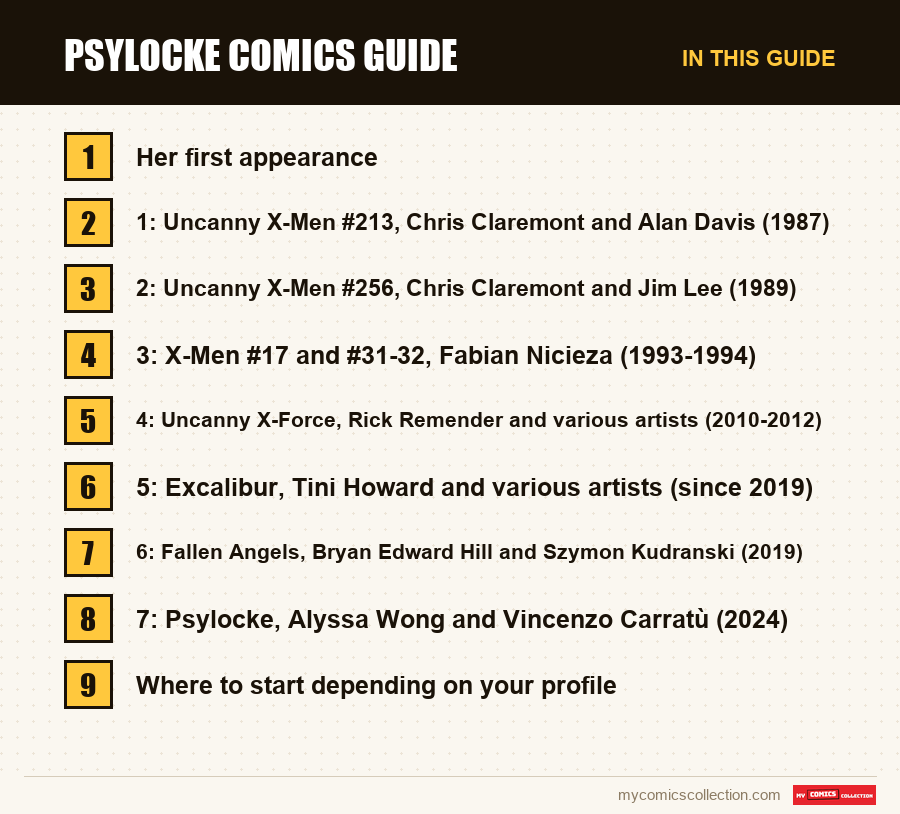
6: Fallen Angels, Bryan Edward Hill and Szymon Kudranski (2019)
Only six issues, starting in November 2019: Fallen Angels brings together Bryan Edward Hill on script and Szymon Kudranski on art. This is where Kwannon takes, for the first time, the name Psylocke, alongside Cable and X-23. The tone is dark, turned toward revenge, and Kudranski's line sets up a crime-thriller atmosphere.
It is for the reader who has already untangled the story of the two women and wants to see what the character becomes when she carries that name alone. With its six single issues, the series is quickly assembled, and a single volume is enough to read it in one sitting.
7: Psylocke, Alyssa Wong and Vincenzo Carratù (2024)
In November 2024, a new Psylocke series starts, written by Alyssa Wong and drawn by Vincenzo Carratù, devoted to Kwannon. This last entry is the most recent of the ranking.
It is for those who follow current X-Men news and want to read the character as she is published today. It is better to have gone through the previous entry to understand Kwannon's legacy. Recent series titles move fast: check the catalog to learn the state of the run before buying.
Where to start depending on your profile
To enter the mutant world through a self-contained story, Uncanny X-Force is enough: few prerequisites, and a Psylocke without illusions, surrounded by Fantomex and Deadpool. If you like the classics, start with Uncanny X-Men #213, then follow with issue #256 to see the character change her look.
If you want to understand the riddle of the two bodies, read issues #17, #31 and #32 of X-Men (1991) before Fallen Angels. The reader who prefers the Krakoa era will take Excalibur (2019), keeping the page on Emma Frost close at hand, another figure of the same moment who sheds light on the island's context. As for the collector, he or she will choose one landmark per period rather than buying everything.
The key issues to know
The first landmark is Captain Britain #8 (December 1976), the first appearance of Betsy Braddock. The second is The New Mutants Annual #2 (October 1986), where the name Psylocke appears. The third is Uncanny X-Men #213 (January 1987), her entry into the X-Men. The fourth is Uncanny X-Men #256 (December 1989), the transformation. The fifth is X-Men #17 (February 1993), the first appearance of Kwannon as Revanche.
Two story landmarks complete the list: the death of Betsy in X-Treme X-Men #2 (2001), scripted by Chris Claremont, and her return in Uncanny X-Men #455 (2005). On the recent side, Excalibur #1 (October 2019) and Fallen Angels #1 (November 2019) mark the two directions Betsy and Kwannon take.
To decide, ask yourself one question per issue: does it durably change Betsy or Kwannon? Then identify the exact printing of your copy and only compare equivalent grades. An old, rare first appearance is not judged like a recent narrative turning point: one is sought for history, the other for use. Do you have one of these single issues lying around in your boxes? The free appraisal gives you a first reference point before you decide.
How to read in trade paperbacks or single issues
The Uncanny X-Force arcs are designed to be read in volumes, and the trade paperbacks follow publication order. The Claremont years are trickier: issues #213 and #256 are found in omnibuses spread over long periods. If the cost of entry in single issues holds you back, start with a trade paperback, then buy the single issue that struck you.
For short series like Fallen Angels, single issues remain affordable as a complete run of six issues. For long series, pick an arc and stop there: the Psylocke reader is better off reading by period, not for completeness.
Frequently asked questions
The very first appearance of Betsy Braddock is Captain Britain #8, a Marvel UK single issue dated December 1976. The character is created by Chris Claremont, with Herb Trimpe on art. The name Psylocke does not exist yet: it appears in The New Mutants Annual #2, in October 1986.
If you want her entry into the X-Men, read Uncanny X-Men #213 (January 1987), by Chris Claremont and Alan Davis. If you prefer a modern series that can be understood almost without prerequisites, open Rick Remender's Uncanny X-Force, launched in 2010. The two entry points are independent.
No. Betsy Braddock is the sister of Captain Britain; Kwannon is a ninja of the Hand, who appeared as Revanche in X-Men #17 (February 1993). Issues #31 and #32 of that series, by Fabian Nicieza, establish that their bodies had been swapped. They then follow distinct paths.
The change takes place in Uncanny X-Men #256, dated December 1989: Betsy is abducted by the Hand and comes out transformed, in a costume designed by Jim Lee with Chris Claremont. The fact that it is a body swap is only explained later, in issues #31 and #32 of X-Men.
Several recent series follow her. Excalibur (October 2019) shows Betsy Braddock as Captain Britain, Fallen Angels (November 2019) sets up Kwannon under the name Psylocke, and the Psylocke series by Alyssa Wong and Vincenzo Carratù starts in November 2024.
Do you have an issue of Uncanny X-Men or Captain Britain in your boxes? Get a first reference point before deciding what to keep.
Estimate my comic