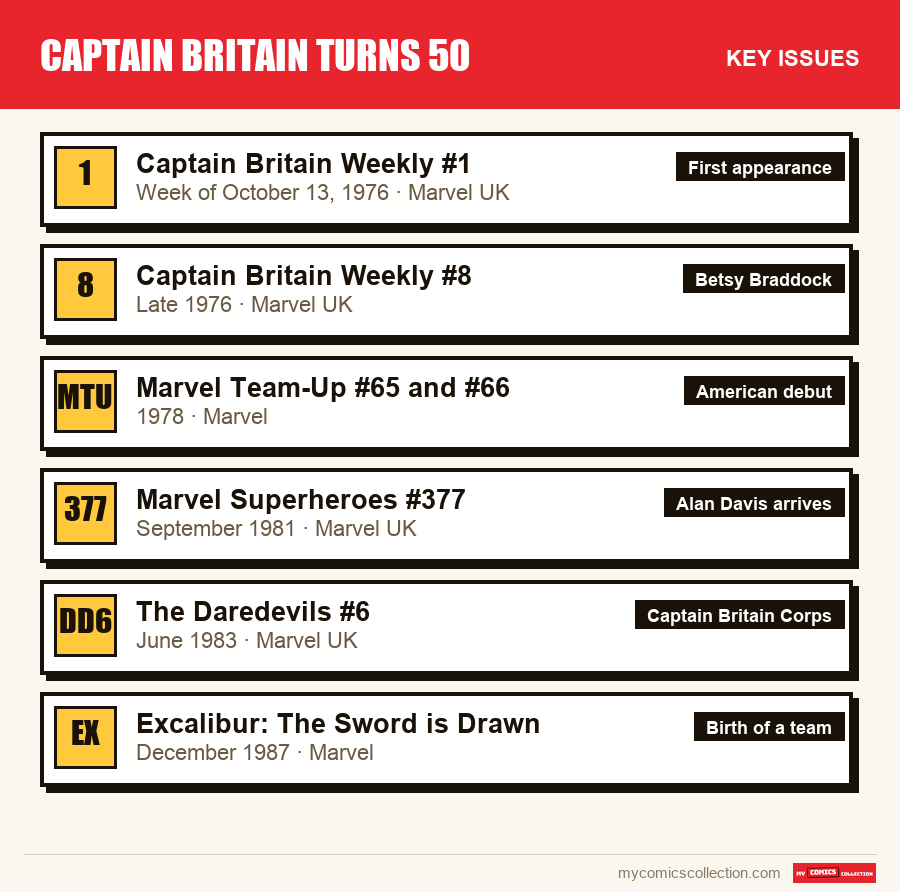
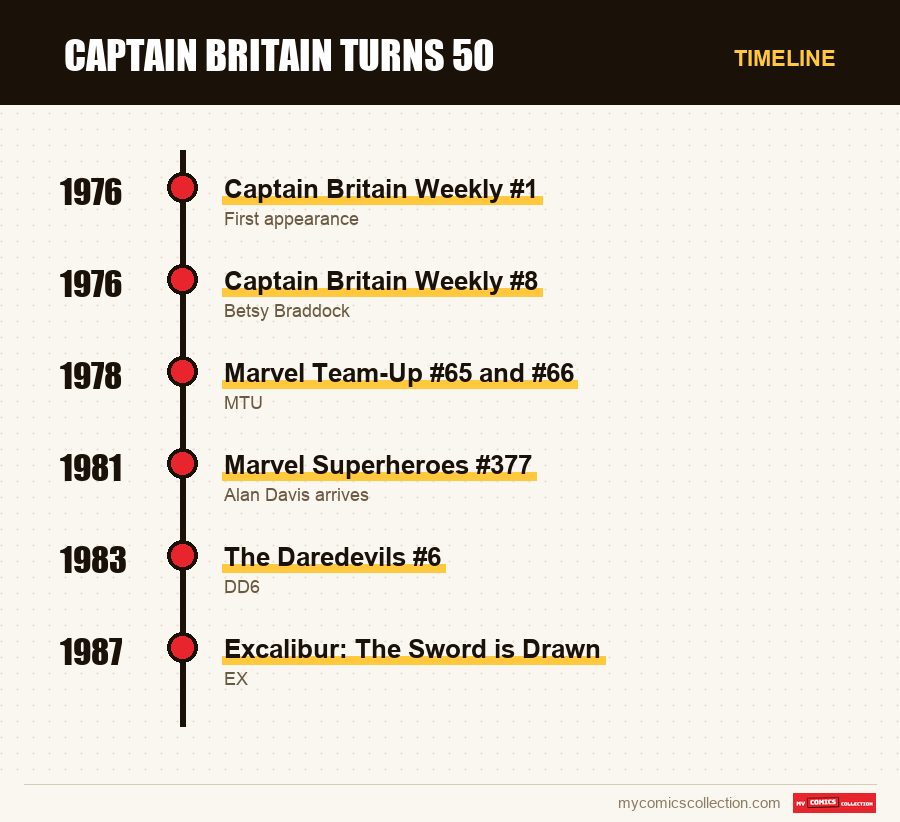
Captain Britain turns 50: he first appeared in Captain Britain Weekly #1, a British weekly dated the week of October 13, 1976, written by Chris Claremont and drawn by Herb Trimpe. Marvel is celebrating the anniversary with a Captain Britain 50th Anniversary Special #1 expected on October 14, 2026, bringing together Alan Davis, Chris Claremont and Dan Abnett among others. The key issues to know: the 1976 #1 and its free mask, #8 where Betsy Braddock appears, Marvel Team-Up #65 (1978) for his American debut, Marvel Superheroes #377 (1981) and Alan Davis's new costume, Alan Moore's run starting at #387 (1982), The Daredevils #6 (1983) and the Captain Britain Corps, then Excalibur: The Sword is Drawn (1987), which launches the American team.
Captain Britain is a special case in Marvel's history. He is a hero conceived by Americans for the British market, published first in a weekly sold only in the United Kingdom, then carried for years by British creators still unknown before returning to the United States through the front door. His chronology is scattered across English titles with multiple numberings, scattered American appearances and several teams. None of this makes a collector's life easy.
On the occasion of the anniversary special of October 14, 2026, this article lays out the chronology flat. This is not an investment method for British keys, a subject covered in another article on the site, but the complete list of the character's milestones, with for each the issue that carries it and what you need to know to identify it.
1976: an American hero for British newsstands
In the mid-1970s, Marvel's British subsidiary published only reprints of American comics. Captain Britain Weekly was its first publication of original content. The content was nonetheless made in the United States by the American team: Chris Claremont, born in London, wrote; Herb Trimpe drew; Fred Kida inked; and Larry Lieber, Stan Lee's brother, supervised from New York. The character's exact creators are not formally established, and Trimpe himself remarked that the costume design resembled the work of John Romita, who was designing many characters for the publisher at the time.
The hero is Brian Braddock, a physics student, who receives his powers from Merlin and his daughter Roma. Each issue of the weekly contains an eight-page Captain Britain episode, completed by American reprints, notably of Nick Fury and the Fantastic Four. The first two issues were sold with a free gift, following a tradition of British launches: a cardboard mask in the first, a boomerang in the second.
Captain Britain Weekly #1
The founding piece. Claremont, Trimpe and Kida present Brian Braddock and his original costume, emblazoned with a heraldic lion.
Captain Britain Weekly #8
First appearance of Betsy Braddock, Brian's twin sister, who will years later become Psylocke in the X-Men, then Captain Britain in her turn.
Claremont left the series after ten issues, in the middle of a story, because of disagreements with the editorial staff. Gary Friedrich replaced him. Sales fell: the weekly went black and white with #24, dated March 23, 1977, then stopped at #39, dated July 6, 1977. The serial immediately migrated to Marvel UK's Spider-Man weekly, renamed for the occasion Super Spider-Man & Captain Britain.
1978 to 1981: America, then back to zero
Marvel Team-Up #65 and #66
Chris Claremont and John Byrne introduce Captain Britain to the American public in an adventure with Spider-Man. The story was later reprinted in the last episodes of the British serial.
After an eclipse, Captain Britain returned in March 1979 in Hulk Comic, with the Black Knight, in a story set in Otherworld. It was the first time the character was written and drawn by British creators.
Marvel Superheroes #377
Relaunch of the character by writer Dave Thorpe and artist Alan Davis, who redesigns the costume at the request of editor Paul Neary. The chest lion disappears, notably because it evoked for British readers a quality mark stamped on eggs.
1982 to 1985: Alan Moore's run
Thorpe's very political stories caused tensions with the editorial staff. He was replaced by Alan Moore starting with Marvel Superheroes #387, dated July 1982. Moore used his predecessor's plots to launch a long story, "Jaspers' Warp", in which a mad scientist, Mad Jim Jaspers, warps reality around him. The serial changed platform over the months: after #388, it moved to a new monthly, The Daredevils, which lasted eleven issues, then to The Mighty World of Marvel.
The Daredevils #6
Alan Moore and Alan Davis introduce the Captain Britain Corps there, a league of defenders from parallel realities, almost all variants of Brian or Betsy Braddock. The concept will feed decades of stories, up to Spider-UK in Spider-Man's multiverse tales.
Moore left the character following a dispute over unpaid invoices. Other writers handled the transition, then a monthly Captain Britain started in January 1985, first written by Jamie Delano on Moore's recommendation. Alan Davis, unconvinced by the direction taken, gradually took back control of the plots, until becoming the writer. The same year, Captain Britain reappeared in the United States in Captain America #305 and #306.
1987 to 1998: Excalibur
Excalibur: The Sword is Drawn
Chris Claremont returns to the character he launched eleven years earlier, this time with Alan Davis. This special issue brings together Captain Britain, his partner Meggan and several former X-Men in a new British team.
The Excalibur series made Captain Britain a character known to the American public. Claremont, whose work on mutants is detailed in our ranking of the best X-Men runs, and Davis develop the humor, Otherworld and parallel realities there, in the line of what Moore had set up. For a reader, it is one of the most enjoyable entry points to the character; for a collector, the series' first issues remain affordable and easy to find, since they were printed for the American market.
In parallel, Marvel UK placed Captain Britain at the center of a team series, Knights of Pendragon, which started well before stopping at #18.
2005 to today: MI-13, Betsy, Avalon
The character then has several lives. In 2005, he leads the team in New Excalibur, which lasts twenty-four issues. In 2008, thanks to a big publisher event, he becomes the hero of Captain Britain and MI: 13, written by Paul Cornell. He then joins the Secret Avengers in 2012 and 2013, then the Avengers.
The most important change comes after the X-Men relaunch of 2019. Brian, corrupted by Morgan le Fay, hands the title to his sister: Betsy Braddock becomes Captain Britain from #1 of the fourth Excalibur series, while Brian takes the name Captain Avalon. For Psylocke collectors, this issue is as important a milestone as her 1976 first appearance.
The October 14, 2026 special
For the fiftieth anniversary, Marvel is publishing the Captain Britain 50th Anniversary Special #1, expected on October 14, 2026. The issue brings together several generations of creators tied to the character, notably Alan Davis, Chris Claremont and Dan Abnett, with Paul Davidson and Kelsey Ramsay. The choice of these names sums up the hero's history: Claremont for the 1976 birth and Excalibur, Davis for the 1981 costume and the long collaboration that followed, Abnett for Marvel UK's British tradition.
As with any anniversary issue, caution is in order: the special is a celebration, not a first appearance, and its place in a collection comes first from what it tells. It is, however, an excellent pretext to go back over the chronology in order.
Building a Captain Britain collection step by step
Start with the American issues
Marvel Team-Up #65, Excalibur: The Sword is Drawn and the first Excalibur issues are easy to find and lay the foundation.
Add the two British keys of 1976
#1, if possible with its mask, and #8 for Betsy Braddock. Check the condition of the paper, often yellowed, and the presence of all pages. Our guide to British pence-priced editions helps distinguish these publications from American comics sold in the United Kingdom.
Read Moore and Davis in collected form
The 1981 to 1985 serials are scattered across several English titles. To read them, a collected edition is the reasonable solution; to collect them, aim first for Marvel Superheroes #377 and The Daredevils #6.
Finish with the modern era
Captain Britain and MI: 13 #1, #1 of the fourth Excalibur series, then the 2026 anniversary special.