A pence copy is a comic printed in the United States, on the same presses and in the same run as the cents edition, but whose cover price box shows a British price because the United Kingdom distributor had ordered a share of it. It is not a British reprint, and it is not a cents copy on which a distributor applied a stamp either. At Marvel, these copies exist with cover dates from May 1960 to December 1981; at DC, in July and August 1971 then from February 1978 to September 1981. From 1982, both publishers print a dual cents/pence price: later British copies are no longer variants. On the market, a pence copy trades below its cents equivalent, often markedly, despite a much lower recorded population. This discount is a demand reality, not a defect of the object.
There is an experience that almost all European collectors of old comics end up having. You sort a lot, you come across an issue from the sixties or seventies whose cover is exactly the one you know, with one difference: where the price is, instead of "12¢", you read "1/-", "9d" or "7p". First reflex, it must be a foreign edition, therefore a worthless reprint. Second reflex, a few searches later, it must be a rare variant, therefore a prize. Both reflexes are wrong.
These copies carry a name borrowed from the English-language vocabulary of the market: pence copies, or more rigorously UK price variants. Their history is well documented, because a small group of British collectors took the trouble, over more than ten years, to survey issue by issue what exists and what does not. Their value, however, is presented crookedly by many sellers, in one direction as in the other. This guide explains how these copies were made, gives a method to recognize what you have in hand, and deals frankly with the question of the discount.
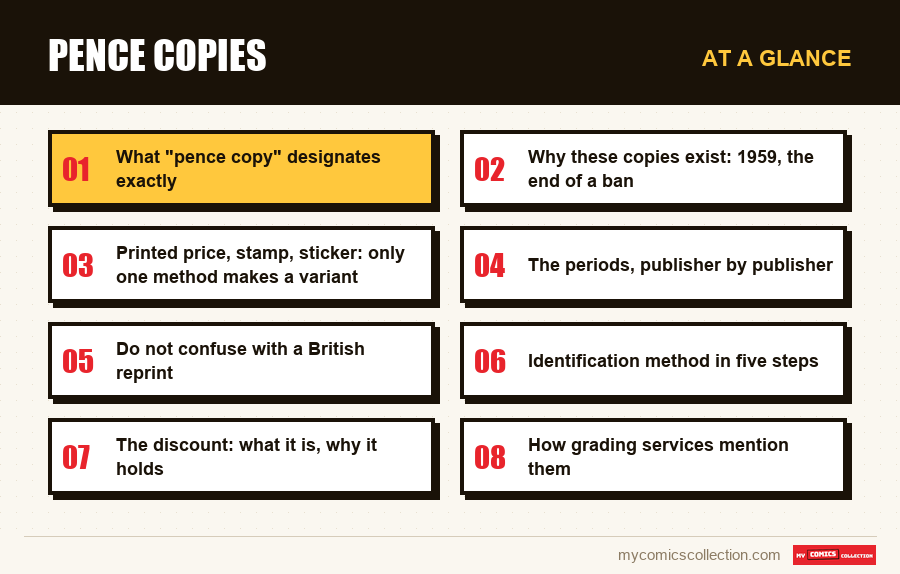
What "pence copy" designates exactly
The definition fits in one sentence, and every word carries weight. A pence copy is a first-printing run, produced by the American publisher, in the same machine pass as the edition intended for American newsstands, whose only difference is a plate change on the cover to show a price expressed in British currency.
Two consequences follow, and they are counterintuitive. The interior content is strictly the same, since the signatures came off the same stack, and it is indeed a first printing: this is the point that poorly informed sellers miss by filing these copies among foreign editions. The variant can therefore exist only if there is an American publication of which it is the variant, a criterion that excludes a whole family of British objects.
Why these copies exist: 1959, the end of a ban
After the Second World War, the United Kingdom sought to protect its national publishers and banned the direct import of American periodicals. Comics did not disappear from British hands for all that: in the 1940s and 1950s, they arrived mostly as ship ballast.
The ban was lifted in 1959, and the landscape changed at once. The company Thorpe & Porter, a British publisher and distributor founded in 1946 that had made a name repackaging American material, became the sole United Kingdom distributor of DC and Marvel comics, but also of Dell, Charlton and American Comics Group. Two channels then coexisted.
The first consisted of recovering unsold American copies: retailers returned unsold issues to a central point, and these returns were shipped to Great Britain, probably in monthly consignments. On arrival, the distributor marked them with a price stamp before putting them in circulation.
The second channel, the one that interests us, consisted of ordering directly from the American publisher a share of the print run carrying a printed British price. The first known copy, all publishers combined, is an Archie issue dated March 1960, at 9d. On the Marvel side, the two oldest are dated May 1960, and one of them carries the indicia of another distributor, L. Miller & Co, which also ordered British-priced print runs for seventeen months before Thorpe & Porter became Marvel's sole counterpart in the United Kingdom, in September 1961.
These copies are therefore not the fruit of an editorial operation or a market test, but of a commercial distributor order. This origin explains everything else: the gaps in series, the unusual prices, and the total absence of communication at the time.
Printed price, stamp, sticker: only one method makes a variant
Three different markings are found on American comics that passed through the United Kingdom. But these three markings do not produce three variants: they produce three objects of very unequal status, and confusing them is the first cause of bad purchases in this area.
The printed price. It is the only one that counts. The British price is built into the cover image, in the same ink, with the same printing screen as the rest of the drawing. Only it marks a pence copy in the strict sense.
The stamp. A price stamp, often circular, often in greasy ink, applied on a cover that still shows its original American price. This method was massively used on 1960s DC titles, precisely because no printed-price run existed then for them. It must be made very clear: a stamped cents copy remains a cents copy. It is not a price variant, and the stamp is even considered by the market as a defect, since it is a mark added after manufacture. Any listing that presents a stamped comic as a "rare UK variant" is, at best, poorly informed.
The sticker. Rarer, and more interesting. A price sticker covers an already-printed price. The best-documented case dates from November 1971, the month of British decimalization, which moved covers from the shilling to the price in new pence. That month, the American issues concerned were mostly extended-format releases, and ten pence copies are known: six carry a price of 8p, four a price of 6p. The 8p seems to have been a mistake, since many copies are found where a 6p label covers the printed 8p. The object remains a printed-price variant, but with an additional layer applied downstream.
The periods, publisher by publisher
Seven American publishers are now identified as having produced British printed-price runs: Archie, Charlton, DC, Dell, Gold Key, King and Marvel. The survey published long ago by a British collector on the CGC forums totaled, at the end of 2020, 4,791 confirmed issues all publishers combined. Set against the tens of thousands of comics published in the period, the whole phenomenon therefore remains narrow.
Marvel
Marvel is by far the leading producer of pence copies, with more than three thousand confirmed issues. Of the roughly 6,500 comics published between May 1960 and December 1981, spread over two hundred titles, only 118 titles had a pence version, and almost all with gaps. Marvel is also the only publisher to have modified elements other than the price: month removed from the cover in the early years, a regional indicia mentioning the distributor, then a title banner changed to "Marvel All-Colour Comics" to signal to the British reader that the issue was indeed in color, many local publications not being so.
DC
The DC case is the most baffling. Only five issues carry a printed British price in 1971: four dated July, at 5p, and a fifth dated August, the only known copy at the unusual price of seven and a half pence. Then nothing for eight years, before regular production from February 1978 to September 1981. Only four prices exist across the whole: 5p, 7½p, 12p and 15p. DC also applied a rigid rule: rather than adjust the British price of an extended-format issue, the publisher gave up producing its pence version.
The other five houses fit in much shorter windows. Archie produced pence copies only from March to August 1960, all at 9d. Dell covers April 1960 to July 1961, most often carrying both prices side by side. Charlton extends from 1960 to December 1963, returns to the American price alone, then adopts a dual price from 1973. Gold Key and King close the list with small volumes. These narrow windows are a dating tool: an Archie with a printed British price dated 1962 does not exist according to the current state of the survey, and if you think you are holding one, you are holding something else.
The pivotal moment, for anyone sorting a collection, is the early 1980s. DC introduced a dual cents/pence price across all its titles from October 1981, and Marvel did the same in January 1982 on its editions meant for the specialty store network, the newsstand editions staying in cents alone. This decision mechanically ended British price variants: the pence price now appears on the standard copy, next to the cents price, and no longer distinguishes anything. A European collector who owns 1980s Marvels with a pence price therefore does not own variants. The difference between these two distribution networks is covered in our guide to direct edition and newsstand.
Do not confuse with a British reprint
The United Kingdom had a flourishing reprint industry, and that is where the costliest confusion plays out. Several British publishers, including Thorpe & Porter itself and L. Miller & Son, acquired rights to republish American material in local publications: black-and-white weeklies, anthologies, year-end bound albums. Marvel pushed the logic further by creating in 1972 a dedicated British structure, which republished the American catalog in weekly format until the mid-1990s.
These publications are autonomous objects: their own numbering, their own periodicity, often their own pagination and covers. They are not "the British edition" of an American comic, even when they reuse its cover. A British weekly devoted to Spider-Man in the 1970s is not a version of Amazing Spider-Man: it is a distinct publication that reprints its content, after the fact, on other paper, in another format.
The border is therefore simple to state. If there is an American issue of which your copy is the exact twin inside, you have a price variant. If not, you have a reprint, which has no reason to follow the value of the original issue, as our guide on how to tell a first edition from a reprint explains.
Identification method in five steps
Here is the order in which to proceed, copy in hand. It first eliminates false candidates and only asks for a fine check at the end of the path.
Look at the format before the price
A pence copy has exactly the format, pagination and paper of an American comic of its year. If you hold a larger, thinner issue, in black and white, stapled differently or bound, stop: it is a British publication, and the rest of this method does not apply.
Check whether the price is printed or added
Tilt the cover under raking light. A printed price is part of the image: same gloss, same screen, no relief. A stamp is laid over the ink, often off-center, sometimes smudged, and leaves an imprint perceptible to the finger. A sticker has an edge. If the American price is still visible next to or beneath it, you have a distribution marking, not a variant.
Read the price character by character
Old prices are puzzling. "9d" means nine pre-decimal pence, the "d" coming from the Roman denarius. "1/-" means one shilling, or twelve old pence. After November 1971, the price is written in new pence followed by a "p". Then confirm that this price appears in the known list for the publisher and year, because an off-list price signals a poorly identified object.
Check the cover date against the publisher's window
This is the most discriminating and quickest step. A Marvel with a printed British price dated 1984 is not a variant, it is a dual-price copy. A DC with a printed British price dated 1975 does not exist in the current survey. Refer to the windows given above before going further.
Open to the indicia, then note the version
On early Marvels, the indicia page sometimes carries additional lines identifying the British distributor, or a notation indicating that the print run was printed for distribution in the United Kingdom: it is a precious confirmation, whose absence disqualifies nothing. Then record the version in your inventory, while you have the object in front of you. Six months later, nobody remembers whether the copy shelved under a given number is the cents or the pence one.
The discount: what it is, why it holds
Let us tackle the touchy point. At identical quality and number, a pence copy sells for less than its cents equivalent. Not marginally less: the gap is perceptible, it is old, and it holds even though the market for old keys has risen a lot. It is the central fact, and no reasoning about scarcity has overturned it yet.
The paradox deserves to be laid out clearly. The populations recorded by grading services show, for most of the great Silver Age keys, a number of certified pence copies far below that of cents copies. British production was a fraction of American production, and the high grades are even harder to find there. In any other niche, a documented scarcity of this order would produce a premium. Here, it produces a discount.
The explanations put forward by collectors who know the file are convergent, and none comes from the object itself. Demand is first where memory is: the immense majority of old-comics buyers are North American and look for the copy they had or could have had in their hands, and the cents price is part of the mental image of the issue. Ignorance then played for a long time, since these copies were filed for decades with foreign editions and reprints, that is, with objects that indeed do not have the value of an American first printing; a market norm settled on this basis, and norms largely outlive the correction of the error that founded them.
The most powerful factor today is probably the thinness of the sales history. On a modest piece, a buyer asks no questions. On a major key, he wants a comparable, and the higher the sum, the more solid he wants it. A pence copy offers fewer comparison points, therefore more uncertainty at resale, therefore a demand for a discount. The mechanism feeds on itself.
Is the discount evolving? Knowledge is progressing, that is certain: the systematic survey published for about ten years has moved these copies from the status of oddity to that of a documented category, and collectors who follow this segment describe a market that is warming up, particularly on the very high grades where scarcity becomes binding. But we must be honest about what that means: a segment that warms up starting from low remains a segment that trades below the reference. Anyone announcing an imminent reversal of the hierarchy is selling you an anticipation, not an observation.
The practical conclusion is twofold, and it is not discouraging. If you buy to read and to own the issue, the pence copy is an excellent deal: strictly the same first printing, for less, and often rarer. If you buy to resell in the short term, factor in that you will be buying back the discount on exit, with a narrower pool of buyers. The reasoning is exactly the reverse of that prevailing on Canadian price variants, where scarcity translates into a premium, and which are the subject of a separate guide.
How grading services mention them
On this point, things have improved markedly, and the vocabulary used on a label has a direct effect on what the buyer understands. Historically, CGC applied the notation "UK Edition" to these copies. The wording was unfortunate, because it maintained exactly the confusion this article sets out to dispel: "British edition" describes a local reprint better than an American first printing with a modified price. Following a reasoned request by the collectors working on the survey, CGC changed this notation in April 2019 to "UK Price Variant", which describes the object correctly.
Three practical consequences follow. An old label and a recent label can describe the same object with two different words, without having to infer that one is worth more than the other. If you see "UK Edition" on an old label, verify for yourself which object it is, because this notation was also used by sellers for reprints. Finally, the notation on the label identifies the variant but creates no premium: it serves authentication, not valuation, and it is a distinction to keep in mind before deciding on certification. Our guide on CGC grading details the cost/benefit reasoning according to the issue's value.
Why you probably have some without knowing it
If you collect from continental Europe, the probability that pence copies sleep in your boxes is high. Between 1960 and 1981, these copies were the normal version sold at British newsstands and newsagents, sometimes from spinner racks supplied by the distributor. Millions of copies were therefore bought, read and kept on this side of the Atlantic. When these collections resurface, they feed the European secondary market: flea markets, shows, estate lots, British retailers' stock. A French, Belgian or Swiss collector who buys old American comics in Europe is statistically buying stock with a strong British component.
Two side effects are worth flagging. The gaps in the survey show up in your collection: if two consecutive issues stubbornly go missing in pence version, it is quite possible that they never existed that way, the months of price transition and the extended-format issues being the usual suspects. And since these copies were sold at the time as ordinary comics, they were read as such, therefore kept without care: high grades are rare for a reason of use as much as of print run. This context also explains why the keys first published in the United Kingdom form a neighboring but distinct subject, since there it is the content that is British in origin, and not only the price box.
What to do with them concretely
The first decision is documentary: sort once, seriously, and record the version for each issue concerned. An inventory that does not distinguish cents from pence will force you to reopen everything the day you sell, or worse, will make you advertise in good faith one object for another. This is exactly what an issue-by-issue tracking allows, with one line per copy.
The second is strategic: are these copies comfort duplicates, the pence serving for reading and the cents as the reference piece, or a collection in their own right? Pursuing a complete series in pence is much harder than it seems given the gaps, and much less costly than an equivalent series in cents; in both cases, the missing issue detection tool avoids searching for months for an issue that does not exist.
The third is commercial, and it is the simplest: never buy a pence copy at the price of a cents copy, and never sell a stamped cents copy as if it were a variant. For modern cover variants, which follow an entirely different logic, our variant covers guide takes over.