
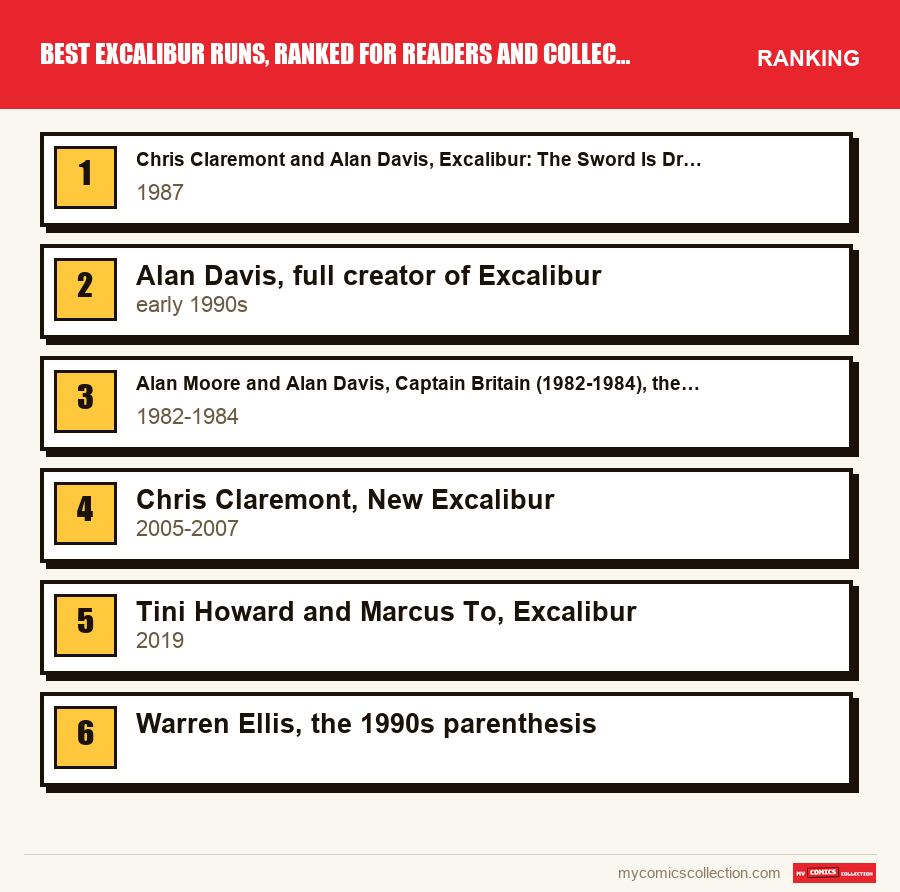
To read Excalibur, start with the special Excalibur: The Sword Is Drawn (December 1987) and the first issues of the 1988 series, where Chris Claremont and Alan Davis bring together Captain Britain, Nightcrawler and Shadowcat. Next come Davis's return as full creator, the Captain Britain of Alan Moore and Davis, New Excalibur (2005-2007), the Tini Howard and Marcus To series (2019) and Warren Ellis's stint. Six runs, ranked by reading interest.
Excalibur is not a character but a team, and that is what complicates the ranking: you do not follow a hero from page to page, you follow a formula, that of former X-Men settled in Great Britain, mixed with the whimsical tradition of Captain Britain. This formula has been taken up several times since 1988, with very different creators and moods. We therefore compared writer periods rather than complete collections.
As always on this guide, only verified information (creators, issue numbers, dates) is stated as fact; the analysis is our own, with no reproduction of protected art or dialogue.
How we ranked the Excalibur runs
Excalibur has had dozens of creators, but few periods read in one go without knowing the rest. We kept the periods that stand on their own, then asked each of them three questions: does the team have a recognizable voice, can the story be understood without the X-Men close at hand, and is the object simple to assemble? The last question weighs less than the first two, because the rank shown here judges reading before collecting.
A useful vocabulary point for what follows: the series launched in 1988 is the first volume, the 2019 relaunch is the fourth. The numberings overlap, so we always cite the year along with the issue number.
Top 1: Chris Claremont and Alan Davis, Excalibur: The Sword Is Drawn (1987) and the 1988 series
It all starts with a special dated December 1987. Claremont, who had created Captain Britain eleven years earlier in a Marvel UK weekly, and Davis, who had redrawn the hero in the 1980s, pair Brian Braddock, his partner Meggan and former X-Men. Nightcrawler and Shadowcat form the American core of the team; Rachel Summers, under the name Phoenix, joins the group in the monthly series that starts in 1988, and the miniature dragon Lockheed follows Kitty Pryde everywhere.
This run matters for a simple reason: it proves that a mutant series can turn its back on permanent drama. Where the X-Men of the same era sink into massacres and mourning, Excalibur chooses light adventure, Otherworld, parallel realities, a humor that owes a great deal to the British context. Davis draws with a clarity of line few contemporaries match, and every page seems designed for quick reading. The reader gains an endearing team, whose characters talk to each other like friends rather than soldiers.
Who is it for? For the one who wants a way into the mutant universe without crossing twenty years of continuity, and for the one who finds classic X-Men too dark. For the starting and ending issues, take the 1987 special as the opening and the first twelve to fifteen issues of the series as the heart of the period; sources differ on the exact moment Davis leaves the series for the first time, so we do not fix a last issue.
To collect it, the special and the first single issues were printed for the American market: they are easy to find, in good condition, without having to track down a British edition. Collected editions exist for those who prefer reading without handling 1988 paper. Our Claremont reading path places this run among the writer's other series.
Top 2: Alan Davis, full creator of Excalibur (early 1990s)
After Claremont's departure, Davis returns to the series as writer and artist at once. The tone tightens: fewer winks, more internal logic, plots that build over several issues around Captain Britain, Meggan and Rachel Summers. Davis's British universe, fed by years at Marvel UK, becomes here the main matter of the story, and no longer a backdrop.
It matters because it shows what Excalibur becomes when a single creator holds both pencil and pen. The humor fades a little before the coherence of the world, and the series gains in readability for anyone who has never opened an X-Men. The flaw is the dependence on the previous period: some arcs pick up threads laid by Claremont, and a reader who has not seen the beginnings loses a few references. This run is therefore for the one who liked Top 1 and wants more of the same vein.
We do not give precise starting and ending issues here: the sources we cross-checked do not agree, and the right attitude, for a collector, is to check the credits in the catalog before buying a sequence of single issues. On the format side, the collected edition avoids this trap, since it groups episodes by creator rather than by issue number.
Top 3: Alan Moore and Alan Davis, Captain Britain (1982-1984), the team's prehistory
This is not Excalibur in the strict sense, but it is impossible to understand the team without it. Alan Moore takes over Captain Britain in Marvel Superheroes #387, dated July 1982, and builds a long story in which a mad scientist warps reality. The Captain Britain Corps, a league of variants from parallel worlds, appears in The Daredevils #6 (June 1983), with Davis on art. These ideas will then feed the whole mythology of Excalibur, from Otherworld to the multiplicity of Braddocks.
The run matters for its density: each episode fits in few pages, and Moore experiments there with techniques later reused in other works. It is for the already curious reader, ready to follow a serial scattered across publications with changing titles. It is the least immediate of the six, but one of the richest.
To collect it, these episodes are scattered across several Marvel UK publications, which complicates everything. The sensible route is the collected edition for reading, and British single issues only for the fan of period pieces; our article on Marvel UK comics and their first appearances explains how to tell these editions apart from American comics sold across the Channel.
Top 4: Chris Claremont, New Excalibur (2005-2007)
After a major event that shook the mutant community, Marvel relaunches the team under the title New Excalibur. Claremont returns to the writing and leads an unexpected lineup around Captain Britain, where Juggernaut tries to find a place and Dazzler has hers. The series runs twenty-four issues and reads as a redemption serial more than as a comedy.
It matters because it shows Claremont revisiting this territory with twenty years of hindsight, and because the taste for characters on the margins finds new ground there. It suits those who have already tasted the 1988 team and want to know what Claremont draws from it twenty years later, in a transformed mutant landscape. Sources differ on the exact cover dates, hence the mention "2005-2007" rather than a precise day.
The series is short, so simple to assemble complete; the twenty-four single issues form a realistic goal, and collected editions cover the same material. Since the event that serves as its starting point is itself a collecting landmark, reread it before choosing whether you want only the series or the whole context.
Do you collect this series?
Track what you own, what you are missing and what your collection is worth. 7-day trial.
Start my trial →
Top 5: Tini Howard and Marcus To, Excalibur (2019)
The 2019 relaunch fits into the overhaul of the X-Men and reshuffles the deck: Betsy Braddock becomes Captain Britain from the first issue, her brother Brian taking the name Captain Avalon. The team, which includes Rogue, Gambit and Apocalypse among others, explores Otherworld and its magical rules. Howard seeks to extend the spirit of the original Excalibur while giving it a more codified universe, and Marcus To draws the first arcs.
The series matters for two reasons: it renews the title of Captain Britain, a major change in the character's mythology, and it accompanies the X of Swords crossover (2020), co-written by Tini Howard with Jonathan Hickman. It is for today's reader, who knows the X-Men of the Hickman era and wants to understand where Avalon and Otherworld come from. The densest passages require having read the parallel series of the same period.
For the collector, this series is too recent: no market value has settled yet, and three factors will move it, namely the longevity of the series, possible reprints and the presence of alternate covers. We assert no print run and no ratio. If you buy the first issue, note the cover letter to tell the common version from the others. The collected edition suits reading perfectly.
Top 6: Warren Ellis, the 1990s parenthesis
In the mid-1990s, Warren Ellis takes the series in hand for a short period, with Carlos Pacheco on art for part of the stint. The humor of Claremont and Davis gives way to a more cynical, faster tone, closer to science fiction. It is the least representative of the spirit of Excalibur, hence its place at the end of the list, but also the most surprising for anyone who thinks they know the series.
It matters because it testifies to the title's ability to absorb a voice very different from its own, and because it shows Ellis before the major personal series. It is for the reader who likes shifts in tone. Sources differ on the exact issues of the stint, and we prefer not to cite them: check the credits in the catalog before buying, and favor, here again, the collected edition of the period for reading.
Which one to start with, depending on your profile
The reader discovering the mutants and wanting to have fun should open Top 1, the 1987 special and then the first issues of 1988. The one who likes stories from a single creative mind will head to Top 2, where Davis holds both pen and pencil. The fan of British comics history will read Top 3 in a collected edition, then come back to Excalibur with a more informed eye.
Anyone following the current X-Men can aim straight for Top 5, the 2019 series, after a detour through House of X, for which our article on the keys to these two series gives the landmarks. As for the one who has already read Claremont on Uncanny X-Men, New Excalibur will be appreciated for the comparison. Finally, Ellis is a detour for the curious reader, not an entry point.
What these runs are worth in a collection
A reading ranking does not say where the ratio between price and effort lies. Here, the first three runs rest on single issues printed in large numbers for the American market, except for the British episodes of Moore and Davis, scattered and fragile. Before buying the 1987 special or a 1988 single issue, compare several completed transactions for that precise title and that condition level, setting aside outliers. Putting a graded issue and a raw issue in the same comparison lot would skew the result.
The rule is the same for everyone: condition makes the ratio, not the title. A high-print-run series like the 1988 one punishes the buyer who pays an average copy at the price of a fine one. Conversely, the Marvel UK weeklies, with their fragile paper, justify paying more for a complete copy. For recent relaunches, patience is better: as long as the series has not finished its course, the market value stays in motion.
For the most sought-after first issues, the free estimate starts from the real condition of your copy. Fans of the team can also consult our rankings devoted to Gambit and Rogue, two members of the 2019 lineup.
Frequently asked questions
With the special Excalibur: The Sword Is Drawn, dated December 1987, then the first issues of the 1988 series. Claremont and Davis introduce the team there without requiring any knowledge of the X-Men, and the light tone lets you quickly judge whether the formula suits you.
No, the 1987 special stands on its own. Some knowledge of Nightcrawler and Shadowcat helps to grasp their role, but the story introduces them. On the other hand, the 2019 series assumes you have followed the X-Men relaunch, notably House of X, to understand Avalon and Otherworld.
In the 1988 series, it is Brian Braddock, who first appeared in 1976 in a British weekly. In the 2019 series, his sister Betsy Braddock, known as Psylocke, takes over the title, while Brian takes the name Captain Avalon.
It is a successful sequel if you accept a change of register. Claremont writes twenty-four issues there, from 2005 to 2007, around a redemption team featuring Juggernaut and Dazzler. It is less light than the original series, but much easier to complete.
The collected edition suits reading, especially for the British episodes of Moore and Davis scattered across several titles. The American single issues of 1987 and 1988 are easy to find and worth it for those who love the object. Always check the credits of a period before buying a sequence.
Is a 1987 Excalibur special or a 1988 first issue sleeping in your boxes? Estimate it before deciding whether to keep it or sell it.
Estimate my comic