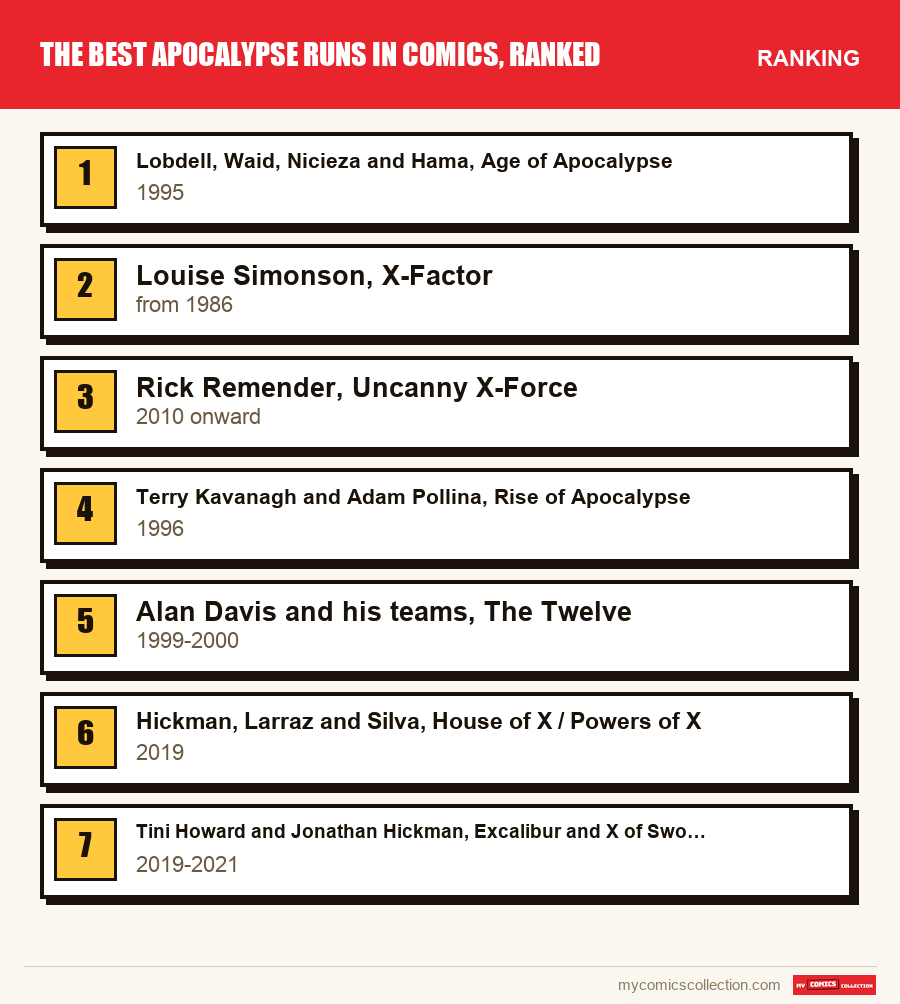
To read Apocalypse in order of interest, start with The Age of Apocalypse (1995), the universe where En Sabah Nur won, then Louise Simonson's X-Factor (from 1986), where he is born, and Rick Remender's Uncanny X-Force (2010 onward). Seven story blocks make up this selection, from the first pages of 1986 to the Krakoa nation, each with the recommended format: original issues or collected edition.
En Sabah Nur has rarely had a title of his own. He shows up in other characters' series, and his best material comes in sagas: a month of cameo, four months of parallel universe, an origin miniseries, a clandestine team arc. Ranking the "runs" of Apocalypse therefore means ranking blocks of story, not monthly collections. Here are our seven picks, with the reasoning behind each placement.
As always in this guide, only verified information (creators, issue numbers, dates) is stated as fact; the analysis is our own, with no reproduction of protected art or dialogue.
How we ranked these runs
A villain without a series of his own has to be judged differently from a hero. We put three questions to each candidate. Is Apocalypse the engine of the story, or just a menacing backdrop? Can a reader get into it without having read the previous ten years of the mutant franchise? And did this story change the way later writers handle the character? Sagas where he merely lingers in the background, like certain late-1980s episodes, were left out.
The rank reflects reading quality, not market value. On the X-Men shelves, the most sought-after copy is almost never the one that tells the character's story best, and the last part of the article treats the collecting side separately.
Top 1: Lobdell, Waid, Nicieza and Hama, Age of Apocalypse (1995)
The event starts from a time-travel accident: Legion, Charles Xavier's son, aims at Magneto and kills his own father. Without Xavier there are no X-Men, and En Sabah Nur rules North America. For four months the usual mutant series disappear and make way for parallel titles, opened by a prologue, Legion Quest, then by X-Men Alpha, and closed by X-Men Omega. The writers named above split the series between them; Joe Madureira, Andy Kubert, Steve Skroce and Chris Bachalo are among the artists.
This run takes first place because it turns the character from an obstacle into the law of an entire world: survival of the fittest becomes an institution, with internment camps, Horsemen in power and a resistance led by Magneto. It also produced lasting figures such as Blink, Nate Grey and Dark Beast. It suits any reader, since the whole thing is built to stand on its own.
For collecting, the question is scale: a dozen parallel series, each with its own number one, which makes a complete hunt a long one. Our feature on the event's number ones explains how to tell them apart. For reading, the collected editions of the full epic settle the reading order that the single issues scatter.
Top 2: Louise Simonson, X-Factor (from 1986)
It all begins with a last-minute rewrite. In X-Factor #5 (June 1986), a silhouette appears on the final page; in X-Factor #6 (July 1986), Louise Simonson and Jackson Guice present the character in full light. Simonson then moves him forward for years: the cult of the Horsemen, Angel's transformation into Death, and then the birth of Archangel. Walter Simonson takes over part of the series' art during this period.
The run matters because it fixes the definition of the character: a patient manipulator rather than a passing conqueror, who recruits mutants by making them believe he is setting them free. The whole edifice of Top 1 rests on this foundation. Be prepared for the pacing of the era: text-heavy pages, and a few nods to the X-Factor team that a newcomer will have to guess at.
The format depends on your goal. Most of the collecting stakes lie in the original issues, detailed in our entry on the first issue of X-Factor; for continuous reading, a chronological omnibus does the job nicely. Save the single issues for numbers 5 and 6.
Top 3: Rick Remender, Uncanny X-Force (2010 onward)
Rick Remender writes a clandestine squad tasked with killing before the danger breaks out: Wolverine, Psylocke, Archangel, Fantomex and Deadpool. Two arcs concern Apocalypse. In "The Apocalypse Solution," the team discovers the powerful adversary reincarnated as a child, and must decide whether taking him down is possible. In "The Dark Angel Saga," Archangel, who carries the cult's legacy, tips toward the role of a new Apocalypse. Jerome Opeña and Esad Ribić are among the artists who give the series its dark tone.
This run lands third because it flips the central question: it asks what becomes of an inheritance of cruelty when a child never chose it. It also gave birth to Evan Sabahnur, a character Jason Aaron later picks up in Wolverine and the X-Men. It suits the modern reader, has a clean ending and requires almost no prior reading. For an analysis of the whole series, see our article on Remender and X-Force.
On format, the collected editions gather the series in coherent volumes. The single issues, being more recent, are easy to find: the stake there is completing the series, not scarcity.
Top 4: Terry Kavanagh and Adam Pollina, Rise of Apocalypse (1996)
Four issues follow the child En Sabah Nur, left in the desert, raised by the tribal chief Baal, then forged by the brutality of those around him. The story crosses paths with Rama-Tut, one of Kang's identities, and with the astronomer Ozymandias, who will become his chronicler. Pollina's thin, angular line suits this ancient fresco.
It ranks fourth because it gives a canonical version of the origin, often cited by later writers, and because it reads in a single sitting. It is aimed at the reader already won over by Top 1, who wants to understand where such a radical doctrine comes from. The four issues complete each other with no variant to chase, which makes it one of the simplest sets on the list.
For the collection, the first issue is the one to hunt. Check the match between the exact title and the year before buying, since the 1995-1996 period is full of series with similar names. A collected edition exists for reading.
Do you collect this series?
Track what you own, what you're missing and what your collection is worth. 7-day trial.
Start my trial →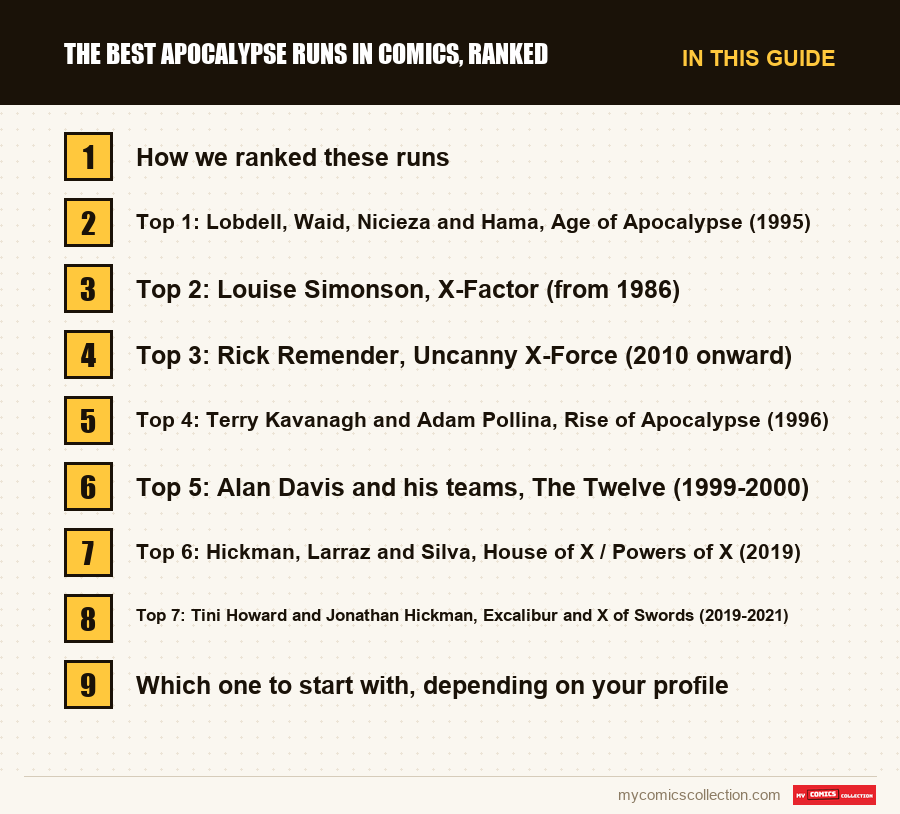
Top 5: Alan Davis and his teams, The Twelve (1999-2000)
Here, Apocalypse aims for godhood: he seeks to gather twelve exceptional mutants in order to absorb their power. The saga runs through the mutant series of the day, with Alan Davis's art as its most recognizable visual signature. It culminates in the conqueror's fusion with Scott Summers, a scene found in Uncanny X-Men #377 (2000) that opens the separation cycle which follows.
It counts because it ties the character to the Cyclops bloodline, already laid down in the Cable and Stryfe affair, and because it shows how far his ambition goes. It is aimed at the seasoned reader: the plot assumes familiarity with the early-1990s treasure hunt. The chapters are scattered from one series to another and the references vary by edition, so we give no opening or closing issue number here.
The collected edition is the best format here: chapters split across several titles are a pain to gather as single issues, and a complete collection is what keeps you from ending on a truncated conclusion.
Top 6: Hickman, Larraz and Silva, House of X / Powers of X (2019)
Two six-issue series are published in alternation: House of X, with pencils by Pepe Larraz, and Powers of X, handled by R. B. Silva. Jonathan Hickman writes the whole thing. Hickman founds the nation of Krakoa and seats Apocalypse among the members of the Quiet Council. The character stops being the outside enemy and becomes a pillar of the mutant government, which turns more than thirty years of reading habits upside down.
It earns its place because it offers a total counterpoint to Top 1: the man who preached war between mutants now sits at the table of peace. A reader can start at this point knowing nothing of the past, though the effect is stronger for those who know what the character did before. To find out which single issues of these two series really carry weight, rely on our entry on House of X and Powers of X.
These issues date from 2019, so their market value is not yet settled. What will move it depends on how long the Krakoa line lives on in the announced adaptations, and on the scarcity of first printings and alternate covers, which we do not detail for lack of certainty. The collected editions cover the whole thing.
Top 7: Tini Howard and Jonathan Hickman, Excalibur and X of Swords (2019-2021)
Tini Howard writes the Excalibur series, which explores the Otherworld and magic, and co-writes with Hickman the crossover X of Swords (2020). It is in this zone that Apocalypse's oldest past is unearthed: his first wife, Genesis, and their children, lost in the dimension of Amenth. The character becomes a grieving father as much as a tyrant.
This last place comes down to access: the story demands more context than the previous ones, since it sits in the middle of an architecture of linked series. It does reward the reader who has made it this far, though, because it gives new meaning to actions judged inexplicable until now.
As with Top 6, the recent period leaves the market value open. Collected editions are the natural format, and there is no point chasing single issues as long as a reading edition is what you are missing.
Which one to start with, depending on your profile
A reader who knows nothing about the X-Men and wants a single story will pick The Age of Apocalypse. One who prefers a tighter format with contemporary art will go for Uncanny X-Force. The origin-curious reader will chain X-Factor and then Rise of Apocalypse, two complementary reads. The reader following today's X-Men will head to House of X, then to the Excalibur arc. If you are after the link with the Summers bloodline, add The Twelve and the ranking of Cable runs. To widen out to the whole team, also see the ranking of X-Men runs.
What these runs are worth as collectibles
The economics of these seven sets are very uneven. The two 1986 issues concentrate most of the demand and are compared grade by grade; the 1995 series exist in abundance and only copies of exceptional quality stand apart from the pack. The recent periods are still open. Before buying a 1986 issue, build your benchmark on completed sales, never on asking prices, and treat a certified copy separately from a raw one: the comparison only makes sense at equal condition, over a span of several months. For reading, an omnibus often costs less than the sum of the single issues, but the two cannot be compared: they are two distinct objects, to be inventoried separately.
Frequently asked questions
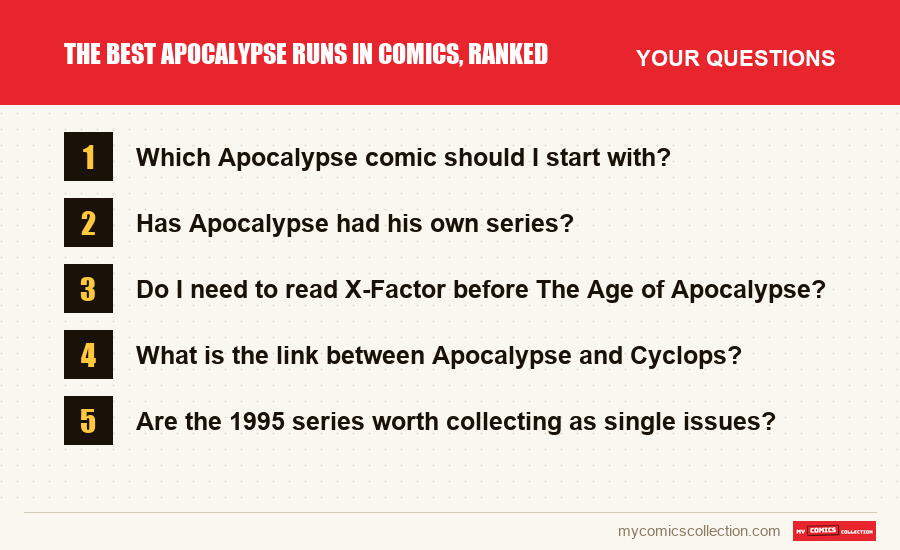
With The Age of Apocalypse (1995), designed as a whole: the Legion Quest prologue, the X-Men Alpha opening and the X-Men Omega conclusion. It shows a world built on the character's doctrine. For a shorter and more recent format, Rick Remender's Uncanny X-Force makes a solid entry point with no prerequisites.
Not a lasting series bearing his name. He lives in the mutant titles: X-Factor at his birth, the parallel series of 1995, then miniseries such as Rise of Apocalypse (1996). That is why his best material is shelved as sagas rather than numbered collections.
No. The 1995 event tells the story of an alternate universe and stands on its own. Reading Simonson's X-Factor afterward is even a pleasure: you see how a discreet manipulator of the 1980s becomes the master of a continent in the parallel world.
It runs through Cable, Scott Summers's son, whom the adversary infects and then sends into the future during the Stryfe affair, and then through The Twelve, which ends with Apocalypse's fusion with Cyclops in Uncanny X-Men #377 (2000). The ranking of Cable runs details this lineage.
For reading, a collected edition is enough. In single issues, the interest lies in the event's opening and conclusion, and in the number ones of the series that produced lasting characters. The rest was printed in large quantities: look for condition, not scarcity.
Do you have a 1986 X-Factor or a 1995 number one and want to pin down its condition before choosing between single issue and collected edition?
Estimate my comic