The 1995 event that replaced an entire series line for four months launched a dozen titles all starting at number one in the same month, and those number ones are wondering today starting at $1.00. As of August 29, 2026, the gross segment counts 110 listings, $1.00 to $250.00 asked, for a median of $9.04; the certified segment counts 15 listings, $29.99 to $425.00, median $95.00. A number one is only worth something if it's rare, and producing twelve of them simultaneously ensures that none will be rare.: to this is added a problem of lasting identification, several of these titles being homonyms of series launched later.
The number one is the only benchmark that all comic book buyers share, including those who don't buy them. It's also the only one that the publisher completely controls: you just have to stop a series and start another to make one.
The following describes what this device produced, what the statement of August 29, 2026 says, why simultaneity cancels the argument, how the confusion of homonymy arises, and what must be recorded so that a collection line remains readable ten years later.
What a complete line replacement produced
The 1995 device was no ordinary crossover. An ordinary crossover crosses series which continue to exist: the numbers keep their numbering, the event is inserted there, and the line resumes its course. Here, the current series were suspended and replaced, for four months, by a set of new titles located in a parallel world.
The editorial consequence is mechanical and was not an accident. Replacing an entire line requires opening as many series as closed, and each of these series necessarily opens with its first issue. Twelve suspended titles produce twelve new titles, therefore twelve number ones, all dated the same month.
From the point of view of the reader at the time, the effect is spectacular: an entire ray changes at once. From the point of view of the collectible market thirty years later, the effect is exactly the opposite, and that is the whole point of this article.
A number one draws its value from a conjunction: it is the entry point of a series which we did not yet know would last, so it was printed without knowing how many people would follow it, and the surviving copies are all the fewer in number because no one had any reason to put it aside. Each of these three sources assumes uncertainty. A number one announced, planned, grouped with eleven others and sold to an informed readership involves none of these uncertainties.
This is not a quality defect. These series have been read, they have been appreciated, and the event occupies a recognized place in the history of the line. But narrative attachment and market value do not obey the same calculation, and it is precisely the gap between the two that the survey makes visible.
What the August 29, 2026 statement says
The headings below were actually observed in the offering that day. These are asking prices, never concluded sales, and the gross segment is counted separately from the certified segment.
The dollar floor
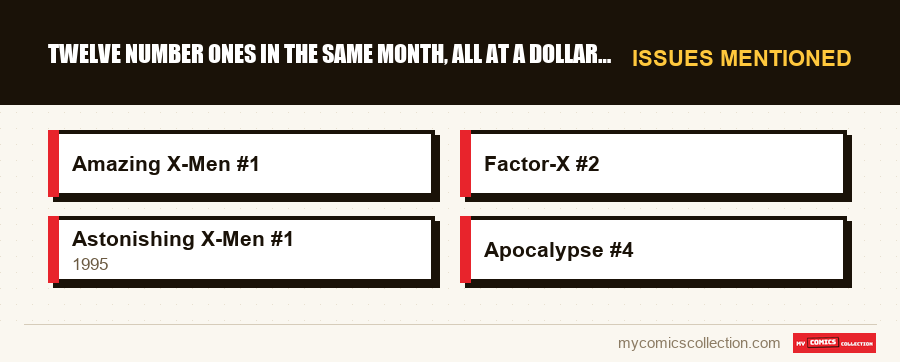
“Amazing X-Men #1 Newsstand Edition March of 1995” wonders $1.00. This is the lowest price in the entire raw segment, on a number one.
Same number, different edition
“The Amazing X-Men #1 Deluxe” wonders $1.81. Two distinct editions of the same number one coexist in today's offer.
A number two at the same level
“Factor-X #2” wonders $1.91, which is more than two of the number ones recorded. Rank in the series doesn't rank anything here.
Another two dollar number one
“Astonishing X-Men #1 (1995)” wonders $1.99, on the same level as “The Astonishing X-Men Age of Apocalypse #4”.
Asking prices observed on August 29, 2026. The raw segment has 110 listings, from $1.00 to $250.00, median $9.04. The certified segment has 15 listings, from $29.99 to $425.00, median $95.00. This is a snapshot of a single day: it describes the state of the offer on that date, and says absolutely nothing about an evolution, a trend or a direction.
The most telling fact of the reading is not the floor, it is the absence of difference. Of these four titles, two number ones, one number two and one number four all sit between $1.00 and $1.99. The rank of the issue in its series does not dictate the prices asked, which is enough to establish that the “number one” designation is not a price factor here.
The raw median of $9.04 is worth reading for what it is. She indicates that half of the day's offer was below this amount, in a population where the gross maximum nevertheless reached $250.00. The offer is therefore not homogeneous: a few announcements far above pull the average, without moving the center.
Why twelve number ones don't make twelve chances
Rarity is not a property of the booklet, it is a relationship between what exists and what is requested. A number one is rare when there are few left compared to the number of people who want one. Neither term is fixed in advance, but the publisher acts directly on the first.
A bulk output saturates both sides at once. On the supply side, twelve titles go simultaneously to the same points of sale and the same buyers. On the demand side, a reader cannot follow everything: he chooses, which distributes attention where a single series would have concentrated it.
A announced number one is a kept number one. When a launch is predictable and presented as such, it is knowingly purchased, often in duplicate, and put aside. The survival rate of copies is increasing, and the survival rate is another name for availability thirty years later.
A short series does not build rear demand. A number one becomes sought after when the series it opens has lasted, established itself, gained readers afterwards who want to return to the beginning. A series closed after a few issues has never had this return movement, due to lack of duration. You can read the whole thing through the story without ever going through the first installment of a particular title.
Substitutability completes the mechanism. Twelve series launched together tell the same world. They replace each other in the interest of a buyer, whereas an isolated number one has no substitute. A demand divisible between twelve objects does not constitute the price of any of them.
These four effects accumulate instead of canceling each other out, and it is this accumulation, not one of them in particular, which explains a raw median of $9.04 on August 29, 2026 in a population with a dozen number ones.
The rule can be summed up in one sentence: the value of a number one is inversely proportional to the number of number ones published at the same time as it.
This is not an opinion on the quality of the series concerned, it is an arithmetic consequence. Number one draws its strength from being a single point of entry; twelve simultaneous entry points into the same world are no longer points, they are a porte cochère. And what you can cross in twelve places cannot be paid for in any one.
The second problem: titles that no longer designate an object
The first problem is value, it is resolved by looking at a price. The second is identification, and it cannot be resolved at all: it gets worse over time.
Several of the titles launched in 1995 bear names that have since been reused for unrelated series, published much later, with other creative teams and numbering also starting from one. Saying "the number one of Amazing X-Men» or “the number one of Astonishing X-Men» therefore designates at least two different fascicles, and nothing in the formula allows us to know which one.
The reading of August 29, 2026 shows that the market is aware of this and compensates as best it can. Two of the titles observed add disambiguation to the title itself: “Astonishing X-Men #1 (1995)” specifies the year in parentheses, and “Amazing X-Men #1 Newsstand Edition March of 1995” goes so far as to write the month. A seller who must date his booklet in the title of his advertisement thereby recognizes that the title alone is no longer enough.
This compensation is unequal. A title like “The Amazing X-Men #1 Deluxe” names an edition without naming a year: it removes the ambiguity of edition and leaves that of series intact. Another, “The Astonishing
The result is an offer where the same object appears under several formulations and where several objects appear under the same one. This is exactly the situation that produces purchasing errors, unintentional duplicates and false inventories, and it is also what makes any price comparison conducted by title illusory.
The extra layer: multiple editions of the same issue
To the confusion between homonymous series is added, within the same series, the coexistence of several editions of the same issue. The statement gives the clear case: issue one of Amazing X-Men appears in the newsstand edition at $1.00 and in the deluxe edition at $1.81.
They are two distinct physical objects with the same number in the same series. They do not replace one another for a collector who is aiming for a specific edition, and they do not stand out in an inventory which only records the series and the number.
The asking price gap between the two: $0.81 on August 29, 2026: is not the point. The subject is that there is a gap at all, therefore that the distinction is carried by the market, therefore that an inventory which ignores it loses information which the offer has preserved.
This situation combines with the previous one in the worst possible way. A series with the same title, a number one, two editions: three axes of ambiguity which multiply instead of adding up. A line marked “Amazing X-Men #1” can correspond to at least four different objects, without any element of the line allowing a decision.
This is the point where the question ceases to be a market curiosity and becomes a practical problem of collection keeping. A single-axis ambiguity is resolved from memory; a three-axis ambiguity can only be resolved by a written note at the time of acquisition.
Collecting this series?
Track what you own, what you are missing and what your collection is worth. 7 day trial.
Start my trial →What the certified segment tells apart
The certified segment of the statement has 15 listings, from $29.99 to $425.00, median $95.00, on August 29, 2026. It should be read separately from the raw segment, not as its continuation upwards.
The certification moves the object sold. A verified copy is no longer just a booklet: it is a booklet whose condition has been noted by a third party and fixed in a box. The service has a cost, and this cost enters into the asking price regardless of what the booklet is worth.
The certified floor is the best indicator of the phenomenon. At $29.99 asking, the low of the verified segment sits well above the high of the low of the raw segment. This floor gap does not measure a difference in desirability between two fascicles: it mainly measures what the operation itself adds.
Fifteen ads do not form a population. On a workforce of this size, a median is a benchmark, not a measurement. One or two very well noted copies are enough to move it, and nothing in the statement makes it possible to distinguish what relates to the noted condition and what relates to the fascicle.
The headcount report is in itself information. 110 raw announcements compared to 15 certified on the same day: the proportion of copies deemed worthy of verification remains low. This fits with a set of abundant fascicles, where the operation only makes sense on the best states.
Again, none of this is a trajectory. A single day's statement gives the status of an offer at a moment in time, and two segments counted separately authorize no conclusion as to what one or the other was doing before, or what it will do next.
What this complicates in concrete terms
The difficulties are practical, and they manifest themselves at the time of purchase as well as at the time of classification.
Des titres homonymes
Several of these series share their name with series launched later, whose numbering also starts from one.
A year in the ad title
Some sellers date their booklet in the title, others do not: the same series can be searched in two ways.
Two editions of the same issue
Kiosk and deluxe coexist on the same number one, at $1.00 and $1.81 requested on August 29, 2026.
A rank that orders nothing
A number two is asked above two number ones in the same statement: the rank does not classify the prices.
The name of the event in addition
Some titles add the name of the event to the title of the booklet, others omit it entirely.
A series broken into twelve
The story is spread over a dozen titles, so no number one is enough to get into it.
What to record on a number one of this event
This type of acquisition requires recording what the title alone will never say, because the ambiguity here is not punctual but structural.
The year of publication, systematically, in the line itself. This is the only element that separates the 1995 number one from that of a series of the same name launched later. The market already does it, “Astonishing X-Men #1 (1995)” writes it in black and white, and an inventory that doesn't does it produces indistinguishable lines.
The exact edition of the booklet, newsstand or deluxe. The August 29, 2026 statement shows both in the same bid, at $1.00 and $1.81 asked. Without this mention, two different acquisitions become the same line and a real duplicate passes for a writing duplicate.
Membership in the event, noted separately from the title. Some announcements include it in the name of the booklet, which the cover does not do. Recording the attachment in a separate field allows you to find all twelve titles without depending on how a seller formulated his title.
The position of the fascicle as a whole, not just in its series. The story runs over a dozen parallel series; “Number one” doesn’t say where you are. Noting the title among the twelve, and not the isolated rank, is what makes the collection readable and allows gaps to be identified.
The asking price noted, with its date and segment. Nine dollars and four cents gross median, ninety-five certified median, August 29, 2026: these three elements (amount, day, segment) are only valid together. An amount recorded without its date can never be compared, and a gross amount compared to a certified amount compares two different objects.
Because there are twelve of them. A number one draws its value from being a unique entry point into a series whose duration was unknown; twelve simultaneous launches in the same world eliminate this uniqueness, saturate the offer, distribute attention and make each title substitutable for the eleven others. The August 29, 2026 statement gives a gross median of $9.04 across 110 listings, with a floor at $1.00.
By the year, never by the title. Several of these series bear a name reused later for unrelated series, also numbered from one. The market is already compensating: one title observed on August 29, 2026 writes “Astonishing X-Men #1 (1995)”, another goes up to the month. When a seller must date his booklet in his title, it is because the title alone is no longer enough.
No. These are two separate editions of the same issue in the same series, and the August 29, 2026 offering shows them side by side: $1.00 asking for the newsstand edition of Amazing X-Men issue one, $1.81 for the deluxe edition. The difference matters less than its existence: the market distinguishes the two, an inventory that does not distinguish them loses the information.
He doesn't change it, he reads it separately. Fifteen ads on August 29, 2026, from $29.99 to $425.00, median $95.00: certification adds to the asking price the cost of the operation and the observed condition, two things which are not the fascicle. Out of fifteen ads, a median is a benchmark, not a measurement, and it does not compare to the raw segment.
The statement does not provide an answer, and no one should pretend otherwise based on it. This is a single-day snapshot of asking prices and not completed sales: it describes the status of the offer on August 29, 2026, and does not contain any information on direction, past or future.
Twelve series, twelve number ones, only one line in your inventory?
Year, edition, title among the twelve: three mentions without which these issues become indistinguishable from each other.