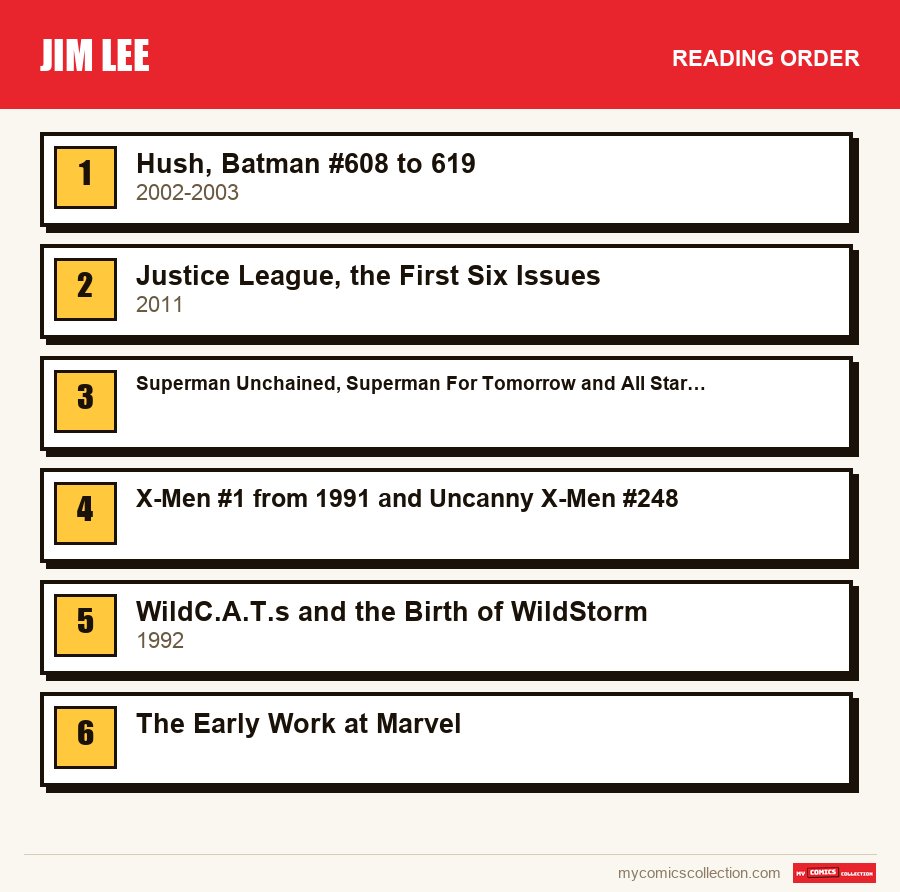
To read Jim Lee, open Batman #608 to 619 first, the Hush arc written by Jeph Loeb: twelve self-contained chapters with no prerequisites. Follow with the first six issues of Justice League (2011), then Superman Unchained and the collaborations with major writers. Then go back to X-Men #1 from 1991 and Uncanny X-Men #248, before the WildC.A.T.s debut at Image and his first work at Marvel. The path has six steps, from the most accessible to the most demanding.
Jim Lee is above all an artist: his name on a cover promises a line, a layout and a sense of spectacle more than a pen. That is what makes his work both easy to approach and misleading. Easy, because the pages read at a glance. Misleading, because the quality of the stories depends on who holds the script, and thirty-five years of career spread across Marvel, Image and DC do not form one continuous series.
As always in this guide, only verified information (creators, issue numbers, dates) is stated as fact; the analysis is our own, with no reproduction of protected artwork or dialogue.
There is no biographical account of Lee's career here, and this page does not replace one: it only lays out a reading route. The idea is to start with the stories you can follow knowing nothing, the ones that reach an ending and whose collected editions are easy to find, then climb toward the episodes that call for editorial context. The opening chapter of the most famous arc, Batman #608, has its own collecting guide devoted to Batman #608, to which we refer you for the question of variants.
Step 1: Hush, Batman #608 to 619 (2002-2003)
This is the obvious front door. The story starts with Batman #608, dated October 2002, and ends at issue #619: twelve chapters, script by Jeph Loeb, inks by Scott Williams, colors by Alex Sinclair. A kidnapping case leads Batman into the sewers of Gotham, face to face with Killer Croc, then the investigation widens to nearly the whole rogues' gallery, with Catwoman as the thread running through it. Superman crosses the arc in its middle, which gives Lee the chance to draw two icons side by side.
Why start here? Because the creative team stays the same from the first chapter to the last, which is rare for a monthly book of that era. You see Lee's line at full maturity: double-page framing, sharply cut silhouettes, dense gothic backgrounds. The plot reads like a mystery full of hidden compartments; some find it uneven, but nobody finds it unreadable.
Effort level: low. Twelve single issues or one collected volume, and no prior knowledge of Batman is needed beyond the name. To gauge the arc's weight within the series, the study on the value of Batman Hush details what is hard to find and what turns up everywhere.
Step 2: Justice League, the First Six Issues (2011)
In 2011, DC relaunched its entire line under the New 52 banner. The flagship title, Justice League, put Lee on art and Geoff Johns on script. The first six issues, collected under the subtitle Origin, tell the heroes' first meeting five years before the relaunched universe's present: Batman and Green Lantern meet, Superman is presented as a young hero still poorly accepted, and a threat from elsewhere forces everyone to cooperate.
This step follows the first for a simple reason: the story is even more self-contained than an arc of a regular series, since it starts from zero. It is also the best showcase for what Lee draws best, namely groups. Seven heroes per page, each recognizable by posture before you even see the color of the costume.
The editorial context deserves a sentence: that same year, Lee already held an executive post at DC, in tandem with Dan DiDio since 2010. This dual role partly explains why his signature appears on the most visible launch of the period. Effort level: low. Six issues, no prerequisites, widely available collections.
Step 3: Superman Unchained, Superman For Tomorrow and All Star Batman & Robin
Now it is time to set Lee against other writers. Superman Unchained (2013), written by Scott Snyder, runs nine issues and pits Superman against a planet-wide threat. Superman For Tomorrow (Superman #204 to 215, 2004-2005), written by Brian Azzarello, imagines a hero who fails to prevent the sudden disappearance of a very large number of people. The third title in the batch is All Star Batman & Robin, a series scripted by Frank Miller whose subtitle names the hero's young partner. It was published from 2005 to 2008 in ten issues.
This trio helps you grasp the artist's limits: an identical line, three different receptions. Unchained is generally appreciated for its graphic scale, For Tomorrow divides readers with its slow pace, and All Star Batman & Robin remains one of the most debated series of the decade, split between defenders of a deliberately over-the-top tone and baffled readers. None of the three is essential, but each sheds light on one aspect: brilliance, restraint and excess, respectively.
Effort level: medium. Each title asks for a small effort to buy into its writer's tone. Several of these stories got a large-format Absolute-type edition, which particularly flatters Lee's double-page spreads, but an ordinary collected edition is enough to judge.
Step 4: X-Men #1 from 1991 and Uncanny X-Men #248
Going back to the Marvel era requires knowing what you are getting into. Lee takes over Uncanny X-Men at issue #248, in 1989, alongside Chris Claremont, and it was during this period that Gambit made his entrance, in issue #266 of 1990, drawn by Mike Collins from a design Lee helped shape. Then comes X-Men #1, dated October 1991: script by Claremont, art by Lee, and a sales record that has not been beaten since. Several covers coexist, which complicates buying; the comparison of the five covers of X-Men #1 goes through them.
What this step brings: an understanding of where the 1990s aesthetic came from. The costumes, the poses and the dynamics of the mutant teams were set by these issues before being copied for ten years. What it demands: some familiarity with the X-Men, since the 1991 team inherits fifteen years of subplots. Someone who has never opened an issue of Uncanny X-Men can get lost, even though the first chapter of the 1991 series is designed as an entry point.
Which issues from those 1989 to 1992 years carry the most weight? The list of key X-Men issues gives the answer. Effort level: medium to high. The multiple covers and massive print runs of the period mean you must read the label on each copy before buying it.
Do you collect this series?
Track what you own, what you're missing and what your collection is worth. 7-day trial.
Start my trial →
Step 5: WildC.A.T.s and the Birth of WildStorm (1992)
In 1992, Lee was one of the seven artists who founded Image Comics after leaving Marvel. His studio, WildStorm, launched WildC.A.T.s, with Brandon Choi on script. The premise is a team of heroes born of a conflict between two alien races, set in a universe belonging to the independent publisher. The story of that split is told in the article on thirty years of Image Comics.
This step is more demanding than it looks. The art is very recognizable, but the WildStorm universe relies on characters you have not met elsewhere, and the series' first years reflect the era's taste for big teams. In return, you touch a pivotal moment: artists who became their own publishers. The WildStorm studio later joined DC in the late 1990s, and several of its characters entered that publisher's universe.
Effort level: medium to high. Reading works better with a collection of the series' early issues, while you sort out the roles. Period issues are easier to find than the Marvel ones, but you should tell first printings from later ones.
Step 6: The Early Work at Marvel
The last rung goes back to 1987-1989, when Lee drew his first issues for Marvel. Among them is Punisher War Journal, scripted by Carl Potts, where the line sharpens issue after issue. These are apprenticeship pages: interesting for the reader who wants to see how a style is built, less effective as stories.
They are for those who already enjoyed the previous steps and are looking for the origin. The interest is documentary more than narrative: you compare a 1989 Punisher with the 2002 Batman and see what fifteen years of craft changed. For fans of the character, the Punisher hub lets you place the series in its timeline.
Effort level: high, not because of reading difficulty but because collected editions are scarce. These issues are mostly read as single issues or in older omnibus volumes. Expect a heavier research effort than for the earlier steps.
How to Read: Single Issues or Collected Editions
The choice depends on what interests you about Lee. For the stories of the 2000s and 2010s, the collected edition is ideal: Hush and Justice League exist in many formats, and large-format editions give the double-page spreads the surface they demand. The article on omnibus editions versus original single issues details this trade-off between reading comfort and object value.
For 1989 to 1992, the logic partly reverses. The single issues of Uncanny X-Men and X-Men #1 were printed in considerable quantities, so they remain affordable to read, but the variants (multiple covers, special editions) make buying a specific copy trickier. A sensible method: read in a collected edition first, then buy single issues only for the episodes whose physical copy you want, with the exact cover checked.
One last habit: since Lee is an artist, print quality matters more than for a heavily written story. Yellowed paper or faded color hurts the reading of a highly detailed page more than that of a text. Look closely at the photos in a listing before deciding.
Summary: The Recommended Order
- Hush: Batman #608 to 619, with Loeb. Low effort.
- Justice League Origin: the first six issues of 2011, with Johns. Low effort.
- Superman Unchained, For Tomorrow, All Star Batman & Robin: Snyder, Azzarello, Miller. Medium effort.
- X-Men #1 (1991) and Uncanny X-Men from #248: with Claremont. Medium to high effort.
- WildC.A.T.s: the start of WildStorm at Image, with Choi. Medium to high effort.
- The early Marvel work: including Punisher War Journal, with Potts. High effort.
If you have to limit yourself to two reads, take steps 1 and 2: they fit in about twenty issues and give the measure of the artist in two registers, the Gotham noir and the team spectacle. If the line convinces you, continue in order; if not, stop there, because the later steps will not change your mind about the style.
Frequently Asked Questions
Start with Batman #608 to 619, the Hush arc, scripted by Jeph Loeb. It runs twelve chapters, reads with no prior knowledge and keeps the same team from start to finish. Then follow with the first six issues of Justice League, launched in 2011 with Geoff Johns.
Rarely. On the best-known stories, the script goes to Loeb for Hush, to Claremont for X-Men #1, to Johns for Justice League and to Snyder for Superman Unchained. Lee mostly contributes through the art, with a few plot or idea contributions in the early WildStorm days.
Largely yes: the first issue of the series was designed as an entry point. Some references to the team of the time remain opaque, but the action can be followed without a glossary. To fully enjoy what comes next, it is better to have read a few issues of Uncanny X-Men beforehand.
The early Marvel work and the first years of WildC.A.T.s: they take patience and a taste for the style of the 1980s and 1990s. It is better to come to them once Hush or Justice League has won you over, after deciding whether the line really appeals to you.
To read, collected editions: Hush and Justice League exist in many formats, including large-format editions that show off the double-page spreads. To own, the original single issues from 1989 to 1992 keep their appeal, as long as you check the exact cover before buying.
Do you have issues drawn by Jim Lee, from Uncanny X-Men to Batman Hush? Get them estimated for free before deciding whether to keep them or complete the set.
Estimate my comic