Avengers: Doomsday comes out on Friday, December 18, 2026 in the United States, two days after the United Kingdom, and Avengers: Secret Wars on December 17, 2027, exactly 364 days later. As of October 1st, 2026, that leaves eleven weeks. This calendar has been public since May 2025 and everyone reads it, sellers included. That is the central point of this article: around an adaptation, price movements are not random, they follow phases that can be dated. The strongest shock happens at the announcement, and Doomsday's dates from July 28, 2024: it has passed. The worst period for the buyer is release week, when supply, attention and urgency all peak at the same time. The useful window comes after, and the 2027 film shortens it.
There is a sentence you hear at every big movie release, and it proves true every time: "I bought right before the movie." It is almost always said with a touch of regret, because "right before the movie" is, statistically, the moment when the buyer is most rushed and the seller best informed. It is not a matter of luck or flair. It is a matter of calendar, and the calendar is written.
This article is therefore not about the comics themselves. It draws up no list of key issues, compares no first appearance, does not discuss the film's plot. It deals with one thing only: time. Which dates structure the eleven weeks that remain, on which dates the previous shocks occurred, what recent and documented adaptations let us deduce from that, and which move belongs to which week.
The thesis is simple and unpleasant: most collectors buy at the worst moment of the cycle, not out of ignorance of the market but out of synchronization with the promotional campaign. In other words, they buy exactly when the studio has spent hundreds of millions to make them think about it. Shifting your move by a few weeks requires no special skill: you only need to have the calendar in front of you, and to know what each phase does to supply.
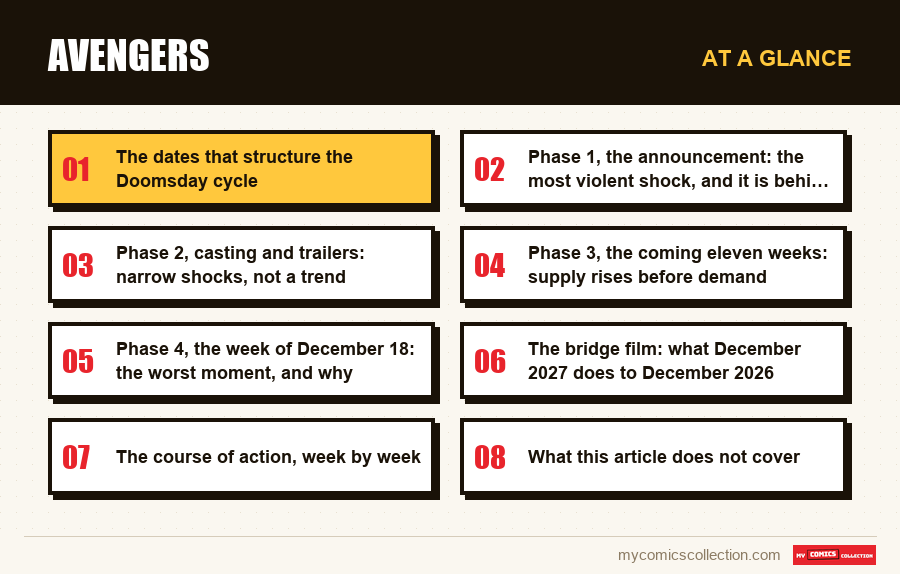
The dates that structure the Doomsday cycle
Here is the film's public chronology, in order. It serves as the backbone for the rest of this article, and each date is an official announcement or broadcast date, not an estimate.
- October 2014: Marvel Studios announces a two-part sequel, Avengers: Infinity War: Part 1 and Part 2. It is the structural precedent for the 2026-2027 duo, we come back to it below.
- July 28, 2024: at San Diego Comic-Con, the film changes its title to Avengers: Doomsday, Robert Downey Jr. is announced in the role of Doom, and the Russo brothers are confirmed as directors. This is the announcement shock.
- March 26, 2025: the cast is unveiled during a livestream of nearly five and a half hours, which becomes the most-watched operation of this kind across all platforms.
- April 28 to September 19, 2025: principal photography, mostly at Pinewood Studios in England.
- May 2025: the release is pushed from May 1st, 2026 to December 18, 2026, to give the production time. It is the project's second delay: in June 2023, the original May 2, 2025 date had already been pushed to May 1st, 2026, partly because of the 2023 writers' strike.
- December 2025: four short trailers play in theaters before screenings of another big end-of-year film. They leak from their first screenings, which the studio had anticipated, then are published online.
- April 2026: the first full trailer is presented at a trade show for movie theater owners.
- July 2026: this trailer is put online, with a mixed reception. Ticketing opens the same month and premium-format presales reach 16.5 million dollars in twenty-four hours.
- August 2026: a promotional segment centered on Doom, shown at Comic-Con then at the publisher's convention, gets a clearly better reception than the July trailer. Presales reach 35 million dollars by the end of the month.
- August 27, 2026: launch of an official countdown podcast, five weekly episodes reviewing the saga's previous films.
- Early September 2026: 50 million dollars in presales at one hundred days before release, a first for a film at this stage. The month is also that of a theatrical re-release of the saga's previous big gathering.
- December 16, 2026: UK release. December 18, 2026: US release, in more than 4,000 theaters.
- December 17, 2027: release of Avengers: Secret Wars, which concludes the phase and the ongoing saga.
Read this list a second time, asking at each line who had the information. The answer is always the same: everyone, at the same time, for free. None of these dates is privileged information. Yet they are the only thing a buyer really needs to avoid the two or three worst weeks of the year.
Phase 1, the announcement: the most violent shock, and it is behind us
The announcement of a film produces the most brutal information shock of the cycle, for a mechanical reason: it is the only moment when the news is entirely new and the available supply has not yet moved an inch. The copies in circulation on announcement day are those that circulated the day before, held by people who, for the most part, have not yet seen the news. Demand jumps, supply takes days or weeks to react. It is the widest gap of the cycle between the two.
Three recent, well-documented adaptations show how early this phase is. Shang-Chi entered scripting in December 2018, got its director in March 2019, and both its title and main cast were announced in July 2019: the film came out on September 3, 2021, more than twenty-five months after that announcement. Eternals was confirmed in development in April 2018, officially announced with its cast at the July 2019 Comic-Con, and released on November 5, 2021, more than twenty-seven months later. The series Moon Knight, announced at the publisher's convention in August 2019, arrived on March 30, 2022: thirty-one months.
In all three cases, the news arrived more than two years before the object. And in all three cases, the issues concerned were identifiable from announcement day, without the slightest investigation: Eternals #1 from 1976 for the 2021 film, and Werewolf by Night #32 from 1975, which carries the first appearance of Moon Knight, for the 2022 series. There was no subtle trade-off to make. Just act fast, or not.
For Doomsday, this phase is dated July 28, 2024, twenty-eight and a half months before release. What was to happen at that moment happened over two years ago. Whoever offers you today to "take advantage of the announcement" is describing a train that left in 2024. The good news is that the following phases do not work the same way at all, and that they, at least, are still ahead of us.
Phase 2, casting and trailers: narrow shocks, not a trend
After the announcement, the cycle does not climb a gentle slope. It advances in jolts, each pegged to a communication date, and each jolt is much narrower than people think: it concerns only what was shown.
The case of Endgame is the clearest. The first trailer, on December 7, 2018, revealed in one go the film's final title and its US release date. The second arrived on March 14, 2019, six weeks before the April 26 release. The promotion budget exceeded 200 million dollars, the highest of all the studio's films at that date. Two dates, two shocks of attention, and a volume of spending that explains the intensity of the whole. Deadpool & Wolverine followed a comparable pattern with a first trailer aired during the February 2024 Super Bowl, for a July 26 release. Thunderbolts* unveiled its own at the July 27, 2024 Comic-Con, for a May 2, 2025 release.
What matters, for a collector, is not that a trailer exists: it is what it shows and what it does not show. A trailer is a sort. The characters who appear enter the day's conversation; those who stay off-screen do not, even if they are in the credits. That is the mechanism explaining why two issues equally important on paper do not move the same way on the same date.
The Doomsday sequence illustrates exactly this point. The full trailer put online in July 2026 was received with mixed feelings. The August 2026 segment, centered on Doom, was clearly better received. Two pieces of the same campaign, five weeks apart, with very different effects on attention, one diffuse and the other concentrated on a specific character. For anyone following the market that summer, it is not at all the same thing, and it shows in the listings.
One detail of the setup deserves mention, because it is unusual: a countdown to the release date appears in the film's trailers. The studio does not merely create desire, it displays a deadline. A countdown is a conversion tool: it turns a dateless desire into a dated purchase. It works on movie tickets, and it works just as well on comics.
Phase 3, the coming eleven weeks: supply rises before demand
We are here. And it is the least understood phase of the five, because it contradicts intuition. As a release approaches, you imagine a market tightening, with copies growing scarce. The opposite generally happens first: it is supply that rises.
The reason is trivial. Sellers read the same calendar as you. They know attention will peak in December, they have read the same presale figures, and they list at that moment what they had been holding for months or years. A holder who had been hesitating since 2024 decides in November 2026, because they judge the peak is near. Tens of thousands of holders make this calculation at the same time.
The attention markers of this campaign are, moreover, public and quantified, which is rare: 16.5 million dollars of premium-format presales in the first twenty-four hours of July 2026, 35 million at the end of August, 50 million in early September at one hundred days before release. No film had reached this level at this stage. A rational seller reading these figures does not wait: they list.
Practical consequence, and this is the heart of the method: during these eleven weeks, watch the number of listings, not the asking prices. The number of listings is robust data, immediately observable, that nobody can disguise. Asking prices, for their part, say nothing: they are set by sellers anticipating December, not by transactions. Three signals are worth noting each week, in a notebook or in your collection tracker: how many copies of the same issue are offered, what is the gap between the cheapest and the most expensive listing, and how long the same listings have been online. A widening gap and stagnating listings mean one thing: supply has outrun demand.
There is a second supply effect, less visible and more decisive: editorial supply. A publisher seeing a big adaptation coming reprints. Marvel, for example, had published in January 2018, three months before Infinity War, a tie-in miniseries meant to bridge to the previous film. In the case of Moon Knight in 2022, the setup went much further: scannable codes inserted in the episodes gave free access to comics of the character, including Werewolf by Night #32 and #33, that is, precisely the issue newcomers would have sought to buy. The studio satisfied reading curiosity without a single physical copy changing hands. It is a brutal reminder: an adaptation creates many curious people, and a publisher knows very well how to serve them other than by sending them to the secondary market. Our file on the emergency reprint details what this editorial reflex does to an issue's real scarcity.
Phase 4, the week of December 18: the worst moment, and why
Release week concentrates everything that works against a buyer. Three mechanisms overlap, and they are independent of one another, which explains why they are underestimated: each seems bearable alone.
First mechanism: the deadline is yours, not the seller's. You want to own the comic before or just after seeing the film. The seller has no date. In any negotiation, the one with a deadline pays for the deadline. It is true in a collecting market as elsewhere, and all the more true when the deadline in question is displayed by a countdown in every trailer.
Second mechanism: asking prices align with the highest recent comparable. A seller posting a listing in release week looks at what was asked in the previous days, not at what sold. As everyone does the same, asks rise by simple copying, with no transaction validating the level. Asking prices and paid prices can then diverge durably, and it is exactly the week when this gap is widest.
Third mechanism: you cannot get out. Suppose even that you buy intending to resell at the peak. The processing time of a professional grading is counted in weeks or months, not days. A copy bought raw on December 18 will not be graded and resalable for quite a while, that is, after the attention peak. Buying in release week is buying the most expensive ticket for a train whose exit door is closed.
On top of that comes a hazard that, by construction, resolves only after release: the film's perceived quality. Eternals earned 402.1 million dollars worldwide and nonetheless became the first film of the saga not to receive a globally positive critical reception. The Fantastic Four: First Steps, released on July 25, 2025, received a globally positive reception for 521.9 million dollars. In both cases, the information arrived after the most rushed buyers had paid. That is the definition of a bad calendar: making an irreversible decision just before the decisive information becomes available.
Finally, let us point out a particularity of December 2026 that plays on the week's intensity: another very big film comes out the same December 18 and has a three-week exclusivity on a large-format projection in the United States. The studio responded by promoting its own premium theater certification. This has no effect on a comic's value, but it guarantees a considerable volume of media coverage around that precise date, therefore maximum attention and a maximum of synchronized buyers.
Phase 5, the months after: back to the starting point, or a higher plateau?
This is the only question that truly interests a long-term collector, and the honest answer is neither "it always falls back" nor "it always stays higher." The answer depends on a single criterion, verifiable after the fact: did the adaptation add a lasting reason to want this issue?
An adaptation can act in two radically different ways. In the first case, it serves as a temporary spotlight: the film passes, the curious pass, and the issue returns to the place it held, the one given by its age, scarcity and importance in the publisher's history. In the second case, it installs something: a character who durably enters the catalog, a version that becomes the visual reference, a new audience that stays. There, the issue does not return to its prior level, because the population seeking it has changed size.
The tiebreak happens over years, not weeks, and it is made not on prices but on observable facts: does the character return to the screen, does the publisher give them a regular series, is the film's version the one seen on covers and merchandise? Moon Knight is the example of a successful installation: the 2022 series was well received and the character kept existing. Eternals, despite a nine-figure box office, did not produce the same anchoring. In both cases, the finding could not be made release week.
For a buyer, the practical consequence is pleasantly simple. The most favorable buying window of an adaptation cycle comes after release, when the supply listed during the anticipation phase has found no taker and attention has fallen. Same copies, same sellers, and a vanished urgency. Our article on the fallout period describes, on an older editorial precedent, how long and little watched this phase is.
The bridge film: what December 2027 does to December 2026
Here, the case of Doomsday stops being a general case. This film is not an endpoint, it is a first part: Avengers: Secret Wars comes out on December 17, 2027 and concludes the phase as well as the ongoing saga. The gap between the two is 364 days.
There is a nearly exact precedent, and it is documented from end to end. The two films were announced together in October 2014 as Part 1 and Part 2. The first came out on Friday, April 27, 2018, the second on Friday, April 26, 2019: 364 days, exactly the same interval as between December 2026 and December 2027. And the intermediate period did not look like an ordinary fallout, because the first film ended on an unresolved situation. Attention did not drop, it was put on hold, then relaunched on December 7, 2018 by the trailer revealing the second film's title and date, that is, only seven and a half months after the first's release.
For anyone looking at the buying calendar, this pattern has three concrete consequences.
The post-release trough risks being shallower and shorter than usual. A release followed by a conclusion a year later does not let attention collapse. You should therefore expect a favorable window tighter than in a classic cycle, probably from early February to summer 2027, before the second film's campaign resumes.
The second film restarts a full cycle, with its own phases. If the 2018-2019 pattern repeats, the first Secret Wars trailer will land around summer or fall 2027, and a second about six weeks before release. Each will produce its own narrow shock, limited to what it shows. In other words, fall 2027 will resemble fall 2026: a period of rising supply and high attention, therefore unfavorable for buying.
A bridge film confirms nothing. The comics identified today as possible sources for the film will only really be validated or dismissed in December 2027. An element shown in 2026 without being used may only make sense a year later, and vice versa. Buying in December 2026 on the strength of what the first film hints is betting on reasoning half of whose premises will come out in twelve months. Our file on Secret Wars' inspiration and the one on the film's announced comic sources deal with this question of sources, which we deliberately leave aside here.
The course of action, week by week
Here is the action calendar for the eleven remaining weeks, then for 2027. It contains no price forecast, only dated moves.
October 1st to 18, 2026: take inventory before buying anything
First rule of the cycle: you do not know what you want to buy before knowing what you own. Eleven weeks before a big release, the most frequent and easiest-to-avoid mistake is to rebuy an issue already in the collection, or a reprint of an issue of which you already own another edition. First go through your relevant series in your tracker, and note not only the number but the edition and the printing.
Before November 1st, 2026: write a short list and a reserve price
Three issues at most, with for each a minimum accepted condition and a price above which you do not buy. Written, dated, before the maximum-attention phase. A ceiling set in October withstands December; a ceiling improvised in December withstands nothing. It is the only device that works against a countdown.
November 2026: record supply once a week, and buy nothing
For each issue on your short list, note on the same day each week the number of listings, the gap between lowest and highest, and the number of listings already present the previous week. In four readings you will have a supply curve, the only information nobody will give you elsewhere. It is also the month when you spot opportunistic listings, posted with December in mind.
December 1st to 17, 2026: abstain
The two and a half weeks before release combine the most abundant supply and the highest asks. If you absolutely must buy before seeing the film, do it at the very start of the month and on an already graded copy, whose condition does not depend on a description. Otherwise, the right decision is to do nothing.
Week of December 18, 2026: see the film, do not buy
It is the least favorable week of the cycle, for the three reasons detailed above: your deadline, the alignment of asks on the highest comparable, and the impossibility of getting out before the end of the peak. It is made for going to the movies, not for buying comics.
January 2027: let thirty days pass, and watch the flow
In January, attention drops but the supply listed in the fall is still there. Resume your November readings: listings that found no taker in three months are the most interesting, because their seller has had time to revise their target. It is the moment to write, not yet to pay.
February to July 2027: the window
On a normal cycle, this window would last until fall. With a conclusion scheduled for December 17, 2027, it will close earlier, as soon as the second film's campaign starts. It is within this interval that supply inherited from 2026 is most abundant relative to demand. If you buy only once in this whole cycle, buy there.
Fall 2027: close out, and do not replay the same mistake
From the first Secret Wars trailer, the cycle restarts with the same phases and the same traps, in an even more intense climate since it is a conclusion. If you held to the calendar once, the only thing to do is remember it: the week of December 17, 2027 will also be the worst of its year.
If you sell: take exactly the other end of the calendar
Everything above reads in mirror for a seller. The periods unfavorable to buying are those favorable to them, with one reservation and it is important: the anticipation phase attracts so many sellers that arriving late in November is arriving in a queue. To sell, the right moment is the start of the phase, not its peak.
What this article does not cover
By construction, this guide is only about time. It does not say what to buy, and that is deliberate: the "when" question has a documentable answer, the "what" question depends on what you already collect. For identifying issues, our other files are better placed: the key issues of Doom for the film's central character, the hub devoted to the character for all his articles, the distinction between partial and full appearance to know exactly what you are buying, and our analysis of the rise mechanism for the demand mechanics themselves. The X-Men and the Fantastic Four, strongly present in the cast, also have their own hubs.
One last note of method, since the subject is time. Everything above rests on public dates and dated precedents, not on a market prediction. If Doomsday were pushed back again, which has happened twice to this project, the whole calendar would shift as a block, but the phases and their order would remain identical. That is precisely the point of reasoning in phases rather than absolute dates: the structure survives the delay.