After the big event of 1992-1993, the publisher did not move on to anything else: he devoted almost an entire year to the consequences. During this fallout phase, the series concerned only tell a single subject: what the absence produced. It is an autonomous editorial object, with its function (to retain attention), its constraint (to be interesting while being only an expectation) and its residue: a mass of booklets printed at the top of the edition. On August 29, 2026, this segment displayed one hundred and twenty proposals from $1.95 to $350.00, median asking $7.97, and only two verified copies, between $91.99 and $254.95.
There is a reading habit which consists of treating a major event like a block: we read it, we put it away, we move on. This habit works poorly for what happened in 1992-1993, because the event itself represents only a fraction of what the editor actually published around it. The long part, the one that occupied the following months and filled the newsstand shelves for almost a year, is not the event. This is the fallout phase: the moment when the affected series stop telling a confrontation to tell an absence, and where this absence itself becomes the main subject of several simultaneous titles.
This phase is rarely treated for what it is. It is mentioned as a transition, an interval, a bridge between two states. It deserves better, because it was designed, calibrated and executed as methodically as the peak that preceded it, and because it explains much of what a collector finds today in bins and in online ads. Looking at the fallout phase as an autonomous editorial object, with its own production rules, completely changes the reading of the segment.
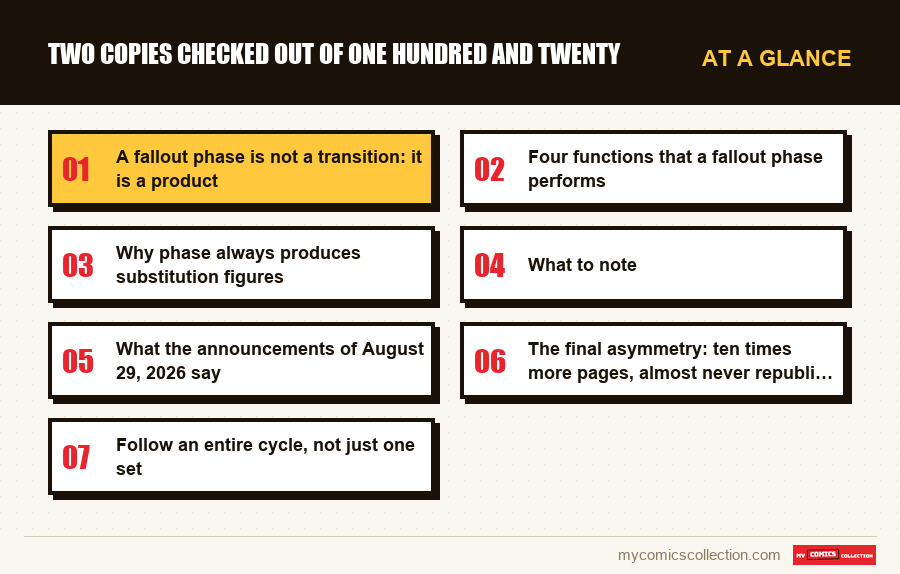
A fallout phase is not a transition: it is a product
A publisher who has just successfully completed an event finds himself in a paradoxical position. It attracted enormous attention, well beyond its usual readership: people who did not buy booklets bought them, points of sale which did not order them ordered them. This attention is real but it is unstable: it was caused by a spike, and a spike, by definition, does not recur the following month. The question then is not “what to tell next?” » but “how can we prevent this audience from leaving as quickly as it came?” ".
The response chosen in 1993 was not to return to normal. Rather than resuming the ordinary course of the series (which would have signaled, in a single delivery, that the parenthesis was closed) the publisher extended the exceptional state. The affected headlines continued to talk about the same thing, together, for months. The reader who came for a moment found himself in front of a system which continued to run, and which offered him several linked issues each month rather than just one. That's the whole mechanic: transforming an exceptional purchase into a monthly habit, before the exception wears off.
Four functions that a fallout phase performs
Extend the attention captured
The peak brings occasional buyers. The trickle-down phase gives them a reason to come back the next month, and the month after that. It extends over time an interest which, left to itself, would disappear in a few weeks. This is its primary function, and it is purely commercial before being narrative.
Convert a peak into a habit
A reader who buys a booklet makes a one-off gesture. A reader who buys four a month for eight months has formed a habit. The impact phase is the conversion mechanism: it occupies the calendar long enough for the purchase to become routine rather than eventful.
Delay the return to normal
Any resumption of the ordinary course disappoints, because it admits that the exception is over. Postponing this moment for several months allows the habit to first be established, and then the return to normal to coincide with an already loyal readership. Delay is a protection.
Occupy the ground on several titles
A single title is not enough to last a year. By distributing the consequences over several series published in parallel, the publisher multiplies the presence on the shelves, increases the number of references ordered by the points of sale, and makes the event visible everywhere at once rather than in one place.
These four functions reinforce each other, and this is what gives the impact phase its product coherence. It is not an improvised filler between two strong moments: it is a construction in which each parameter (the duration, the number of titles, the pace of publication) meets a retention objective. We can judge it to be successful or not, but we cannot read it as an accident.
The constraint specific to this phase is almost insoluble on paper: it must be interesting while being, by construction, an expectation. A reader knows, from the first delivery, that the exceptional state will not last indefinitely. He therefore reads something whose provisional nature he already knows.
The whole art consists of making this waiting habitable: dense enough that we want to stay there, open enough that exit remains possible at any moment. It's a balancing act, and it explains most of the editorial choices of the period, including the most criticized.
Why phase always produces substitution figures
You must fill the vacant role
A series built around a central figure cannot remain empty for very long. Someone has to occupy the boxes, make the decisions, carry the blankets. Substitution is not an aesthetic choice: it is a monthly manufacturing necessity.
The calendar doesn't stop
Titles are released on a schedule set well in advance, regardless of the state of the plot. Each month must produce pages. Substitution is what makes it possible to keep this schedule without returning prematurely to the previous situation.
Replacements are intended as temporary
A substitution figure cannot be too successful: if it became essential, a return to normal would become impossible. It is therefore calibrated to be interesting without being irreplaceable: which dooms its longevity in advance.
Several figures are better than one
Distributing the substitution between several titles avoids betting everything on a single proposition and allows different directions to be tested in parallel. This is also what mechanically multiplies the number of issues produced over the period.
The draw is still at the top
These booklets come out just after the peak, when orders from points of sale are still based on the previous euphoria. They are therefore printed in very large quantities, often well beyond what actual demand will subsequently justify.
They contain neither the beginning nor the end
The reader who seeks the starting point finds it in the event; he who seeks resolution finds it afterwards. The environment is not claimed by anyone in particular, and this is precisely what the fallout phase has produced en masse.
Collecting this series?
Track what you own, what you are missing and what your collection is worth. 7 day trial.
Start my trial →What to note
The fallout phase is an editorial subject, not an interval. It has an assigned function, retaining an audience captured by a peak, a calculated duration, a distribution between titles decided in advance, and a planned release. Treating it as a simple in-between means ignoring the most voluminous part of what the publisher actually published around 1992-1993. On printed pages, it weighs a multiple of the event it prolongs.
Its constraint is structural and no one has ever really resolved it. A fallout phase must focus attention on a state that everyone knows is temporary. It cannot conclude, otherwise it will end too soon; nor can it stand still, under penalty of losing the reader. The solutions adopted (multiplying the tracks, increasing the tension without releasing it, opening parallel directions) are responses to this constraint, and they recur each time an editor finds himself in the same position.
The substitution figures are a mechanical effect, not a weakness of inspiration. As soon as a central role becomes available and the release schedule continues, someone must fill it. And since the return to the previous state is planned, this replacement is designed with an expiration date. To blame these figures for not having lasted is to blame them for having done exactly what they were created to do.
The drawdown for the period does not reflect the demand for the period. Spinoff booklets were ordered by outlets on the basis of prior enthusiasm, not their own appeal. The result is a lasting abundance: these issues circulate in quantity, are found in batches, and have never experienced scarcity. This is a manufacturing characteristic, independent of the quality of what they contain.
On August 29, 2026, this segment displayed one hundred and twenty proposals online and only two verified copies. Amounts claimed for unverified listings ranged from $1.95 to $350.00, with a median requested of $7.97. The two listings checked were priced between $91.99 and $254.95. On two copies, no verified median means anything, and these amounts must be read for what they are: prices displayed by sellers, never recorded transactions.
What the announcements of August 29, 2026 say
Two copies verified out of one hundred and twenty proposals: this is the clearest signal that a collection segment can send. Third-party verification has a cost, and that cost is only incurred when the seller believes it will be recouped upon resale. Here, one hundred and eighteen sellers out of one hundred and twenty implicitly concluded the opposite. This is not a judgment on the content of these fascicles; it is an economic observation on what the market is ready to recognize as worth expertise.
The second lesson is even more revealing of the nature of the phase. The cheapest offerings: those between $1.95 and $2.00: are not all the same: they come from four different series. This is exactly the signature of what we have been describing from the beginning. The fallout phase is not focused on one title; it is split between several, published in parallel. We therefore do not find one cheap booklet, but a set of cheap booklets spread over four separate labels.
The difference between the bottom and the top of the unverified range, from less than two dollars to three hundred and fifty, does not describe a progression, nor a hierarchy of value. It describes a dispersion of seller expectations. The asking median of $7.97 places the center of gravity of what sellers hope to obtain, far from the displayed maximum. An isolated maximum reflects the hope of a seller, nothing more; it says nothing about what anyone paid. These numbers are a snapshot of a single day, and they describe requests, not sales.
The final asymmetry: ten times more pages, almost never republished
This is where the reading of the fallout phase as an editorial object leads. The 1992-1993 event is republished indefinitely. It is available in all forms, in all formats, reissued for every anniversary and every commercial occasion. A reader who wants to read it today has no difficulty in doing so, and can choose between several editions.
The fallout phase is almost never republished. It is longer, more voluminous, it represents a multiple of the pages of the event, and it is precisely this mass which condemns it. Re-editing a peak is simple: an object, an entry point, a conclusion. Republishing a year's worth of consequences spread across several titles requires a considerable volume, a reconstitution of reading order, and a bet on a public that demands the middle of a story of which it already has the beginning and end.
The asymmetry is therefore total, and it is instructive. What the market preserves and puts back into circulation is not what has been published the most: it is what is easiest to repackage. The long part remains in its original form, in fascicles, in abundant quantities, at prices that no one considers worth checking. It is simultaneously the most available and the least in demand: two properties that, contrary to popular belief, go together.
For a collector, this asymmetry is useful information rather than a cause for discouragement. It indicates where the accessible content is located, and it reminds us that the value of a set is not read in the price of its parts but in its completeness. A fully reconstituted spinoff cycle, with its four series and their respected release order, is a cohesive item that very few people own: not because it's expensive, but because no one bothers to put it together.
Almost a full year after the 1992-1993 event. It is this duration that distinguishes it from a simple transition of a few deliveries: it occupied the editorial calendar long enough to constitute a cycle in its own right, with its own rhythm and its own internal logic.
Because they were printed at the peak of the print run. Point-of-sale orders were still stuck on the euphoria of the previous peak when these numbers came out. Production has therefore far exceeded real demand, and this initial abundance is found intact in current circulation.
That almost no seller believes that a paid expertise would be profitable on resale. It is an indicator of perception of the segment by those who sell it, recorded on August 29, 2026. With only two copies verified, no central value can be drawn from it, and the amounts observed remain asking prices.
No, the event is sufficient in itself: this is even its main quality, and the reason why it is constantly republished. The fallout phase answers another question: what the absence produced in each of the series involved. We read it for that, not to complete the pic.
By reasoning by cycle rather than by series. The challenge is to know, at any time, which issues of which series make up the set and which are still missing. Monitoring at the cycle level avoids late discovery that a title has been forgotten for several months of publication.
Follow an entire cycle, not just one set
My Comics Collection allows you to put together a cycle spread over several titles, to immediately see what is missing and to follow its completeness over the course of acquisitions.