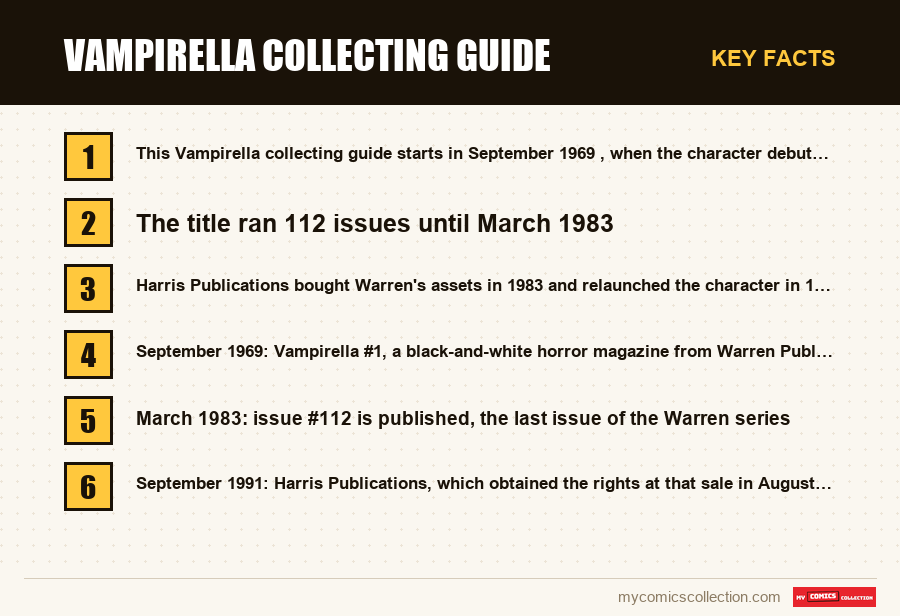
This Vampirella collecting guide starts in September 1969, when the character debuted in the black-and-white magazine Vampirella #1 from Warren Publishing, created by Forrest J Ackerman, with a costume designed by Trina Robbins. The title ran 112 issues until March 1983. Harris Publications bought Warren's assets in 1983 and relaunched the character in 1991, then Dynamite Entertainment acquired the rights in 2010 and relaunched the series with a #1 in November 2010, followed by a new #1 in April 2026.
Vampirella is one of those characters whose collection reads in three layers: a 1970s magazine, comics from the Harris period, and then the Dynamite series. Each layer has its own format, tone, and landmarks, and mixing one up with another is the classic mistake of the beginning buyer.
This guide relies on the publishing history as it emerges from specialist encyclopedias, the comics press, and Dynamite's announcements; the collector's reading (what to aim for, what to check, how to store it) is our own analysis, with no price estimates.
What happened
Vampirella's history comes down to four pivotal dates, and each one corresponds to a change of publisher or format.
- September 1969: Vampirella #1, a black-and-white horror magazine from Warren Publishing, sister to the titles Creepy and Eerie.
- March 1983: issue #112 is published, the last issue of the Warren series. The company ceases operations the same year and its assets are sold at auction.
- September 1991: Harris Publications, which obtained the rights at that sale in August 1983, relaunches the character with the miniseries Vampirella: Morning in America.
- 2010: Dynamite Entertainment acquires the rights (March 17, 2010) and publishes a new #1 in November of the same year.
Since then, Dynamite has multiplied series, miniseries, and crossovers, up to a new #1 in April 2026 by Christopher Priest and Davis Goetten, which also carries issue #688 in the historical numbering. This double numbering makes reading a recent cover less obvious than it seems.
Point 1: the Warren period, 1969 to 1983
Forrest J Ackerman is credited with creating the character, and Trina Robbins designed the original costume and hairstyle. At the start, Vampirella is a host, in the manner of Uncle Creepy and Cousin Eerie in the publisher's two other titles: she introduces short horror stories without being their heroine. The cover of issue #1, dated September 1969, is by Frank Frazetta, who replaced a cover first planned by Aslan. Tom Sutton draws the character's first stories there.
The editorial turn is attributed to Archie Goodwin. As editor and writer, he made Vampirella the central character of the magazine in the early 1970s, after a period when she was only a hostess, by giving her an origin and a mission. José González then became the series' main artist, starting with issue #12, and his line remains associated with the whole period. Over the years, several people succeed one another in the editorial chair: Bill Parente at the start, then Archie Goodwin, Billy Graham, Bill DuBay, and Louise Jones.
Warren also published an annual in 1972 and, in 1977, a special issue reprinting José González stories in color. Both publications fall outside the regular series.
For a collector, remember the format: it is a magazine, larger than a standard comic book, printed on magazine paper. A copy goes in a bag and backing board made for magazines, not in standard comic sleeves. Our guide on keeping comics in good condition details the supplies, the risks of acidity, and upright storage.
Point 2: Harris Publications and the 1990s
Warren's bankruptcy does not end Vampirella. In August 1983, Harris Publications bought Warren's assets at auction, Vampirella among them, and relaunched the character in September 1991; its 1990s series revise her origin and make her the daughter of the demon Lilith. The original magazine thus gives way to a series of comics in the classic format.
The 1990s are the years of multiplying titles. Among the dated landmarks worth citing: the miniseries Vampirella: Morning in America, four issues from September 1991 to April 1992, written by Kurt Busiek with art by Louis La Chance; Vengeance of Vampirella, twenty-five issues from April 1994 to April 1996, with Tom Sniegoski writing; Vampirella Strikes, seven issues from October 1995 to October 1996, which brings together several writers including Mark Millar; and Vampirella Lives, three issues from December 1996 to February 1997, by Warren Ellis and Amanda Conner. The Mark Millar page gathers the rest of his work.
Harris also multiplied crossovers: Vampirella vs Pantha in March 1997, then several meetings with Chaos! Comics heroines, including Vampirella/Lady Death in February 1999 and Lady Death vs. Vampirella in March 1999.
A legal episode closes the period. In 1999, James Warren, founder of the original company, recovered the rights to Creepy and Eerie through a lawsuit; the rights to Vampirella stayed with Harris until they were transferred to Dynamite.
On the collecting side, the Harris period is where telling issues apart becomes hardest: several parallel series, #0 issues, multiple-cover editions, and miniseries all share the same editorial line. To find your way, the rule is simple: write down, for each copy, the exact title, the issue number, and the year, rather than relying on the character's name alone.
Point 3: Dynamite Entertainment, 2010 to today
Dynamite Entertainment acquired the rights to Vampirella on March 17, 2010 and relaunched the series with a #1 dated November 2010. The script is by Eric Trautmann, the art by Wagner Reis, with a bonus story by Jeph Loeb and Tim Sale. The publisher announced four equal-share covers, by J. Scott Campbell, Alex Ross, Jelena Kevic-Djurdjevic, and Joe Madureira, as well as an original-art variant by Alex Ross, at a ratio of 1 for 21. Alex Ross has his own page: Alex Ross, creator.
What follows is a succession of series. Vampirella and the Scarlet Legion (five issues, from May to October 2011) is written by Joe Harris. Vampirella vs. Dracula runs from January to August 2012. In 2016, Kate Leth and Eman Casallos launch a series with a new costume; in 2017, Paul Cornell and Jeremy Whitley take up the torch.
The fiftieth anniversary, in 2019, is marked by a twenty-five-issue series by Christopher Priest and Ergun Gunduz, running from July 2019 to November 2021; in parallel, Tom Sniegoski's Vengeance of Vampirella runs for twenty-five issues from October 2019 to December 2021. Other titles follow: Vampirella vs. Purgatori in 2021, the five-issue miniseries Pantha in 2022, Vampirella vs. Red Sonja from November 2022 to March 2023, and Vampirella vs. the Superpowers in 2023.
Finally, a new Vampirella #1 comes out in April 2026, written by Christopher Priest, on the series since 2019, and drawn by Davis Goetten. The plot follows Draculina, who has lost her Vampiri powers and the child she had taken from Vampirella. The main cover is by Lucio Parrillo, and variants are by Derrick Chew, Joseph Michael Linsner, and Elias Chatzoudis. Dynamite notes that this issue carries the number 688 in the historical numbering, and that issue #700 looms about a year away.
Dynamite also reprints the Warren-period stories in archive volumes. For anyone who wants to read the beginnings without hunting for the original magazines, this is the simplest route, and it protects fragile copies.
Do you collect this series?
Track what you own, what you are missing and what your collection is worth. 7-day trial.
Start my trial →
Point 4: the key issues to look for
This list covers only issues whose date and content are established; it says nothing about their market value, which we do not put figures on.
- Vampirella #1 (Warren, September 1969): the start of the series, with a Frank Frazetta cover and stories drawn by Tom Sutton.
- The Archie Goodwin issues (Warren, from 1970): the period when Vampirella stops being a hostess and becomes the heroine of her own stories.
- Vampirella annual (Warren, 1972): a publication outside the regular series.
- Vampirella #112 (Warren, March 1983): the last issue of the original series.
- Vampirella: Morning in America (Harris, 1991 and 1992): a four-issue miniseries by Kurt Busiek, a landmark of the Harris period.
- Vampirella #1 (Dynamite, November 2010): the launch of the Dynamite era, with four equal-share covers.
- Vampirella #1 (Dynamite, April 2026): the Christopher Priest and Davis Goetten relaunch, issue #688 in the historical numbering.
These landmarks are enough to build a reasoned collection. The first issues are the most exposed to false trails: the 1969 #1 is a magazine, the 2010 one a comic book, and the 2026 one a relaunch that already has an issue #688. Always write the publisher and the year next to the number. To understand what makes an issue a landmark, see our explanation of what a first appearance is.
What this means for a collector
Choose your layer. A collector of the Warren period works with magazines more than forty years old, where the condition of the paper comes first. A collector of the Dynamite period works with recent comics, where the challenge is choosing the right cover. Mixing the two makes the collection less readable.
Read the cover as two numbers. Since 2026, Dynamite's cover shows the series' #1 and its historical number. When you add a copy, write down both, or you risk buying again a title you already own under another number.
Check the multiple covers. The 2010 #1 exists in four equal-share covers and in ratio variants, and the 2026 relaunch adds variants by Parrillo, Chew, Linsner, and Chatzoudis. Decide in advance which cover you want, and check that it matches the copy you receive.
Photograph the condition. For an old magazine, document the spine, the corners, and the paper on receipt, with a dated photo; our collection photography guide shows which angles are useful.
Store by format. A Warren magazine and a Dynamite comic are not the same size. Choose bags and backing boards sized exactly to each item, stored upright in a dry cabinet, away from the window. Yellowed paper cannot be fixed: protection must come before deterioration.
Avoid the short-story trap. The covers that celebrate Vampirella are often better known than the stories themselves. Reading a few episodes from the Goodwin period, or Dynamite's archive volumes, gives a more reliable idea of what you are collecting than a cover image alone.
What remains to be confirmed
The current series moves fast, and this guide stops at the information published by the publisher. A release date can move, and several points have not been announced:
- the exact date of issue #700 in the historical numbering, mentioned as an upcoming milestone with no precise schedule;
- the number of issues planned in the 2026 series and the creative team that will carry it on;
- future Dynamite crossovers and miniseries around Vampirella;
- the next archive volumes devoted to the Warren period;
- the collectible status of recent Dynamite issues, which no source has settled yet.
The landmarks of the Warren period, for their part, have been fixed for decades: the one variable left is the condition of the copy you hold in your hands.
Frequently asked questions
Vampirella was created by Forrest J Ackerman and appeared in Vampirella #1, a Warren Publishing horror magazine dated September 1969. Trina Robbins designed her costume, Frank Frazetta painted the cover of this issue #1, and Tom Sutton drew the first stories in it.
Dynamite Entertainment has published Vampirella since 2010, after acquiring the rights from Harris Publications on March 17, 2010. The latest launch is a new #1 dated April 2026, written by Christopher Priest and drawn by Davis Goetten, which also carries issue #688 of the historical numbering.
The Warren series has 112 issues, from September 1969 to March 1983. It is a black-and-white magazine, larger than a classic comic book. An annual appeared in 1972 and a special color issue in 1977, with stories drawn by José González.
There are three, depending on the period: the Warren magazine of September 1969, the Dynamite comic of November 2010, and the April 2026 relaunch. The choice depends on your collecting layer. In every case, write down the publisher and the year, then check the cover and the condition before buying.
Dynamite uses two numberings: a #1 for the relaunch and a historical number that continues the series' running count. The April 2026 #1 is therefore also issue #688. Always write down both to avoid duplicates in your collection.
A Warren magazine or a Dynamite #1 deserves an estimate based on its real condition: run one in a few minutes.
Estimate my comic