
A well-preserved comic can be worth ten times more than a neglected copy of the same issue. The state of preservation, the condition : is the first thing any serious buyer looks at before making an offer.
A well-preserved comic can be worth ten times more than a neglected copy of the same issue. The state of preservation, the condition : is the first thing any serious buyer looks at before making an offer. And yet, most collectors discover too late that their comics have degraded under improper conditions: humidity, heat, light, paper acidity... The enemies of a great collection are everywhere, but they can be fought with the right tools and the right habits.
This practical guide explains everything you need to know to keep your comics in the best possible condition, from choosing bags and boards to managing CGC slabs, including the environmental parameters to monitor.
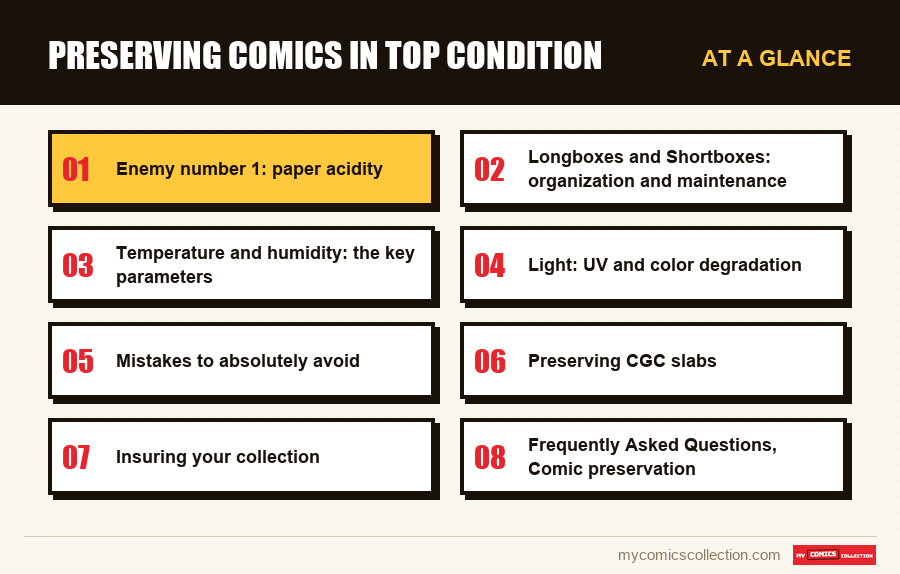
Enemy number 1: paper acidity
Comic book paper is made of cellulose. Over time, the chemical bonds in cellulose break down, a process called acid hydrolysis. This phenomenon is accelerated by heat, humidity, and the residual acidity of the paper itself. The visible result: progressive yellowing of the edges (tanning ), overall browning ( browning), and eventually, the weakening of the paper until it becomes brittle (brittleness).
Comics from the 1930s to 1970s are printed on pulp paper, with high acid and lignin content. That's why Golden Age and Silver Age comics degrade much faster than modern comics, which are printed on coated paper with a neutral pH. A Golden Age comic stored in poor conditions can show significant yellowing within a few decades. The first line of defense against this is using archival-quality bags and boards.
Key takeaway: Acidity transfers. An acidic comic placed in a regular bag or on a non-acid-free board will gradually "contaminate" its surroundings. Protective materials must be chemically neutral to break this degradation cycle.
Bags and Boards: which ones to choose?
The bag + board combination is the foundation of any comic's preservation. The bag protects against dust, surface moisture, and handling; the board keeps the comic flat and prevents creases and bending.
Choosing the right size
Comics have evolved in their dimensions over the decades. There are three standard sizes of bags and boards:
- Current Size (also called Modern): for comics published from the 1970s to today. This is the most common size.
- Silver Age Size: slightly larger, for comics published between the 1950s and late 1960s. Silver Age comics are about 1 cm wider than modern comics.
- Golden Age Size: the largest, for comics from the 1930s to 1950s, which are noticeably larger than later formats.
Polyethylene or Mylar?
Two materials dominate the comic bag market:
Polyethylene bags
The most common and least expensive. Standard-quality polyethylene bags provide adequate protection for a few years of storage. However, they degrade over time and should be replaced every 3 to 5 years. For an everyday collection, they offer good value for money. Choose "acid-free" or "archival quality" models.
Mylar bags (polyester)
Mylar is a chemically inert polyester film that emits no harmful gases and doesn't degrade for several decades. It's the solution recommended by conservation professionals and by CGC for valuable comics. Its only drawback: the price, about 3 to 5 times higher than polyethylene. Reserve Mylar for your key issues and most valuable comics.
Acid-free boards
Boards must absolutely be acid-free and preferably buffered (with a pH-neutralizing agent). Non-acid-free boards become acidic over time and accelerate the degradation of the comic they're supposed to protect, the opposite of the intended effect. Always check for the "archival quality" or "acid-free" label on the packaging.
Longboxes and Shortboxes: organization and maintenance
Once bagged and boarded, your comics need a suitable container for storage. Longboxes and shortboxes are the standard containers for comic collections.
A shortbox holds about 150 to 200 bagged and boarded comics; a longbox, 250 to 350. Shortboxes are easier to handle and move, a significant advantage if you need to relocate or reorganize regularly. Longboxes are more space-efficient for storage.
Cardboard longboxes
The least expensive but least durable. Cardboard absorbs moisture and can warp over time. Choose acid-free models and avoid placing them directly on a damp floor.
Plastic longboxes
More durable and resistant to surface moisture. They are heavier and more expensive but offer better long-term protection, especially in slightly humid environments.
Regardless of the material, always store your longboxes horizontally with the comics standing upright, never lying down with comics stacked flat, which creates pressure on the copies at the bottom and can cause warping. Don't fill longboxes to 100%: leave a few centimeters of space to make handling easier without damaging the bags.
Temperature and humidity: the key parameters
The storage environment is just as important as the protective materials. Two parameters are critical:
The ideal temperature is between 18°C and 22°C (64°F to 72°F). Above 25°C (77°F), the chemical degradation of paper accelerates significantly. An attic that reaches 35°C (95°F) in summer is a destructive environment for comics. Temperature stability is just as important as the level itself: sudden variations cause the paper to expand and contract, creating micro-tears invisible to the naked eye but that weaken the comic over the long term.
The ideal relative humidity is between 45% and 55%. Below 40%, the paper dries out and becomes fragile. Above 65%, the risk of mold skyrockets, and mold on a comic is virtually irreversible. Invest in a hygrometer ($15 to $30) to monitor the storage conditions of your longboxes, and add a dehumidifier or humidifier if needed.
Ideal storage conditions: summary
- Temperature: 18-22°C (64-72°F), stable
- Relative humidity: 45-55%
- Ventilation: light, no direct air current
- Light: darkness or indirect non-UV light
- Position: comics standing upright, never stacked flat
Collecting this series?
Track what you own, what you are missing and what your collection is worth. 7 day trial.
Start my trial →Light: UV and color degradation
Light, and particularly ultraviolet rays : is one of the main causes of color degradation on comic covers. A comic exposed to direct sunlight for a few weeks can show visible fading on its cover, especially in the red and green areas that are particularly sensitive to UV.
Fluorescent lights also emit UV, albeit at a lower level than direct sunlight. If you store your comics in a lit room, prefer LED bulbs (which emit little to no UV) and keep your longboxes away from any direct light. Display cases with built-in lighting should use UV filters, available from conservation specialists.
Mistakes to absolutely avoid
Some common practices are particularly harmful to comic preservation. Here are the main ones to eliminate:
- Rubber bands: they leave permanent marks on covers and embed into the paper with heat.
- Tilted stacks: tilted longboxes or comics stored at an angle create permanent cover bending (spine roll).
- The damp basement: ground moisture rises into cardboard boxes and promotes mold. Always place your longboxes on shelves or pallets, never directly on the floor.
- The attic in summer: temperatures can exceed 40°C (104°F), drastically accelerating paper degradation.
- Newspapers as padding: newspaper is extremely acidic and can contaminate your comics through contact or through the gases it releases.
- Eating or drinking while reading: grease and moisture stains are impossible to remove and permanently damage comics.
Preserving CGC slabs
Comics graded and encapsulated by CGC (or CBCS, PGX) benefit from superior physical protection thanks to their rigid plastic case. But slabs are not indestructible and deserve specific precautions.
The main vulnerability of slabs is their corners: an impact can crack or chip the case, making the slab non-compliant and requiring resubmission to CGC, a lengthy and costly process. Store your slabs in specially designed storage boxes (available from Gemini or specialty shops), never stacked loosely.
Slabs are also sensitive to significant temperature variations, which can cause condensation inside the case. Avoid any sudden thermal shock, for example, moving a slab directly from a hot attic to an air-conditioned room. Maintain the same temperature and humidity conditions as for your ungraded comics.
Insuring your collection
A well-organized and well-preserved collection can represent significant financial value, sometimes several thousand, even tens of thousands of dollars. This value deserves to be protected by appropriate insurance.
Most standard home insurance policies don't cover collectibles at their true market value. For adequate coverage, there are insurers specializing in collectibles who offer "agreed value" or "scheduled" guarantees, calculated based on a detailed inventory.
This inventory is the first step: each valuable comic should be photographed (cover, back, overall condition) and its estimated value documented. My Comics Collection lets you build this photo inventory issue by issue, with the estimated valuation based on current eBay listings, a valuable document to share with your insurer.
Frequently Asked Questions, Comic preservation
Inventory and value your collection
Photograph each issue, note its condition, and track its value, updated daily. My Comics Collection gives you a complete picture of what your collection is worth, essential for proper insurance and protection.
🚀 Free 7-day trial, No commitment