There is one question that every comic book collector has asked or wondered at some point: why is this issue worth so much? The answer, in the vast majority of cases, boils down to two words: first appearance.
There is one question that every comic book collector has asked or wondered at some point: why is this issue worth so much? The answer, in the vast majority of cases, boils down to two words: first appearance. The first time an iconic character sets foot in the printed universe is an editorial event that never happens again. And the market values it accordingly.
But the reality of first appearances in comics is more complex than it seems. It is not enough for a character to simply "appear" in an issue for that issue to become valuable. The collector community has developed a precise vocabulary -- 1st full, 1st cameo, 1st named, 1st cover -- that determines the hierarchy of key issues and, by extension, their market value.
What is a first appearance? The 4 types you need to know
The term first appearance refers to the first comic book issue in which a character exists. But this simplistic definition hides a much more nuanced editorial reality. Collectors, specialized guides, and auction houses distinguish four types of appearances, each with its own market value.
1st Full Appearance
The first complete appearance: the character is present, plays an active role in the story, and is usually named. This is the most valued type of first appearance and the one referred to when talking about a character's "key issue." Example: Amazing Fantasy #15 is Spider-Man's 1st full appearance.
1st Cameo Appearance
A brief, partial, or silhouette appearance with no active role. The character is present but not yet identified or named. Often found in the issue preceding the 1st full, the cameo is a key issue in its own right. Example: Incredible Hulk #180 is Wolverine's 1st cameo (the full appearance being in #181).
1st Named Appearance
The first time the character is called by name in a comic's text. Sometimes distinct from the 1st full appearance, particularly when a character appears in several issues before being officially named. Less valued than the 1st full, but considered a key issue by advanced collectors.
1st Cover Appearance
The first time the character appears on a comic book cover. Not necessarily the same issue as the interior 1st full appearance -- often a later issue. A 1st cover of an iconic character has its own value and is highly sought after for display collections.
Why first appearances are worth so much
The high value of first appearances in comics results from the combination of several market forces. Understanding these mechanisms not only allows you to accurately evaluate your own comics, but also to anticipate the next key issues that will skyrocket.
The MCU/DCU effect: demand multiplied by millions
The Marvel Cinematic Universe has radically transformed the first appearance market. Before 2008 and the first Iron Man film, Silver Age issues related to Iron Man mainly interested specialized collectors. Since then, every movie or Disney+ series announcement triggers a rush on the key issues of the characters involved.
The mechanism is simple: a Marvel announcement reaches millions of people, a significant fraction of whom seek to acquire the character's first comic. Demand becomes global and instantaneous. Supply, on the other hand, remains that of copies printed between 1938 and 1980, whose number available on the market never increases. Infinite demand, fixed supply: prices can only go up.
Rarity in good condition: the survival equation
Comics from the Golden Age (1938-1956) and Silver Age (1956-1970) were not considered valuable objects at the time of their publication. Children read them, dog-eared them, cut them up, and threw them away. Parents collected them for paper drives during World War II. Survival rates in good condition are extraordinarily low.
A comic printed in 200,000 copies in 1938 may have only 50 to 100 survivors in acceptable condition today. And among those, perhaps 3 or 4 in Near Mint (CGC 9.0+). This absolute rarity, combined with global demand, creates exceptional auction conditions.
Condition: the value amplifier
The difference in value between a copy in Good (2.0) and one in Near Mint (9.8) can reach a ratio of 1 to 100, or even more for the rarest issues. CGC grading has standardized this evaluation and secured the market. Result: collectors are willing to pay an enormous premium for a certified high-grade copy, because it guarantees absolute rarity.
To better understand the grading system, check out our CGC & Grading guide. And to track the grades of your own copies, use the CGC feature of My Comics Collection.
Original print run: not all Silver Age comics are equal
Contrary to popular belief, not all Silver Age comics had the same print runs. Some less popular issues were printed in very small quantities, making them inherently rarer than issues from flagship series. The combination of "low print run + character that became iconic" is the formula for maximum value.
The 20 most sought-after first appearances
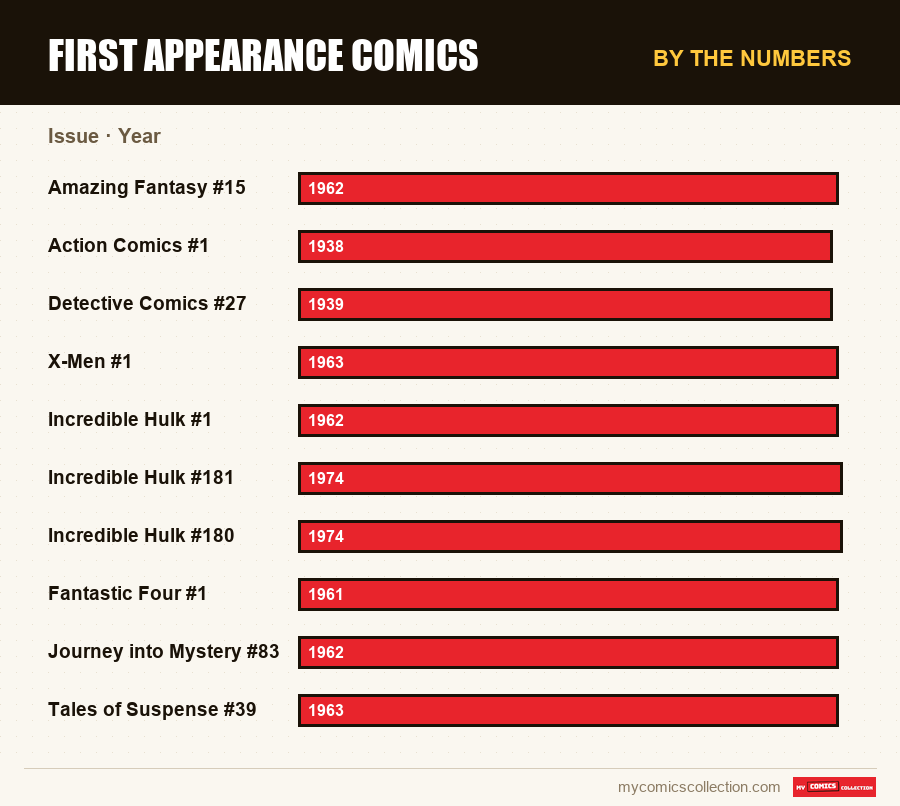
This table presents the 20 most valued first appearances on the current market. The CGC 9.8 prices listed reflect market estimates based on sales completed in 2024-2025. Since the market is volatile, these values are indicative.
| Issue | Publisher | Year | Character | Type | CGC 9.8 est. |
|---|---|---|---|---|---|
| Amazing Fantasy #15 | Marvel | 1962 | Spider-Man | 1st full | $3,600,000 |
| Action Comics #1 | DC | 1938 | Superman | 1st full | $6,000,000+ |
| Detective Comics #27 | DC | 1939 | Batman | 1st full + 1st cover | $1,500,000+ |
| X-Men #1 | Marvel | 1963 | X-Men (team) | 1st full | $800,000+ |
| Incredible Hulk #1 | Marvel | 1962 | Hulk | 1st full | $490,000+ |
| Incredible Hulk #181 | Marvel | 1974 | Wolverine | 1st full | $20,000+ |
| Incredible Hulk #180 | Marvel | 1974 | Wolverine | 1st cameo | $9,000+ |
| Fantastic Four #1 | Marvel | 1961 | Fantastic Four | 1st full | $300,000+ |
| Journey into Mystery #83 | Marvel | 1962 | Thor | 1st full | $250,000+ |
| Tales of Suspense #39 | Marvel | 1963 | Iron Man | 1st full + 1st cover | $180,000+ |
| New Mutants #98 | Marvel | 1991 | Deadpool | 1st full | $4,500+ |
| Giant-Size X-Men #1 | Marvel | 1975 | Storm, Colossus, Nightcrawler | 1st full (multiple) | $18,000+ |
| Strange Tales #110 | Marvel | 1963 | Doctor Strange | 1st full | $32,000+ |
| Amazing Spider-Man #300 | Marvel | 1988 | Venom | 1st full | $3,000+ |
| Batman Adventures #12 | DC | 1993 | Harley Quinn | 1st comics appearance | $5,000+ |
| Walking Dead #1 | Image | 2003 | Rick Grimes | 1st full | $8,000+ |
| Amazing Spider-Man #14 | Marvel | 1964 | Green Goblin | 1st full | $40,000+ |
| Fantastic Four #48 | Marvel | 1966 | Galactus + Silver Surfer | 1st full (double) | $10,000+ |
| Edge of Spider-Verse #2 | Marvel | 2014 | Spider-Gwen / Ghost-Spider | 1st full | $300+ |
| Captain Marvel #17 | Marvel | 2014 | Kamala Khan (Ms. Marvel) | 1st full | $400+ |
For an extended ranking including issues 21 through 50, check out our dedicated article: The 50 most valuable comics in history.
Collecting this series?
Track what you own, what you are missing and what your collection is worth. 7 day trial.
Start my trial →How to spot a first appearance before everyone else
Key hunting -- the art of finding undervalued first appearances before they skyrocket -- is a discipline in its own right within the collector community. It combines editorial monitoring, market knowledge, and a keen eye for promising characters.
Follow Marvel, DC, and movie studio announcements
Every presentation at San Diego Comic-Con or Anaheim's D23 can send a first appearance's value through the roof in just a few hours. Follow the official Marvel Studios and DC Studios accounts and specialized journalists (CBR, The Hollywood Reporter Comics). The advantage: announcements are public. The downside: you are not the only one paying attention.
Use specialized key issue guides
The Overstreet Comic Book Price Guide remains the annual reference. For real-time data, Key Collector Comics (mobile app) and GoCollect track market trends daily. ComicBookRealm and CBDB are comprehensive databases for verifying first appearance attribution.
Immerse yourself in collector communities
The subreddits r/comicbooks , r/comicbookcollecting , and r/keycomics are goldmines of information. The ComicBookResources forums and specialized Facebook groups let you cross-reference analyses from expert collectors. The community often identifies the next "hot key issues" before specialized websites do.
Watch for adapted independent comic characters
Studios are increasingly looking for fresh IPs outside Marvel/DC. Series from Image, BOOM! Studios, IDW, Valiant are full of characters likely to be adapted. A $5 Image comic today could be worth $500 after a movie announcement -- Invincible and Walking Dead are perfect examples.
How My Comics Collection helps you track your first appearances
Managing a collection focused on key issues and first appearances requires a dedicated tool. Identifying, valuing, and tracking the market price of your valuable issues is impossible to do manually on a spreadsheet once your collection exceeds a few dozen copies. This is precisely what My Comics Collection was designed to solve.
Key issue tagging in your collection
Each issue in your collection can be tagged as a key issue with an appearance type (1st full, 1st cameo, 1st named, 1st cover) and custom notes. This filtered view gives you an immediate overview of your strategic issues, without having to dig through your entire collection.
Daily-updated eBay valuation
The valuation feature of My Comics Collection analyzes current eBay listings to calculate the actual market value of each issue. Unlike annual guides that update once a year, this valuation reflects the current market -- essential when a first appearance's price can double in a single week after an MCU announcement.
Integrated CGC tracking for your graded copies
For your most valuable first appearances submitted for CGC grading, the app stores the grade, CGC certificate number, slab condition, and submission date. This information is integrated into the total valuation of your collection and appears in your detailed statistics.
Alerts and progression statistics
Track the progress of your key issue collection, identify missing issues to complete your first appearance runs, and export your data to share with other collectors via the collection sharing feature.
Collection Valuation
Track the estimated value of your first appearances.
CGC & Grading
Certify and protect your most valuable key issues.
Top 50 valuable comics
The complete ranking of the most valued issues.
FAQ -- First appearances in comics
Track your first appearances like an expert
Tag your key issues, value your first appearances, updated daily, and track your CGC grades in My Comics Collection. Free 7-day trial, full access.
Free 7-day trial -- No commitment7 days of full access · No charge during trial · Cancel anytime